
In short
- A winning bid is a purchase, not a donation. That makes it a supply for VAT, so it needs a treatment.
- At a qualifying fundraising event, donated lots are zero rated and bought-in lots are exempt. Away from one, bought-in lots are standard rated.
- The exemption has conditions: the charity organises the event, it is promoted as a fundraiser, and no more than 15 events of the same kind at one location in a financial year.
- None of it bites unless your charity is VAT registered or close to the £90,000 registration threshold, which stood at that level in October 2026.
- On the night it comes down to two things: donated or bought in, and whether anyone can prove what you announced.
I run the auction, not the accounts, but charity auction VAT is the one subject where your finance lead and your auctioneer need the same sheet of paper. The treatment of a lot turns on facts that only exist in the room: who donated it, what was said about it before the hammer came down, and whether the night was sold as a fundraiser at all.
This is general information taken from HMRC’s published guidance, not tax advice. Your charity’s position depends on its registration status, its financial year and its governing document, so put it in front of your own accountant before you print anything.
Is an auction lot a sale or a donation?
It is a sale. HMRC’s Gift Aid guidance says a payment for an item at a charity auction is not a gift to charity, it is a purchase.
A donation is different in kind. VAT Notice 701/1 puts one outside the scope of VAT provided it is freely given with nothing supplied in return. A hammer price always has something supplied in return, so it stays inside the VAT system. The only question is whether it is standard rated, exempt or zero rated.
So the pledge sheets and the lot sheets are not the same money, and they should never be added up in one column.
How does charity auction VAT work at a qualifying fundraising event?
At a qualifying fundraising event, income from the event is exempt from VAT. Notice 701/1 covers admission fees and other income generated at the event, and HMRC’s fundraising helpsheet, updated on 20 April 2026, lists an auction of bought-in goods among the kinds of event that can qualify.
The conditions are where galas come unstuck.
- The charity has to be the organiser. HMRC’s internal charities manual asks who carries financial responsibility if the ticket sales fall short, and warns that a gala advertised as raising funds for charity is often run by a corporate body that donates the proceeds instead.
- It has to be promoted as a fundraiser. Publicity, tickets and invitations should say “in aid of” or similar, and keep examples. After the Yorkshire Agricultural Society decision of 9 January 2025, HMRC accepts an event can have more than one primary purpose, but fundraising must be one of them and you still have to evidence it.
- Fifteen of a kind, one location, one financial year. Hold 16 similar events at the same place in a year and none of them qualify, not just the sixteenth. Smaller regular events are treated separately where takings from all similar events stay under £1,000 a week.
- It is not optional. Where an event meets every condition the exemption is mandatory, so you cannot choose to charge VAT because it suits your input tax position.
One useful wrinkle: an auction run in a marquee alongside a bigger event can be its own exempt event.
Donated lots and bought-in lots are not treated the same
This is the distinction that does the most work, and it maps exactly onto how you should be sourcing lots.
Donated lots are zero rated. Notice 701/1 zero rates the sale of goods donated to a charity, provided they were donated and made available to the general public, with no arrangement between donor, charity and buyer before the goods were offered publicly. The charities manual applies the same logic to an auction: the sale has to be open to the general public, access restricted only on health and safety grounds, though you can advertise it wherever you like.
Bought-in lots are exempt at a qualifying event and standard rated outside one. If the charity buys a lot to sell on, the sale carries VAT at the standard rate, 20% in October 2026, unless the event qualifies for the fundraising exemption. Exempt is not the same as free: selling the lot exempt affects what VAT you can reclaim on buying it.
There is also a point worth putting in your ask. A VAT-registered business must account for VAT on goods it gives away, but can zero rate them where they are donated so the charity can sell them. “We will sell this at auction” is the sentence that lets a corporate donor hand over stock cleanly.
Does charity auction VAT change if your charity is VAT registered?
Yes, and for most small charities that is the whole answer. VAT only has to be accounted for by a registered body, and registration turns on taxable turnover passing £90,000 in any 12 months, the figure in force in October 2026.
Exempt income does not count towards that turnover, so a charity whose only trading is one exempt gala a year may never need to register. Taxable income creeps up from elsewhere, though: Notice 701/1 warns that taxable sponsorship alone can take a small charity over the limit.
If you are registered, exempt income cuts the other way. The exemption covers what the charity supplies at the event, not what suppliers charge the charity, so the VAT on the room, the catering and the staging usually sticks. That is the partial exemption problem in miniature, and it is why some charities run events through a trading subsidiary. Charity law also limits what a charity may run directly, which the Charity Commission’s trustee duties guidance covers.
Can a bidder Gift Aid what they paid for a lot?
Usually not, and never automatically. Gift Aid and VAT answer different questions, and a lot of confusion comes from treating them as one.
Because a bid is a purchase, the bidder has received a benefit. HMRC values that benefit at the shop price where the lot is commercially available, and at the full hammer price where it is not, which covers most promises, experiences and signed items. Where the lot can be bought separately and the bidder knew its value at the time of the winning bid, the bidder can buy the benefit and Gift Aid the excess. Where they did not know, nothing qualifies. I have written up how that interacts with a buyer’s premium separately.
The money with the cleanest treatment is the live pledge. Nothing is given in return, so it is a gift, outside the scope of VAT and capable of carrying Gift Aid. That is one more reason I run one at nearly every event.
How does charity auction VAT treat auctioneer and platform fees?
A fee for running your auction is a supply to the charity, so it sits outside the exemption and carries VAT if the supplier is registered. HMRC is specific about commission models: where an agent charges or retains any part of the gross receipts, that is consideration for agency services and subject to VAT, even if the amount is no more than the cost of arranging the event.
A buyer’s premium behaves the same way. The auctioneers’ scheme treats seller’s commission and buyer’s premium as charges for the auctioneer’s own services rather than part of the lot. I quote a single fee agreed in advance instead, and the reasoning is on my auctioneer fees page.
What this changes about how I describe a lot from the rostrum
Most of the VAT position is decided before I pick up the microphone, but two habits on the night protect it.
The first is announcing values. Where a lot is commercially available, I say what it is worth before bidding opens, because that is the only way the split between purchase and donation stays available afterwards. Those figures belong in the auction catalogue as well as my notes, so the evidence is not just my memory.
The second is not blurring the categories for effect. It is tempting to tell a room that every pound of a hammer price is going straight to the cause, or to call a lot donated when a committee member bought it and was quietly reimbursed. Both make the finance lead’s job impossible in January.
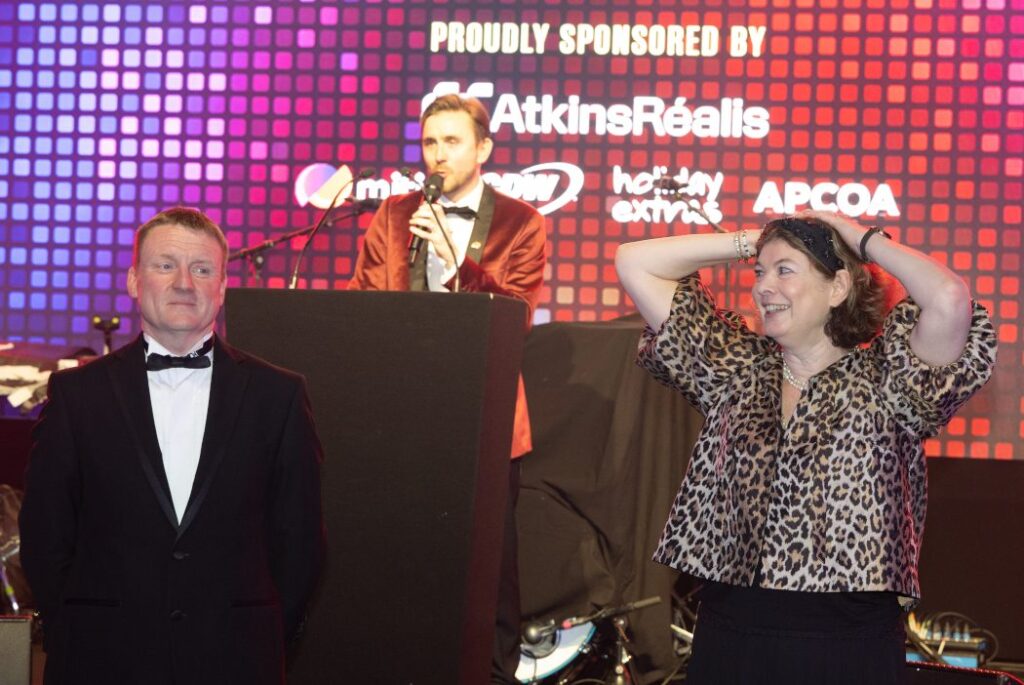
I learned the value of saying it out loud at an MS UK event. I told the room at the start exactly where every pound was going: which lots gave the charity 100%, and which only paid out above the reserve. The money followed the transparency, and the records matched the night.
So I keep the running order honest about what each lot is, and I keep the pledge visibly separate from the auction. Your event will have facts mine does not, which is why this needs an accountant’s eye rather than a blog post’s.

What to record on the night
| Lot | Record |
|---|---|
| Every lot | Donated or bought in, and by whom |
| Commercially available lots | The retail value announced before bidding |
| Bought-in lots | What the charity paid and any VAT on it |
| Hammer prices | Kept separate from pledges and raffle income |
| The event itself | Publicity, tickets and invitations showing the fundraising purpose |
Keep that alongside the ticket wording and your count of similar events at the venue this financial year, and whoever files the return has what they need.
If you are planning an event and want the auction structured so the money is clean as well as large, email hello@thecharityauctioneer.uk or call 07596 851647.

Kevin Durham
Charity auctioneer & event host