
In short
- Host at an affiliated club if you can. A scratch team playing a charity match is not covered by the club insurance the RFU arranges.
- Personal accident cover still reaches non-affiliated teams, but only if the match is properly refereed and run to RFU and World Rugby rules.
- Front rows derail amateur fixtures. A squad of 23 needs six players who can pack down, or the scrums go uncontested.
- The gate rarely pays for the day. Sponsorship, a programme, a raffle and a dinner with an auction do.
A charity rugby match is harder to stage than most people assume, and a better event to build a fundraising night around. The paperwork is real. Rugby is a contact sport with its own rules on insurance, registration, age bands and medical cover. Do it early and you get the good part: a clubhouse full of people who have just watched their friends play, with nothing to spend their money on yet.
Here is what the Rugby Football Union expects, and then the part a charity auctioneer like me gets booked for.
What is a charity rugby match?
A charity rugby match is a one-off fixture played to raise money, not league points. The sides are usually club legends against a current XV, one club against a neighbour, or staff against supporters.
The format scales a long way. The 745 Game, an annual union against league fixture named for the shirt numbers of Rob Burrow, Ed Slater and Doddie Weir, raised £110,000 for motor neurone disease causes at Kingsholm in November 2025. Ten thousand people came, hospitality sold out, TNT Sports broadcast it, and a prize raffle ran alongside. Four income streams, one of which is the gate.
A charity football match hangs on county FA sanction. Rugby hangs on who your players are registered with, and whether anyone can safely play prop.
How do you get a club and a pitch for a charity rugby match?
Ask an affiliated club to host, rather than hiring a pitch from a council or school. Affiliation brings the insurance, the referee contacts, the posts and the clubhouse with it. Start with the RFU club directory and approach the club with a reason to say yes: the cause is local, a member is affected, or one of the sides is theirs. Then ask three things.
- Who provides the first aid cover? Under the pitchside care standards the hosting club arranges it, so this is their answer, not yours.
- Is the clubhouse free afterwards? If the function room is booked, move your date. The room is where your total is made.
- What do they want out of it? Clubhouse takings, new members, a banner for a sponsor. A club that gains something puts volunteers on the gate.
Get the arrangement in writing. The Fundraising Regulator expects a written risk assessment before any fundraising event, and charities with five or more employees must document theirs by law.
What insurance does a charity rugby match need?
It depends on whether the teams are affiliated. The RFU spends around £3.5 million a year arranging cover for the community game through its broker, Howden: combined liability for the club, its players, coaches and officials, plus personal accident cover for catastrophic injury.
That is for affiliated clubs. For a scratch side the broker is blunt: if you are a non-affiliated team playing a charity match, standard RFU insurance will not apply. Personal accident cover does still reach you, for permanent serious disability or death including catastrophic brain and spinal injury, but only if the match is properly refereed and run in line with RFU rules and the World Rugby laws. A kickabout with a volunteer whistle is not that.
Public liability is the gap. The RFU does not provide it to a non-affiliated team unless its legal and governance department agrees in writing, or the team is connected to a club or constituent body. So run the fixture through affiliated clubs, or buy event liability cover and read what it excludes.
Which players can play: registration, age bands and the front row
Adult players register at their home club at the start of every season under RFU Regulation 13, which covers clubs, higher education teams and services teams only. Invitational teams are explicitly outside it, which is why a thrown-together side sits differently to a club XV.
Age bands are stricter than people expect. Regulation 15 runs age grade rugby from under-7s tag up to under-18s with its own rules of play for each age group, and a 17-year-old who wants to play adult rugby needs a club approval form and a player approval form signed off first. You cannot put a promising under-16 in a legends match because he is big for his age.
Then the front row, which decides whether your fixture is real rugby or a kickabout with lineouts. World Rugby Law 3 sets the minimum by squad size: 3 front-row players in a squad of 15 or fewer, 5 in a squad of 19 to 22, 6 in a squad of 23. Each team tells the match official before kick-off which front-row positions its players can cover, and it is the team’s job to make sure they are suitably trained and experienced. If either side cannot field one, scrums go uncontested. So recruit from the front row backwards: two props and a hooker per team, plus cover.
What medical cover does a charity rugby match need?
At minimum, one qualified first aider for the match, arranged by the hosting club, with a documented risk assessment behind it. RFU Regulation 9 wants an annual first aid risk assessment completed between 1 July and 30 September each season, telephone access so emergency services can be called immediately, and clear vehicular access for an ambulance.
The pitchside care standards set the numbers. For adult regional, county and lower XV rugby the minimum is one first aider per match, one per team as best practice, and for under-13s to under-18s it is one per match.
Two things organisers miss. Spectator and volunteer cover is assessed separately from player cover, so your crowd is your problem. And any player showing signs of concussion comes off permanently, with no return to play that day.
Where does a charity rugby match make its money?
Not at the turnstile. Ticket income covers the pitch, officials, first aid and kit.
| Income stream | How it works | Watch out for |
|---|---|---|
| Tickets | Advance sales beat cash on the gate | Admission is not a gift, so no Gift Aid |
| Matchday programme | Ad pages sold to local firms, printed to order | Agree artwork deadlines in writing |
| Shirt and pitchside sponsors | Businesses pay for the kit and the boards | The club may already own board space |
| Raffle | Sold at the ground during the event | Event raffle tickets cannot be sold in advance or online |
| Dinner, auction and pledge | After the final whistle, in the clubhouse | Needs a room, a running order and a host |
The programme is the stream people skip, and close to pure margin printed to order. Twenty local businesses at £100 a page is £2,000 before anyone has kicked a ball.
For the raffle, the Gambling Commission allows up to £500 of ticket money on prizes and £100 on running costs, with no limit on donated prizes, and tickets can only be sold at the event while it is happening. My guide to running a charity raffle covers the rest.

The matchday run of show
Kick-off is the middle of your day, not the end of it. Build the programme backwards from the moment everyone is sitting down with nowhere else to be.
Gates and programme sellers an hour before kick-off. Raffle tickets sold on the way in and through the break, with the draw and a sponsor thank-you over the PA at the interval. After the whistle, forty minutes for the players to shower and the crowd to get inside. Then into the room for food, two minutes from the charity on what the money does, the auction, the pledge.
Should you run an auction and a live pledge after the match?
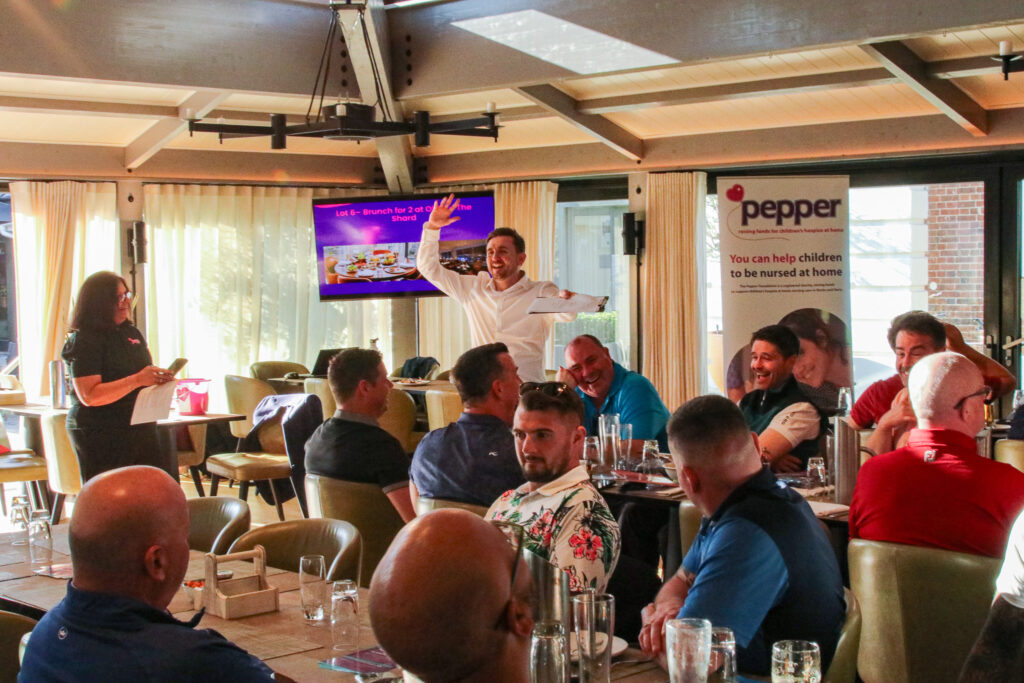
Yes, and the pledge is the one that pays. A rugby crowd has spent eighty minutes being noisy together, exactly the room you want for a live pledge.
Paul Whiteing of AvMA said after one of their nights: “Kevin has been brilliant yet again. He did a live pledge for us this year and helped us raise loads of money. He’s been so helpful to our charity in raising money and awareness.” The lesson carries to a clubhouse: a pledge lets everyone give at a level that suits them, not just the two people bidding on a shirt.
Keep the auction to around ten strong lots. The matchday shirt signed by both sides, sold off the back of whoever scored, is the obvious one, and signed memorabilia from a nearby professional club does the heavy lifting. The same pacing works at a sports dinner, which is what your evening has become.
A winning bid is a purchase, not a gift, but part of it can qualify for Gift Aid if the bidder knew its retail value.

A warning from my own worst night, too. I once announced a live auction while a room was still talking, and only a fraction of the guests heard the lots. Get the quiet first, even if that means standing on a chair.
Before you ring a club
Settle the insurance question first: it decides everything else. Then count your front rows, book the first aid cover, and reserve the clubhouse before you confirm a kick-off time.
If your rugby day is built around a dinner, I can run the auction and the live pledge. The difference shows up in the final total. To check availability, call me on 07596 851647.

Kevin Durham
Charity auctioneer & event host