

In short
- A sponsorship form is a Gift Aid declaration with a list under it. Get the declaration wording right and the charity claims an extra 25p for every £1.
- Each sponsor needs their own full name and home address. A first name and “the office” will not do.
- Sponsorship money does not belong to the person being sponsored, so they cannot Gift Aid it on everyone’s behalf.
- Family count as connected persons. On a challenge event their sponsorship usually fails the Gift Aid test unless the participant pays the full cost themselves.
- The charity keeps the original sheets, normally for six years, and the form must be clear about any conditions attached.
A sponsorship form looks like the simplest piece of paper in fundraising. It is also the one that quietly decides whether the charity gets an extra 25% on top of everything collected, or nothing at all.
Twenty years of charity auctions, and more than £10 million raised, have shown me that charities can lose real money on paperwork rather than on the night. Here is what the form has to show, what HMRC’s rules say, and how to get the money in afterwards. It is guidance, not tax advice: your finance lead or accountant should sign off your final wording.
What should a sponsorship form include?
A sponsorship form should carry a Gift Aid declaration at the top of every sheet, then one row per sponsor with their full name, full home address, the amount pledged, the amount actually collected, the date it was handed over, and a tick box for Gift Aid.
That is HMRC’s own layout. Its sponsorship form template, published in March 2013 and last updated in August 2020, is a single page you can adapt, and the detailed guidance sets the same fields out in section 3.10.4.
Two things people get wrong. The declaration has to sit on each sheet, not just page one, because sheets get separated. And the address matters more than it looks: HMRC will accept a house name or number plus a full postcode, so “Flat 2, SW4 7TH” is fine, while “work” is not.
Add the charity’s name and number, the participant’s name, and what the money pays for.
What does the Gift Aid declaration on a sponsorship form say?
The declaration on a sponsorship form has no fixed design, but HMRC says it must name the charity, capture the donor’s full name and home address, say which donations it covers, record that the donor wants Gift Aid applied, and explain the tax position.
That last part is the bit most homemade forms shorten into nonsense. The required sense of it, from the declarations guidance, is that the donor must pay at least as much UK Income Tax or Capital Gains Tax in the tax year as every charity will claim on their gifts, and that the donor is responsible for paying any difference.
Keep the tick box next to the money, not buried in small print at the bottom. A sponsor who ticks nothing has still given you a donation. They just have not given you the 25%.
Who can sponsor and still add Gift Aid?
Any UK taxpayer giving their own money can sponsor and add Gift Aid, as long as they get nothing of real value back and the charity holds a valid declaration from them.
Three tests cover most of it:
- Is it their own money? Nobody can Gift Aid £50 they collected from eight colleagues.
- Do they pay enough UK Income Tax or Capital Gains Tax to cover what every charity will reclaim this year?
- Are they a person, not a company? Companies get relief a different way, so a firm’s cheque belongs in its own column.
What stops a sponsorship form donation qualifying for Gift Aid?
A donation fails if it was not freely given by an individual out of their own taxed income, or if the donor gets something worth more than HMRC’s benefit limits in return.
The common disqualifiers on sponsored events, drawn from HMRC’s list of what you can claim Gift Aid on:
| Payment | Gift Aid? |
|---|---|
| Sponsor’s own donation, declaration completed | Yes |
| Money a sponsor collected from other people | No |
| A company donation | No, relief works differently |
| The participant’s own registration fee or deposit | No |
| Raffle tickets, or a ticket to the finish-line party | No, that is a purchase |
| Cash in a bucket with no names | See the small donations scheme below |
Benefits are the other trap. Under HMRC’s donor benefit rules, a thank-you worth up to 25% of the donation is fine on gifts up to £100, and above that the limit is 25% of the first £100 plus 5% of the rest, capped at £2,500. A badge is nothing to worry about. A free place at the dinner is.
Connected persons: the rule most forms leave out
A connected person means the donor’s spouse or civil partner, their relatives, a relative’s spouse, and any company they control. On a sponsored trip where the charity covers flights, accommodation or entry costs, HMRC treats the participant’s benefit as passing to those relatives too. Sponsorship from a parent, sibling or spouse usually fails the benefit test. Sponsorship from a colleague or a neighbour is fine.
There is a clean way out. If the participant pays the full advertised cost themselves, the value of that benefit drops to nil, and all sponsorship can be Gift Aided, family included. HMRC’s guidance at 3.38.12 says event literature and sponsorship forms must explain this and define a connected person.
Most downloadable forms do not. Add those two lines if yours covers a trek, or a marathon place the charity paid for.
What does the charity have to keep?
The charity keeps the original sponsorship forms, the declarations, and a record linking every donation to an identifiable donor, normally for at least six years.
HMRC sets the periods out in section 3.30: six years after the end of the accounting period for a charitable company, and for a charitable trust the later of six years after the tax year or twelve months after the claim. Declarations covering ongoing giving are kept permanently, and cancelled ones too, with the date.
So do not bin the paper once the money is banked. Scan the sheets and store them by event name.
Conditions, cancellations and the wording that protects you
The Fundraising Regulator’s fundraising code, in the version effective from 1 November 2025, is explicit about sponsorship forms. Rule 10.3.2 says you must make sure the form is clear about any conditions the participant needs to meet. The obvious one is finishing the marathon.
Rule 10.3.3 then asks for a procedure for when the event is cancelled or the conditions are not met: who tells the sponsors, and how refunds work. Money given with no conditions attached belongs to the charity whether or not the walk ever happens, and the Regulator’s events guidance notes you may not be able to refund it anyway.
Rule 10.2.1 adds one more line: say whether any of the money will directly benefit the participant. Anyone whose own costs come out of their sponsorship above the thresholds in section 58 of the Charities Act 1992 (uprated to £15 a day and £1,500 a year on 30 September 2026) may count as a professional fundraiser.
Paper sponsorship form or online fundraising page?
Use both, and treat them as one total. Paper wins where you can put it in front of someone. An online page collects the declaration and the address cleanly, with no handwriting to decipher.
| Paper form | Online page |
|---|---|
| Wins the face to face ask, and the sponsor who never clicks a link | Wins on sharing, and on sponsors who are not in the room |
| Address and tick box often incomplete | Declaration captured properly, fewer rejected claims |
| You chase the cash yourself | Money arrives without chasing, platform fees may apply |
In practice: paper for the asks made in person, a page for everything else, and one person holding the running total. My posts on fundraising ideas and school fundraising cover the activities themselves.
Collecting the money afterwards
This is where sponsored events leak. Pledges on paper are not donations until they are in the bank.
What works:
- Print a return date and a named person on the form.
- Count and bank the cash fast. Code rule 3.1.1 requires procedures for counting, recording and banking donations without delay, and cash handed over outside a sealed box needs a receipt under rule 3.1.5.
- Check the sheets before the claim, not after. Missing postcodes are fixable while people still remember the event.
- Thank sponsors by name, then tell them the total.
- Count the nameless cash separately. Donations of £30 or less can be topped up under the Gift Aid Small Donations Scheme with no declaration, up to £8,000 a tax year, if you record the total, the denominations and the date.
Trustees carry this. Charity Commission guidance is clear that they remain accountable for fundraising even when it is delegated to volunteers.
Where the form sits in the wider event
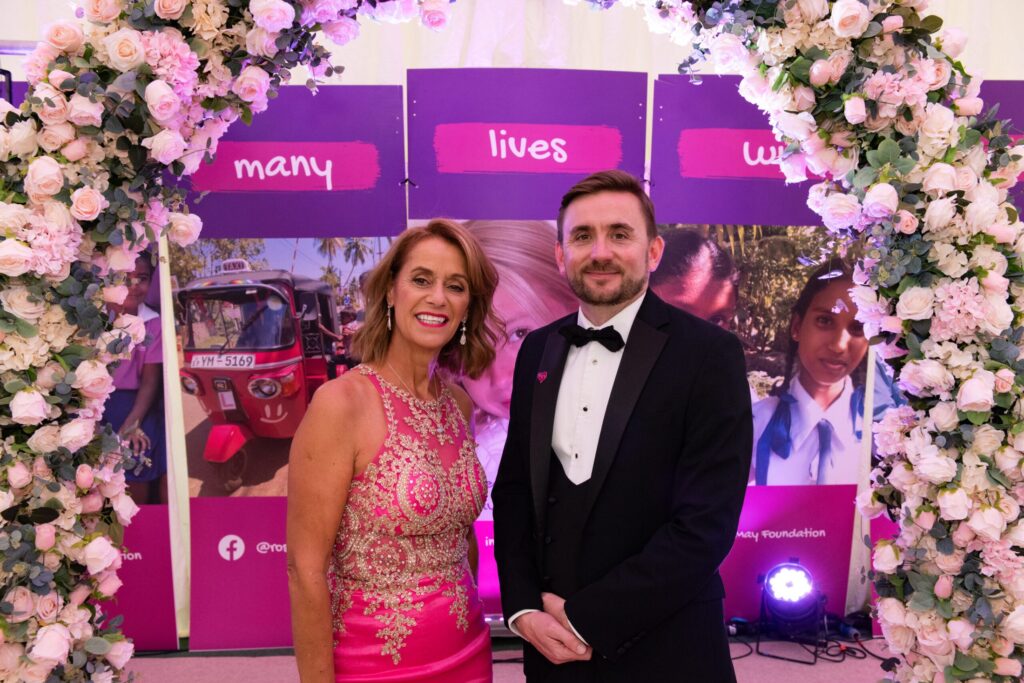
A sponsored activity and a fundraising evening are not rivals. The best campaigns use the sponsored element for reach, then put a live moment at the centre of the event: the auction, and above all the live pledge, which in my experience out-raises a lot-based auction at most galas.
Sponsorship forms give you names, addresses and permission. That is the raw material for next year’s fundraising strategy and for match funding, where a sponsor doubling the total gives everyone holding a form a reason to go back out.
The form is the admin. The night is where the room decides how far it will go. If you are building an evening around money your supporters have already raised, see how I work as a charity auctioneer and event host, or call 07596 851647.

Kevin Durham
Charity auctioneer & event host