
Home About Kevin Auctions Virtual auctioneer Pledges Hosting Entertainment Free software Software examples Case studies Reviews Other services Fees Fundraising games Fundraising consultant Get in touch Blog Podcast

Auction house auctioneer for a charity gala: what to check first

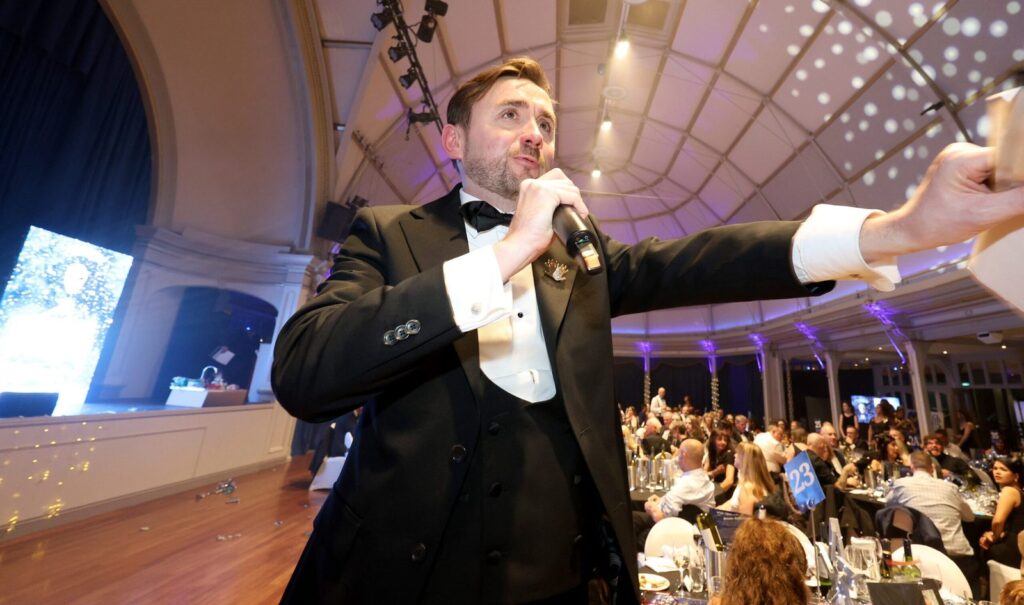
Kevin Durham in a burgundy velvet dinner jacket working a gala room on the microphone

In short

  • A saleroom auctioneer can run a gala auction well. Calling bids, describing items and handling paperwork are their daily work.
  • “Free” needs checking. Ask whether a buyer’s premium, commission or expenses apply, and who keeps them.
  • Ask who plans the lots and the live pledge with you before the night. That planning is the part a charity auctioneer is hired for.
  • A saleroom and a charity auctioneer can share an evening, as long as someone decides who does what.

An auction house auctioneer for a charity gala is a saleroom professional, usually a valuer by trade, who agrees to call your lots on the night, often for little or nothing. If a local firm has offered, that is a generous offer and worth taking seriously.

I am Kevin Durham, a professional charity auctioneer and event host. This is how I would weigh the offer if I sat on your committee: what a saleroom does well, the checks that decide whether “free” is free, and the part of the job that is easy to miss.

What does an auction house auctioneer do well at a charity gala?

An auction house auctioneer is good at the mechanics of selling: calling bids clearly, describing and valuing items accurately, keeping a bidder’s trust and handling the paperwork afterwards. Those skills carry straight into a gala, and some salerooms run charity evenings regularly.

Hansons Auctioneers in Derbyshire is one example (pages read November 2026). Its owner, Charles Hanson, hosted a charity ball at the Derby Roundhouse for the British Heart Foundation as MC and ran the auction, with signed football boots, hotel stays and diamond jewellery among the lots. He was also guest speaker and auctioneer at a charity golf day dinner for the Tiny Tim Trust on 3 September 2021.

That is real experience of a fundraising room, and it is exactly the record to ask any candidate for. A valuer also brings reassurance on lots such as jewellery, art or antiques, where bidders want to trust the description.

I have no quarrel with salerooms. The question is where the work sits, and my guide to the auctioneer’s job covers the wider split.

Is a free auction house slot really free for a charity gala?

An auction house slot is only free if the charity pays no fee, no commission and no expenses, and keeps the whole winning bid. Three questions settle it. Ask them in writing: is a buyer’s premium charged, is any commission taken, and who pays for travel and printing?

It can be done. The Royal West of England Academy’s 2024 fundraising auction said Bonhams was waiving all fees for the sale, including buyers’ commission (read November 2026). Never assume another house does the same.

A buyer’s premium is a fee added to the winning bid and paid by the buyer. I explain it in buyers premium. As an illustration, not any firm’s rate: at 25%, a £1,500 winning bid costs the bidder £1,875, and the extra £375 goes to the house, not your cause.

If the house keeps a premium or commission while telling guests the sale supports your charity, the law may treat it as a commercial participator. Section 58 of the Charities Act 1992 defines one as a business that runs a promotion saying charitable contributions will go to a charity. The Charity Commission’s CC20 guidance, read November 2026, says trustees must have a written agreement before the fundraising begins and should check how much the charity receives compared with the amount generated. That is general information, not legal advice.

It also affects what you say from the stage. The fundraising code says fundraising must not mislead donors (rule 1.2.1), so “every penny goes to the charity” must be true.

Will an auction house auctioneer plan the lots and pledge for your charity gala?

An auction house auctioneer will plan your lots and pledge only if you ask, and ask early. A saleroom sale starts with consignments. A gala starts with a room of guests, a story and a target, which is a different brief, and nobody should find that out on the night.

In my experience the live pledge, where guests give at set levels with no prize, usually out-earns the auction of lots when it is built well, and most committees are never told. So the questions below matter more than the hammer.

An online catalogue of original artworks for a charity auction, each with a lot number, artist and starting bid

AskA good answerLook again if
Who chooses the number and order of lots?A named person agrees a short list with you, well ahead“We will see what turns up”
Is there a live pledge, and who builds it?Yes, the levels and the story are agreed with youIt is not mentioned
Who will you meet before the night?The auctioneer who will be on stageA coordinator only
What happens if a lot stalls?There is a plan for it“We withdraw it”
Who explains Gift Aid to the room?Someone who knows the rulesNobody

The last row is not a trick. HMRC’s Gift Aid guidance, paragraph 3.40.1, read November 2026, says a payment for an item at a charity auction is a purchase, not a gift. A pledge can be treated differently, which is one more reason to plan it. Your running order should show where each segment sits, and my page on running a pledge shows how I build one.

Timing, and who is on stage

Confirm who will be on stage and what happens if they are not available. Ask when the saleroom’s own sales fall around your date, who covers if the named auctioneer is booked elsewhere, and when you will have a first call about lots. Get the answers in writing, with the premium terms.

If your first conversation about lots happens in the week of the gala, the plan was made without you.

When is it worth hiring a charity auctioneer instead?

It is worth hiring a charity auctioneer when your target depends on the live auction and pledge and nobody on the committee has run them before. The value is the planning as much as the calling: a short set of lots, a pledge built around your cause, and someone who commands the room.

The saleroom route is the right call too, in the right set-up. If you have a handful of valuable lots, a small room, the premium waived in writing and a committee member who will build the pledge, a local auctioneer may be all you need. Some evenings split the work: a valuer calls the big items and someone else plans the programme and the pledge. Just decide who does what before the night.

Here is how Naomi Chaning Pearce of Jigsaw Trust described the planning side, in my client reviews:

“Kevin owned the room as he conducted the live auction, more than doubling our target. It was not just during the event where Kevin showed his skills, but also in guiding our planning.”
Naomi Chaning Pearce, Jigsaw Trust

What to have ready before you call

Have the date, the size of the room, your target, your draft running order and the saleroom’s offer in writing, premium terms included. Add what happened to the auction last time. With those, a short call is enough to say whether you need me, your local auctioneer or both.

Call 07596 851647. I would rather talk it through on the phone. If you book me as your auctioneer and host, I build the auction platform around your event, in your branding and loaded with your lots and tickets. It is included for the event and stays live for a month afterwards.

Kevin Durham, charity auctioneer

Kevin Durham

Charity auctioneer & event host
20years£10m+raised60–80events/yr
Check availability07596 851647

Let’s talk

Bring this to your event

Book a free consultation with a charity auctioneer who has raised over £10 million.

Buyers premium explained: should a charity auction charge one?

Kevin Durham in black tie taking a bid from the floor during a live charity auction, with a full room of guests behind him

In short

  • A buyer’s premium is a percentage added to the hammer price. At Sotheby’s in London it starts at 28%.
  • Charity auctions rarely need one. Guests believe they are giving, and a charge on top of the bid undercuts that.
  • A winning bid is a purchase, not a donation, so Gift Aid is rarely available on auction lots.
  • For VAT, donated lots sold by a charity are zero-rated. Bought-in lots at a qualifying fundraising event are exempt.
  • If you do add a premium, print it in your terms and say it from the stage before the first lot.

A buyer’s premium (you will often see it written buyers premium) is a fee added on top of the winning bid, paid by whoever wins the lot. Commercial auction houses rely on it. At a charity auction it is a choice, and usually the wrong one.

I am Kevin Durham, a professional charity auctioneer, and my advice to most charities is to skip a buyer’s premium. Here is what a premium does to a charity room, and how Gift Aid and VAT treat what your bidders pay.

What is a buyers premium?

A buyers premium is a fee the winning bidder pays on top of the hammer price, usually as a percentage of it. It goes to the auction house, not the seller, and it is separate from the commission the seller pays.

At the top of the market it is steep. Sotheby’s publishes its premium rates by location: in London, 28% of the hammer price up to £1,500,000, then 22% up to £6,000,000, then 15%. A £10,000 hammer price there becomes a £12,800 bill before tax.

The modern premium dates from September 1975, when the big London salerooms introduced it at 10%. In the UK it is a charge for the auctioneer’s service and carries VAT: HMRC’s guidance on the auctioneers’ scheme works through a 15% premium plus VAT.

What is the hammer price?

The hammer price is the winning bid at the moment the hammer comes down. At most charity auctions it is exactly what the winner pays.

I explain how bids build to that moment in how bidding works, and why most donated lots are better without a minimum in my guide to reserve prices.

Should a charity auction charge a buyers premium?

In most cases, no. A charity auction should not charge a buyers premium, because it brakes the bidding at the exact moment you want hands going up, and it muddies the message that the money is going to the cause. Bidding momentum is a skill, not luck, and I don’t want anything working against it.

The case for one is real enough. A premium can cover card fees, platform charges or delivery, so they don’t come out of the hammer price.

From the guest’s side, someone who bids £2,000 on a villa week believes they have given the charity £2,000. With a 20% premium, the invoice says £2,400. Either they knew and quietly bid less, or they didn’t and feel caught out. Neither helps your total.

A better line from the stage: every penny of the hammer price goes to the charity. Only say it if it is true. The fundraising code says fundraising must not mislead donors, and claims about costs need evidence. When it is true, it moves people.

Cheaper ways to cover your costs:

  • Build them into the ticket price.
  • Ask a sponsor to pick up the card fees, the venue or the auctioneer.
  • Source lots in-house, so nothing goes back to a supplier.

Where the money really leaks

The real deductions at a charity auction hide inside the lots. Commission-based suppliers bring consigned items with a reserve and a split, so a bid that sounds like a donation partly goes back to the supplier.

The year before MS UK hired me, an external auction company grossed around £13,000 at their event and the charity saw about £1,300. When I came in, I told the room at the start where every pound was going: which lots gave the charity 100%, and which only paid out above the reserve.

The company grossed around £3,500 that year. The live pledge raised £8,300, all of it to the charity. I didn’t name or shame anyone, and the room did the giving. I just turned the lights on, and the money followed the transparency.

Under the Charity Commission’s trustee guidance, trustees remain accountable for their charity’s fundraising, including the parts someone else runs. I compare fee models in auctioneer commission.

Can you claim Gift Aid on auction items?

Usually not. Section 3.40 of HMRC’s Gift Aid guidance is blunt: a payment for an item at a charity auction is a purchase, not a gift.

There is a narrow exception for bidders who deliberately pay more than an item is worth, but only within the benefit rules. HMRC’s example is a football sold in a shop for £10:

  • A £40 bid. The £10 benefit is 25% of the payment, inside the limit, so all £40 qualifies.
  • A £30 bid. The benefit is a third, too high. If the charity told bidders at the start that the ball cost £10 locally, the £20 excess qualifies. If nobody said so, none of it does.
  • The same ball, signed by the team. It is no longer the shop item, so the whole bid counts as the benefit. Nothing qualifies.

That last case is most of a gala auction. Signed items, experiences and auctions of promises have no shop price, so the whole bid is the benefit. The guidance doesn’t mention a buyer’s premium at all, so take advice before claiming Gift Aid on any part of one.

Where Gift Aid does work is the live pledge. A pledge is a gift of money with nothing given back, so it can qualify when the donor pays UK tax and makes a Gift Aid declaration. The pledge is where the real money lives, which is why I push for one at every event.

Kevin Durham on the microphone pointing out a pledge from the stage during a live pledge drive at a charity gala

How does VAT work on a charity auction?

VAT on charity auction lots mostly depends on whether the lot was donated or bought in. It only matters if your charity is VAT-registered, which turns on its taxable sales passing the threshold in VAT Notice 701/1.

  • Donated lots sold by a charity are zero-rated if the sale is open to the public. HMRC’s charities manual applies this to auctions.
  • Bought-in lots are normally standard-rated, but exempt when sold at a qualifying fundraising event such as a gala dinner. Conditions apply, including a limit of 15 events of the same kind at one location in a financial year.

None of this guidance covers a premium charged by a charity itself, so ask your accountant first.

Kevin Durham in a burgundy velvet jacket pointing to a bidder across the room during the live auction at Jigsaw Trust charity gala

What should your charity auction terms and conditions say?

Your charity auction terms and conditions should tell bidders, in plain English, what they will pay and what they will get. Print them in your auction catalogue and on the bid sheets. Cover:

  • Whether there is a buyer’s premium. The best version: there isn’t one, the hammer price is the price.
  • How and when payment is taken.
  • Which lots were donated, which came from a supplier, and what share of each reaches the charity.
  • Expiry dates and exclusions on experiences.
  • Collection and delivery.
  • A line saying auction purchases generally don’t qualify for Gift Aid.
  • Who settles a disputed bid on the night.

One legal point: when second-hand goods are sold at a public auction people can attend in person, the buyer is not treated as a consumer under the goods rules of the Consumer Rights Act 2015. Describe every lot accurately anyway. I’m an auctioneer, not a lawyer, so have unusual terms checked.

If you still want a buyers premium

If your committee decides a premium is right, do it in the open:

  • Keep it small, and say what it pays for.
  • Print it everywhere a price appears.
  • Have the auctioneer announce it before the first lot, not after the last. Nobody should meet it for the first time on their invoice.
  • Never apply it to the live pledge.
  • Agree the Gift Aid and VAT treatment with your accountant before the night.

Getting the money to the cause

The real question is usually how to cover costs without putting off donors. Sponsorship, ticket pricing, lots sourced in-house and a pledge people can Gift Aid all answer it better than a premium.

If you want to talk through how your auction is structured, call me on 07596 851647. I’d rather talk it through than trade emails, and the first fundraising consultation is free.

Kevin Durham, charity auctioneer

Kevin Durham

Charity auctioneer & event host

20years£10m+raised60–80events/yr
Check availability07596 851647

Let’s talk

Bring this to your event

Book a free consultation with a charity auctioneer who has raised over £10 million.