
In short
- Pick a short format and play it twice. A side that drives an hour to field for three hours does not come back.
- The square is hand-prepared and in short supply, and the groundsman picks your strip. Ask in the winter.
- The ECB’s hard-ball safety rules are mandatory for under-18s. No parental waiver.
- Rain is a certainty, not a risk. Book a reserve date and keep the money indoors.
A charity cricket day hands you something a football match never will: six hours of other people’s time. Both the opportunity and the problem. Long enough to feed a crowd, sell a programme, run a raffle and still get everyone sat down for dinner. Long enough, too, for the rain to arrive and the whole day to clear £400.
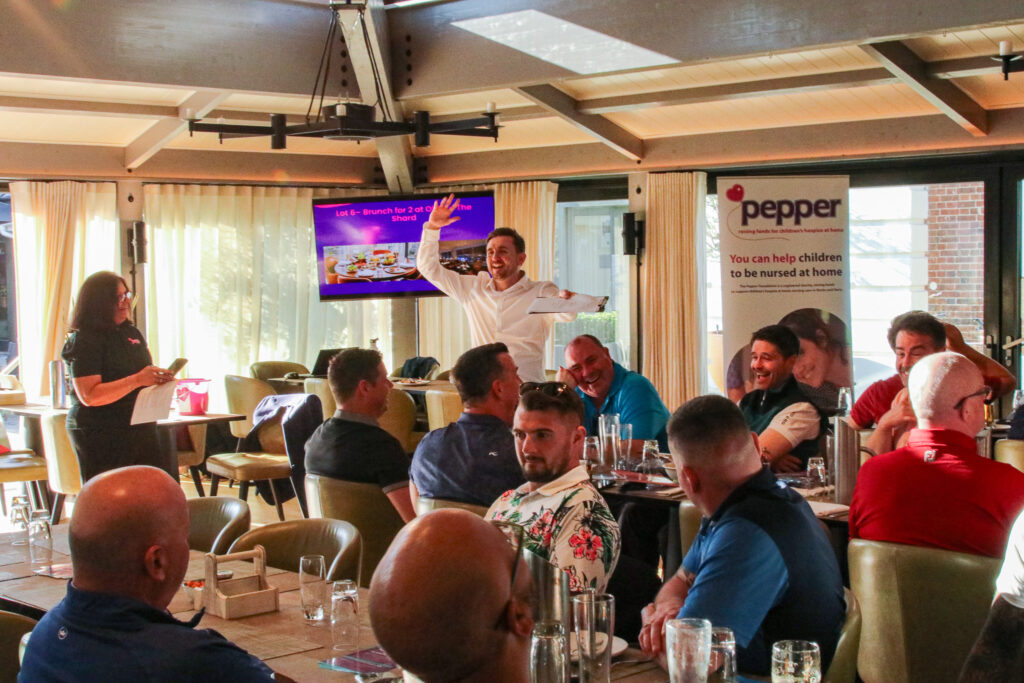
I run charity auctions at 60 to 80 events a year, mic in hand, out on the floor rather than behind a podium. This guide covers what is specific to cricket: the format, the club, the square, the hard ball and the weather. Then the part that decides your total.
What format should a charity cricket day use?
Use the shortest format your players will take seriously, and run it as a tournament rather than one long match. Four teams playing short games keeps four sets of sponsors, players and families on site all day. One eleven-a-side fixture keeps 22 players and a thin crowd.
| Format | Shape |
|---|---|
| T20 | 20 overs a side, about three hours |
| 100-ball | 100 balls an innings, ends change every 10 |
| Sixes | Six overs a side, one bowler two overs |
| Celebrity XI | One fixture, names on the card |
The ECB’s own Club T20 runs on the generic 20-overs playing conditions, so a club side knows where it stands. If half your crowd has never sat through a full innings, borrow The Hundred’s rules: 20 balls per bowler, a 25-ball powerplay.
The sixes model is the quiet fundraising winner. Sticky Wicket, the events industry’s cricket day, puts teams of up to ten into five-over matches and charges for team sponsorship rather than tickets. In July 2026 it raised £60,086 for the Lord’s Taverners, its best year in 19.
A celebrity XI sells tickets, but get every name in writing with reserves lined up.
How do you get a club and a square for a charity cricket match?
Ring the club over the winter and ask for a date in the shoulder of the season, because mid-July Saturdays belong to the league. Expect to be treated as a hirer, not a guest, because that is what you are.
An ECB registered club carries £15,000,000 of public liability for the year to 31 January 2027, covering the club’s own activities. The same certificate tells clubs that when they hire facilities to a third party, insurers require them to check that party’s public liability, at least £5,000,000. Have your charity’s certificate ready before the first call.
Then the square. A club table holds a handful of strips, cut and rolled by hand for league fixtures, and the groundsman works to a programme: define and cut the pitch, then roll, groom and manage moisture, then the final cut, marking out and the stumps. Get your day into that plan months out, not sprung on him in May.
Ask about the room while you are there. A clubhouse that seats 80 for dinner is worth more than the strip, as at a sports dinner in any other sport.
What do the ECB rules say about hard-ball safety and age groups?
They are mandatory, not advisory, and they bite hardest on anyone under 18. A hard ball weighs 140 to 166 grams and arrives fast, which is why the ECB writes it down in such detail.
From the safety regulations in force since 17 December 2025:
- Under-18s batting against a hard ball must wear a helmet meeting BS7928:2013, and male players a box. A parental note waiving it is not accepted.
- Wicketkeepers under 18 standing up to the stumps need a helmet or a face protector.
- Fielders aged 13 or under stand at least 11 yards from the striker, 14 and 15 year olds 8 yards.
- Fast bowlers are capped by their actual age, not their age group: four overs a spell and eight a day at 11 and under, up to seven and 18 at 18 or 19.
- A junior cannot play open age cricket before their 12th birthday, and then only with written parental consent.
Adults get recommendation rather than regulation: a helmet when batting, keeping up to the stumps, or fielding inside 8 yards. If the day is really a family fun event, use a soft ball: none of the protective equipment regulations apply to softball cricket.
Who officiates, scores and provides first aid on the day?
Two umpires, a scorer for each side and at least one first aider, all booked weeks ahead.
In the ECB’s Club T20, umpires are arranged locally by the host club, and from the national stages they are full ECB Association of Cricket Officials members with current DBS clearance. Ask the club to source ACO umpires and pay them properly. Each team also brings its own non-playing scorer, and a side arriving without one loses a player to the job all match.
The ECB also wants a first aider present whenever cricket is on: an adult who has done an in-person course of at least three hours in the last three years.
The Fundraising Regulator expects a written risk assessment covering set-up, the event and the pack-down, insurance including cancellation cover, and a written agreement with every third party who contributes, paid or free.
Rain is the one thing cricket cannot shrug off
Football plays through a shower. Cricket stops. Worse, as the Grounds Management Association points out, play is often held up after the rain has stopped, because a wet pitch dries slowly. That is what covers are for.
So build the weather in rather than hoping:
- Book the reserve date when you book the first one. The ECB does that in its own competition, pairing 9 August with 16 August and 30 August with 6 September.
- Shorten instead of scrapping. The ECB tells clubs facing a washout to play even a few overs rather than settle it on a coin.
- Move the money under a roof. Lose the cricket at three, keep the evening, keep the total.
Where does a charity cricket day make its money?
Not at the gate. The gate pays for the ground, the officials and the balls. The money comes from sponsorship sold weeks earlier, and from the hour after everyone sits down.
| Income stream | How it works |
|---|---|
| Team entry | Each side pays or finds a sponsor to enter |
| Sponsored overs | A business buys an over, read out at the change of ends |
| Programme | Local firms buy space, players buy a copy |
| Admission | Not a gift in Gift Aid terms, so no claim on it |
| Raffle | Event raffle tickets must be physical and sold only at the event |
| Auction and pledge | At the dinner, with someone driving it |
Sponsored overs are the best thing cricket has that other sports do not: twenty sellable moments with the announcement built into the game, and every pound reaching the cause with nothing deducted.
Keep the lot list open until the auction starts. At an event earlier this year the former footballer Vinnie Jones was among the guests. I asked whether he could put anything into the auction, and he donated a shooting experience that raised £6,000 for the charity. A pavilion full of players is worth the same question.
Running the long day without losing the room
Treat the tea interval as the one moment the whole site sits still. That is when raffle tickets sell and silent auction sheets get signed, so have volunteers moving with a float and a clipboard. Let people breathe while they eat, and never approach someone with a fork on its way to their mouth.
A shape that works: first game at half ten, tea in the middle, final by five, dinner at seven.
Should the auction and pledge come after the dinner?
Yes. Once the room has eaten and sat down, never out on the outfield at five o’clock with half the crowd loading kit bags into cars.
Open with Heads or Tails before anybody speaks. At a fiver a head, a dinner of 150 collects £750, and a room standing up and laughing is worth more later than the money.

Command the room first, then about ten strong lots, not fifty: a net session with the club professional, a signed bat from the county, the captaincy of next year’s charity XI, the right to name the trophy. Then the live pledge, the most powerful segment of any fundraising night I work.
The pledge suits a cricket crowd because everyone there watched somebody play for the cause that afternoon. The tone shifts, serious and from the heart. It should still feel hopeful: the energy climbs as the hands go up.
Before you ring a cricket club
Decide the format, get both dates in the diary, send your insurance certificate early, and plan the evening before the toss. The pattern matches a charity football match, but cricket gives you a longer day to sell into and a sky that can take it away.
If you want the auction and pledge run properly at the end of it, that is what I do. The difference shows up in the final total. To check availability, call me on 07596 851647.

Kevin Durham
Charity auctioneer & event host