Home About Kevin Auctions Virtual auctioneer Pledges Hosting Entertainment Free software Software examples Case studies Reviews Other services Fees Fundraising games Fundraising consultant Get in touch Blog Podcast

What does a charity auctioneer do before the guests arrive?

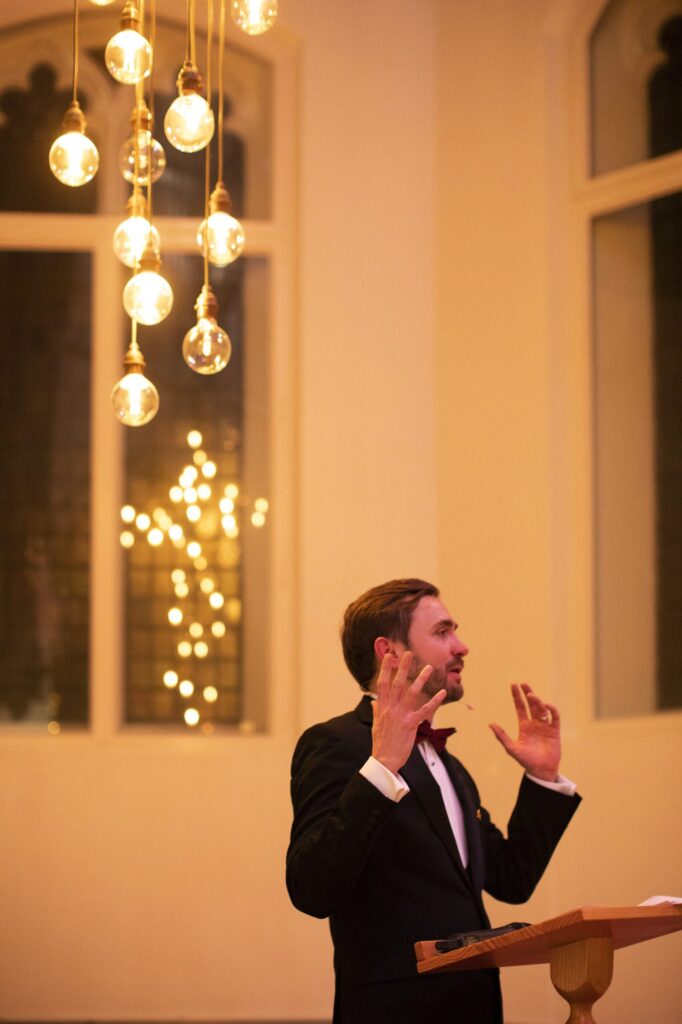
Kevin Durham in black tie reading through his notes on a pad at a charity reception

In short

  • A professional charity auctioneer is usually at the venue hours before the guests arrive, often before the organisers.
  • I arrive four or five hours early, because trains and roads are the one part of the night nobody can rehearse.
  • Once I am dressed and in the room, I take my notes onto the empty stage and rehearse until the scripts are well trodden.
  • Your part is simple: agree access times with the venue, name one contact, and have the stage and running order in place.
  • When you book anyone, ask what time they will be in the building and what they do once they get there.

What does a charity auctioneer do before the guests arrive? For a professional, those hours are preparation time: travelling with a wide margin, settling in, and rehearsing on the empty stage so the words are second nature by the time the doors open. I am Kevin Durham, a professional charity auctioneer and event host. I have spent 20 years on stage at fundraising events, at 60 to 80 events a year, and this is the part of the job guests never see.

What does a charity auctioneer do before the guests arrive?

A charity auctioneer uses the hours before the guests arrive to take the risk out of the night. Most of that comes down to two things: getting to the venue long before anyone needs you, and rehearsing the scripts in the room where they will be spoken. Here is my own routine, in the order it happens.

  1. I leave home in the morning. For most events that is the plan, even when the doors open in the evening. From the moment I leave my door until the event ends, my head is in the event.
  2. I get there very early. I would much rather be at the venue four or five hours early than leave anything to chance.
  3. I check in and get dressed. Then I go to the venue.
  4. I am usually one of the first people there. Most of the time I am well ahead of the organisers.
  5. I take my notes and get up on stage. I rehearse there, refining my scripts until they are well trodden before the event goes live.

That is the whole list. It is not glamorous, and nobody in the room will ever know it happened. That is rather the point.

Why does a charity auctioneer arrive hours early?

A charity auctioneer arrives hours early because travel is the one risk that cannot be fixed once it goes wrong. If the train is cancelled at 5pm, no amount of skill on the microphone gets the auction started at 9pm. A wide margin turns a late train into a shorter coffee break.

My own reason is plain: I worry about public transport and roads. The figures suggest I am right to.

  • Trains. In the Office of Rail and Road’s rail performance release for April to June 2026, published September 2026, 85.0% of station stops in Great Britain were reached within three minutes and 4.1% of services were cancelled. That quarter had 17 severely disrupted days, nearly one day in five.
  • Planned works. Network Rail says its engineering work is frequently scheduled overnight, at weekends and on bank holidays. Plenty of galas fall on a Saturday.
  • Roads. The Department for Transport’s travel time figures for the year to June 2026 put average delay on local A roads at 43.4 seconds per vehicle per mile, compared with free-flowing traffic.

Run the arithmetic on that last figure. Forty miles of local A roads at 43.4 seconds a mile is 1,736 seconds, about 29 minutes of delay, and that is an average across the whole day, not a worst case. A four or five hour margin absorbs all of it.

What does rehearsing on an empty stage change?

Rehearsing on an empty stage means the auctioneer’s scripts have already been spoken out loud, in that room, before a single guest hears them. When the doors open, it is the second time through. It is the same logic as a theatre’s dress rehearsal, a full run shortly before the first performance.

I take my notes, get up on stage and rehearse, refining the scripts as I go until they are well trodden. The notes themselves are put together in the week before, so on the day the work is in the delivery, not the drafting.

There is a reason this helps. Psychologists call practising past the point of first mastery overlearning, and the research summary notes its benefit is strongest when the material is only needed for a short time, which describes an evening’s scripts exactly. There is also work on context-dependent memory: in Godden and Baddeley’s 1975 study, divers recalled words best in the same setting where they had learned them. I would not stretch that study too far, but a stage rehearsed on is a stage that feels familiar at 9pm.
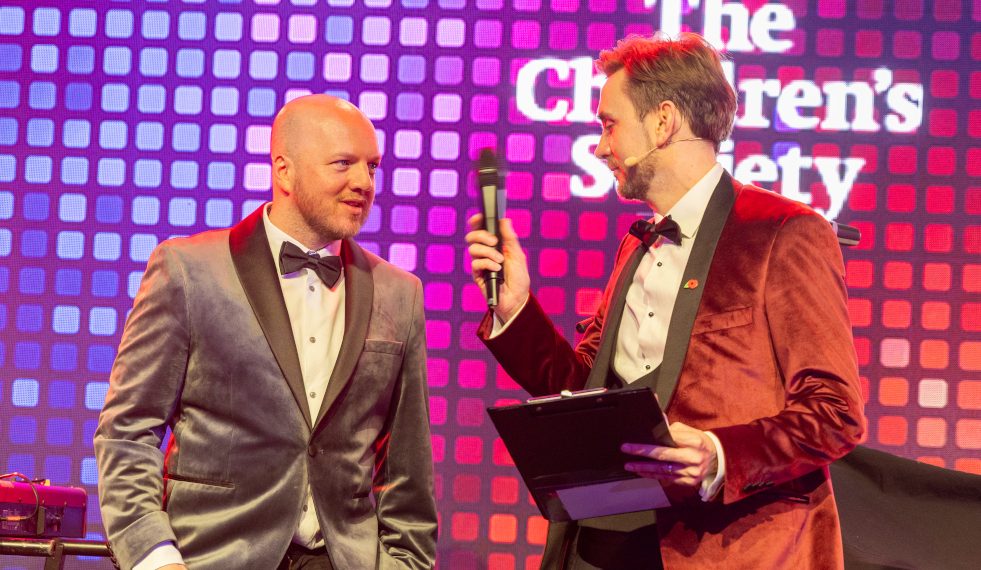
Kevin Durham on stage at a charity gala, microphone in one hand and his notes on a clipboard in the other

A whole day in the event, not an evening

Leaving home in the morning for an evening event sounds excessive until you look at what it protects. It means the whole day goes on your event and nothing else.

Your committee, meanwhile, is usually having the busiest day of its year. An auctioneer who is already in the building, dressed and rehearsed, is one name on the list nobody has to chase.

What should the organiser have ready before the guests arrive?

The organiser should have three things ready for the auctioneer before the guests arrive: access to the stage, one named person to find, and the final paperwork in print. The table is general good practice for any professional you book, not my personal routine.

Have readyWhy it helps
Access time agreed with the venueThe auctioneer can rehearse on the real stage, not in a corridor
One named contact and mobile numberQuestions get answered once, by the right person
Stage or speaking position setRehearsal happens where the auction will happen
A microphone to tryA sound check is usually done before audience entry
Final running order and lot list, printedLate changes are caught before doors, not during them
Where the spotters will standThe auctioneer knows which corners are covered

Two notes on that table. First, Ofcom says some licence-exempt bands for wireless microphones are shared with other low-power equipment and can suffer interference, so ask the venue or AV supplier to test the actual microphone in the actual room. Second, the named contact works best when it is your night lead.

For the paperwork itself, my posts on the run sheet and auction spotters cover it. The weeks-out auctioneer briefing is a separate job.

How can you tell if an auctioneer will prepare like this?

Ask before you book. A professional charity auctioneer should be able to tell you, without hesitating, what time they will be in the building and what they do once they get there. A vague answer usually means nobody has planned those hours.

Useful questions:

  • What time will you be at the venue, and how are you getting there?
  • If your train or road fails, what is the fallback?
  • Will you want time on the stage before guests arrive?
  • Who do you need to see when you get there?

A committee member running the auction as a favour usually cannot give these answers, and that is no criticism. They have a day job, a table to host and a dozen other tasks on the day.

One organiser, Luke Holmes of Noah’s Ark, wrote that “He came early to do a run through and meet guests.” Kind words, and my part is small next to the team behind the charity. More are on my client reviews page.

When is it worth hiring a professional charity auctioneer and host?

Hire a professional when the auction and pledge carry a real share of the night’s target, and when nobody on your committee can spend the afternoon at the venue preparing for them. If the auction is a few lots at a small supper and a confident volunteer can be there early, doing it yourselves is a reasonable call.

What a professional changes is that the person on the microphone arrives with the travel risk already absorbed and the scripts already rehearsed in your room. Because I usually host the whole night as well as the auction, that preparation covers the welcome, the speeches and the close, not just twenty minutes of bidding.

If that sounds like your event, call me on 07596 851647. Have ready your date, the venue, its access times, your draft running order and what went wrong last time. The auction software is included when you hire me: I build it around your event, in your branding with your lots and tickets, and it stays live for one month afterwards. My auctioneer services page sets out the rest.

Kevin Durham, charity auctioneer

Kevin Durham

Charity auctioneer & event host
20years£10m+raised60–80events/yr
Check availability07596 851647

Let’s talk

Bring this to your event

Book a free consultation with a charity auctioneer who has raised over £10 million.

Charity gala seating plan: why round tables raise more

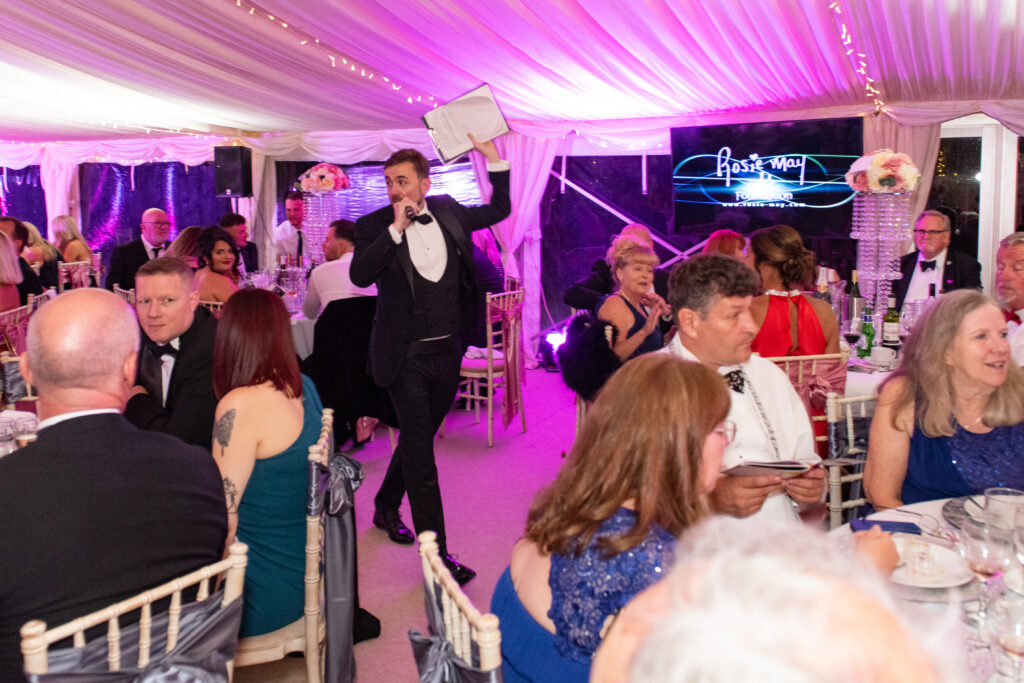
Charity auctioneer Kevin Durham walking between round tables of guests in black tie at a marquee charity gala, holding the lot sheet above his head

In short

  • A charity gala seating plan raises most when guests sit at big round tables, ideally 10 or 12 to a table.
  • Round tables work because everyone at the table can see who is bidding and who is giving.
  • Long banqueting tables let people hide. Each guest only really sees the two people beside them.
  • Exactly who sits where matters far less than most committees think, so settle the table shape before you spend an evening moving names around.
  • Visibility is not pressure. The host keeps it playful, and nobody is singled out for not giving.

A charity gala seating plan is the map of which tables go where and who sits at each one. For fundraising, the decision that moves the total is the shape and size of the tables, not the order of the names on them.

I look out over a seating plan from the stage at 60 to 80 events a year, and my rule is short: big round tables, the bigger the better.

What is the best table layout for a charity gala seating plan?

The best layout for a charity gala seating plan is large round tables of 10 or 12 guests, set around one clear stage. Round tables let every guest see every other guest at the table, so bidding and giving happen in full view. That visibility, more than any clever placement, is what lifts a fundraising room.

If the venue offers tables of ten, take them. I would go to twelve if the tables and the room allow it. The more people who can see each other at one table, the more each table behaves like a small crowd with its own momentum.

The room still has to work: one focal point, a voice that carries, sightlines from the back. My venue guide covers that side. This post is about the tables themselves.

Why do round tables raise more than long tables?

Round tables raise more because they create a gentle, perceived peer pressure. Everyone at the table can see how much each person bids and how generous they are, or are seen to be. On a long table you see your neighbours and not much else, so it is easy to sit quietly through the auction and the pledge.

I have seen what long tables do to a total. I worked a big event abroad that used long, banquet-style tables. The year before, the same event had been on round tables, and that year it raised more. My view is simple: people can hide on long tables. A round table gives nobody anywhere to hide.

The research leans the same way. In a field experiment across 30 Dutch churches, published in the Journal of Public Economics in 2005, Adriaan Soetevent swapped closed collection bags for open baskets, where people could see their neighbours’ gifts. Giving to external causes rose by about 10% at first, though the effect faded over the 29 weeks.

A 2012 Yale field experiment by Dean Karlan and Margaret McConnell found gifts rose with the promise of public recognition, mainly because donors wanted to improve their social image. Ariely, Bracha and Meier make the underlying point plainly in their work on image motivation: image depends on behaviour being visible to other people. Put ten or twelve people round one table and you have built exactly that.

How many guests should sit at each table?

Seat 10 to 12 guests at each round table for a fundraising dinner. A 6ft round, about 183cm across, is the table that does it: Trent Furniture says its 183cm banqueting round seats 10 to 12, and Event Hire UK lists its 6ft round as seating up to 12 (both read November 2026).

Here is the arithmetic for a 240-guest gala:

Table sizeTables neededOther guests each person can see across the table
8307
10249
122011

Same room, same guests. At twelve, every bid and every pledge card can be seen by eleven people instead of seven, and there are ten fewer tables for the host to work.

Not everyone agrees with big tables, and the other side deserves a fair hearing. Howard Givner, writing for PCMA in 2013, called the 60-inch round “possibly the worst invention in the history of the hospitality industry” and argued for smaller tables so guests can actually talk. For a networking dinner he has a point. A fundraising gala has a different job: the conversation that matters is the one the whole table has when a paddle goes up.

Kevin Durham leaning in at a round table during a table-side game, a guest holding up a phone while the rest of the table watches

Does it matter where each guest sits on the seating plan?

Less than most committees think. I do not believe it matters much exactly where people sit; what matters is round tables. Hours spent moving names between tables 4 and 9 would be better spent making sure there are no long tables in the room at all.

There is plenty of placement advice out there, and it is other people’s practice rather than mine. Common tips include putting sponsors and corporate tables near the front (my piece on selling tables covers what buyers expect), giving each table a host, and selling the tables nearest the kitchen doors last. A well-briefed table captain does more for a table than its position does.

The one placement job I would never skip is closing gaps. A half-empty table drains the tables around it, which is why reseating no-shows before the doors open is worth the effort.

The find-your-table screen for a demo charity gala, showing the stage, a long top table and twelve round tables of ten with how many seats are filled at each

“Banquet seating” can mean two opposite things

Be careful with the word on a venue call. In American event language, banquet-style seating usually means round tables with chairs facing inward. British usage is looser: Trent Furniture sells its 183cm round as a banqueting table, yet plenty of organisers say “banquet tables” and mean long rows. Never assume. Ask by shape and size.

Venues have a reason to steer you towards rows. One UK hire firm’s table guide, dated August 2026, says rectangular tables are more space-efficient, while conversation on them is limited to immediate neighbours. That trade is exactly the problem. More guests in the room on long tables can still mean less money.

So ask for what you want in numbers: 6ft rounds, how many, and a floor plan drawn at your headcount. If the room will only hold your guest list on long tables, think hard about whether it is the right room.

Visibility, not pressure

The peer pressure a round table creates is the gentle kind: being seen. It is never about embarrassing someone who cannot or will not give. The Fundraising Regulator’s Code, effective from 1 November 2025, sets out in standard 1.1.2 that fundraisers must avoid putting undue pressure on a person to donate.

That line matters to me on the mic. I am playful with the room, and a bidder who has just been outbid will hear about it: “Sir, you could be the hero. They’d sing songs about you around the campfire. Is that not worth another hundred pounds?” What I never do is single out a guest for keeping their hand down. Visibility works because generosity is on show, and the people who give feel good about it. Nobody needs leaning on.

When is it worth hiring a charity auctioneer for the room?

It is worth hiring a charity auctioneer once the room is big enough that nobody can see every table at once, or when last year’s total stalled. For a small supper of around 40 guests who all know each other, a confident volunteer and round tables may be all you need.

In a bigger room the tables need working. Because I usually host the whole evening as well as the auction, I read the tables early. A fundraising game such as heads or tails at the top of the night is one of my first tests: a low take-up tells me the room will need a lot more work by the time the auction starts. Hosting from the start also builds trust, so guests feel more comfortable giving later.

As Tom Donovan of Parkinson’s UK put it on my reviews page: “You engaged the crowd and got everyone involved.” On a round table, everyone involved is the whole point.

If you get in touch, have these ready:

  1. Your date and venue, with the floor plan at your headcount.
  2. Guest numbers and the table size the venue has offered.
  3. Last year’s total, and what you think held it back.

Get the tables right first

Round tables of 10 or 12 will not run your auction for you, but long tables can quietly cap it. Settle the furniture before you settle the names.

If you would like a second opinion on your room and your seating, call me on 07596 851647. When you hire me, the auction platform comes with it, built around your event with your lots, tickets and a table plan your guests can search on their phones. It is included for your event and stays live for one month afterwards.

Kevin Durham, charity auctioneer

Kevin Durham

Charity auctioneer & event host

20years£10m+raised60–80events/yr
Check availability07596 851647

Let’s talk

Bring this to your event

Book a free consultation with a charity auctioneer who has raised over £10 million.

What if an auction lot donor pulls out before the event?

Kevin Durham on a gala stage in front of a screen headed Prizes donated by, listing the companies that gave the auction lots

In short

  • When an auction lot donor pulls out, confirm in writing what was promised, then decide the same day whether to replace, substitute or drop the lot.
  • A substitute needs the donor’s agreement, and the agreement of any bidder who has already bid on the original.
  • Until the hammer falls there is no sale, so a lot can generally be withdrawn. The bigger risk is advertising a lot you know has gone, which the Code of Fundraising Practice says must not mislead.
  • Remove the lot from every place it appears, and tell everyone who was told it would be there.

An auction lot donor pulls out when the person or business that promised an item withdraws it, or cannot deliver it, after it has been listed in your catalogue, programme or bidding platform. Most galas meet this sooner or later, and printing something you cannot deliver does more harm than losing the lot. Everything below is general advice as at November 2026, not legal advice.

What should a charity do first when an auction lot donor pulls out?

A charity should act the same day, in this order: confirm in writing what was promised, ask once whether the donor can still help, then remove or replace the lot everywhere it appears and tell anyone who was expecting it. Do the written confirmation first: every later step leans on that record.

  1. Confirm what was promised. Pull the signed lot donation form and check the description, exclusions and expiry. No form? Write down what you were told, by whom and when. Then email the donor to confirm they are withdrawing, so the record is clean.
  2. Ask once whether anything can be saved. A later date, a smaller version, a different gift from the same donor. Then accept the answer, whichever it is.
  3. Decide: replace it, substitute it, or drop it.
  4. Remove it everywhere, using the table below.
  5. Tell the people who were told. Ticket buyers who booked for it, bidders with pre-bids, a table host, a sponsor, a journalist.
  6. Thank the donor anyway. Withdrawing honestly three weeks out beats going quiet, and a gracious reply keeps next year’s door open. My piece on thanking donors covers the wording.

Can you swap in a substitute lot of equal value?

A charity can offer a substitute lot only when the donor agrees to it and, if anyone has already bid on the original, the bidder agrees too. Equal or greater value is the minimum, and the replacement should be described as fully as the original was.

Nobody has bid: you need the donor’s consent and a fresh description. Someone has pre-bid: ask them, and let them walk away. Never quietly move a bid to a different item, because a bid is for the thing described.

Do not buy a replacement and present it as a donation. If the room was told about the original, say the lot has changed.

Where a withdrawn lot has to come out

A withdrawn lot has to come out of every place it appears, because one leftover mention is how it gets announced in error.

Where it appearsWhat to do
Printed catalogue or programmeAdd an insert slip or reprint; if already printed, announce it from the stage
Bidding platform or appUnpublish the lot, then contact every pre-bidder
Run of show and auctioneer’s lot sheetStrike the line, re-time the segment, hand the host the new sheet
Screens and slidesRemove the slide so the numbering does not jump
Ticket page, emails, social postsCorrect the wording; if it was the headline draw, say what changed
Donor credits and sponsor logosTake them off the lot slide

Your run sheet is the document most likely to be forgotten, and the one that decides what the host says.

Can an auction lot be withdrawn before the hammer falls?

In general, yes. Under section 57 of the Sale of Goods Act 1979 (read November 2026), a sale by auction is complete when the auctioneer announces it by the fall of the hammer, and until then any bidder may retract. The Act does not use the word withdraw, so the right to pull a lot comes from case law.

In Harris v Nickerson (1873), as summarised there, a notice that goods would be auctioned was held not to be an offer that they would be put up, so withdrawing them beforehand gave the disappointed buyer no claim.

There is a limit. In Barry v Davies (Court of Appeal, 2000), an auctioneer withdrew no-reserve machines after genuine bids and was held bound to sell, because a lot cannot be pulled simply because the price is low. So withdraw before bidding opens, for a real reason, and never after the first bid because you dislike the number.

Once the hammer has fallen, a contract exists. If a winner has paid or been told they have won, tell them at once, offer a refund or an agreed substitute, and take advice.

What do the fundraising rules say about a lot you cannot deliver?

The Code of Fundraising Practice says fundraising must not mislead donors, including by giving inaccurate or unclear information, so a charity should not keep advertising a lot it knows has gone. The Code does not mention withdrawn lots, so that is my reading of it, not a ruling.

Three nearby standards back it up, all read November 2026:

  • Section 8.1.3 says information about fundraising activities must be accurate.
  • Section 10.2.1 says every communication about an event must be clear and accurate.
  • Section 10.1.3 says you have a plan for all situations reasonably expected. A donor dropping out is one.

The Charity Commission’s CC20, updated 3 February 2026, says trustees must identify, review and manage fundraising risks. It does not mention auction lots either, but an undeliverable lot is a fundraising risk, and a written plan is the answer.

What does the auctioneer say if a withdrawn lot was announced in error?

The auctioneer should say it once, in one plain sentence, name nobody and move straight to the next lot: “Lot 7 has been withdrawn, so please cross it out of your catalogue. Lot 8 is…” Use your own words, but keep it that short.

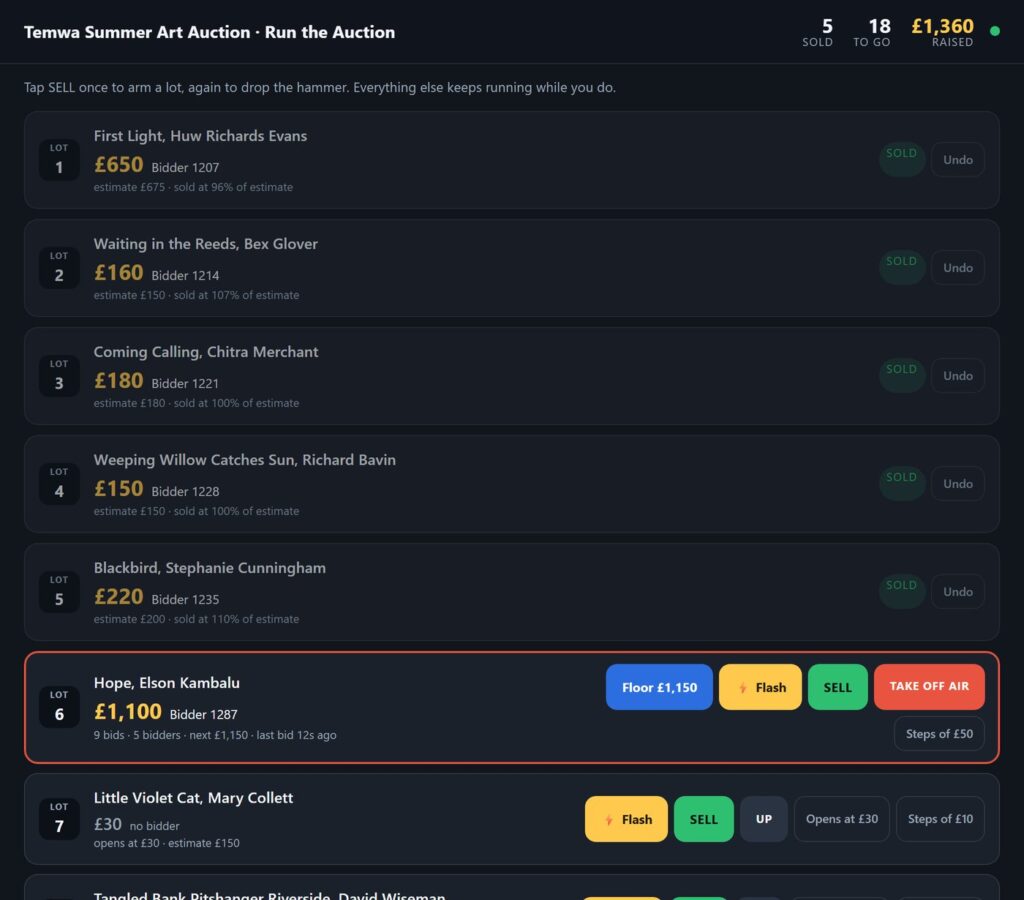
The auctioneer's console during the Temwa art auction: five lots sold with their hammer prices, lot six on air with Floor, Flash, Sell and Take off air buttons, and the running total

Skip the apology speech, the reason and any joke at the donor’s expense. If someone had pre-bid, a team member should speak to them before that lot would have come up.

My view is that you never let a lull sit, and a long explanation is a lull. Say it, move on, and let the next lot rebuild the pace; my post on bidding momentum says why.

Preventing the next time a donor pulls out

When a donor pulls out, three things limit the damage: a lot donation agreement signed when the gift is made, a confirmation date set before anything is printed, and a held backup lot ready to drop in.

  • Agreement. The donation form records what was promised and what happens if the donor cannot honour it.
  • Confirmation date. Pick a date a few days before the print deadline and ask every donor to reconfirm in writing. Nothing unconfirmed goes to print.
  • Held backup. One genuinely donated lot, fully described, kept off the printed list and out of the running order. Use it only if it is a fair match.

I would rather run about ten great lots than fifty or a hundred. With a short catalogue every lot carries weight, so a lost one stings more and each is worth confirming.

When is it worth hiring a charity auctioneer for this?

Doing it yourself is the right call when a lot goes weeks before print: reword the catalogue and nobody notices. A charity auctioneer earns the fee when a withdrawal lands in the final days or on the night, because someone has to reorder the programme and hold the room.

After 20 years on the mic, my rule is to get the room quiet first, then rebalance the order around whatever has gone. A Jigsaw Trust organiser said on my reviews page: “Kevin owned the room as he conducted the live auction, more than doubling our target. It was not just during the event where Kevin showed his skills, but also in guiding our planning.” (Naomi Chaning Pearce, Jigsaw Trust.) That is kind of them. The work that made the night was theirs.

To get a quick answer, have ready: your event date, room size, current lot list, which lot has gone, what is already printed, and when you found out.

If a donor has pulled out and you want a second pair of eyes on the running order, call 07596 851647. If you hire me as your charity auctioneer, I build the auction software around your event, with your branding and lots, included for the event and live for a month afterwards.

Kevin Durham, charity auctioneer

Kevin Durham

Charity auctioneer & event host

20years£10m+raised60–80events/yr
Check availability07596 851647

Let’s talk

Bring this to your event

Book a free consultation with a charity auctioneer who has raised over £10 million.

Is money raised at a charity gala taxable? What HMRC says

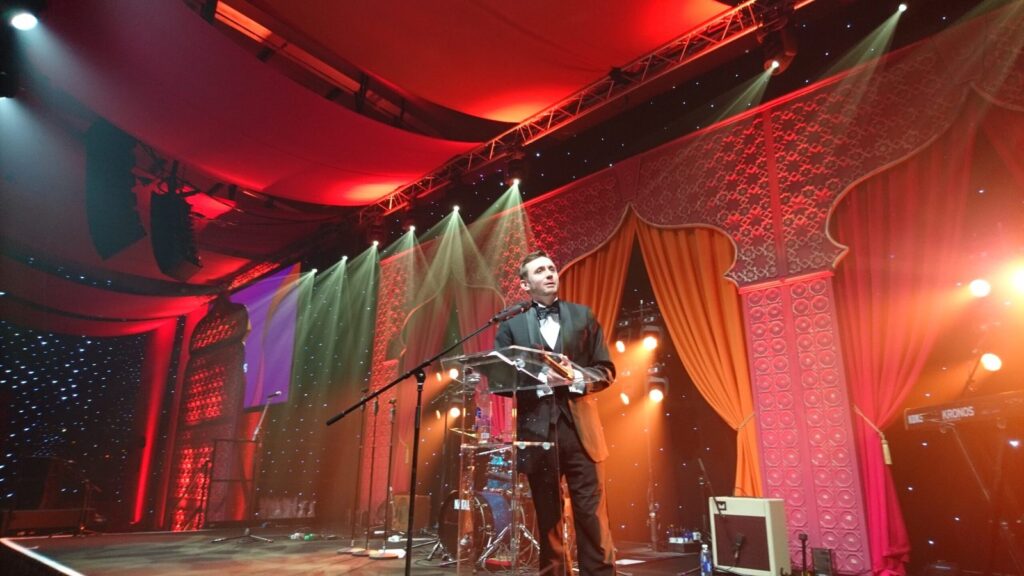
Kevin Durham hosting a black-tie charity gala from the stage under red and gold lighting

In short

  • Money raised at a charity gala is usually not taxable for the charity, if the gala qualifies as a fundraising event under HMRC’s rules and the profit is applied to charitable purposes. That is HMRC’s position as at November 2026.
  • The test follows the VAT fundraising-events exemption: the charity organises it, it is promoted as a fundraiser, and there are no more than 15 events of the same kind at one location in a financial year.
  • Donations and live pledges need no events exemption: HMRC treats gifts to a charity as exempt income or outside the scope of tax.
  • A gala that fails the test is a trade, and its profit is taxable unless small-scale trading limits cover it: £8,000, or 25% of total income, capped at £80,000.
  • This is general information, not tax advice, on income tax and corporation tax only.

Is money raised at a charity gala taxable? Money raised at a charity gala is taxable only where it is profit from a trade that no exemption covers. For a one-off gala run by a charity itself, an exemption usually does. Here is how, from HMRC’s own guidance, read on 1 November 2026.

I run the auction and pledge at 60 to 80 events a year, but I am not a tax adviser. Every charity’s position depends on its legal form and how the evening is run, so take your own advice before relying on any of this. VAT is a separate tax with its own rules and is not covered here. Gift Aid on tickets and lots is separate too: HMRC’s Gift Aid chapter covers charity auctions at 3.40 and events at 3.43.

Is a charity gala taxable if the charity runs it?

A charity gala is not taxable when it meets HMRC’s fundraising-events conditions and the profits are applied to charitable purposes or transferred to another charity. Annex IV of HMRC’s charity guidance, paragraph 29, says an event that meets the VAT exemption criteria automatically qualifies for the direct tax exemption.

Without that exemption, a gala can be a trade for tax purposes. HMRC says a one-off venture can still be trading, and that charitable intent for the profits is irrelevant to the question (paragraph 2). The exemption sits in section 483 of the Corporation Tax Act 2010 for charitable companies, and section 529 of the Income Tax Act 2007 for charitable trusts, per Annex I. It must be claimed.

What conditions must a gala meet to be exempt from tax?

To be exempt, a gala must be a one-off event, not a continuing trade, organised by a charity or another qualifying body, and promoted as a fundraiser. HMRC’s fundraising helpsheet, updated 20 April 2026, sets the conditions out:

  1. The organiser. Only events organised exclusively by charities, their trading subsidiaries and qualifying bodies count (4.5). A separate group is unlikely to qualify unless it has charitable status (4.2), so check who the organiser is.
  2. The purpose. The event must be clearly organised primarily to raise money, and guests must know it (3.2). Since a January 2025 Upper Tribunal decision, fundraising can be one of two inseparable purposes, with documentary evidence (3.3).
  3. The promotion. Tickets and publicity should refer to fundraising, with wording such as “in aid of”. Keep examples (3.16).
  4. The frequency. No more than 15 events of the same kind at one location in a financial year. At 16, none qualify (3.5). Successive evenings count separately (3.7), and a frequently run shop or bar is not an event at all (3.2).
  5. The package. More than two nights’ accommodation falls outside (3.15).
  6. The destination. The profits must go to charitable purposes or to another charity.

One annual gala dinner is nowhere near the limit.

How is each source of gala money treated?

Each stream at a gala reaches an untaxed position by a different route: tickets and bought-in lots through the events exemption, donated lots because selling them is generally not a trade, and donations and pledges because gifts to charity are exempt income. The table shows HMRC’s position as at November 2026.

MoneyIncome and corporation tax positionHMRC source
Tickets, dinner, items sold on the nightTrading income of the event. Exempt if the event qualifies and the profit is applied charitablyAnnex IV, 29
Bought-in auction lotsAn auction of bought-in goods is a listed kind of event, so the profit follows the event testHelpsheet, 3.4, 4.7
Donated auction lotsGenerally not a trade: the proceeds are the value of a gift realised. Significant refurbishment can change thatAnnex IV, 17
SponsorshipA donation if the charity only acknowledges the sponsor. Trading income if it gives large prominent logos or colours, or describes the sponsor’s productsAnnex IV, 22, 23
Donations and live pledgesGift Aid donations are exempt if applied charitably. Other donations are outside the scope of taxAnnex I, 4.1; Annex II, 3

The company side of sponsorship is in my post on corporate donations.

A live pledge asks for nothing back, so the event test matters least there.

When is a charity gala taxable?

A charity gala is taxable when it fails the fundraising-events test and no other exemption applies. Its profit is then trading profit, taxable even if every penny goes to the charity. Annex IV, paragraph 5, allows exemption by three routes only: a charitable trade, the small-scale limit, or a qualifying fundraising event.

Failures to watch for are a 16th event at the same venue, an organiser that is not the charity, and an evening that is part of a members’ social calendar (helpsheet, 3.7). The fallback is the small-scale trading exemption, which covers turnover (not profit) from all non-exempt trading, up to:

Charity’s total income for the yearMaximum non-exempt trading turnover
Under £32,000£8,000
£32,000 to £320,00025% of total income
Over £320,000£80,000

These are in Annex IV, paragraph 15, and match section 482 as at 1 November 2026. Total income excludes capital receipts.

A charity with £120,000 of total income has a limit of £30,000. Gala turnover of £25,000 sits inside it. £35,000 does not, unless the charity can show it reasonably expected, at the start of the year, to stay under (paragraph 16).

Does a charity need a trading subsidiary for a gala?

A charity does not automatically need a trading subsidiary for an annual gala that qualifies for the exemption. Charity law can require one, though, where an event carries significant risk or trading is substantial and regular. A subsidiary pays corporation tax like any company, then passes profits up with Gift Aid.

The Charity Commission’s CC35, published in 2016, says a risky event must be run by a subsidiary, which gets no special corporation tax treatment. Annex IV, paragraph 45, says a subsidiary donating its taxable profits gets a matching deduction, subject to restrictions, but cannot pay out more than its distributable profits.

What has changed recently

HMRC’s detailed guidance was last updated on 20 October 2026. What touches a gala:

  • 18 June 2025: the helpsheet gained section 3.3, accepting more than one primary purpose.
  • April and October 2026: Annexes I to III were updated for new charity compliance measures on 9 April, and Annex II on due diligence and records on 20 October. The exemption needs profits applied charitably, so keep the trail.
  • The limits: the change log entries I read, December 2025 to October 2026, do not name Annex IV.
  • Budget 2026: I searched HMRC’s Budget 2026 overview, published 28 October 2026. Its charity items concern other things, such as donated medicines, and none changes these exemptions.
  • Wording: the helpsheet still calls the relief extra-statutory concession ESC C4. Annex IV and section 483 put it in statute, with the same VAT-exempt event test.

What to put in front of your accountant

  1. Who organises the gala: the charity, a subsidiary or a committee.
  2. How many events of the same kind you hold at that venue each financial year.
  3. Tickets and invitations showing “in aid of” wording.
  4. Income by stream: tickets, bought-in lots, donated lots, sponsorship, pledges.
  5. The charity’s total income and any other non-exempt trading.
  6. How the profit will be applied, and how the claim will be made.

When is it worth bringing in a professional?

Bring in an accountant for the tax questions and a professional auctioneer for the room: they solve different problems. I cannot tell you whether your gala qualifies. What a professional host changes is what comes in on the night.

In my experience a well-built pledge raises more than the lots, which is why I always recommend one. Naomi Chaning Pearce of Jigsaw Trust said: “It was not just during the event where Kevin showed his skills, but also in guiding our planning.” Kind words, though the charity’s team did the real work. More is on the reviews page.

DIY is the right call for a once-a-year dinner with a volunteer MC and a raffle, where your treasurer can work through the checklist above. In my view it stops being enough when the room is large or the sponsors are many.

If you have a gala coming up, call 07596 851647. Have ready the date, venue, room size, a draft running order and which money streams you expect. If you book me, the auction software comes with it: I build the platform around your event, in your branding, with your lots and tickets, and it stays live for a month afterwards. My charity auctioneer services page has the detail.

Kevin Durham, charity auctioneer

Kevin Durham

Charity auctioneer & event host

20years£10m+raised60–80events/yr
Check availability07596 851647

Let’s talk

Bring this to your event

Book a free consultation with a charity auctioneer who has raised over £10 million.

Donor data protection charity checklist for auction night

Kevin Durham on stage holding a clipboard, talking to an event organiser

In short

  • One gala creates more personal information than most charities gather in a month, and hardly any of it arrives through a designed form.
  • The riskiest items are paper: the bid sheet, the clipboard, the raffle stub, and the card number someone wrote down when the terminal failed.
  • Your auctioneer, AV crew, photographer and bidding platform all walk out holding something. One named person should be chasing it back.
  • The auction record cannot simply be shredded. HMRC wants an audit trail behind every Gift Aid claim.
  • The most common mistake is the Monday thank-you email that turns a guest list into a mailing list.

Donor data protection charity policies tend to be written for the office: a privacy notice, a retention schedule, an unticked box on the donate page. Then you run an auction, and by midnight the charity holds several hundred pieces of personal information nobody planned for.

This is about that night, not the law in the abstract. It is general information rather than legal advice, and the regime itself sits with the ICO and the fundraising code.

What does donor data protection charity guidance actually ask of you?

Four things, all practical. Collect only what you need, say what you are doing as you collect it, keep it secure, and get rid of it when the purpose ends.

The ICO’s data minimisation principle calls for adequate, relevant data limited to what is necessary. The Fundraising Regulator’s data privacy guide, updated in June 2026, is blunter: once the purpose ends you must destroy or delete, and it is not lawful to keep data just in case. The Code also asks you not to unreasonably intrude on anyone’s privacy.

None of that is hard. It fails on the night because nobody owned it.

What is on the bid sheet, and who picks it up?

A name, a table number, a phone number, and how much that person was willing to spend. At a silent auction, forty of those sheets sit unattended in a room full of strangers for three hours.

The ICO is explicit that the security principle covers physical measures as well as systems, and that many incidents come from hard-copy records being lost, stolen or incorrectly disposed of. A bid sheet abandoned at the end of a gala is all three waiting to happen.

Fix it with logistics, not policy. Number the sheets, and give one named volunteer the job of collecting every one, counting them against that list and putting them in a closed box. If a sheet is missing, somebody needs to know before the cleaners arrive, because accidental loss of personal data is a breach and the clock on it is 72 hours.

Why should nobody ever write a card number on paper?

Because the card security code must not survive the payment, and a biro does not know that. The PCI Security Standards Council’s guidance on telephone payments states that storing the three or four digit validation code after authorisation breaches PCI DSS requirement 3.2, even encrypted.

It still happens. The terminal loses signal mid-checkout, a queue builds, and a helpful volunteer says write it down and we will run it in the morning. Nobody is being careless. The charity is now holding live card numbers in a cash tin.

Three better answers, all duller. Hold the lot until the terminal recovers. Send a payment link the next working day against an invoice. Or put the guest on the venue’s terminal and settle with the venue afterwards.

The registration desk is where your mailing list gets decided

Everything about the follow-up email is settled in the ninety seconds a guest spends at the door, and almost nobody realises it.

Charities did gain real flexibility here. A charitable purposes soft opt-in commenced on 5 February 2026, with final ICO guidance in April 2026, and paying to take part in a charity’s fundraising event can count as support. It only works if the opt-out was offered when the details were taken. The ICO says staff taking details verbally should specifically offer that choice, and that an opt-out in a later confirmation email does not count.

So the clipboard matters more than the privacy notice. One line on the sheet, read out by whoever holds the pen: we will email you about our work unless you tick here.

The raffle stub is the same problem in miniature, usually a phone number on a cloakroom ticket. If you sell raffle prizes and want to keep those numbers, say so on the ticket book. If not, use stubs with nowhere to write one. A commission bid needs the same box and the same collection route.

Who gave you the corporate table’s guest list?

A company bought ten seats and emailed ten names, ten dietary notes and a wheelchair access request. Nobody on that list ever gave you anything.

You still owe those guests privacy information. Where data comes from a source other than the individual, the ICO’s timing is a reasonable period and no later than one month. Dietary and access notes can reveal health or belief too, which is more sensitive than a name on a seating plan.

The second trap catches more charities. The soft opt-in applies only where you obtained the details directly, and the ICO states it does not apply if someone else obtains them for you. A table host’s spreadsheet is not a mailing list. Put a sentence on the booking form asking the company to tell its guests who will hold their details.

What notice do people actually get about photography?

Usually a line in a joining email nobody opened. That is thin, and the fix costs nothing: put it on the ticket, in the joining instructions, and on a sign at the door naming who is filming, what the footage is for and how long it is kept. Tell the photographer where not to point the camera, which means the registration desk, the payment table and any screen showing bidder names.

The pledge moment deserves its own thought. A close-up of a guest raising a paddle records what that person gave, which is rather more revealing than a photograph of the dessert. If it is going in next year’s appeal, decide that before the shoot.

Who owns donor data protection charity duties for your suppliers?

You do. The charity is the controller, and the people you hired act on your instructions, which makes them processors rather than co-owners of anything.

Write it down. The ICO sets out what the contract must contain, including that no sub-processor is brought in without your written authorisation and that everything is deleted or returned at the end. Ask one question before you sign: after the event, can we export the lot, and will you delete your copy.

A charity auction platform open on a laptop, beside a notebook and a glass of water

Then list who physically holds what. The platform has the bidder records. The AV company may have a running order with table names on it. The photographer has a memory card. I come off stage with a lot sheet on a clipboard, which is why it goes back to the charity’s named person rather than into my bag.

The volunteers’ own phones

Nobody writes a policy for this one. By the end of the night there is a WhatsApp group with twelve people in it, a photo of the bid sheet and a screenshot of the bidder list.

That is personal devices the charity does not control, and it will sit there for years. Decide in advance what may be posted in the group, normally table numbers and nothing else. Delete the group once reconciliation is done, and ask people to confirm the photos have gone.

What has to survive the night, and what gets shredded?

The Gift Aid trail survives. Almost nothing else does.

HMRC requires records providing an audit trail linking each donation to an identifiable donor who gave a valid declaration, and for a charitable company those tax records must be kept until six years after the end of the accounting period. The auction record, the pledge totals and the declarations are not yours to bin. My guide to pledge cards covers what those should capture.

Everything else has a shorter life, and the storage limitation principle expects you to justify the period you chose. Dietary notes die with the dinner. Working copies of the seating plan go once the room is cleared. Write those periods down before the event rather than guessing in January.

Shred, do not bin. The ICO’s security guidance asks specifically how you dispose of paper.

The end-of-night checklist

Give this to one person, on paper, with a pen attached.

  1. Collect every numbered bid sheet and count them against the list.
  2. Sweep the tables, the lectern, the desk and the toilets for stray paper.
  3. Collect the raffle stub books and the absentee bid forms.
  4. Check the cash tin for anything with a card number on it. Deal with it tonight.
  5. Take back laptops, tablets and printed bidder lists.
  6. Get the photographer and the AV crew to confirm what they are taking away.
  7. Put all paper in one closed, labelled box and hand it to the named person. Not the boot of a car.
  8. Post one message in the volunteer group: forward nothing from tonight.
  9. Within 48 hours, type up what you need and shred what you do not.
  10. If anything is unaccounted for, tell whoever makes the breach decision.

What I watch for in the room

The queue at checkout. I do 60 to 80 events a year, and that queue is where the evening’s data decisions actually get made, by a tired volunteer with a biro and a long queue behind them.

I would rather these questions were settled months out, next to the running order and the lot list. What are we collecting, who holds it, and how does a guest say no.

If you want the paperwork designed as carefully as the auction, that is part of what I do as auctioneer and host. Call 07596 851647.

Kevin Durham, charity auctioneer

Kevin Durham

Charity auctioneer & event host
20years£10m+raised60–80events/yr
Check availability07596 851647

Let’s talk

Bring this to your event

Book a free consultation with a charity auctioneer who has raised over £10 million.

Charity event venue: how to pick a room that raises more

Kevin Durham on stage with a clipboard, talking through the running order with an event organiser

In short

  • Judge a room by what it does to the money, not by how it photographs.
  • Acoustics come first. A room that blurs the ask gets a smaller answer.
  • One focal point, clean sightlines from the back. Bidders you cannot see do not bid.
  • Big round tables, ten or twelve to a table, beat long banqueting rows.
  • A free room is not always the cheap one.

Most advice about choosing a charity event venue is written by people who have never had to raise money in one. A directory listing and a capacity chart tell you nothing about whether the room will help you or fight you once the fundraising starts.

My work as an auctioneer and host takes me to 60 to 80 events a year, in ballrooms, marquees, function rooms and halls. Here is what I look at, and what I would ask before signing.

What makes a good charity event venue?

A good charity event venue seats your target number comfortably, gives the room one obvious place to look, and carries a single voice to the back wall. The rest is decoration.

Three questions settle most of it. Can everyone hear the ask? Can everyone see the person making it? Can guests see each other giving? The HSE treats venue design as a planning decision rather than a detail. A room can be beautiful and still be hopeless for fundraising.

How do a room’s acoustics affect bidding?

Hard surfaces and a tall ceiling smear speech, and a room that smears speech loses bids. Reflections arriving within roughly 50 milliseconds read as reverberation; past that you get a distinct echo, which is why reverberation time is designed into concert halls on purpose.

What you need is intelligibility, and that depends on background noise, reverberation time and long-delayed reflections together, which is the basis of the speech transmission index.

Clap once, hard, where the stage will go and listen to the tail. Carpet, drapes, upholstered chairs and a full room pull it down. Bare stone, glass and a vaulted roof push it up.

The worst night of my career was a room I did not command. We were running late, nothing teed up the auction, and I announced it over people who were still talking. Only a fraction of the room heard the lots, and one man bid on an item he could not hear clearly. A hard room makes getting that quiet twice as difficult.

Does the room have a focal point the back tables can see?

The best rooms have one end everybody is already facing. If the only clear space for a stage is a corner, or the room turns a dog-leg, a third of your guests spend the auction looking at the backs of heads.

Giving is social: people bid harder when they can see others doing it, and that is most of what bidding momentum is. Pillars break that, and so does a flat floor with twelve rows of round tables and a stage at floor level. If a bidder cannot see me, I cannot see them, and a bid I cannot see does not happen.

Ask two things: can we have a riser, and how high. Even a 450mm stage changes what the back of a flat room can see. Spotters help, and they are part of how I run a live auction, but they patch a sightline problem rather than fix it.

Ceiling height matters too: a low ceiling over a packed room holds energy. A cavernous hall with 120 guests in it swallows applause, and a room that cannot applaud cannot build.

Round tables or long tables in a charity event venue?

Big round tables of ten or twelve raise more than long banqueting rows, because neighbours can see each other’s faces.

A table plan screen showing the stage, the top table and twelve round tables with check-in numbers

On a long table each guest talks to two people and half sit with their back to the stage all night. On a round, everybody can swivel and the table behaves like a small team chasing one lot together.

Ask for a floor plan drawn at your headcount with the stage marked, not the maximum capacity plan. They are rarely the same room.

The bar, the service doors and the catering turnaround

A bar at the back with its own queue competes with the stage all evening. Ask whether it can close during the fundraising segment, and get that in writing.

If the kitchen pass crosses the room behind the stage, your quietest moment has staff walking through it. Ask where that route runs and whether it can be paused.

Then ask how long the turnaround takes between courses, and whether service can hold during the pledge. Let the room breathe over dinner: sell raffle tickets while people wait, and never approach a guest mid-mouthful. Protecting that slot in the running order is a venue question as much as a programme one.

Will the in-house AV carry a voice to the back?

In-house AV is usually built for a speech from a lectern, not an auctioneer working the floor. What you need: a radio handheld microphone with a spare, speakers spread so the back tables hear the same level as the front, and a competent operator present during the event, not only at set-up. Friends House, a charity-owned London venue, lists AV support and high-speed wifi as standard.

Then lighting. Can you bring the house lights up over the guests during the auction, or is the room on one switch? If the stage is lit and the floor is dark, I cannot see hands.

Power next. If you are taking bids on phones, ask how many concurrent devices the guest wifi really supports, and where the sockets are. That decides whether auction software is worth running.

Is the venue accessible to every guest?

Ask for the venue’s access guide before you ask for the price. Under the Equality Act 2010 service providers have duties not to discriminate, and the GOV.UK guidance was last updated in May 2026. This is not legal advice: take your own, and ask the venue what it does already.

Check the step-free route to the stage as well as to the room: a speaker or lot donor may be a wheelchair user. Ask whether there is a working hearing loop, since large-area loops send audio straight into hearing aids. Ask when it was last tested.

A standard accessible toilet is not always enough. A Changing Places toilet needs at least 12 square metres, a height-adjustable bench and a ceiling hoist. Attitude is Everything runs an access charter for venues.

The charity event venue contract questions people forget

Most venue arguments start with a question nobody asked. Work through this before you sign:

  • Minimum spend. Is it food and drink only, and does sponsored or donated catering count towards it?
  • Corkage. What is the per-bottle charge on donated stock, and does it apply to anything you auction?
  • Get-out time. What time must the room be clear, and what does an overrun cost per hour?
  • Access time. When can you get in to set up, sound check and rehearse?
  • Exclusivity. Is another event in the building sharing your foyer and toilets?
  • AV supply. Is the in-house supplier compulsory, and what does bringing your own cost?
  • Final numbers. When do guest numbers lock, and what happens if you fall short?

Ask which licences the venue holds, too. A hall without a premises licence needs a Temporary Event Notice: £21, served 10 clear working days ahead, under 500 people including staff, in England and Wales, as at October 2026. Music generally needs TheMusicLicence from PPL PRS. The Fundraising Regulator’s events guide, updated in July 2025, says you must carry out a risk assessment and should document it.

Put the answers in the contract, not in an email chain. The person who promised the bar would close may have moved on by March.

Is a free charity event venue really cheaper?

A donated room only saves money if it does not cost you more on the night than it saves on the invoice. Donated rooms are often the hardest to work in: sports hall acoustics, no stage, strip lighting on one switch, a fixed lectern microphone, nowhere to plug anything in. If the back third cannot hear the live pledge, you can lose more in that one segment than the hire fee was worth.

A charity-owned venue with proper AV is a real win, and published rates make budgeting honest: Friends House lists evening rates for its larger spaces from £880 against day rates from £1,450 (checked October 2026).

Price the difference honestly: hire saved, against hired AV, staging, a riser and lighting. And ask every venue for a charity rate and an evening rate. Plenty have one and many will not mention it unless asked.

What to do on the site visit

Go at the same time of day as your event, and bring whoever will run your auction. Then, while you are standing there:

  1. Speak at normal volume from the stage position; have someone listen from the furthest table.
  2. Clap once, hard, at both ends of the room and listen to the tail.
  3. Sit in the worst seat and look for the stage.
  4. Walk the route a guest takes from door to table.
  5. Find the sockets, the lighting controls and the AV position.
  6. Open the service doors and see where they lead.
  7. Ask what is booked in the room before you and after.

The room will not raise the money for you, but the wrong one quietly caps what a very good evening could have been, and you never see the number you missed. If you are weighing up two rooms and want a second opinion on which will raise more, call 07596 851647.

Once the room is settled, the rest is sequencing: see my guide to planning a gala.

Kevin Durham, charity auctioneer

Kevin Durham

Charity auctioneer & event host
20years£10m+raised60–80events/yr
Check availability07596 851647

Let’s talk

Bring this to your event

Book a free consultation with a charity auctioneer who has raised over £10 million.

Collecting payment at a charity auction: on the night or by invoice?

Kevin Durham in a burgundy jacket pointing out a bidder on the floor

In short

  • Take payment on the night wherever you can. Every hour between the hammer and the card is an hour for enthusiasm to cool.
  • A bid becomes a contract at the fall of the hammer, so your terms must say what happens next.
  • In-person UK card rates sit around 1.5% to 1.75% as of October 2026, and overseas cards cost more.
  • Record five things per lot: lot number, winner, hammer price, how they paid, when it was banked.
  • Chase twice, warmly. Court is rarely worth what it costs a charity in goodwill.

The hammer falls, the room applauds, and not a penny of it is in the bank yet. Collecting payment is the least glamorous part of a charity auction and the part that quietly decides what the night actually raised.

Twenty years on the auctioneer’s mic and over £10 million raised have taught me that auction totals shrink in the gap between the stage and the finance team’s spreadsheet, and that the gap is an admin problem, not a bidding one. This is guidance from the floor, not legal or tax advice.

Should you collect payment on the night or invoice afterwards?

Take payment on the night for everything you can, and invoice only by exception.

It is not suspicion, it is momentum. A guest who has just been applauded for winning a lot wants to pay. The same guest on a Tuesday morning has a diary full of other things. The Fundraising Regulator’s code asks for procedures to count, record and bank donations without delay, and the easiest way to keep to that is to have the money before the room empties.

Keep a short list of genuine invoice cases: a company that needs a purchase order, an overseas guest whose card will not clear, a large lot going by bank transfer. Agree the payment date out loud at the desk and write it on the record. An undated invoice is a donation that may or may not arrive.

When is a bid at a charity auction legally binding?

Under the Sale of Goods Act 1979, a sale by auction is complete when the auctioneer announces its completion at the hammer’s fall, and until that announcement any bidder may retract their bid.

Two other parts of the same section matter at a gala. Each lot is treated as a separate contract, so one unpaid lot does not unravel the night. A reserve can also be notified in advance, worth putting in writing.

Having a right and enforcing it are different things, and for a charity the second is rarely worth doing. So the paperwork before the auction matters more than the law after it. Register bidders, capture a name, a mobile and an email, and make sure the room understands how bidding works first.

Setting up the payment desk

Put the desk where people walk out, not next to the stage, and open it before the auction, not after.

Staff it with two people minimum. Charity Commission guidance on internal financial controls asks for at least two to handle and record cash, for money to be banked as soon as possible without expenses taken out, and for card readers to be kept secure and reconciled.

An interactive table plan showing each table and how many of its ten seats are checked in

A few things I insist on:

  • One person holds the master lot sheet and nobody else writes on it.
  • The desk never opens during the live pledge. Guests queuing at the back kills the quietest, most valuable part of the evening.
  • Silent and live auction winners settle at the same desk, or you will double-charge somebody. My guide to running a silent auction covers the closing process that feeds it.
  • I announce the desk from the stage, by name and location, twice.

The code’s events standards ask for a plan covering all situations you could reasonably expect. A reader running out of battery at 10.40pm counts as reasonably expected.

What do card readers cost a charity auction?

Expect to lose roughly 1.5% to 1.75% of every in-person card payment, plus whatever the reader itself costs.

ProviderIn-person rate, October 2026Worth knowing
Zettle1.75% per card transactionSame rate for mobile wallets and Amex; invoices 2.5%
Square1.75% with UK cardsNon-UK cards add 1.5%; keyed-in payments 2.5%
Stripe1.5% plus 20p, standard UK cardsPremium UK cards 2.8% plus 20p, international 3.15% plus 20p

On a £20,000 auction that is roughly £300 to £350 of fees. Budget for it rather than finding it in January. International guests mean a chunk of the room pays non-UK rates.

Do not quietly add the fee to the bidder’s bill. If you want the winner to cover costs, that is a premium and it belongs in your published terms. I have written separately on whether a buyers premium earns its keep.

What should a charity record for each lot?

Record the lot number, the winner’s name and contact details, the hammer price, how it was paid, and the date the money reached the bank.

Charity Commission guidance asks for records of each fundraising event showing how much was collected and what it cost. Build it from the lot sheet up and the total reconciles itself.

A gala big screen showing the lot on the block, its current bid and the running total

Then the tax point that catches people out. HMRC’s guidance is blunt: a payment for an item at a charity auction is not a gift to charity, it is a purchase. Auction income is not Gift Aid income by default, and it should not go in the same bucket as the pledge sheets.

HMRC allows a narrow route where a bidder treats part of the payment as buying the item and Gift Aids the excess, but only where the item can be bought elsewhere and the bidder knew its value when bidding. So the retail value has to be announced before bidding opens and written on the lot record. Print the values in your auction catalogue and have me read them from the stage.

The same goes for pledges. The vast majority are paid on the night, and ideally all of them, because once people leave the room they conveniently forget what they promised. Where I have seen a high drop-out, it came from too few payment terminals and volunteers on the ground.

How do you chase an unpaid lot politely?

Send a thank-you with the amount and a payment link the next working day, one friendly reminder about a week later, then make it a phone call from someone the bidder actually knows.

Tone decides this. The code requires fundraising to be legal, open, honest and respectful, and rules out undue pressure and unreasonably persistent approaches. Two written nudges and a call is not persistent. Six emails and a text at 9pm is.

Give the deadline a reason the bidder can see: the charity has to pay a supplier, or tell the lot’s donor it has been honoured. And let the table captain or the trustee who invited them make the call rather than the finance officer. The person who filled the table has a relationship. The spreadsheet does not.

What if a bidder refuses to pay or disputes the amount?

Check your own record first, then decide whether the money is worth the relationship.

Most disputes are honest. Two paddles went up together and the spotter called the wrong one. The bidder thought the price was per person. Someone bid for their table and three people at it have since gone quiet. If your record is genuinely unclear, offer the figure the bidder believed they were committing to, write the resolution down, and move on.

Flat refusal is a contract question. An unpaid lot is a simple contract debt, and an action on a simple contract cannot be brought more than six years after the cause of action arose, so no panic in week three. A money claim is possible: court fees start at £35 for claims up to £300, £70 for £500.01 to £1,000 and £80 up to £1,500.

A charity rarely comes out ahead by suing a gala guest. The fee is the small part. The cost is trustee time, awkwardness with whoever brought that guest, and the story travelling. Agree a write-off threshold with your board beforehand, so the decision is policy rather than argument.

When a lot should be re-offered

If the bidder retracted before the hammer, nothing was sold, so the lot can go straight back up. After the hammer, do not re-offer to the room.

Go quietly to the under-bidder instead. They know the price, and a call saying the lot is available at their bid beats putting it in the next newsletter at a discount. Never name a non-payer publicly.

Dated lots need a faster decision. Hospitality, match tickets and experiences with an expiry date are worth nothing once they lapse, so set a cut-off: unpaid after two weeks and the lot goes to the under-bidder. Tell the donor what happened. Most offer to donate it again next year.

What I ask a committee before the hammer falls

Three questions, every time. Who is on the payment desk, and have they used the reader before. What do the terms say about when payment is due. Who makes the call if a lot is still unpaid in a fortnight.

In my experience what goes wrong most often after the night is the admin: who won which lot, for how much, and how to reach them. Under-planning and too few volunteers cause most of it, so over-plan and put more people on the desk than you think you need.

If you want to talk through how your auction and payment process is structured, call me on 07596 851647. I would rather talk than trade emails, and the first fundraising consultation is free.

Kevin Durham, charity auctioneer

Kevin Durham

Charity auctioneer & event host

20years£10m+raised60–80events/yr
Check availability07596 851647

Let’s talk

Bring this to your event

Book a free consultation with a charity auctioneer who has raised over £10 million.

Charity auction run sheet: lot order, timings and cues

Charity auctioneer Kevin Durham calling a lot from a lectern, working from his printed notes under warm gala lighting

In short

  • A charity auction run sheet is not the gala timeline. It scripts the auction segment only.
  • Build it as a table: clock time, duration, lot, who speaks, what AV and the committee do.
  • Plan on about ten lots, 14 at a push. The live auction runs from about 30 minutes to an hour, depending on the client.
  • Agree standby and go wording with the AV desk before doors, and put a name against every cue.
  • The live pledge belongs on the same sheet, straight after the last lot, with its own cues.

I have run auctions off a scribbled list and off a proper run sheet, and the sheet wins every time. A charity auction run sheet is narrow: it covers the half hour to hour in which most of the night’s money arrives. After twenty years and over £10 million raised, this is how I build mine.

What is a charity auction run sheet?

A charity auction run sheet is a timed, cue-by-cue script for the live auction segment, written so someone who has never seen your event could stand up and run it. It lists every lot in order, how long each gets, who speaks, and what the desk and the floor do while they speak.

The idea comes from theatre. A cue sheet shows the sequence of technical cues for a show, usually as a table. An auction is a show with a till attached.

How does a run sheet differ from the gala running order?

The running order covers the whole evening; the run sheet covers one segment in far more detail. If the gala running order says the auction starts at 21:10 and runs for half an hour, the run sheet says what happens in each of them.

They serve different people. The running order goes to the venue, the caterers and the speakers. The run sheet goes to five or six: auctioneer, AV operator, spotters, clerk, and whoever on the committee can decide mid-segment.

What goes in each column of the run sheet?

Six columns do the job. Production teams build these grids with key events down the first column and each department’s cues beside them, as this production cue sheet guide shows.

ColumnWhat it holds
Clock timeReal time, not elapsed. 21:12, not “minute two”.
DurationMinutes allowed for this row.
Lot or segmentLot number, short name, donor credit.
AuctioneerOpening bid, increment ladder, reserve, closing line.
AV deskSlide, film, sound, lighting state, totaliser.
Floor and committeeSpotter positions, who holds the paperwork.

Two things sit in the header rather than a column: a version number and a time stamp. Production cue sheets are always given a version number, because they change and the crew must know which one they hold. Something as short as “v3, 18:40” does it.

Why does lot order decide the total?

Because bidding momentum is a skill, not luck, and the sequence either builds it or flattens it. Open with something broad and affordable so the first hands go up. Hold your strongest lot for the middle, once the room has warmed. Finish on something with real pull.

My strong opinion, and it costs some auction companies money to hear it: around ten good lots beats fifty ordinary ones. Ten is my optimum, and 14 is the most I would recommend at a push. There is no minimum, because the live pledge can carry the night. A long catalogue splits the bidding. Put a one-line reason beside each lot, so nobody rearranges the order late on.

Order also protects the awkward lots. Note each lot’s status on the sheet, donated or consignment, and say it out loud. I did exactly that at one event, and the money followed the transparency.

How long should each lot get?

It depends on the client. With the flexibility to do the best I can with every lot, the live auction runs from about 30 minutes right up to an hour if there are a lot of lots. If a client wants the lots short and snappy, I can do that, though engagement may dip slightly because I cannot do my usual banter with people in their seats. Either way, when two bidders start grinding each other down, that is the moment to close.

Put the duration in as a number and keep a running total in the margin. When a lot overruns, take the time back from the weakest lot, never from the pledge.

A worked example charity auction run sheet

A short sample, five lots in twenty-one minutes plus a ten minute pledge, to show the shape as I would hand it to an AV desk I had never met. A longer auction simply has more lot rows.

TimeMinsLot or segmentAuctioneerAV deskFloor and committee
21:082Beneficiary film endsStage left, mic liveHold frame, standby AV 1Spotters in position, clerk at laptop
21:101Auction opensHold for quiet, then “it is time for the live auction”AV 1 go: title slide, music outChair seated and visible
21:112Lot 1, signed shirt, donatedOpen £150, steps of £50AV 2 go: lot 1Spotter A left, B right
21:133Lot 2, restaurant experienceOpen £200, steps of £100AV 3 go: lot 2Clerk confirms winning table
21:163Lot 3, hotel break, consignmentOpen £300, state the reserveAV 4 go: lot 3Committee checks reserve wording
21:194Lot 4, headline experienceOpen £1,000, duel the top twoAV 5 go: 30 second filmSpotters watch the back tables
21:233Lot 5, closing lot, donatedOpen £400, close on a liftAV 6 go: lot 5Clerk totals, slip to chair
21:262Raffle drawDraw three ticketsAV 7 go: raffle slideSales closed 21:00, drum ready
21:282Pledge set-upHand to chair, 60 secondsLights to 50%, standby tiersChair speaks from the floor
21:3010Live pledgeTiers £5,000 to £100, hold at £500AV 8 go: tier slides, totaliser liveFour counters on paddles
21:402Total and handoverAnnounce the total, hand backAV 9 go: total slideClerk prints for the chair

Change the lots, keep the shape, and a stranger could run it.

Who cues what between the auctioneer, the AV desk and the committee

Kevin Durham on stage at the MAG-FEST charity ball, arms wide, with the AV screen behind him and his open notes on a stand

Borrow the stage manager’s convention. A standby is called ten-ish seconds before the cue, then the cue name and “go” at the moment it happens. “Standby AV 4”, then “AV 4, go”. Write both in, so nobody invents their own language.

Then name people, not departments. Councils say the same about events: identifying specific responsibilities for everyone involved is essential to avoid overload. On an auction sheet that is a named AV operator, a named clerk, a named decision-maker, and spotters with a side each.

Volunteers need more than a name on a page. The fundraising code expects volunteer fundraisers to get training and support suited to their role, so brief the spotters: how to signal a bid, and what to do when two people claim it.

The lines your run sheet must spell out

Some rows exist for legal reasons, not theatrical ones. I check these twice.

  • Reserves and consignment status. Guests should know where their money lands, and trustees must keep a charity open and accountable about fundraising.
  • Any lot sold as a split payment. HMRC allows the excess over an item’s value to count as a donation only where the item is commercially available and the donor knew, at the winning bid, what it could be bought for. Put that split payment wording in the auctioneer column.
  • The raffle cut-off. Tickets for an incidental lottery can only be sold at the event while it is taking place, and prizes cannot roll over. Give the cut-off and the draw their own rows.
  • The Gift Aid prompt. Worth 25p on every eligible £1, but only with a declaration.
  • A contingency row. The code requires a risk assessment before an event, plus a plan for anything you could reasonably expect. For an auction that is a drop-two-lots plan, and who makes that call.

What stops a run sheet working on the night?

Mostly the sheet existing and nobody reading it. A document emailed at 17:00 is decoration. Walk it through out loud, in the room, before doors open.

The other failures are familiar. Nobody commands the room before lot one, so the first lots are sold into noise: I lost a room that way once, and a man bid on an item he could not hear properly. Speeches overrun and the auction absorbs the loss. Three people end up working from v2. Or the sheet swells into a second auction catalogue.

Win the room first. The sheet just helps you keep it.

Common questions about a charity auction run sheet

Who should write the auction run sheet?

The auctioneer, with the event manager. The auctioneer drafts the auction and pledge rows, the organiser merges them into the evening timeline, and both sign off one final version. More on that in my guide to briefing your auctioneer.

Where does the live pledge sit on the run sheet?

Immediately after the last lot, on the same sheet, with its own tier rows and cues. The live pledge is usually the biggest earner, so it gets the warmest minutes and the most detail. At one event the pledge was not going well with just me at the front asking. I brought up people the charity had helped to speak, and from then on it really ran. Give that moment a row of its own.

How many copies do you print?

One each for the auctioneer, AV desk, clerk and chair, plus one per spotter. Paper, not phones, all the same version. You can hire an auctioneer for a free consultation if you want yours built with you.

Kevin Durham, charity auctioneer

Kevin Durham

Charity auctioneer & event host

20years£10m+raised60–80events/yr
Check availability07596 851647

Let’s talk

Bring this to your event

Book a free consultation with a charity auctioneer who has raised over £10 million.