In short
- A charity gala seating plan raises most when guests sit at big round tables, ideally 10 or 12 to a table.
- Round tables work because everyone at the table can see who is bidding and who is giving.
- Long banqueting tables let people hide. Each guest only really sees the two people beside them.
- Exactly who sits where matters far less than most committees think, so settle the table shape before you spend an evening moving names around.
- Visibility is not pressure. The host keeps it playful, and nobody is singled out for not giving.
A charity gala seating plan is the map of which tables go where and who sits at each one. For fundraising, the decision that moves the total is the shape and size of the tables, not the order of the names on them.
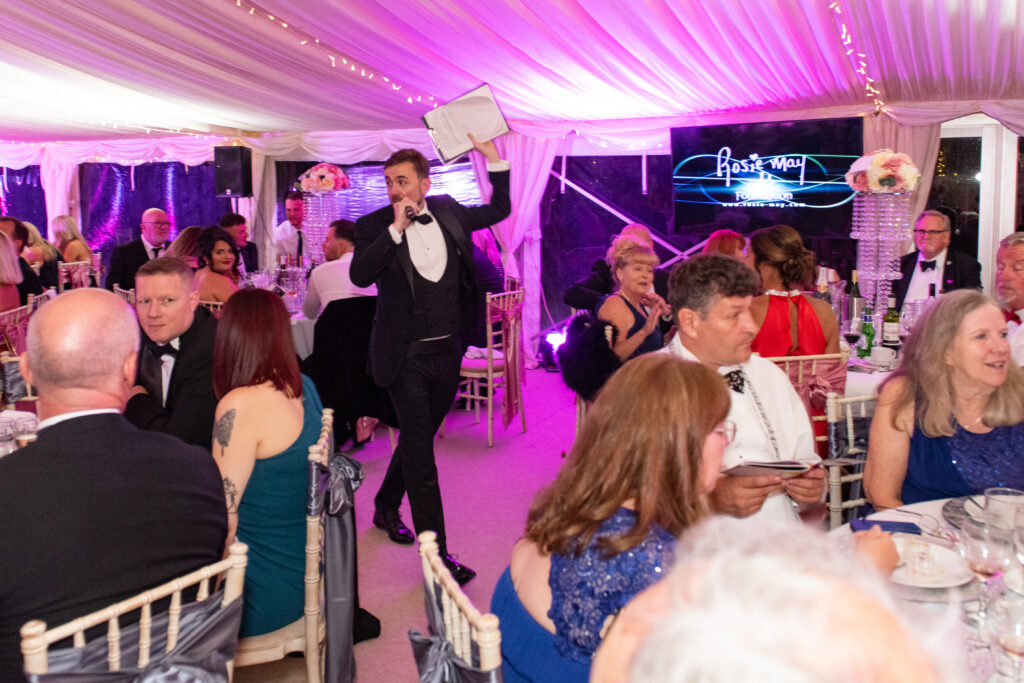
I look out over a seating plan from the stage at 60 to 80 events a year, and my rule is short: big round tables, the bigger the better.
What is the best table layout for a charity gala seating plan?
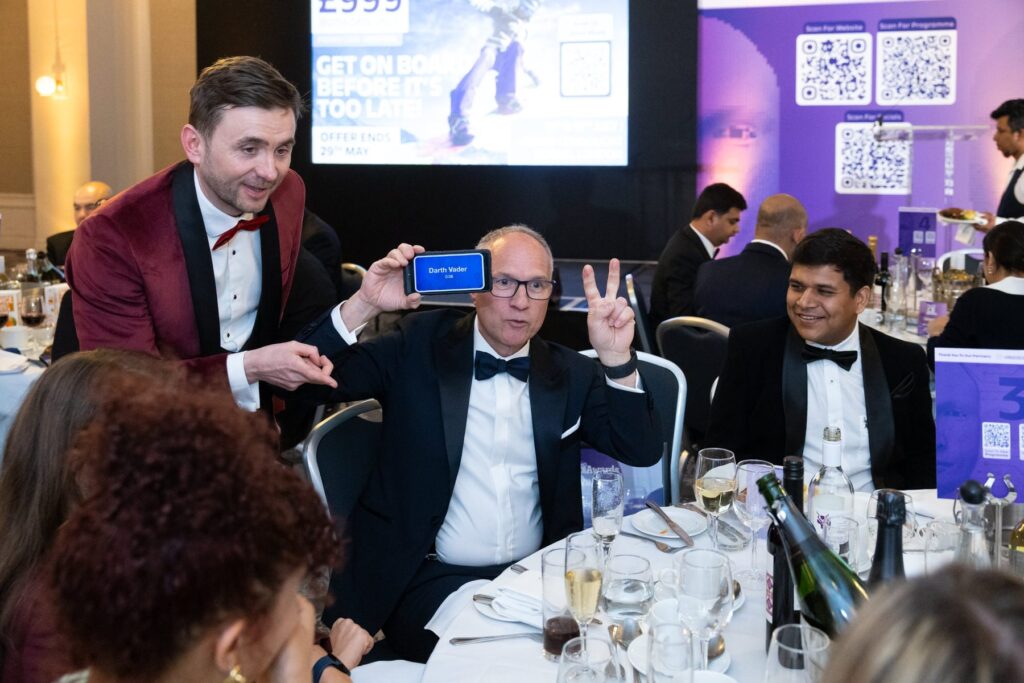
The best layout for a charity gala seating plan is large round tables of 10 or 12 guests, set around one clear stage. Round tables let every guest see every other guest at the table, so bidding and giving happen in full view. That visibility, more than any clever placement, is what lifts a fundraising room.
If the venue offers tables of ten, take them. I would go to twelve if the tables and the room allow it. The more people who can see each other at one table, the more each table behaves like a small crowd with its own momentum.
The room still has to work: one focal point, a voice that carries, sightlines from the back. My venue guide covers that side. This post is about the tables themselves.
Why do round tables raise more than long tables?
Round tables raise more because they create a gentle, perceived peer pressure. Everyone at the table can see how much each person bids and how generous they are, or are seen to be. On a long table you see your neighbours and not much else, so it is easy to sit quietly through the auction and the pledge.
I have seen what long tables do to a total. I worked a big event abroad that used long, banquet-style tables. The year before, the same event had been on round tables, and that year it raised more. My view is simple: people can hide on long tables. A round table gives nobody anywhere to hide.
The research leans the same way. In a field experiment across 30 Dutch churches, published in the Journal of Public Economics in 2005, Adriaan Soetevent swapped closed collection bags for open baskets, where people could see their neighbours’ gifts. Giving to external causes rose by about 10% at first, though the effect faded over the 29 weeks.
A 2012 Yale field experiment by Dean Karlan and Margaret McConnell found gifts rose with the promise of public recognition, mainly because donors wanted to improve their social image. Ariely, Bracha and Meier make the underlying point plainly in their work on image motivation: image depends on behaviour being visible to other people. Put ten or twelve people round one table and you have built exactly that.
How many guests should sit at each table?
Seat 10 to 12 guests at each round table for a fundraising dinner. A 6ft round, about 183cm across, is the table that does it: Trent Furniture says its 183cm banqueting round seats 10 to 12, and Event Hire UK lists its 6ft round as seating up to 12 (both read November 2026).
Here is the arithmetic for a 240-guest gala:
| Table size | Tables needed | Other guests each person can see across the table |
|---|---|---|
| 8 | 30 | 7 |
| 10 | 24 | 9 |
| 12 | 20 | 11 |
Same room, same guests. At twelve, every bid and every pledge card can be seen by eleven people instead of seven, and there are ten fewer tables for the host to work.
Not everyone agrees with big tables, and the other side deserves a fair hearing. Howard Givner, writing for PCMA in 2013, called the 60-inch round “possibly the worst invention in the history of the hospitality industry” and argued for smaller tables so guests can actually talk. For a networking dinner he has a point. A fundraising gala has a different job: the conversation that matters is the one the whole table has when a paddle goes up.
Does it matter where each guest sits on the seating plan?
Less than most committees think. I do not believe it matters much exactly where people sit; what matters is round tables. Hours spent moving names between tables 4 and 9 would be better spent making sure there are no long tables in the room at all.
There is plenty of placement advice out there, and it is other people’s practice rather than mine. Common tips include putting sponsors and corporate tables near the front (my piece on selling tables covers what buyers expect), giving each table a host, and selling the tables nearest the kitchen doors last. A well-briefed table captain does more for a table than its position does.
The one placement job I would never skip is closing gaps. A half-empty table drains the tables around it, which is why reseating no-shows before the doors open is worth the effort.

“Banquet seating” can mean two opposite things
Be careful with the word on a venue call. In American event language, banquet-style seating usually means round tables with chairs facing inward. British usage is looser: Trent Furniture sells its 183cm round as a banqueting table, yet plenty of organisers say “banquet tables” and mean long rows. Never assume. Ask by shape and size.
Venues have a reason to steer you towards rows. One UK hire firm’s table guide, dated August 2026, says rectangular tables are more space-efficient, while conversation on them is limited to immediate neighbours. That trade is exactly the problem. More guests in the room on long tables can still mean less money.
So ask for what you want in numbers: 6ft rounds, how many, and a floor plan drawn at your headcount. If the room will only hold your guest list on long tables, think hard about whether it is the right room.
Visibility, not pressure
The peer pressure a round table creates is the gentle kind: being seen. It is never about embarrassing someone who cannot or will not give. The Fundraising Regulator’s Code, effective from 1 November 2025, sets out in standard 1.1.2 that fundraisers must avoid putting undue pressure on a person to donate.
That line matters to me on the mic. I am playful with the room, and a bidder who has just been outbid will hear about it: “Sir, you could be the hero. They’d sing songs about you around the campfire. Is that not worth another hundred pounds?” What I never do is single out a guest for keeping their hand down. Visibility works because generosity is on show, and the people who give feel good about it. Nobody needs leaning on.
When is it worth hiring a charity auctioneer for the room?
It is worth hiring a charity auctioneer once the room is big enough that nobody can see every table at once, or when last year’s total stalled. For a small supper of around 40 guests who all know each other, a confident volunteer and round tables may be all you need.
In a bigger room the tables need working. Because I usually host the whole evening as well as the auction, I read the tables early. A fundraising game such as heads or tails at the top of the night is one of my first tests: a low take-up tells me the room will need a lot more work by the time the auction starts. Hosting from the start also builds trust, so guests feel more comfortable giving later.
As Tom Donovan of Parkinson’s UK put it on my reviews page: “You engaged the crowd and got everyone involved.” On a round table, everyone involved is the whole point.
If you get in touch, have these ready:
- Your date and venue, with the floor plan at your headcount.
- Guest numbers and the table size the venue has offered.
- Last year’s total, and what you think held it back.
Get the tables right first
Round tables of 10 or 12 will not run your auction for you, but long tables can quietly cap it. Settle the furniture before you settle the names.
If you would like a second opinion on your room and your seating, call me on 07596 851647. When you hire me, the auction platform comes with it, built around your event with your lots, tickets and a table plan your guests can search on their phones. It is included for your event and stays live for one month afterwards.

Kevin Durham
Charity auctioneer & event host