Home About Kevin Auctions Virtual auctioneer Pledges Hosting Entertainment Free software Software examples Case studies Reviews Other services Fees Fundraising games Fundraising consultant Get in touch Blog Podcast

How to thank donors after a charity auction: who to ring

Kevin Durham in a burgundy velvet jacket speaking into a microphone and gesturing towards the room at a charity event

In short

  • Ring your top bidders with a personal thank-you.
  • Thank pledgers most warmly of all: a pledge is a pure gift.
  • For anyone who pledged about £1,000 or more, make it a phone call, not an email.
  • Keep the call to thanks. Ask for nothing and let the relationship grow from there.
  • A thank-you call is good manners with a long-term payoff. Large trials have not shown it lifts repeat giving by itself.

Knowing how to thank donors after a charity auction means treating the two kinds of givers differently. The people who won lots bought something. The people who pledged gave outright, and they are the ones worth a phone call.

What follows is what I advise after the auctions and pledges I run, plus general guidance from the sources linked. It is not legal or tax advice.

Who should you thank after a charity auction, and how?

Thank everyone, but not in the same way. Ring the top bidders, phone the larger pledgers, and send the rest a prompt, specific message. The more someone gave without receiving anything, the more personal the thank-you should be.

My guide to thanking donors covers the close of the night and the week-one message that goes to everybody. This post is the layer above it: the handful of people who deserve more than a mailing.

WhoWhat they didSuggested thank-you
Top biddersBought lots at the top of the roomA personal phone call
Pledgers at about £1,000 or moreGave outright, nothing in returnA phone call, not an email
Smaller pledgersGave outrightA personal email or note, by name
Everyone elseCame, bid, or gave through the nightThe week-one thank-you to all

The £1,000 line is mine. Set your own with your committee, and write it down before the night so nobody is arguing about it afterwards.

Why does a pledger deserve a phone call?

A pledger gave money and received nothing back, so a pledge is the purest gift of the evening. Someone who gives that way, expecting nothing, can become a regular donor, which is why the thank-you should be a call and not a form message.

I thank the pledgers especially, because pledging is, in my words, “a sheer act of generosity”. A bidder at least goes home with a lot. HMRC’s guidance on what charities can claim makes the same distinction in tax terms: only voluntary gifts qualify, and payments received in return for goods do not.

For anyone who pledged about £1,000 or more, I first thought a personal email would do. On reflection a phone call is more fitting, precisely because they get nothing for that money. Treat them as people who could give your charity a great deal over a long period, because some of them could.

Top bidders deserve a call too. They paid the most for the night’s lots, and a winner thanked by a human is easier to ring again. How you handle the money side is in collecting payment.

Kevin Durham in a red velvet jacket on stage with a microphone, holding out a clipboard of lots

What do you say on a thank-you call?

Say who you are, thank the person by name for a specific thing, tell them one concrete thing the money will do, and stop. The call is not a pitch. It is a short, warm conversation that leaves them feeling seen.

This is general advice, not a script I run. A short outline:

  1. Who calls. A trustee, the chair or the person who invited them, not the finance officer. The caller should have a relationship.
  2. Open with thanks. “Thank you for what you gave on Saturday” beats a speech.
  3. One real outcome. Name what the money pays for, using the net figure, not a vague “your support means so much”.
  4. No ask. Do not mention next year’s event or another gift. The call earns the right to ask later, once.
  5. Listen. Note why they gave and what they said, and put it in the donor record.
  6. Voicemail. Leave a short thank-you and your name. A message still counts.

Does a thank-you call after a charity auction bring donors back?

Not by itself. A large randomised trial found no effect on repeat giving, so a call is courtesy first. For a handful of major pledgers, courtesy is a good enough reason to pick up the phone.

The study, by Anya Samek and Chuck Longfield, was reported in the Chronicle of Philanthropy in January 2020. It randomised more than half a million first-time donors at 70 public television stations and one national nonprofit. Calls that discussed the gift’s impact and made no ask did not change repeat giving, whatever the size of the first gift.

A July 2026 review on UK Fundraising argues the null result may reflect generic, transactional scripts, and notes that stronger claims rest on practitioner experience and single case studies. It does not split results by donor size. I found no study of a gala pledger who gave four figures, so I make no promise about what a call will do.

My rule follows from that. Do not ring forty people and call it a retention strategy. Ring the few who gave most, mean it, and judge the result by whether they want to hear from you again.

Can you phone them, and what about Gift Aid?

You can phone someone to thank them, but keep the call to thanks. The ICO’s April 2026 news on the charity soft opt-in describes it as covering electronic mail: emails, texts and social media messages. It does not describe calls.

The ICO says its guidance on live calls covers calls made for direct marketing purposes, and is under review. So a call that only thanks, asks nothing and promotes nothing is the safest shape. Check with whoever owns data protection, and see my donor data checklist. The Fundraising Regulator’s rule 1.1.2 also asks you to avoid unreasonably intruding on privacy, putting undue pressure on a person, or being unreasonably persistent.

Gift Aid is the other thing a thank-you call tends to touch. A pledge is a gift, so it can qualify where the donor is eligible and has made a valid declaration. A lot bought at auction is a purchase. HMRC’s Gift Aid notes (paragraph 3.40.8) say only the amount paid above the item’s value can be treated as a gift, and only where the bidder knew that value when they bid.

If a pledger’s declaration went missing on the night, HMRC’s declarations guidance allows it to be given verbally, as long as you send written confirmation, and says declarations can be backdated. Records are the point: keep either an audio recording or a record of when the confirming letter went out. Then claim, because HMRC’s claim guide sets four years from the end of the financial period you received the donation in, as at November 2026.

Balance the asks before you thank anyone

A warm call cannot rescue an evening where guests felt fleeced. If people were asked for money every fifteen minutes, one ask after another, many will not come back next year.

So the thank-you starts before the night. Leave guests mostly alone during dinner, and run the asks in a sensible order: silent auction, a game, the live auction, then the pledge. If a lot of fundraising came before the pledge, I am happy with a watered-down one, with a single tier and a smaller target.

My test is simple: sit in a guest’s chair and ask how you would feel being asked this many times. If you feel fine, the plan is sound. If not, rethink it. The point is not to put people off coming back. Review all of this properly at your event debrief.

When is it worth hiring a charity auctioneer for this?

The calls themselves are yours to make. A small supper where the committee knows every guest does not need a professional for this, and a trustee’s call will land better than mine.

A professional earns the fee on the night, because the follow-up depends on it. A live pledge can be frantic: many hands go up at once, and every one has to be captured, and paid, quickly. If a pledge is missed, no call can thank the person. I plan for that with the committee, including how a live pledge is structured and who is on the volunteer team.

If you want that groundwork done as part of my services, have your date, room size and running order ready, and call me on 07596 851647.

Kevin Durham, charity auctioneer

Kevin Durham

Charity auctioneer & event host

20years£10m+raised60–80events/yr
Check availability07596 851647

Let’s talk

Bring this to your event

Book a free consultation with a charity auctioneer who has raised over £10 million.

Can guests give or bid anonymously at a charity gala?

Kevin Durham pointing to a bidder in the room while holding a microphone on stage

In short

  • Guests can be anonymous to the room: a paddle number or a “table 4” announcement keeps names off the microphone and the screen.
  • They cannot be anonymous to the charity. A bid needs someone to pay for the lot, and a Gift Aid declaration needs a name and home address.
  • Anonymous cash of £30 or less can still earn a 25% top-up under the Small Donations Scheme, with no declaration.
  • A large anonymous gift or bid needs a trustee’s attention. The Charity Commission accepts anonymity when there are safeguards.
  • Tell guests what you collect, and why, before the first bid.

Anonymous giving at a charity gala means a guest gives or bids without their name being read out, shown on screen or printed in the programme, while the charity still holds the details it needs in private. That is allowed and it is common. What the rules do not allow is a gift the charity knows nothing about.

I work the floor at galas with a wireless mic, so I am often the one who reads a pledger’s name out, or does not. Here is where the line sits, using the guidance as read in November 2026. It is general information, not legal or tax advice.

Can guests give or bid anonymously at a charity gala?

Yes, to the room, but not to the charity. Guests can bid by number, give through a pledge card and be thanked as a guest at table 4, while the charity keeps their name and contact details in a private record.

The Charity Commission’s due diligence guidance says a charity can accept an anonymous donation as long as trustees look out for suspicious circumstances and have adequate safeguards in place. The private record is that safeguard. A winning bidder has to be found and paid, and a Gift Aid claim has to be traceable to a person.

How do numbered paddles keep a bidder’s name private?

A numbered paddle links a bidder to a registration record without announcing who they are. At registration the guest gives a name and a way to pay and receives a number. From then on the auctioneer, the screen and the lot sheet use the number only.

Auction houses use the same system with more checks: Christie’s bidding guide asks in-person bidders to bring photo ID and proof of address to collect a paddle. A gala needs much less. The UK GDPR’s data minimisation principle says personal data should be adequate, relevant and limited to what is necessary, and for a bidder that usually means a name, a mobile number and a payment method.

Tell people why you are collecting it. The ICO says privacy information must be given at the time the data is collected, so one line on the registration form will do: your number appears on screen, your name does not.

My advice, as general practice and not a rule: call the number, never the name. It protects anyone who wants to stay private, and nobody in the room has to guess who is bidding. The guide to auction paddles covers the mechanics.

Can an anonymous gift earn Gift Aid?

No. HMRC’s Gift Aid guidance, updated on 20 October 2026, says a declaration must state the donor’s home address, and the charity must keep an audit trail linking each donation to the donor and their declaration. A gift with no name behind it cannot carry Gift Aid.

The fix is to separate what the room hears from what the charity records. A guest can complete a pledge card privately, with name, address and declaration, and be announced only as a supporter at table 4. The charity claims and the room never learns who.

Winning bids are different. HMRC says a payment for an item at a charity auction is a purchase, not a gift, so a paddle number earns no Gift Aid by default. A narrow split-payment route exists, covered in the post on collecting payment.

What about anonymous cash and the Small Donations Scheme?

The Gift Aid Small Donations Scheme lets a charity claim 25% on cash donations of £30 or less, and contactless card donations of £30 or less, with no declaration and no name. GOV.UK limits the claim to £2,000 in a tax year, which is 25% of £8,000 of small donations.

The charity must have claimed Gift Aid in the same tax year, the claim cannot exceed ten times its ordinary Gift Aid claim, and it must record the total collected, the collection date and the date banked. A bucket at the door suits it, and so does the pinned cash on a money tree.

What the guest givesName needed?Gift Aid route
Pledge with a declarationYes: name and home addressStandard declaration
Cash or contactless gift of £30 or lessNoSmall Donations Scheme, if eligible
Anonymous gift above £30NoNone
Winning bidYes, to take paymentA purchase; split payment only in narrow cases

What must a charity still know about an anonymous six-figure bid?

A charity must know who is behind a very large bid, even when nobody else in the room does. CC20, updated on 3 February 2026, says criminals can make donations to launder money and asks charities to look out for anonymous donations and to report them to trustees or senior staff.

The Commission is balanced about this. Charities are not expected to identify each small cash donor, but for substantial sums trustees should take reasonable steps to know the donor and where the money came from. Where significant money arrives from an unknown or unverified source, trustees should report to the Commission, with £25,000 or more as a guide.

That guidance is about donations, and a winning bid is legally a purchase. The money still reaches the charity, so my reading is that the same questions apply. That is my interpretation, not the Commission’s wording.

In practice, I would suggest four things:

  1. The bidder registers under their own name.
  2. Payment comes from an account in that name, by card or bank transfer, and not from an unexplained third party.
  3. The treasurer or a named trustee holds the record.
  4. Before the night, the committee agrees what happens above a set figure.

The Commission’s know your donor questions also ask about unusual payment methods and conditions attached to a gift.

Announcing a matched or named gift without a name

Announce the amount and the role, not the person. For example: “A supporter at table 4 will match every pledge up to £10,000.” The room hears the challenge, the charity holds the donor’s name and agreement, and the match works as it would with a name attached.

Get the offer in writing beforehand, including any conditions, because the Commission’s questions flag conditions attached to a gift. If the donor does want to be named, ask first: a name is personal data. The guide to match funding shows how to structure the challenge.

Kevin Durham on the microphone pointing out a pledge from the stage during a live pledge drive at a charity gala

How should anonymous cash given at a charity gala be recorded?

Record anonymous cash by source and total, counted by two people and banked with its date. The Fundraising Regulator’s Code, rule 3.1.1, requires procedures for counting, recording and banking donations, with cash counted in a secure place by two unrelated people if possible.

Log an anonymous bucket as a source: door bucket, two named counters, amount, time. A single large note is different. Do not let it vanish into the bucket. Ask the guest quietly for a name and pass it to the treasurer.

What should you tell the room at a charity gala?

Tell guests three things before the first lot: they bid by number, their name stays off the screen, and the charity keeps their details privately for payment and Gift Aid. Say it on the registration form and once from the stage.

Plain speaking pays. At MS UK I told the room at the start exactly where every pound was going, and the money followed. Telling guests what happens to their details is the same habit.

Anonymity must never become pressure. The Code rules out undue pressure, so nobody gets called out for not giving.

When is it worth hiring a charity auctioneer for this?

It is worth hiring a charity auctioneer when the room is large, most guests are strangers and a live pledge is planned, because anonymity then has to be run on the night and not just written in a policy. For a small supper with a seating plan and a short auction, a good volunteer and a clear registration form are enough.

In a bigger room the work is mostly planning. With a committee, I settle how bids are called, how the pledge is tiered so gifts are not announced person by person, and who holds the private record. One organiser put it this way on the reviews page:

“We hosted just over 300 guests and raised more than double what we achieved last year. Kevin’s key suggestion, the live pledge alone, brought in nearly £20,000.” Gabriel Dos Santos, OCU Foundation.

If you hire me, I build the auction platform around your event, in your branding and loaded with your lots and tickets. It is included for the event and stays live for a month afterwards. My charity auctioneer services page explains the rest.

Have your date, room size and registration form ready, and call me on 07596 851647.

Kevin Durham, charity auctioneer

Kevin Durham

Charity auctioneer & event host
20years£10m+raised60–80events/yr
Check availability07596 851647

Let’s talk

Bring this to your event

Book a free consultation with a charity auctioneer who has raised over £10 million.

How to run a charity event debrief that changes next year's gala

The live auction page on a charity's auction site, with Kevin Durham calling a lot on the video stream

In short

  • Hold the debrief within a week or two, while memories and receipts are fresh, with everyone who ran a part of the night.
  • Ask five questions and finish with a one-page list of decisions, each with an owner and a date.
  • Read the money in layers: gross, costs, net, then per head, per lot and the pledge share.
  • Record what the room did, not only the total.
  • Report back promptly, and claim Gift Aid while the paperwork is complete.

A charity event debrief is a structured meeting, held within a week or two of a fundraising evening, where the people who ran it compare what happened with what was planned and agree what changes next year. Most committees skip it. The total is announced, the thank-yous go out, and the lessons stay in people’s heads until someone leaves the committee.

I run the auction and pledge on the night, but to be plain about what follows: the debrief method is general practice, drawn from the guidance and event-review guides linked below, not a service I run. The MS UK figures are from an event I hosted.

When should a charity event debrief happen, and who should be there?

Hold the debrief seven to fourteen days after the event, once the final payments are in. A guide for school fundraisers from PTA+ says within seven days, “before you lose momentum”, and a 2015 piece in the Chronicle of Philanthropy says at least a week but no more than a month. Ten days is a sensible middle.

Invite the chair, the treasurer, whoever ran ticketing, sponsors and volunteers, the venue contact and your host or auctioneer. Send a short form to anyone who cannot come. Southwark Council, updated in October 2026, also suggests asking partners, performers and stallholders as well as the audience.

PTA+ adds a good rule: let someone who was not involved analyse the answers, so nobody defends their own corner. And trustees have a stake. The Charity Commission’s CC20 guidance, updated in February 2026, tells trustees to discuss fundraising at their meetings, so the one-page result belongs on the next board agenda.

Which five questions change next year’s event?

Five questions do most of the work, because each one ends in a decision rather than a discussion.

  1. Did we reach the net target, and which income line missed? Compare every line with its budget, not only the total.
  2. What did the room do? Where did attention fall, who left early, which lots were fought over?
  3. Was each cost worth it? Set every cost line against the income it helped produce.
  4. What did guests experience? Sound, queues, seating, food timing, complaints, anything a guest said to a volunteer.
  5. Who must be told what, and by when? Donors, bidders, sponsors, the venue, the board.

End the meeting by writing down three things to change and three to keep. That is your one-page output. Anything longer will not be read in October next year. If you need the planning side, my guide to planning a gala covers the sequence.

How do you read the numbers after a charity gala?

Read them in layers: gross raised, then costs, then net, then per-head and per-lot figures, and last the split between pledge and auction. The net is what the charity receives, and it is the only figure to hold against the target. My guide to setting a target covers the other end of that comparison.

Here is the arithmetic with made-up round numbers, not a real event:

MeasureHow to work it outExample
Gross raisedAll income, on the night and after£48,000
CostsEverything spent, including card fees£11,000
NetGross minus costs£37,000
Gross per headGross divided by 120 guests£400
Net per headNet divided by 120 guests£308
Cost to raiseCosts divided by gross23p per £1

Published commentary on fundraising ratios, updated in July 2026, puts established charities with large regular giving bases at 10p to 20p per £1 raised, and newer or growth-investing charities at 40p to 60p or more. Those are whole-organisation figures. For one evening, the trend against your own last two years tells you more.

The split matters as much as the total. A debrief that only records the total can miss that the pledge, or a single lot, was the biggest line, and that changes how you build next year’s programme. I explain the mechanics in a live pledge.

For lots, record the hammer price as a percentage of the estimate. Lots that sell far under tell you the estimate or the audience was wrong. Lots far over tell you what to find more of.

How do you capture what the room did?

Ask the people who watched it, within a day or two, because nobody remembers clock times a week later. Give the host, the table captains and the front-of-house volunteers three lines each: when attention dropped, which lots drew competition, and who left before the auction.

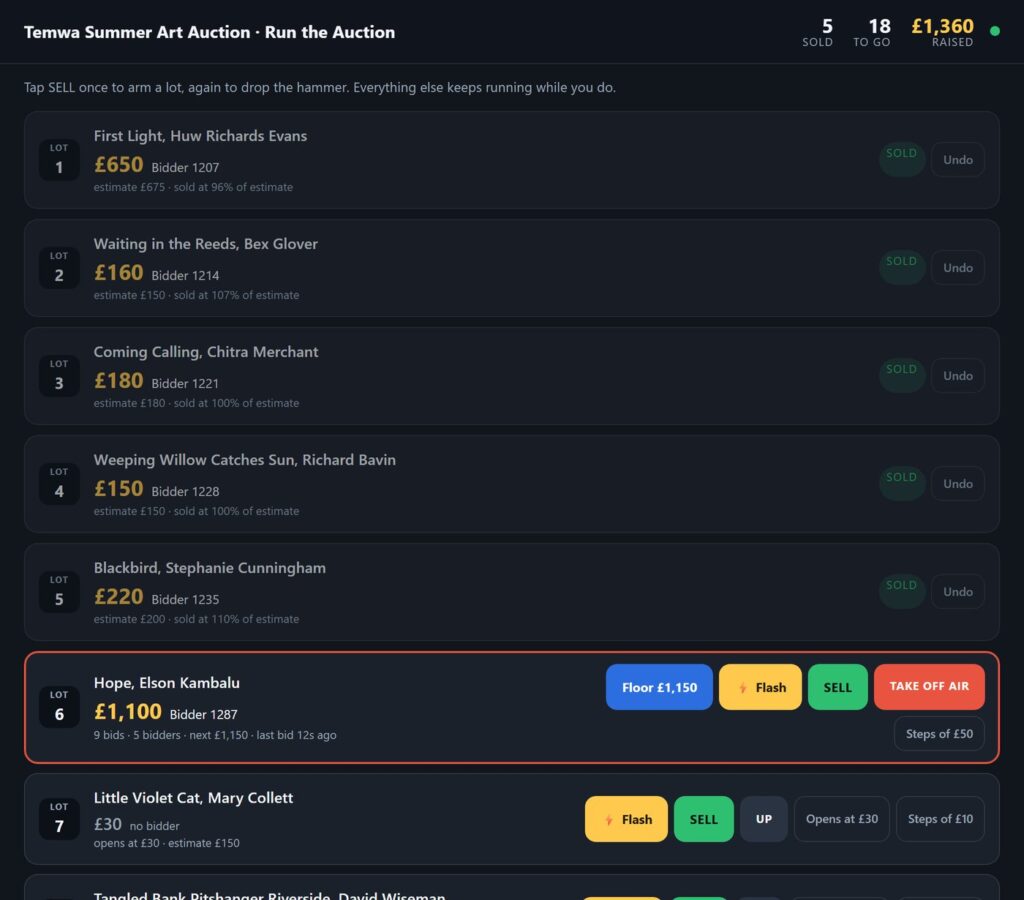
Then build a timeline with clock times: doors, first course, speeches, auction start, pledge, last bid. Lay the money over it: each lot’s hammer price against its estimate, how many bidders it drew, and which tables gave nothing. The console on the platform I use shows each lot’s sale as a percentage of its estimate as it sells, so the lot-by-lot sheet exists before the guests have gone home.

The auctioneer's console showing five sold lots, each with its hammer price as a percentage of estimate

What should you tell donors and bidders afterwards?

Tell them what the night raised and what it will do, within about a week, then claim Gift Aid. Specific beats warm: name what the net pays for. My guide to thanking donors covers the thank-you itself, so this is the reporting half.

At MS UK I told the room at the start where every pound was going, and which lots gave the charity 100%. The report back is the same promise kept, so quote the net, not the gross. Two rules in the Fundraising Regulator’s Fundraising Code, effective 1 November 2025, bear on it. Standard 1.2.2 says that when you collect for a restricted purpose you must say what happens if you raise more or less than the target. Standard 1.2.3 says you need evidence for claims about costs. Your debrief figures are that evidence.

On Gift Aid, HMRC’s claiming guide says you must claim within four years of the end of the financial period you received the donation in, and keep records for a further two. Ticket payments generally do not qualify. For auctions, only the excess over an item’s value can, and HMRC says the value must be made clear to bidders before each item is sold. Four years is the deadline, not the plan. I would claim within weeks. One caution on data: a thank-you is not permission to market, so check consent before guests join a mailing list.

When is it worth bringing in a professional?

For a small first event, such as a quiz or school fair, a volunteer can run this debrief with the template below. A professional earns the fee when totals have plateaued and nobody can say why: the room is warm, but bidding stalls at the same amounts every year. In my experience that is rarely the lots. It is that nobody is managing the room’s energy, and the difference shows in the final total.

Gabriel Dos Santos of OCU Foundation put it on my reviews page this way: “We hosted just over 300 guests and raised more than double what we achieved last year. Kevin’s key suggestion, the live pledge alone, brought in nearly £20,000.” Those are their words and their numbers, and the work after the money lands is theirs. My part is small next to it.

If you do get in touch, have ready the date, room size, running order, last year’s net figure and what stalled. The auction platform is included when you hire me: I build it around your event, and it stays live for a month afterwards, long enough to run the debrief from the lot-by-lot record.

A charity event debrief template

Copy this onto one page and fill it in at the meeting.

SectionFill in
ResultGross, costs, net, target, variance
Income linesEach line against its budget
RatiosPer head, cost to raise, pledge share
RoomTimeline, stall points, early leavers
GuestsComplaints and feedback themes
DecisionsThree changes, three keeps, owner, date
TellingDonors, bidders, sponsors, Gift Aid claim date

Run it within two weeks, write one page, and put the three changes in the diary before anyone leaves the room. If you want a second pair of eyes on last year’s figures before the next gala, call 07596 851647. You can also see my auctioneer services.

Kevin Durham, charity auctioneer

Kevin Durham

Charity auctioneer & event host
20years£10m+raised60–80events/yr
Check availability07596 851647

Let’s talk

Bring this to your event

Book a free consultation with a charity auctioneer who has raised over £10 million.

Fundraiser challenges: what treks, skydives and runs really net a charity

Kevin Durham on the microphone at the start line of a Macmillan Mighty Hike, with hikers in green wearing race bibs

In short

  • A challenge raises sponsorship, but the charity keeps only what is left after the event’s costs, so ask for the net per person.
  • A minimum pledge turns good intentions into a figure. Christie’s skydive terms, for example, ask for 60% of it four weeks before the jump.
  • Gift Aid works on sponsorship from people not connected to the participant, never on the participant’s own fee.
  • The Fundraising Regulator expects a written risk assessment and, with a third party, a written agreement.
  • The best use of a challenge is a night where finishers are thanked from the stage and next year’s group is recruited.

Fundraiser challenges are physical or endurance events, such as a trek, a skydive or a marathon, where people take part and raise sponsorship from friends and colleagues for a charity. (The phrase also means the everyday problems of a fundraising job. This post is about the events.)

Fundraiser challenges are not my day job. I run charity auctions, and have raised more than £10 million that way. But they are a fundraising mechanism like any other, and the useful question is the one I ask about every auction lot: what does the charity actually keep? This is general information, not advice.

What do fundraiser challenges actually raise for a charity?

Fundraiser challenges raise the participants’ sponsorship minus the cost of the event, and that cost varies enormously. Costs for a skydive and an overseas trek are very different. Always compare the net per participant, not the headline target.

Here are published terms as at November 2026:

ChallengeFeeMinimum raisedWhat the page tells you
Skydive (The Christie)£40£400, excluding Gift Aid60% due four weeks before
London Marathon 2027 (Tommy’s)Free£2,500, excluding Gift AidNo registration fee
Inca Trail (Royal Marsden)£450£4,750 targetRun by Charity Challenge, charity acts as agent
Kilimanjaro (CRY)£499 deposit£4,150Charity receives at least £1,975 per fundraiser

Only the last row tells you the net. That is the number to ask for.

How does the operator model work, and what does the charity keep?

In the operator model, a travel company runs the trip and the participant’s sponsorship pays for it, so the charity keeps only the surplus. CRY says it receives at least £1,975 from a £4,150 minimum, roughly 48p in each £1. Other charities do not publish their share.

The Fundraising Regulator, in guidance updated November 2025, describes two set-ups: a company offers an event and the public join it to fundraise, or a charity contracts a travel company and asks supporters to take part. In the second, it says there should be a written agreement setting out each side’s responsibilities and who is liable if something goes wrong.

Operators also protect themselves. Charity Challenge, in a blog dated June 2026, explains that a participant who has not reached 80% of their target can be moved to paying their own costs, because the charity could face financial detriment otherwise. The risk of a shortfall is the charity’s.

The Chartered Institute of Fundraising’s challenge events guide says to cost the returns first, and warns these events can be labour-intensive and costly.

A small committed group often beats a big casual one

A small group of fundraisers with a minimum pledge often beats a large group with no target, because a minimum makes each person do the asking. A pledge is a commitment. A hope to raise something is not.

Take an illustration, with invented numbers. Ten skydivers at the Christie’s £400 minimum are worth £4,000. Under those terms £2,400 of it should be in hand a month before the jump. Now imagine 150 people at a casual walk with no minimum, where the average comes in at £25. That is £3,750, and a lot more admin.

Your own numbers will differ. The decision rule does not: count the money committed before the day, then divide by the staff time it takes. My guide to a sponsored walk covers the casual end properly.

Should fundraiser challenges mobilise supporters or recruit new ones?

Most fundraiser challenges mobilise people already close to your charity and then reach new donors through those people’s own networks. Choose the format by the goal. A hike for existing supporters is cheap and loyal. A big public event recruits strangers but costs more to manage.

The CIoF lists the possible objectives as new donor relationships, publicity and fundraising, and says to be clear which one you want. In my view, if the goal is income this year, pick the committed group. If it is a donor list, choose a public event and plan the follow-up before anyone signs up.

What duty of care do you owe people doing a challenge?

You owe participants a documented risk assessment, adequate insurance and clear information. The Fundraising Regulator’s events guide, updated July 2025 and written for the 2025 Code of Fundraising Practice, says you must conduct a risk assessment before your event and act on it.

The same guide says:

  • A charity with five or more employees must document it in writing; with fewer, it should anyway.
  • If fitness or training is reasonably needed, only people who meet and agree to the criteria in writing should take part, but you must not refuse unreasonably.
  • For events abroad, be clear who books travel, supplies equipment, insures the risk and meets the package travel rules.

The Code’s section 10 covers events and 7.4 covers permissions, as the Regulator’s challenge-events page notes. Take specialist advice on overseas trips.

Can you claim Gift Aid on fundraiser challenges?

Gift Aid can be claimed on fundraiser challenge sponsorship given by people not connected to the participant. HMRC’s Gift Aid guidance, chapter 3.38 on adventure events (read November 2026), says a participant’s deposit or registration fee cannot be Gift Aid, and sponsorship from a spouse, relative or controlled company usually fails the benefit rules.

The trap is the cost. When the charity pays a third party for the participant’s trip, the participant receives a benefit. HMRC’s worked example has a £200 deposit and £1,000 balance, so a £1,200 advertised cost. If the participant pays the charity the full £1,200 from their own resources, the benefit falls to nil and all sponsorship, family included, can be Gift Aided.

HMRC also says the event literature and sponsorship form must explain the connected-person limit and define the term. My sponsorship form guide has the wording.

One more figure. The Regulator’s events guide says a participant who uses more than £1,000 of the sponsorship to pay their own costs may be considered a professional fundraiser. That guide predates the Order in force from 30 September 2026, which raised the figure in section 58 of the Charities Act 1992 to £1,500. Check the Regulator’s current wording.

Bringing the challenge back into the room

A fundraiser challenge comes back into the room when you invite the people who did it to your next event and recognise them from the stage. It thanks them properly and shows the room what a challenge looks like, which is how next year’s group gets recruited.

Kevin Durham presenting to a crowd of challenge participants at the Colour Obstacle Rush

The finishers are your best advertisement, and a dinner is where a warm room can act on it. Read the names, say what the group raised and, if you can, what it paid for. Add a beneficiary, which lands harder than anything I say. My guide to a live pledge shows why that moment matters, and the post on thanking donors covers the follow-up.

Be honest about the money. Challenge figures deserve plain treatment, with the net stated.

If the finishers are recognised and the room is warm, a live pledge follows naturally. At Jigsaw Trust, a pledge the charity had not even planned brought in £30,600 on top of the auction. That is the room I would want finishers to walk into.

Weighing a challenge against a gala, a quiz or a match? My guide to big-money fundraising compares them. If you want a charity auctioneer to run the night, call me on 07596 851647 for a free fundraising consultation.

Kevin Durham, charity auctioneer

Kevin Durham

Charity auctioneer & event host

20years£10m+raised60–80events/yr
Check availability07596 851647

Let’s talk

Bring this to your event

Book a free consultation with a charity auctioneer who has raised over £10 million.

Charity event ticket price: what to charge, and what it costs you

A gala ticketing page offering single tickets, a pair, a table of ten and a VIP package at early-bird prices

In short

  • A charity event ticket price settles two things: who walks in, and how much they have left when the bidding starts.
  • Price to fill the room with people who can give, not to clear the catering invoice.
  • Gift Aid does not apply to a ticket. HMRC treats admission as payment for goods or services.
  • Tables of ten are bought by one person on behalf of nine. Price them as a single decision.
  • Comps are not lost income. The right non-paying guest earns the seat back several times over.

I work 60 to 80 rooms a year. A charity event ticket price is not a revenue decision. It is a decision about who comes, and how much room is left in their evening when I stand up after dinner and ask them for money.

What should a charity event ticket price actually cover?

At the very least, the cost of the person in the seat: their food, their service charge, their share of the room. Everything above that line is a judgement, not a sum.

Most committees start from the catering quote, divide by headcount, add a little for contingency and call that the price. It produces a number. It does not produce a room.

Catering quotes also keep moving under you. In the ONS figures released in October 2026, restaurants and hotels ran at 3.8% over the twelve months to September 2026, against overall CPI of 3.5%. A venue pricing a November dinner back in March is pricing into that, and so are you.

The Charity Commission sets no ceiling. Its guidance on trustee duties, revised in February 2026, says there is “no set amount that a charity should spend on its fundraising”, only that the decision “must be in the charity’s best interest”. A cheap ticket is not automatically the responsible choice.

Does a high charity event ticket price raise more or less on the night?

Often, less. Not because expensive guests are mean, but because of arithmetic that happens in their heads before I open my mouth.

Someone who paid £180 has already filed the evening under “given”. They arrive square with the cause. Someone who paid £85, told plainly that it covers their dinner, arrives with the giving still ahead of them. When the live auction starts, those two people behave completely differently.

There is a real exception. Where the price is doing a job other than revenue, a high one lifts the total. A £500 ticket screens for people who can bid at £5,000, and it signals the level of the evening to everyone who reads the invitation. That works when your fundraising target rests on twenty serious bidders rather than two hundred warm ones, and it fails when a committee prices for the room it wishes it had.

Admission income rarely carries a fundraising evening. When a charity shows me last year’s figures, one of the first things I check is how many came and what they paid. Plenty of guests on a high ticket price next to a modest fundraising total tells me there is a lot of room to improve.

Which is why I would rather have 180 guests at £100 than 120 at £150: the same ticket income, and sixty more people holding paddles.

Kevin Durham on stage with an organiser at a Children's Society gala, microphone in one hand and running-order notes in the other

How do tables of ten change the ticket price?

They turn ten decisions into one, and the person making it is rarely buying dinner.

Companies buy tables for reasons sitting between marketing and goodwill, and they decide in a different part of the building from the one that buys single seats. Price accordingly: a shallow discount or none at all, with the value delivered as visibility rather than money off. That is what tiered sponsorship packages are for.

One thing to know before you quote a corporate table. HMRC denies a trading-profit deduction for business entertaining, while a straight gift to charity is generally deductible if made wholly and exclusively for the business. Your invoice should make plain which part is which.

Are early-bird and tiered prices worth the complexity?

An early-bird price earns its keep. Four tiers do not.

Early pricing buys you information at the only point where it is still useful. Eight weeks out, knowing you have sold 40 of 200 seats lets you ring table captains and change the plan. Two weeks out the same number tells you nothing you can act on.

Past two prices you are mostly manufacturing admin and giving people a reason to wait. Whatever you land on, quote it honestly. The CAP Code requires quoted prices to include non-optional fees that apply to all or most buyers. If your platform adds a booking fee at checkout, that fee belongs on the poster.

What do you do about supporters who cannot afford the price?

Decide before you publish the price, and handle it quietly enough that nobody could point at who was helped.

Affordability is not an edge case. The Charities Aid Foundation’s UK Giving work puts total giving at £14 billion in 2025 and reports that one in five people say they cannot afford to give to charity at all. Some of them are your most loyal volunteers.

What works: hold back six or eight seats before tickets go on sale, offer them by direct invitation, never label them on a booking page, seat those guests on ordinary tables. A published “supporter rate” does the opposite, telling half the room they are the cheap half.

The Code of Fundraising Practice, in force since November 2025, sets the floor. Standard 1.1.1 requires fundraising to be “legal, open, honest and respectful”.

Who should never pay for a ticket?

Four groups, and you should budget their covers as a cost line rather than hoping nobody notices.

  • Your auctioneer and host. I am working.
  • The beneficiary or service user who is speaking. Charging someone to tell the room about the worst year of their life is not a good look.
  • Press and photographers, if you want the coverage.
  • The guests of your largest donor, where those guests are why your largest donor came.

Ten free covers at £55 is £550 of catering against a speaker whose three minutes sets up the whole live pledge. I know which side of that I take.

Does Gift Aid apply to a charity event ticket price?

No. A ticket buys admission, admission is a payment for goods or services, and Gift Aid cannot be claimed on it.

HMRC’s guidance on Gift Aid, last updated in October 2019, lists payments for goods and services among those you cannot claim on, and says a qualifying payment must not be compulsory for attending an event. The detailed guidance is blunter. Chapter 3, updated in October 2026, says at paragraph 3.4.6 that “payments to a charity in return for services, rights or goods are not gifts to charity”, using admission to a concert as its example.

Two things follow for your booking page. First, a voluntary donation alongside the ticket can qualify, as long as people can genuinely attend without making it: separate line, optional in fact and not only in wording, declaration collected.

Second, the admission-to-charity-property rule will not rescue you, the one where a donation 10% above the normal entry charge qualifies. Chapter 3 excludes rights going beyond viewing the property at 3.19.3. A gala dinner is squarely one of those.

On VAT, admission charges to a qualifying fundraising event fall under the events exemption, updated in April 2026, with conditions that deserve their own hour with your finance lead. This is general information rather than advice: take your own before you publish a price.

Showing people where the ticket money goes

Put it on the booking page in one sentence, in pounds, before anyone reaches for a card. “Your £95 covers dinner, service and the room. Everything raised on the night goes to the service.”

CC20 says a charity “must be open and accountable about its fundraising”, and that appeals should explain whether any of the money will go on fundraising costs, and what proportion. The Code asks the same of events at standard 10.2.1.

It is also the cheapest thing you can do to the total. One plain sentence about where the money goes, and the room bids knowing the charity keeps it.

The honest arithmetic of one ticket

Run the numbers before the committee falls in love with a price. Say the ticket is £95 and the venue charges £58 a head for three courses and service. Another £12 covers that guest’s share of the room, the AV and the print. You are left with about £25 a head.

Two hundred guests, and the entire ticket exercise has contributed roughly £5,000. One well-placed lot does that. A live pledge, set up properly in your running order, does it several times over.

The ticket is not your fundraising. It is the invitation to it.

Set the price for the room you want

Work backwards. Decide who needs to be there, ask what price gets them through the door with money unspent, then check it at least covers their dinner. If it does not, that gap is a sponsorship conversation, not £40 on everyone’s ticket. The sequence around it sits in my guide to how to plan a gala.

To talk a price through before you publish it, call 07596 851647.

Kevin Durham, charity auctioneer

Kevin Durham

Charity auctioneer & event host

20years£10m+raised60–80events/yr
Check availability07596 851647

Let’s talk

Bring this to your event

Book a free consultation with a charity auctioneer who has raised over £10 million.

Auction lot donation form: the fields that matter on the night

Kevin Durham reading lot details from a clipboard on stage

In short

  • An auction lot donation form records what was given, who gave it, what it is worth, and what conditions come with it.
  • The fields that save you on the night: an honest description, a value with evidence, every restriction and expiry date, who holds the item, and consent to publish the donor’s name.
  • Gift Aid does not apply to a gift of goods, and HMRC treats a winning bid as a purchase, although part of a bid can qualify if bidders are told the retail value first.
  • The Code of Fundraising Practice expects you to be clear about who insures each risk, so insurance and collection belong on the form.

The auction lot donation form is the least glamorous document in your event file, and the first one I ask to see. By the time I am in the middle of a room with a wireless mic, every decision about a lot has already been made by whoever filled that form in. If the value is guesswork, I cannot anchor the bidding. If nobody wrote down the expiry date, the winner finds out in March that the weekend away cannot be taken.

What is an auction lot donation form, and what should it do?

An auction lot donation form is a short agreement between the charity and the donor: what the item is, what it is worth, what conditions apply, and who is responsible for it until the winner collects it. It gives me the facts to sell the lot honestly, the winning bidder terms they agreed to before their hand went up, and your finance team something to point at in February.

Keep it to one page. Donors abandon anything longer, and a form nobody fills in is worse than none.

Who is donating, and in what capacity?

Start with the boring block: name, organisation, position, email, mobile, address. Then the field most forms miss, and the one I end up chasing: who is the contact during the event, and on what mobile number?

Ask whether the gift comes from an individual or a business. A business donating a service may want its logo in the auction catalogue and an invoice reference. An individual may just want a thank-you letter.

Your form is also a fundraising document, which carries its own obligation. The Charity Commission’s guidance on trustee duties says that if your charity’s income exceeded £10,000 in its last financial year, fundraising materials must state it is a registered charity, and should include the register number. Footer job, done once.

How should the form describe the lot?

Make the donor write the description, then make them write what is not included. The exclusions are where the arguments live, and I would rather read them out than discover them on the night.

“A weekend at a cottage” is not a lot. “Three nights, Friday to Monday, sleeps six, excluding bank and school holidays, travel not included, dates by arrangement with the owner” is a lot. The first sells for less and causes trouble afterwards.

Not just good practice, either. Under section 11 of the Consumer Rights Act 2015, every contract to supply goods by description includes a term that the goods will match the description, and a winning bidder is a consumer like any other. The Code of Fundraising Practice also requires fundraising communications to be accurate and says fundraising must not mislead donors. An over-egged description breaks both by accident.

For a signed item, add a provenance field: who signed it, when, and what paperwork comes with it.

What value should the donor put on the lot?

Ask for two numbers, not one. The retail or market value, and the evidence for it: a link, a price list, a receipt, or the donor’s own standard rate.

That second field does real work. Under FRS 102 and Charities SORP 2015, donated goods are recognised at fair value when you receive them rather than only when they sell, unless measuring that value is impractical, per ICAEW guidance reviewed in July 2015. Collect the numbers at the point of donation and it takes thirty seconds.

It also sets the floor. A reserve price has to sit on a number you can defend from the stage.

Can a charity claim Gift Aid on a donated lot?

No. Gift Aid applies only to gifts of money, and HMRC’s guidance is explicit that charities cannot claim it on donations of physical items.

The winning bid is a different question, and this is where your valuation field earns its keep. HMRC treats a payment at a charity auction as a purchase, not a gift. Where the item is available commercially elsewhere, the benefit to the bidder is its shop sale price, and if that sits inside the donor benefit limits the whole bid can qualify. Where it exceeds them, the bidder may still buy the benefit and Gift Aid the excess, but only if they knew the retail value at the time. HMRC’s own example: a £10 football sold for £30 gives £20 of eligible Gift Aid if the room was told it costs £10, and nothing if it was not.

So saying the retail value out loud before bidding starts is worth money, and I can only say it if someone wrote it down. For a lot that is not commercially available, including most promises and experiences, the benefit is the full price paid, and none of it qualifies.

One more route. A charity can sell goods as the owner’s agent, ask the owner to donate the proceeds, and claim Gift Aid on the net proceeds. That needs the owner to keep ownership until the sale, and a valid Gift Aid declaration from them covering the gift of the proceeds.

Restrictions and expiry: the small print that decides the sale

Every experience lot needs a redemption window. Record the valid-from date, the expiry, blackout periods, the notice required, and whether it can be transferred.

Twelve months from the event is the sensible default. Anything shorter dampens bidding, because guests do the arithmetic in their heads and decide they cannot use it. Open-ended makes the donor nervous.

Ask the awkward questions while the donor is still keen. Minimum or maximum numbers? Age limits? Who pays travel? And if the donor cannot honour the lot, what then?

Who holds the lot, and who insures it?

Put it on the form: with the donor, with the charity, or in transit. Then name who insures it, and until when.

The events standards in the Code of Fundraising Practice require a pre-event risk assessment that includes being clear about who insures against each risk. A donated watch sitting in a desk drawer for six weeks is exactly that kind of risk, and nobody thinks about it until it is missing.

Add the logistics: delivery method, who collects, by what date, and where it needs to be on the day. If a third party handles lots or fulfilment, the Code expects a written agreement covering the activities and timescales involved.

Consent to publish the donor’s name

Separate the options out: name in the catalogue, logo on screen, a mention from the stage, a photo on social media. Donors say yes to some and no to others, so one blanket box tells me nothing when I am deciding who to thank by name.

You are collecting personal data, so the ICO’s right-to-be-informed guidance requires privacy information at the point of collection: your purposes, your retention period, who the data is shared with. Where you rely on consent for marketing afterwards, the ICO is clear that valid consent means an unambiguous indication by clear affirmative action, and that pre-ticked boxes do not count.

What the form tells me from the stage

My booking contract asks the charity to tell me, at least ten working days before the event, if any lot comes from a third-party supplier on a consignment, reserve or minimum-return basis. That lets me tell the room at the start exactly where every pound is going: which lots give the charity 100%, and which only pay out above a reserve.

I did not criticise anybody. I just turned the lights on. The only reason I could was that somebody on their team had written the terms of each lot down. Nobody claps for that part. It made the night work.

My strong view, and it is a view: lots sourced in house, with an auctioneer guiding the paperwork, keep more money with the charity than lots arriving on commission.

What should an auction lot donation form include?

One page. This is what goes on it.

BlockFields
DonorName, organisation, position, email, mobile, address, event-day contact
The lotTitle, full description, what is excluded, quantity, provenance and paperwork
ValueRetail or market value, evidence for it, whether it can be bought elsewhere
TermsValid from, expiry, blackout dates, notice, transferable or not, age or health limits
LogisticsWho holds it, who insures it, delivery or collection method and date
PermissionsCatalogue, logo, stage mention, social media, privacy notice
Sign-offDonor signature and date, charity staff name, registered charity statement

Build it as a web form where you can: online you can make the fields that matter compulsory.

An auction lot form open on a laptop

Where to start

Write the form before you start asking. It is tempting to chase donation ideas first and sort the admin later, but the questions on a good form are the ones that produce a better lot.

Still deciding what to go after? Start with how to source auction lots and work back to the paperwork. If you want a second pair of eyes on your lot sheet before the invitations go out, that is part of what I do as a charity auctioneer. Call 07596 851647.

Kevin Durham, charity auctioneer

Kevin Durham

Charity auctioneer & event host

20years£10m+raised60–80events/yr
Check availability07596 851647

Let’s talk

Bring this to your event

Book a free consultation with a charity auctioneer who has raised over £10 million.

Money tree fundraiser: how to run one and what it raises

A man in a tuxedo holding two pound-sign money bags beside a woman with a collection bucket

In short

  • Two versions share the name: a display where guests pin cash on and nobody wins anything, and a game where they pay to take a sealed envelope and keep what is inside.
  • The envelope version is a lottery in law. At an event, the incidental lottery exemption covers it without a licence, on strict conditions.
  • Paying for a chance at a prize is not a gift, so envelope money cannot be Gift Aided. Anonymous pinned cash can take a 25% top-up through the Small Donations Scheme.
  • Budget on a few hundred pounds, not a few thousand. It is a foyer earner, and a live pledge in the same slot beats it many times over.

A money tree fundraiser is a branch, frame or board hung with money, and it hides two completely different fundraisers under one friendly name. One is a donation. The other is a prize game, and UK law treats them nothing alike.

I run charity auctions from the floor rather than the podium, and here is how to build one, what it brings in, and why I would never give it the slot I keep for a live pledge.

What is a money tree fundraiser?

A money tree fundraiser is a decorated branch or board that guests either attach money to or take a paid-for sealed envelope from. That one sentence covers two mechanics with different legal and tax consequences.

The donation version is the simpler of the two. You dress a bare branch in a pot, hang clips on it, and guests peg notes on through the evening. Nobody wins anything. The tree is a totaliser made of real money, which is why it works: a half-full tree asks a question of everyone who walks past.

The prize version is the one most people picture. The classic charity build uses identical envelopes, each holding a coin or note sealed in by a supporter and stapled at the corner to a cardboard tree. A picker pays a set price, chooses without feeling the envelope, and keeps what is inside. US fundraisers run a richer lottery tree on the same frame, mixing in scratch cards, small notes and wildcards such as double-or-nothing.

How do you set up a money tree at an event?

Decide which version you are running before anyone picks up a glue gun. The answer changes your paperwork. Then build it:

  1. Get the tree high and lit. A branch in a weighted pot on a plinth, at eye level, near the door people come through. On a low table it disappears behind the first three guests.
  2. Make the envelopes identical. Same size, same paper, same staple. If one bulges, that is the one everyone picks.
  3. Price it in one number. £5 or £10 a pick, on a sign as big as the charity’s name. Discounts for multiple picks are fine.
  4. Staff it with two people. One takes the money, one manages the tree.
  5. Count it properly. The Code of Fundraising Practice wants cash counted and recorded in a secure place by two unrelated people where possible, never left unattended, banked promptly.
  6. Show the running total. A fundraising thermometer beside the tree does more for the last hour’s takings than another sign.

Tell people where the money goes while you are at it. The Fundraising Regulator’s guidance on lotteries and raffles is blunt about donors knowing how much reaches the cause, and about not leaning on anyone.

Seeding a sealed-prize money tree

The sealed-prize version works because the room can see the odds and still cannot see inside the envelope.

Charities seed the tree one of two ways. Either supporters each fill an envelope in advance, so the contents are genuinely unknown to the organisers, or the charity fills them to a planned spread: plenty of small amounts, a handful worth more than the ticket price, and one or two headline envelopes the volunteers can shout about.

Keep those headline prizes donated rather than bought. Better arithmetic, and a condition of the exemption you are relying on.

A signed football shirt and a signed tennis ball donated as charity auction prizes

Can you run a money tree fundraiser in a workplace?

You can, and the office version is the one most likely to break a rule nobody has read.

A prize tree among colleagues is a work lottery. Everyone taking part has to work at the same physical location. Tickets must be physical, one price, non-transferable, and never sold online, by email or by phone. The draw happens on the premises. You cannot profit from it: proceeds go to reasonable expenses and prizes, or to charity.

Hybrid colleagues at home are outside the exemption altogether, so a Teams link to a prize tree is not a work lottery at all.

A pinned-cash tree in the staff kitchen avoids all of that, because nobody wins anything. It is a collection with better staging.

Where does the Gambling Commission line sit?

The line sits at the moment someone pays for a chance at a prize. Under the Gambling Act 2005 a simple lottery is an arrangement where people must pay to take part, prizes go to members of a class, and the allocation relies wholly on chance. Paid picks from sealed envelopes meet all three tests.

That does not mean you need a licence. An incidental lottery is one of six lottery types you can run without a licence, and a prize tree at a gala fits it, within the conditions:

  • the lottery cannot be the main reason for the event
  • proceeds go to charity, not private gain
  • physical tickets, sold at the venue while the event runs, never online or in advance
  • up to £100 of proceeds on running costs and £500 on bought prizes, donated prizes unlimited
  • no rolling a prize over

If the tree is the event, you are outside the exemption. The way to avoid a lottery altogether is a free draw, which needs a free entry route no more expensive and no less convenient than the paid one, promoted just as prominently. More administration than most tables are worth.

Can you claim Gift Aid on a money tree fundraiser?

Only on the version where nobody wins anything. HMRC is explicit that a raffle or lottery ticket payment is not a gift but a payment for the right to enter, and the size of the prize makes no difference. An envelope with a prize attached is a purchase, outside Gift Aid.

Pinned cash is different, and this is the bit most event teams miss. Anonymous notes have no declaration behind them, but the small donations scheme covers cash gifts of £30 or less with no declaration at all, at the same 25%, up to £2,000 a tax year. Your charity has to have claimed Gift Aid in the same year, the claim is capped at ten times that claim, and you need records of totals, collection dates and banking dates.

So a £600 money tree of pinned fivers and tenners can be worth £750. The same sum taken for envelope picks is worth £600 and nothing more.

What a money tree fundraiser raises, and what it costs

Do the arithmetic first. Sixty envelopes at £10 a pick is £600 across a whole evening. If you buy prizes from the proceeds, the exemption lets you spend up to £500 of that on them, so a tree stocked that way hands back most of what it took. Donated prizes are the difference between a fundraiser and an expensive piece of theatre.

Costs are small: a branch, a pot, envelopes, clips, signage and a cash float. Call it £50 and two volunteers.

The real ceiling is cash itself. UK Finance put cash at 8% of payments in 2025, 3.9 billion of them, against 45% in 2015. At a black-tie dinner in 2026, much of the room is carrying nothing to pin on your tree. Put a card reader beside it or accept you are fishing in a shrinking pool.

Money tree or live pledge for the same slot?

If those two are competing for the same half hour of your evening, run the pledge. This is not a close call and I will not pretend otherwise.

A money tree has a ceiling built into it: the number of envelopes times the price, minus the prizes. A live pledge has no ceiling, because the room sets the number. One gala I ran in Monaco raised over €1,000,000 in a single evening, with a structured pledge drive as part of the plan. No tree in a foyer gets near that, and the room gave to the cause, not to me.

The reason is structural. A pledge happens when the whole room is quiet, after a story nobody can look away from. The tree happens while people queue for the cloakroom. A tree in a foyer never has the whole room’s attention. I have written up pledge drive against live auction in more detail elsewhere.

Where I would put a money tree in the running order

In the foyer, from arrival until the room sits down, and again after the auction. Never on stage.

My running order gives the stage to whatever needs the room’s full attention. I open with heads and tails to warm everyone up, let dinner breathe while volunteers sell for the charity raffle, then run the live auction and the pledge. A money tree, like a tombola, earns its keep in the gaps around those moments.

Used that way it is £400 or £600 the charity would not otherwise have had, plus a photograph they will use for years. Used as the centrepiece, it is a pretty way to leave money in the room.

If you want your running order to work as hard as your lots do, call 07596 851647 and we will talk it through.

Kevin Durham, charity auctioneer

Kevin Durham

Charity auctioneer & event host

20years£10m+raised60–80events/yr
Check availability07596 851647

Let’s talk

Bring this to your event

Book a free consultation with a charity auctioneer who has raised over £10 million.

Corporate donations: how companies give, and what to ask for

Hosts presenting a charity donation board on stage beside a sponsors' logo wall

In short

  • A donation gets the company nothing related to its business. A sponsorship payment does, and HMRC treats the two differently.
  • Companies cannot use Gift Aid. They deduct qualifying donations from their own profits instead, so never send a company a declaration.
  • Benefits have hard limits: on a gift of £1,001 or more, anything worth over 5% (capped at £2,500) breaks it.
  • Gifts in kind, matched giving and payroll giving each have their own rules.
  • Decide which route you are asking for, then write it down.

Corporate donations are the money a company gives your charity without buying anything in return. That last part decides the rest: the relief the company claims, whether VAT lands on the payment, and what you can promise in the room.

From the auctioneer’s side of the room, corporate money arrives at a gala in four shapes, and the fundraisers who raise the most know which one they are asking for before they call.

This is general guidance, not tax advice. Your finance team or accountant should sign off anything that lands on a return.

What are corporate donations, and how are they different from sponsorship?

Corporate donations are gifts from a company that secure nothing related to its business in return. Sponsorship payments buy something: a logo on your screens, the right to sell at your event.

HMRC puts both in the same guide, because both reduce a company’s Corporation Tax bill. A limited company can give money, equipment or trading stock, land, property or shares, staff on secondment, or sponsorship payments, and deduct the value from its profits before tax.

The route changes the paperwork. Donated money goes in the “Qualifying donations” box of the tax return. Sponsorship and secondment costs are business expenses. Equipment goes through capital allowances.

One limit catches people out: the deduction can only take profits to zero. No trading loss, nothing to carry forward. That is part of why a business having a thin year may offer stock or staff time instead of cash.

Why does the difference matter for tax and VAT?

Because a donation sits outside VAT and sponsorship usually does not. VAT Notice 701/1, updated on 19 October 2026, says a donation is outside the scope of VAT provided it is freely given with nothing supplied in return.

Where your charity is obliged to give a sponsor a significant benefit, that sponsorship becomes a business activity taxable at the standard rate. HMRC’s list of significant benefits runs from naming the event after the sponsor and displaying their logo to free tickets, access to a gala evening and hospitality. A flag, a sticker or a name in a list of supporters is not significant.

For a small charity that is not VAT registered, one large sponsorship deal can be enough taxable income to push you over the registration limit. HMRC flags the risk itself.

If a company wants to do both, keep the parts apart. The donation is only safe where it sits outside the sponsorship agreement, or the agreement says which part is payment for services, and the benefits are not conditional on the gift.

How much can a company accept in return before it stops being a donation?

A company can accept a benefit worth up to 5% of a donation of £1,001 or more, capped at £2,500. Below that the limits tighten. HMRC’s table for donating money sets them out:

DonationMaximum value of benefit
Up to £10025% of the donation
£101 to £1,000£25
£1,001 and over5% of the donation, up to £2,500

The limits also cover benefits given to anyone connected with the company, including close relatives. Two tickets for the managing director’s family count.

Cross the line and the payment is not disallowed, it is reclassified: where the benefit is related to the company, HMRC says it qualifies as a sponsorship payment instead. It is your VAT position that moves.

Three payments never qualify: a loan the charity will repay, a payment conditional on the charity buying property from the company, and a distribution of profits such as a dividend.

Can a company claim Gift Aid on corporate donations?

No. A company cannot claim Gift Aid, and nor can your charity. HMRC’s list of what you cannot claim names donations of money from a company.

“Corporate Gift Aid” is a loose nickname for the relief that replaces it. The company deducts the donation from its own profits before Corporation Tax, so the saving stays with the business rather than reaching you as a 25% top-up. The money you bank is the money they sent.

So never put a declaration in front of a company cheque, and never build a corporate ask on a figure that includes Gift Aid.

What counts as a gift in kind?

A gift in kind is anything a company gives that is not money: used equipment, items it makes or sells, land, shares, staff time. CAF’s Corporate Giving Report 2026 found recorded FTSE 100 charitable donations fell to £1.69 billion in 2025, the lowest since its survey began. Cash is tighter, so ask for goods and time.

  • Used equipment. Furniture, computers, vans, tools. The company claims full capital allowances on the cost, provided it used the equipment itself.
  • Trading stock. Items the company makes or sells. It leaves the gift out of its sales income, so it gets relief on the cost. For VAT it must account for items it gives away, but it can zero rate them where the gift is made specifically so your charity can sell, hire out or export them.
  • Staff. A secondment, or an employee volunteering in work time, is deductible as a normal business expense while the company keeps paying them and running PAYE. Not available to community amateur sports clubs.

Put that VAT point in your ask. “We will sell this at auction” is the phrase that lets a VAT-registered donor zero rate the gift.

Sourcing lots in-house, guided by your auctioneer, keeps far more with the charity than a commission-based supplier does. A gift in kind from a local business is the purest version of that.

Where do matched giving and payroll giving fit?

Both are company money that arrives through employees rather than the finance director. Neither needs a new event.

With match funding, the employer matches what its staff raise or give, often pound for pound up to a cap. Ask your corporate table hosts before the night whether their employer runs a scheme. That answer changes what a pledge is worth.

Payroll Giving runs through PAYE. The donation comes out of pay before tax but after National Insurance, so it costs a higher-rate taxpayer less to give the same amount. The employer sets it up with an agency and can choose to pay the admin fee so the charity receives more.

One rule to remember: you cannot claim Gift Aid on Payroll Giving. The relief has already been given.

When a “donation” is really a commercial promotion

Some offers are neither. A business that promotes its own goods or services on the basis that it will contribute to your charity is a commercial participator, a term defined in section 58 of the Charities Act 1992.

That triggers real obligations. Section 6 of the Code of Fundraising Practice requires appropriate checks before you agree anything, and a written agreement before the promotion starts, stating how much you will get and how it is calculated.

“We’ll give you 50p from every jar sold and put your logo on the label” is a lovely offer and a regulated arrangement. Treat it as a contract, not a cheque.

Kevin Durham with a guest on stage at a Children's Society fundraising night

What should you ask a company for?

Ask for one specific thing, in the shape that suits the company. Four asks cover almost every business you will approach:

  1. A cash donation, with nothing promised beyond a thank you and a name in the supporter list.
  2. A gift in kind for the auction or raffle, with “to sell at our event” in writing.
  3. A match, where they back the live pledge up to an agreed cap.
  4. Sponsorship, where they want the exposure and will accept an invoice.

A profitable company with a marketing budget often prefers the fourth. My post on corporate fundraising ideas covers the activity side once the route is agreed.

How to make the ask land

Go to a named person, not an inbox, and lead with the cause. The detail on letters, timing and follow-up sits in my guide to a donation request.

Then put three lines in writing: what they are giving, what they get back (even if that is only a mention), and who to invoice if it is sponsorship. That paragraph keeps both finance teams out of a row in February.

I would rather hear “donation, no benefits, no invoice” than a promised headline slot nobody has priced. The clean yes beats the big maybe.

Corporate donations on the night

Corporate donations do their best work when the room can see them. A matched pot announced before the live pledge changes how people give: every hand counts twice.

Dave Hands of LTS Global Solutions summed up one such night: “It’s gone really well with the pledge, we couldn’t have done it without him. If you need someone to run an event like this, get Kevin to join you. Full credit to him.”

So name the business that donated a lot, say what the charity keeps, and let the room reward them. A structured live pledge outperforms a lot-based auction at most galas, and a corporate match is the cheapest way to make it bigger.

Building the corporate side of a gala starts with a fundraising strategy, not with asks. A corporate charity auctioneer will tell you which of the four routes your room responds to. Call 07596 851647 and we can go through it.

Kevin Durham, charity auctioneer

Kevin Durham

Charity auctioneer & event host

20years£10m+raised60–80events/yr
Check availability07596 851647

Let’s talk

Bring this to your event

Book a free consultation with a charity auctioneer who has raised over £10 million.

Pledge cards: how to use them at a charity gala without killing the mood

Kevin Durham holding up a card on stage at the MAG-FEST charity gala

In short

  • Let hands do the asking and cards do the paperwork.
  • A Gift Aid declaration needs a proper tax explanation. “I am a UK taxpayer” on its own is not enough.
  • Keep the original cards. HMRC says typing them into a database is not an auditable record.
  • Chase unpaid pledges once, politely, then let them go.

Pledge cards are small printed cards that let a guest write down a promise to give: who they are, how much, and whether the charity can claim Gift Aid. Used well at a charity gala, they catch money the room wants to give. Used badly, they turn the most emotional ten minutes of the night into a form-filling exercise.

Every charity I work with hears the same advice from me: run a live pledge. This guide is about the card itself: what to print, when it comes out, and how to collect the money. For the ask from the stage, read my guide to the live pledge.

What are pledge cards, and why use them at a gala?

Pledge cards are a written record of a promise to donate. At a gala they do two jobs a raised hand cannot: they show exactly who promised what, and they collect the details the charity needs to claim Gift Aid.

That second job is real money. Gift Aid lets a charity claim 25p for every £1 an eligible UK taxpayer gives, and a pledge is a gift, not a purchase.

But the card is the paperwork, not the ask. The ask is the story, the levels and the energy, which my guide to the fund-a-need covers.

When do pledge cards beat a show of hands?

Pledge cards beat a show of hands when guests need privacy, or when you need details more than theatre. A raised hand is public, fast and contagious. A card is quiet.

Cards win when guests would rather not give in front of colleagues, want an amount that wasn’t called, or when you need every donor’s Gift Aid details.

For most galas, do both: hands during the ask, cards at the table straight afterwards. My comparison of a pledge drive and a live auction explains why that momentum matters.

What should go on a pledge card?

Less than most people print. As one fundraising consultancy puts it, less is more.

  1. The cause in one line. What tonight’s money pays for.
  2. The amount. The levels called from the stage as tick boxes, plus “other”.
  3. Name, email and phone. One donor per card.
  4. How they’ll pay. Tonight, by link or by transfer.
  5. Gift Aid. The declaration below, with its own tick box.
  6. Marketing permission as a separate unticked box. The ICO says pre-ticked boxes are not valid consent.

Word the cause with care, because the card is part of your fundraising appeal. The Code of Fundraising Practice says you must not promise money for one specific thing if it might be used for another (1.2.1), and you should say what happens if you raise more or less than the target (1.2.2).

Leave card numbers off: the Regulator’s guide to cashless donations says card payments must meet the PCI DSS security standards.

How do you put a Gift Aid declaration on pledge cards?

You print HMRC’s required wording next to a tick box. Under HMRC’s detailed guidance, as checked on 19 October 2026, a valid declaration must:

  • give the donor’s name and home address (in the UK, house number or name and postcode is enough)
  • name the charity
  • identify the gift, for example “my pledge at tonight’s gala”
  • confirm the donor wants it treated as a Gift Aid donation
  • not use a company name or joint names

The charity must also explain that donors who pay less Income Tax or Capital Gains Tax than the Gift Aid claimed on all their donations that year must pay the difference. HMRC’s model declaration has the full wording and fits on the back of a card. No signature is needed, but a date helps. And because joint names invalidate a declaration, a couple’s card needs one name: the person whose money it is.

Three more rules catch galas out:

  • Auction bids are not gifts. HMRC treats a winning bid as a purchase, and there is no Gift Aid on payments for goods or services. The box covers the pledge, not the ticket or the lots.
  • Keep the original cards. HMRC says typing them into a database isn’t an auditable record on its own. Keep declaration records for six years after the most recent donation you claimed on.
  • A missed box can be fixed later. A declaration can be given after the donation.

Donation envelopes work the same way: HMRC lets you print the declaration on the envelope. For cash or contactless gifts of £30 or less with no declaration, the small donations scheme may give you a top-up instead.

The Code says to claim Gift Aid only when all the conditions are met. I’m an auctioneer, not a tax adviser, so check your card with your finance team.

Getting the cards out and back without killing the mood

Hand out cards in the middle of the ask and every head goes down to a pen. The story the room just heard is gone.

The pledge should feel warm, never sombre, and the excitement builds as the money comes in. At the Jigsaw Trust, a live pledge they hadn’t even planned for added £30,600 on top of a £27,000 auction. That was their team and their guests, and it’s exactly the moment to protect. The paperwork can wait ten minutes.

  • Before the ask, put cards on the tables or in the programme.
  • During the ask, it’s hands, not pens, and every eye stays on the stage.
  • Straight afterwards, volunteers take cards to the tables where hands went up.
  • When collecting: never approach someone with food going into their mouth. Give them a minute.

Brief the volunteers. The Code says you must not take advantage of a donor’s mistake (1.2.4), so if a card says £5,000 and the hand went up at £500, check. Nor should you accept a gift from someone you believe cannot make an informed decision (5.2.3).

Should you use pledge cards, a card reader or phones?

Use whatever turns a promise into money fastest without stopping the room. Usually that’s a mix.

A digital pledge page with six giving levels and a Gift Aid note

OptionStrengthWatch out for
Paper pledge cardsQuiet, private, Gift Aid in writingPayment is not taken on the night, so it depends on follow-up
Card readerPayment taken on the nightQueues, fees, training
Phone or QR codeFast, donors type their own detailsNot every guest wants their phone out

Whichever you pick, the Regulator’s guide says to know the fees, train whoever uses it, and enter only the amount the donor agreed. You can see how I run the pledge itself on my live pledge page.

Following up unpaid pledges

The aim is for the vast majority of pledges to be paid on the night, ideally all of them. Drop-out is highest when a charity under-prepares its payment terminals and its volunteers on the ground, so fix that first. For anything still outstanding:

  • The next morning, send a thank-you with the amount, the cause and a payment link, and ask for any missing Gift Aid details.
  • About a week later, send one friendly reminder.
  • Then stop. The Code rules out unreasonably persistent approaches (1.1.2).

If a declaration turns out to be incomplete, HMRC lets a charity validate it with a written statement that gives the donor 30 days to cancel. And bank the money promptly, as Code standard 3.1.1 asks.

The thank-you matters more than the reminder, so thank donors properly.

Before you print your pledge cards

Three checks: can a guest fill it in within a minute, does the Gift Aid wording match HMRC’s, and does every volunteer know when the cards come out?

To talk through the pledge for your own gala, call me on 07596 851647. I’d rather talk it through than trade emails.

Kevin Durham, charity auctioneer

Kevin Durham

Charity auctioneer & event host

20years£10m+raised60–80events/yr
Check availability07596 851647

Let’s talk

Bring this to your event

Book a free consultation with a charity auctioneer who has raised over £10 million.

Church fundraising ideas that go beyond the jumble sale

Kevin Durham speaking from a lectern on stage at the MAG-FEST charity gala

In short

  • Match the idea to the goal. Running costs need regular giving. A roof needs an appeal with a proper ask.
  • An auction of promises suits a congregation: skills and time instead of bought prizes.
  • For a big project, end the evening with a live pledge.
  • A raffle at a church event needs no licence if every ticket is sold at the event, while it is happening.
  • Loose plate collections of £30 or less can earn a top-up through the Gift Aid Small Donations Scheme.

The best church fundraising ideas start with one question: what is the money for? A leaking roof, the heating bill and a mission partner overseas each call for a different plan, and the jumble sale only suits one of them.

Most evenings I spend as a professional charity auctioneer go into building what a church already has: a community that turns up every week. Here are ideas that turn that goodwill into real money, plus the UK rules on raffles, Gift Aid and collections.

What are the best church fundraising ideas?

The best church fundraising ideas are the ones matched to a clear goal. Parish Resources, the Church of England’s guidance site, puts it simply: one-off events add to income, but running costs are best met by regular giving.

GoalIdea that fitsWhy it works
Heating, insurance, running costsRegular giving by Direct DebitSteady and predictable
Roof or restorationAppeal evening with an auction and pledgeBig gifts in one room
Hall, youth club, equipmentQuiz night, concert, auction of promisesBrings in the wider parish
A cause beyond the churchRetiring collection or sponsored walkSimple, and Gift Aid can apply

Christmas brings its own carol nights and fayres. Everything below works year round.

Why should regular giving come before events?

Regular giving should come first because it pays the bills that never go away. It’s the least glamorous part of church fundraising, and the most important. An event is a bonus; a standing order is a foundation.

Parish Resources’ introduction guide points out that many people assume the church is wealthy or government funded. So tell them what a gift does. Its example: £20 heats the church for a whole day.

The Parish Giving Scheme lets churches take gifts by Direct Debit, card, Apple Pay and Google Pay. Church of England churches also get Cornerstone free, with a grants database of over 1,000 grants, updated weekly. Other churches should ask their own denomination what it offers.

Fundraising ideas for church halls and small congregations

Small congregations need ideas that don’t exhaust the same ten volunteers. These fundraiser ideas for church groups also work as community fundraising ideas, because the whole village can join in:

  • A quiz night in the hall. Teams, a modest entry fee and a good quizmaster. My quiz night guide covers the running order.
  • A soup lunch or bake sale after the service. Low cost, and it gives newcomers a reason to stay.
  • A sponsored walk between local churches. HMRC confirms sponsorship payments can be Gift Aided, subject to the normal rules.
  • A concert by the choir or a local school. The building is the star.
  • A stunt for the local paper. Parish Resources suggests the vicar sleeping on the roof to raise money for the roof. Local radio loves it.

These double as fundraising ideas for small charities of any kind. There are plenty more in my easy fundraising list.

Kevin Durham starting a Macmillan Mighty Hike, with walkers in green T-shirts

How do you run an auction of promises at church?

You run an auction of promises by asking members to pledge their time or skills, then selling those promises to the highest bidder. A congregation is ideal. It is full of people who can bake, garden, mend, tutor or drive.

Think of a homemade cake every month for a year, a day’s gardening, a lift to the airport or a piano lesson. None of it costs the church a penny.

One thing to know: HMRC says a payment at a charity auction is a purchase, not a gift. Where the promise can’t be bought anywhere else, its value is the price paid, so the bid doesn’t qualify for Gift Aid. My guide to an auction of promises covers gathering and pricing lots.

How do you raise money for a church roof or restoration?

You raise money for a church roof with a planned appeal: a clear target, grant bids running alongside, and one evening where you ask the room directly.

Parish Resources publishes 12 capital funding guides for building projects. Its event guide advises a cheerful atmosphere and speeches of five minutes at most. I agree. One short, honest talk about the roof, then the ask.

That ask should be a live pledge. It is the single most powerful segment of any fundraising evening I run, because everyone can give at a level that suits them. At one gala the pledge stalled with just me at the front asking, so I brought up people the charity had helped and let them speak. After that it really ran. Here’s how I approach running a pledge.

Kevin Durham on stage at the MAG-FEST gala with The Children's Society on the screen behind him

Keep the tone sincere, and let a little joy build as the pledges come in. Two rules from the floor. Get the room quiet first, because nobody gives to an appeal they can’t hear. And never approach someone with food going into their mouth.

Can a church run a raffle or tombola?

Yes. A church can run a raffle or tombola at a fete, supper or concert without a licence, as an incidental lottery. The Gambling Commission’s rules, as they stood in October 2026:

  • The raffle can’t be the main reason for the event.
  • Tickets must be physical and sold only at the event, while it is happening.
  • You can spend up to £500 of the proceeds on prizes and £100 on expenses. Donated prizes have no limit.
  • Prizes can’t roll over to another lottery.

Selling tickets in the weeks before, or running a 100 club, is different. That needs a small society lottery registered with your council: £40, buyers aged 16 and over, and at least 20% to the good cause. HMRC doesn’t treat raffle tickets as gifts either, so no Gift Aid. My charity raffle guide has the detail.

How do Gift Aid and the Small Donations Scheme work for churches?

Gift Aid lets a church claim 25p for every £1 a UK taxpayer gives, provided the church is recognised as a charity for tax purposes and holds a declaration from the donor.

Most churches are charities already. In England and Wales, churches linked to the Church of England, the Methodist Church, the Baptist Union and several other denominations, with income of £100,000 or less, are excepted charities: they don’t have to register, but the Charity Commission regulates them like registered charities. That exception has an end date of 31 March 2031.

For the plate, there is the Gift Aid Small Donations Scheme. As GOV.UK’s top-up guidance stood in October 2026:

  • Donations of £30 or less, in cash or by contactless, qualify with no declaration.
  • You can claim on up to £8,000 a year, which is a £2,000 top-up, capped at ten times your Gift Aid donations.
  • You must also claim Gift Aid in the same tax year.

Parish Resources notes that loose plate collections and undeclared envelopes form the basis of most parish claims, with the £8,000 limit applying per church.

Making it easy to give on the day

Whatever you run, make giving effortless. Parish Resources’ checklist says to have chances to donate everywhere, and wherever someone can donate, to offer Gift Aid. As the guide puts it, if you don’t ask, you don’t get.

Put a contactless reader by the door. Agree with the treasurer how cash is counted and banked before the day, not after. Then thank everyone and tell them what they raised.

Planning your church fundraising ideas for the year

Spread events through the year, review which ones raised the most, and keep the big ask for the project that deserves it.

If you are planning an appeal evening or an auction of promises, call me on 07596 851647. I’d rather talk it through than trade emails, and I’ll tell you honestly what works in a room like yours.

Kevin Durham, charity auctioneer

Kevin Durham

Charity auctioneer & event host

20years£10m+raised60–80events/yr
Check availability07596 851647

Let’s talk

Bring this to your event

Book a free consultation with a charity auctioneer who has raised over £10 million.