Home About Kevin Auctions Virtual auctioneer Pledges Hosting Entertainment Free software Software examples Case studies Reviews Other services Fees Fundraising games Fundraising consultant Get in touch Blog Podcast

What does a charity auctioneer do before the guests arrive?

Kevin Durham in black tie reading through his notes on a pad at a charity reception

In short

  • A professional charity auctioneer is usually at the venue hours before the guests arrive, often before the organisers.
  • I arrive four or five hours early, because trains and roads are the one part of the night nobody can rehearse.
  • Once I am dressed and in the room, I take my notes onto the empty stage and rehearse until the scripts are well trodden.
  • Your part is simple: agree access times with the venue, name one contact, and have the stage and running order in place.
  • When you book anyone, ask what time they will be in the building and what they do once they get there.

What does a charity auctioneer do before the guests arrive? For a professional, those hours are preparation time: travelling with a wide margin, settling in, and rehearsing on the empty stage so the words are second nature by the time the doors open. I am Kevin Durham, a professional charity auctioneer and event host. I have spent 20 years on stage at fundraising events, at 60 to 80 events a year, and this is the part of the job guests never see.

What does a charity auctioneer do before the guests arrive?

A charity auctioneer uses the hours before the guests arrive to take the risk out of the night. Most of that comes down to two things: getting to the venue long before anyone needs you, and rehearsing the scripts in the room where they will be spoken. Here is my own routine, in the order it happens.

  1. I leave home in the morning. For most events that is the plan, even when the doors open in the evening. From the moment I leave my door until the event ends, my head is in the event.
  2. I get there very early. I would much rather be at the venue four or five hours early than leave anything to chance.
  3. I check in and get dressed. Then I go to the venue.
  4. I am usually one of the first people there. Most of the time I am well ahead of the organisers.
  5. I take my notes and get up on stage. I rehearse there, refining my scripts until they are well trodden before the event goes live.

That is the whole list. It is not glamorous, and nobody in the room will ever know it happened. That is rather the point.

Why does a charity auctioneer arrive hours early?

A charity auctioneer arrives hours early because travel is the one risk that cannot be fixed once it goes wrong. If the train is cancelled at 5pm, no amount of skill on the microphone gets the auction started at 9pm. A wide margin turns a late train into a shorter coffee break.

My own reason is plain: I worry about public transport and roads. The figures suggest I am right to.

  • Trains. In the Office of Rail and Road’s rail performance release for April to June 2026, published September 2026, 85.0% of station stops in Great Britain were reached within three minutes and 4.1% of services were cancelled. That quarter had 17 severely disrupted days, nearly one day in five.
  • Planned works. Network Rail says its engineering work is frequently scheduled overnight, at weekends and on bank holidays. Plenty of galas fall on a Saturday.
  • Roads. The Department for Transport’s travel time figures for the year to June 2026 put average delay on local A roads at 43.4 seconds per vehicle per mile, compared with free-flowing traffic.

Run the arithmetic on that last figure. Forty miles of local A roads at 43.4 seconds a mile is 1,736 seconds, about 29 minutes of delay, and that is an average across the whole day, not a worst case. A four or five hour margin absorbs all of it.

What does rehearsing on an empty stage change?

Rehearsing on an empty stage means the auctioneer’s scripts have already been spoken out loud, in that room, before a single guest hears them. When the doors open, it is the second time through. It is the same logic as a theatre’s dress rehearsal, a full run shortly before the first performance.

I take my notes, get up on stage and rehearse, refining the scripts as I go until they are well trodden. The notes themselves are put together in the week before, so on the day the work is in the delivery, not the drafting.

There is a reason this helps. Psychologists call practising past the point of first mastery overlearning, and the research summary notes its benefit is strongest when the material is only needed for a short time, which describes an evening’s scripts exactly. There is also work on context-dependent memory: in Godden and Baddeley’s 1975 study, divers recalled words best in the same setting where they had learned them. I would not stretch that study too far, but a stage rehearsed on is a stage that feels familiar at 9pm.
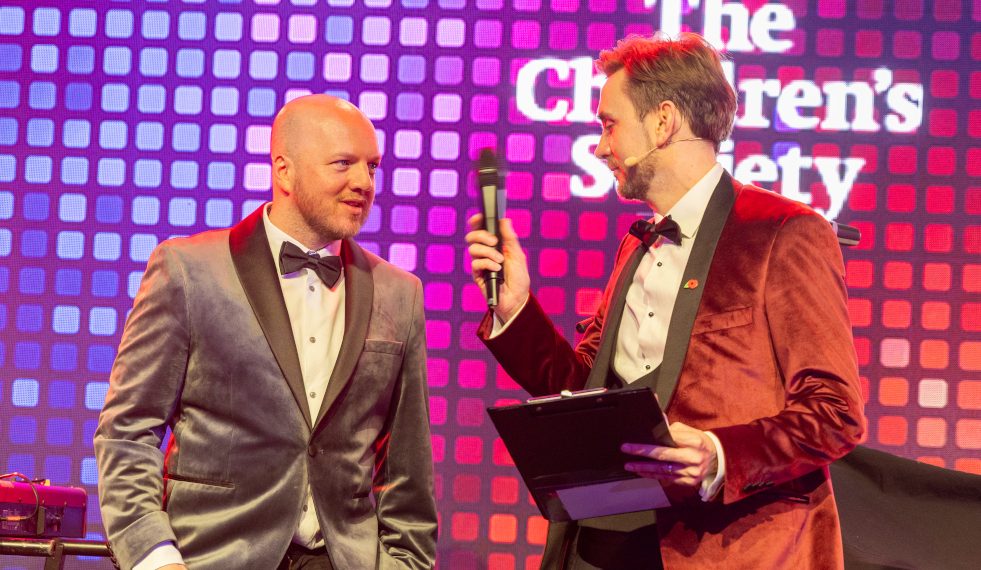
Kevin Durham on stage at a charity gala, microphone in one hand and his notes on a clipboard in the other

A whole day in the event, not an evening

Leaving home in the morning for an evening event sounds excessive until you look at what it protects. It means the whole day goes on your event and nothing else.

Your committee, meanwhile, is usually having the busiest day of its year. An auctioneer who is already in the building, dressed and rehearsed, is one name on the list nobody has to chase.

What should the organiser have ready before the guests arrive?

The organiser should have three things ready for the auctioneer before the guests arrive: access to the stage, one named person to find, and the final paperwork in print. The table is general good practice for any professional you book, not my personal routine.

Have readyWhy it helps
Access time agreed with the venueThe auctioneer can rehearse on the real stage, not in a corridor
One named contact and mobile numberQuestions get answered once, by the right person
Stage or speaking position setRehearsal happens where the auction will happen
A microphone to tryA sound check is usually done before audience entry
Final running order and lot list, printedLate changes are caught before doors, not during them
Where the spotters will standThe auctioneer knows which corners are covered

Two notes on that table. First, Ofcom says some licence-exempt bands for wireless microphones are shared with other low-power equipment and can suffer interference, so ask the venue or AV supplier to test the actual microphone in the actual room. Second, the named contact works best when it is your night lead.

For the paperwork itself, my posts on the run sheet and auction spotters cover it. The weeks-out auctioneer briefing is a separate job.

How can you tell if an auctioneer will prepare like this?

Ask before you book. A professional charity auctioneer should be able to tell you, without hesitating, what time they will be in the building and what they do once they get there. A vague answer usually means nobody has planned those hours.

Useful questions:

  • What time will you be at the venue, and how are you getting there?
  • If your train or road fails, what is the fallback?
  • Will you want time on the stage before guests arrive?
  • Who do you need to see when you get there?

A committee member running the auction as a favour usually cannot give these answers, and that is no criticism. They have a day job, a table to host and a dozen other tasks on the day.

One organiser, Luke Holmes of Noah’s Ark, wrote that “He came early to do a run through and meet guests.” Kind words, and my part is small next to the team behind the charity. More are on my client reviews page.

When is it worth hiring a professional charity auctioneer and host?

Hire a professional when the auction and pledge carry a real share of the night’s target, and when nobody on your committee can spend the afternoon at the venue preparing for them. If the auction is a few lots at a small supper and a confident volunteer can be there early, doing it yourselves is a reasonable call.

What a professional changes is that the person on the microphone arrives with the travel risk already absorbed and the scripts already rehearsed in your room. Because I usually host the whole night as well as the auction, that preparation covers the welcome, the speeches and the close, not just twenty minutes of bidding.

If that sounds like your event, call me on 07596 851647. Have ready your date, the venue, its access times, your draft running order and what went wrong last time. The auction software is included when you hire me: I build it around your event, in your branding with your lots and tickets, and it stays live for one month afterwards. My auctioneer services page sets out the rest.

Kevin Durham, charity auctioneer

Kevin Durham

Charity auctioneer & event host

20years£10m+raised60–80events/yr
Check availability07596 851647

Let’s talk

Bring this to your event

Book a free consultation with a charity auctioneer who has raised over £10 million.

What should a charity auctioneer booking agreement include?

Kevin Durham in a burgundy velvet jacket speaking into a microphone and pointing out into the room at a charity gala

In short

  • Put it in writing. The fundraising code expects a written agreement with any paid third-party fundraiser, and for some the law requires one first.
  • Fix the date, the times, and whether you are booking the auction alone or the hosting and pledge too.
  • Say how the fee is worked out and what it leaves out: travel, accommodation, expenses.
  • Agree payment dates, cancellation for both sides, and what happens if the auctioneer is ill.
  • List what your committee supplies, then add short clauses on insurance, data and recordings.

A charity auctioneer booking agreement is the written record of what an auctioneer will do at your event, when, for what fee, and what happens if either side cannot go ahead. This guide answers one practical question: what should a charity auctioneer booking agreement include? It is for the committee chair or gala coordinator about to say yes, and it applies to any auctioneer you book.

I’m Kevin Durham, a professional charity auctioneer and event host, and I work 60 to 80 events a year. I am not a solicitor, so this is general information, not legal advice, as at November 2026. Most of it describes what to look for in any auctioneer’s agreement. One section sets out my own booking terms, as an example.

The clauses at a glance

ClauseWhat to pin down
Date and timesDate, venue, arrival, auction slot, hard finish
ScopeAuction only, or hosting and pledge too
Fee and exclusionsHow it is worked out; travel, accommodation, meals
PaymentsThe date each falls due; what is non-refundable
Cancellation and postponementEach side, dated against the event
IllnessAgreed replacement, or refund
Committee dutiesRunning order, lot list, microphone, AV, a named contact
InsuranceCover held by each side
DataWho holds guest and bidder details, and for how long
RecordingsWho may film, who owns it, what it is for

Does a charity auctioneer booking need a written agreement?

Yes. The Fundraising Regulator’s fundraising code, read in November 2026, says at 6.2.1 that you must have an appropriate written agreement with any third-party fundraiser, unless they are a volunteer. For a professional fundraiser in the legal sense, the law requires one before they start.

Whether a paid auctioneer falls inside that definition depends on the facts. Section 58 of the Charities Act 1992 turns on being paid to solicit money for the charity and excludes several kinds of person. Ask your adviser, and write the agreement as though it applied.

The stakes sit in section 59, which covers England and Wales. An agreement that misses the prescribed requirements is not enforceable against the charity without a court order, and the fundraiser cannot claim fee or expenses under it. The 1994 Regulations set the form: in writing, signed by both sides, with names, date signed, period, terms for early ending and variation, main objectives and methods, and how fee and expenses are determined.

Section 59(7) adds three more items, covered in my piece on trustee fundraising duties. The Charity Commission’s CC20, read in November 2026, says to get advice if you are unsure what to include.

What should the agreement include about dates, times and scope?

The agreement should name the date and venue, the auctioneer’s arrival time, the slot for the auction and any pledge, and a finish time, then say plainly whether you are booking the auction only or the hosting and pledge too. Times and scope are easy to leave to a phone call. They are hard to prove afterwards.

Write the auction slot in, not just the doors time. I once announced a live auction in a room that was running late, with no speech or film to tee up the lots and people still talking. Only a fraction heard them. I have not made that mistake since: command the room first, or the lots are wasted. So the agreement and the running order should agree on when the money is asked for.

Scope is a plain list: live auction, live pledge, hosting from welcome to thank-you, games, and any planning calls beforehand. One client described the planning side in their own words: “Kevin had incredible enthusiasm and was a great source of advice in our planning.” That is Kristen Kemmet, Group Charity Coordinator, on the reviews page. If advice is part of what you are paying for, put it in writing.

What should a booking agreement include on fees and expenses?

A fee clause should say how the fee is worked out, whether it is fixed or moves with the total raised, and what it leaves out: travel, accommodation, parking and meals. Ask for a total you can budget against, with expenses either included or capped.

A percentage of the total and a fixed fee behave very differently, and my guide to commission explained sets out the models. This post covers what the agreement says. The fees page covers the money.

Where lots are sold on someone else’s behalf, ask who keeps what. A supplier selling on consignment or above a reserve may pass the charity only part of each sale. Write down which sales pay the charity in full.

What should the agreement include on deposits and cancellation?

Give the date each payment falls due, say what is non-refundable, and set out cancellation for each side as a scale dated against the event. The penalty rule is the reason to keep it proportionate: in Cavendish v Makdessi the Supreme Court tested whether a payment on breach is out of all proportion to the innocent party’s legitimate interest.

A scale that rises as the date nears is easier to justify than one flat sum, because an auctioneer can rebook a date six months out and cannot six days out. Whether a particular clause is caught is a solicitor’s call.

Cover both directions. If you cancel, what is due and when. If the auctioneer cancels, you get back what you paid, and ideally help finding someone. Postponement is a separate clause: who agrees the new date, and whether payments carry over.

What are my own booking terms?

Everything above applies to any auctioneer. For one real example to compare against, this is how my own standard fundraising contract handles the same points.

  • Deposit: 50%, due within seven days of the contract being issued. It is non-refundable, and I do not hold the date until it has cleared.
  • Balance: the other 50%, due no later than 14 days before the event.
  • Cancellation: in writing. Twenty working days or more before the event, I keep the deposit. Within twenty working days, the full fee is payable.
  • Illness: if I am ill, I use reasonable endeavours to find a suitable replacement. If none can be found, you get a full refund of the fees you have paid.
  • What you provide: the briefing materials (running order, lots, pledge structure and scripts) at least seven days before, plus a working PA, a wireless microphone and sound check access before guests arrive.

I also offer a performance-based guarantee, and other terms apply. If the total raised falls below 90% of a realistic, specific target we agreed in writing before the event, and my performance was the primary cause, I refund 40% of my performance fee. It needs at least four viable auction lots with genuine market appeal, and it applies only where both a live auction and a live pledge are delivered. It is void if any lot is supplied by a third party on consignment, reserve or minimum-return terms. Read the full conditions in the contract before you sign.

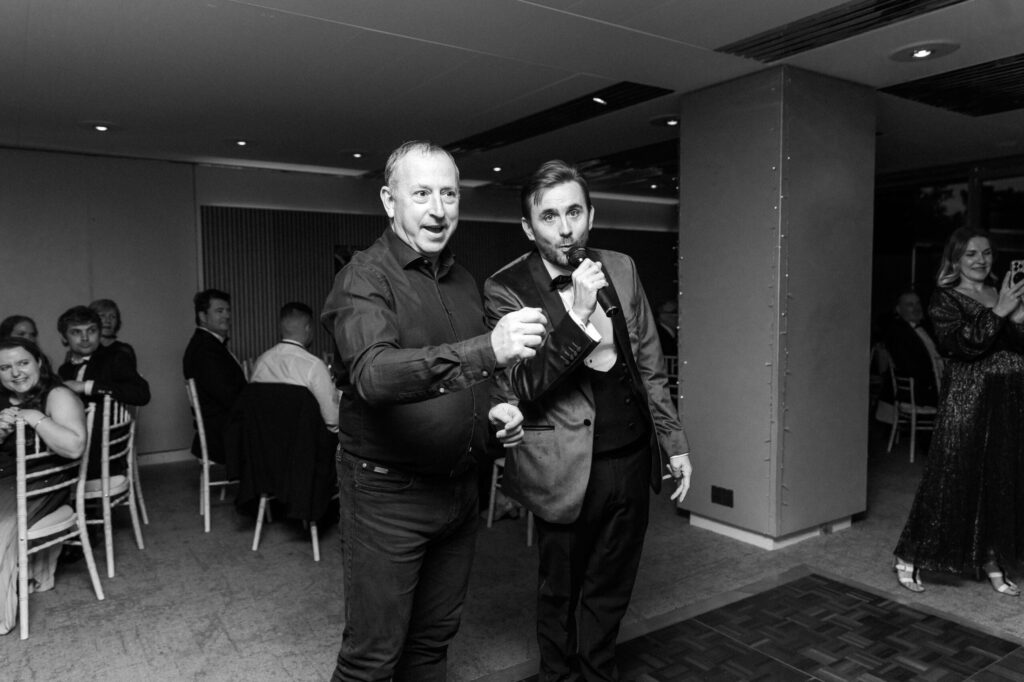
Kevin Durham sharing the microphone with a guest during the live auction at a charity gala, in black and white

What happens if the auctioneer is ill?

The agreement should say whether the auctioneer will arrange an agreed replacement or refund what you have paid. With no clause, the Law Reform (Frustrated Contracts) Act 1943 may apply if illness makes the job impossible: money paid is recoverable, though a court can let the other side keep expenses already incurred.

That is a fallback, not a plan. So ask who chooses the replacement, whether you can refuse them, and how soon you will be told. A phone call on the day is too late to recruit anyone, and nobody wants to meet the replacement plan for the first time in the car park. Code 6.2.3 also expects the agreement to say whether the fundraiser may subcontract, so a replacement is a subcontracting question as much as a diary one.

What the committee supplies

List what you must provide, because that is the part you control: the running order, the final lot list, a named contact on the day, the room, a tested microphone and the screens. If the auctioneer brings equipment, say so, and say who is responsible if it fails.

My guide to briefing an auctioneer covers the briefing. For the agreement, what matters is the deadlines: when the running order and lot list reach the auctioneer, and what happens when they change late.

Insurance, data and recordings

Insurance. Ask what cover the auctioneer holds. The Charity Commission’s CC49, read in November 2026, says public liability insurance is normally recommended for major events and advisable for smaller ones, and that some venues require it. It adds that charities running galas often buy cover against cancellation, for example because of bad weather.

Data. If the auctioneer handles guest or bidder details on your behalf, Article 28(3) of the UK GDPR requires a contract that sets out the processing, makes them act only on your documented instructions, and has them delete or return the data at the end. One clause covers it.

Recordings. Under section 9 of the Copyright, Designs and Patents Act 1988 the author of a film is its producer and principal director, so unless the agreement says otherwise, ownership may not sit with the charity. Section 182 separately needs a performer’s consent to record a qualifying live performance. Whether auction patter qualifies is for your solicitor. The practical fix is a clause saying who may record, what the footage is for, and for how long.

When is a written agreement worth the effort?

When someone is being paid, a lot rides on one evening, or any clause above is unclear. For a small local night with a volunteer auctioneer, a confirming email covering date, times, expenses and what each side supplies is often enough, and the code lets you decide against a formal agreement with a volunteer.

A professional booking is different, because the agreement becomes the plan for the night. If you are still choosing, my guides to vetting an auctioneer and hiring one come first. When you get in touch with anyone, have ready the date and venue, room size, running order, target and what went wrong last time.

If you would like to talk it through, call me on 07596 851647. Free auction software comes with hiring me: I build the platform around your event, with your branding, lots and tickets, and it stays live for a month afterwards. More on what I do is on my services page.

Kevin Durham, charity auctioneer

Kevin Durham

Charity auctioneer & event host
20years£10m+raised60–80events/yr
Check availability07596 851647

Let’s talk

Bring this to your event

Book a free consultation with a charity auctioneer who has raised over £10 million.