
A virtual auctioneer, for a room that is partly not in the room.
Streamed, hybrid, or entirely online, and multistreamed to your channels so the auction reaches people who have never heard of you. The job is the same as it has always been: read the room, hold the pace, and take the money out of it. Only now the room has no walls.
What actually changes when the room is a screen
Less than people expect, and not the things they expect.
The bidding still needs a rhythm. Somebody still has to decide when a lot is finished. What goes is the thing an auctioneer leans on hardest in a hall: the ability to see hesitation. You cannot spot the man at table nine who has stopped raising his paddle but has not stopped wanting the lot. So the pace has to carry more of the work, and the lots have to be introduced properly rather than announced.
Three shapes, and they need different evenings
Fully online. Nobody is in a room. The auction is called to camera, and the whole evening has to be shorter than a live one. Attention at home runs out faster, and an hour that flies in a hall is a long time in a living room.
Hybrid. A room, plus people watching. The hardest of the three and the most common. Bids have to come from both places into the same lot, and the auctioneer has to be believed by both. If the people at home feel like spectators at somebody else’s party, they stop bidding.
Streamed. A normal gala with the auction broadcast for people who could not travel. Nearly a live event, with one rule: the camera is a table, and it gets talked to like one.
What I did not expect from the first one
I called my first fully virtual auction on my own platform, and the thing that surprised me had nothing to do with the bidding.
A room holds the people you invited. That is its limit and it is a hard one: four hundred seats, four hundred people, and every one of them already knows the charity well enough to have bought a ticket. You are raising money from your existing supporters, which is the whole job in a hall and is only half of it online.
A stream has no seats. Somebody who has never heard of the charity can arrive in the middle of lot four, watch for ninety seconds, and leave knowing what it does. Some of them stay. A few of them give. That is not a bonus on top of the auction, it is a second reason to hold one, and I do not think most charities have noticed it yet.
Multistreaming: the same auction, in several places at once
The auction goes out to more than one platform simultaneously. YouTube, Instagram, TikTok and Twitch, on your channels or mine or both. LinkedIn as well, where the account has been approved for it, which is not automatic and is worth starting early if you want it.
The reason to bother is not that more platforms means more screens. It is that each platform decides for itself who to show it to. Instagram pushes it at one group of people, TikTok at a completely different one, YouTube at another again, and none of those algorithms are consulting each other. Four audiences that do not overlap, all watching the same lot go under the hammer at the same moment.
Your existing supporters would have found the auction wherever you put it. This is about the people who would not.
How somebody watching joins in
It is the same thing every creator on those platforms already does, pointed at an auction instead of a shop.
In the run-up, the link in each profile is switched to the auction page. That is one change per account, made a week out or the day before, whichever suits how you are promoting it.
Then on the night I put a card up through OBS at the moments it will land: as a lot sells, before a headline piece, whenever the room is warm. It says where the bidding is and to follow the link in the profile. Somebody watching on their phone is one tap from your profile and two from the auction, and that is a short enough journey that people make it.
From there they are on exactly the same footing as everyone else. They register, they bid, and they are on your list on Monday morning.
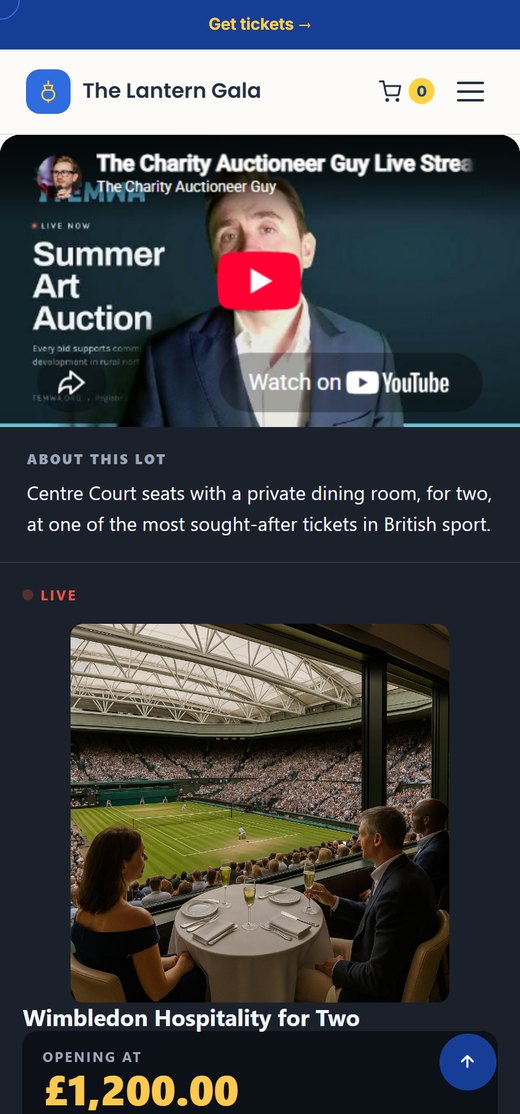
It stops being a webcam and starts being a programme
I run the broadcast through OBS Studio, which is the same software a professional streamer uses, and it changes what an evening can be.
Your project lead can join live from wherever the work actually happens and talk for ninety seconds about what the money does. That is a far better ask than me describing it second hand, and on a stream it costs nothing to arrange because there is no travel and no stage. Your existing film can be played into the broadcast at full quality at the moment it will land hardest, rather than being introduced and then buffering. Lot numbers, the running total, the link to bid and the names of sponsors can all sit on screen where they help.
The result is closer to a small television programme than a video call, and audiences treat it that way. People who would click away from a static camera in a hall will stay with something that moves and changes.
So it is not only an auction any more
It is three things happening at once: money raised on the night, a charity introduced to people who had never encountered it, and a mailing list and a following that are bigger on Monday than they were on Friday.
I would still hold a live event in a room if the room is right for it. But if you are choosing between a small in-person auction and a virtual one because of cost, the virtual one is no longer the compromise it was two years ago, and the reach is not a consolation prize.
The technology, and why I run my own
I built the platform I use, which means when something goes wrong on the night I am not on hold to a supplier. Bids from the floor and bids from home compete in the same lot at the same price. A standing online maximum answers the room automatically, so nobody loses a lot to somebody simply because that person is in the building.
Ask any virtual auctioneer what happens to a bid placed the moment somebody’s signal drops. The answer tells you whether they have run one of these or only sold one.
What it costs
A fixed fee, agreed before the event, and never a percentage of what you raise. A written fundraising agreement and solicitation statement come as standard, as the Charities Act requires.
Questions
Frequently asked questions
Can a charity auction be run entirely online?
Yes. The auction is called to camera and streamed, and everybody bids from wherever they are. It needs to be shorter than a live one, because attention at home runs out faster than it does in a hall, and the lots need introducing properly rather than announcing.
Can people bid from the room and from home in the same auction?
Yes, and this is the part most software gets wrong. A bid from the floor and a bid from a sofa compete in the same lot at the same price. A standing online maximum answers the room automatically, so nobody loses a lot to somebody simply because that person is in the building.
Which platforms can the auction be streamed to?
YouTube, Instagram, TikTok, X and Twitch, on your channels or mine or both. LinkedIn as well where the account has been approved for live video, which is not automatic and is worth applying for early.
How do people watching on social media join the bidding?
The link in each social profile is switched to the auction page in the run-up. On the night a card goes up through OBS at the moments it will land, telling viewers to follow the link in the profile. That is one tap to the profile and two to the auction.
Do we need our own streaming equipment?
No. I bring the production: cameras, OBS Studio, the multistream, and graphics on screen. You need somebody from the charity available if you want them to speak live, and your existing film if you want it played in.
What does a virtual auctioneer cost?
A fixed fee agreed before the event, never a percentage of what you raise. A written fundraising agreement and solicitation statement come as standard, as the Charities Act requires.
No obligation
Tell me about the evening
Thirty minutes on your event, your audience and your target, and an honest view of whether a virtual auction is the right shape for it.