
In short
- Winning bidders pay whoever the proposal says takes payment. That can be the company, a platform or the charity’s own account.
- Until the money reaches the charity’s account, the charity is waiting on someone else, and that wait is the risk.
- A company’s proposal should say whose account bidders pay into, and on what day the charity is paid.
- The law and the Code of Fundraising Practice expect a written agreement with a company that raises money for you.
- If the charity’s own payment account takes the bids, the question mostly goes away.
The money at a charity auction is held by whoever takes the payment: the auction company, a software platform, or the charity itself. Which of the three it is decides what happens to your total if something goes wrong between the hammer and your bank statement.
I am an auctioneer who argues for lots the charity sources itself, so read this knowing my side. It is for the trustee or treasurer with an auction company’s proposal on the desk and a signature line waiting. Everything about other companies comes from their own pages or a named news report, read in November 2026. It is general information, not legal advice.
Who holds the money at a charity auction?
The money at a charity auction sits wherever the winning bidder’s card or transfer lands first. That is one of three places, and the risk is different in each.
| Where bidders pay | Who holds the money | The risk | What to ask |
|---|---|---|---|
| The company’s account | The company, until it pays the charity | Everything rests on the company paying on time | What day is the charity paid, and from what? |
| A platform’s account | The platform, often minus a fee | Waiting on its payout schedule | When does the payout run, and what is deducted? |
| The charity’s own account | The charity, from the start | The charity must reconcile its own income | Who reconciles, and when? |
Whoever holds the bids holds the risk. So my test is simple. If the supplier vanished tonight, whose name would a bidder’s bank statement show, and who would the bidder ask for a refund?
A charity auction company that closed in 2024
In June 2024 several charities said they were owed money after a charity auction company stopped trading. Civil Society reported on 10 June 2024 that Good 2 Auction, which ran silent auctions and gala dinners for charities, had closed.
Garden House Hospice Care and the Seashell Trust told the magazine they had not yet received funds they expected. Garden House said its supporters had won prizes at a March gala dinner and that it was working to reimburse them for money lost through their banks and card providers. Seashell said some supporters had given through the company, trusting it to pass the money on. Noah’s Ark Children’s Hospice said it was affected and had reported the matter to Action Fraud, the police and the Charity Commission, which confirmed it had received a related serious incident report.
I have not followed the case further, and I make no comment on the company or why it closed. My point is narrower. In those accounts, supporters had paid through a business that was not the charity, and the charity was left chasing.
What do charity auction companies say about paying the charity?
Two auction companies describe collecting payment themselves, as their own pages stand in November 2026. Neither page names a payment day or says whose account winners pay into.
- A Star Experience’s FAQs say that after the event it takes care of all payment collection, and that its aim is to get the charity paid as quickly as possible.
- The Event Bureau’s silent auction page says its team takes payments from winners, and that the charity receives a detailed financial breakdown after the event.
That is not a criticism of either, and I am saying nothing about any company’s finances. A website is a summary, so those answers belong in your proposal, in writing, with a date.
What should the agreement say about who holds the money at a charity auction?
An agreement with a company that raises money for your charity should be written, and it should say who holds the bids and when the charity is paid. The fundraising code says a charity must have an appropriate written agreement with any third-party fundraiser, and must carry out appropriate checks first.
The law adds weight. Under section 59 of the Charities Act 1992, a professional fundraiser or commercial participator must act under an agreement meeting the prescribed requirements, and one that does not is not enforceable against the charity except as a court allows. The Charity Commission’s CC20 guidance says to monitor such agreements regularly. Whether a given company counts depends on how it describes the deal, so take advice.
Here is what I would want in the paperwork:
- Whose bank or card account the bidder pays into.
- The date by which the charity receives the money, counted from the event.
- What is deducted before the charity is paid, and the reserve on every lot.
- A written statement of the total taken and the total paid out, within an agreed number of days.
- What happens to bidders’ money if the company cannot continue.
- Who deals with a bidder who has paid and not received the lot.
Item 5 is the one I would press hardest. If the answer is vague, treat that as the answer.
Reconciling what a platform pays you
The Charity Commission’s financial controls guidance says many charities use fundraising platforms, and that you should understand when to expect payments so you can spot a problem. It also asks for regular reconciliations matching the transaction history to the income in the charity’s bank account.
You cannot reconcile what you cannot see. So ask for read access to the payment records, and diarise the date money is due. A missed date is the first warning, and it costs nothing to notice.
Concern about companies running charity auctions is not new: Third Sector reported in January 2010 that the Institute of Fundraising’s view was that a charity should have a contract with such a company. The advice has barely changed.
Where the money sits when I run the auction
When I run an auction, the platform I build takes payment through the charity’s own Stripe account, so winning bids go to the charity and not through me or a company in between.
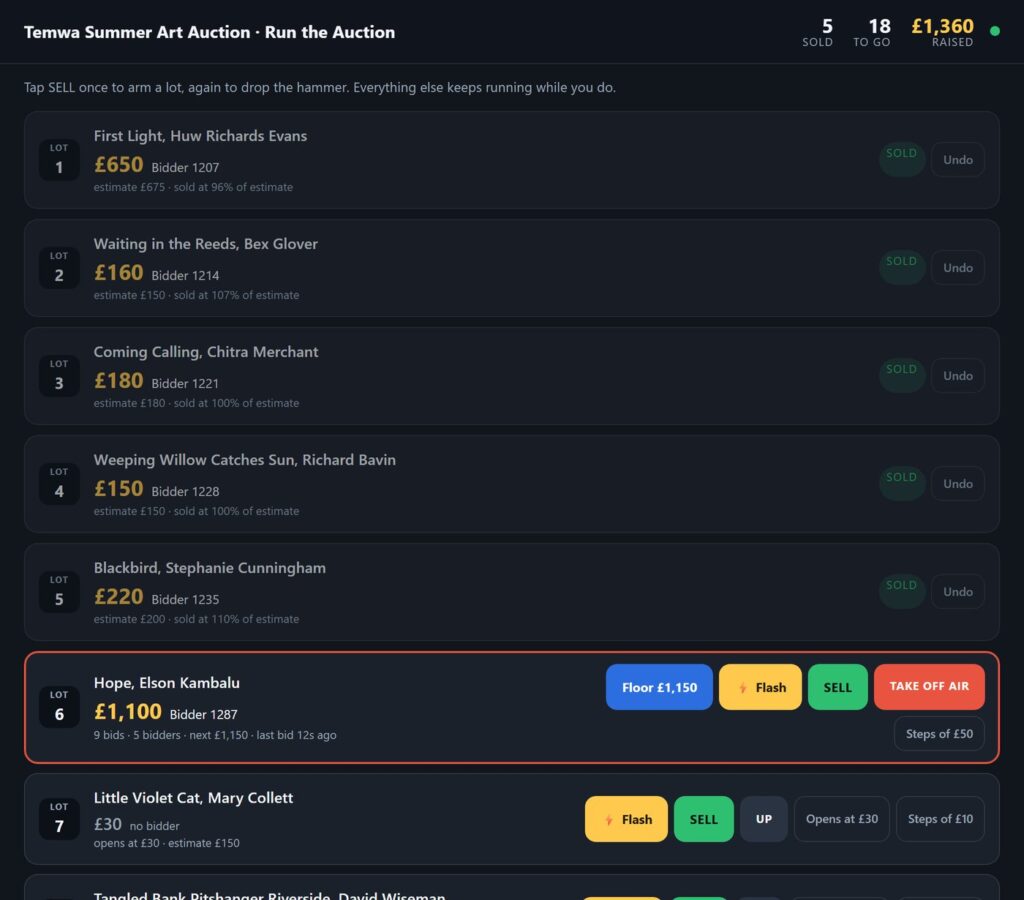
My fee is agreed up front and sits as its own line, never a percentage of what the room raises. There are no consignment lots, and I never hold the bids. The auction software is built around your event and included when you book me. It stays live for a month afterwards, and it is not sold on its own.
That does not remove the charity’s job. You still need two people on reconciliation, and my note on collecting payment covers the desk on the night.
When is it worth hiring a charity auctioneer for this?
Hire a professional charity auctioneer when you have donated lots, or can get a handful of strong ones, and you want one fee and one person planning the night, with the money landing in the charity’s own account. A company earns its place when you have no time and no donor network to ask.
If a company is the right fit, the questions above still apply, and a good one will answer them quickly. DIY can also be right: with a small room and a confident trustee on the microphone, you may not need an auctioneer. My piece on silent auction companies covers when to run the silent side yourselves.
What should you have ready when you call?
Have the date, venue and guest numbers, and any company proposal that has landed on your desk. The most useful lines in it are the reserve on each lot, whose account bidders pay into, and when the charity is paid.
Add last year’s total, and how much the charity actually received once everyone had taken their share. Bring your running order too, and anything that went wrong last time.
Call me on 07596 851647 and tell me what the company has proposed. I will tell you plainly whether it protects your money, and what my auctioneer services would change.

Kevin Durham
Charity auctioneer & event host