
In short
- A table can pool its money and bid as one. It is common, and nothing in a normal gala forbids it.
- It happens most on experiences with a lot of seats, like a dinner for eight, and on niche experiences.
- One person holds the paddle and their name goes on the lot record.
- Agree the ceiling, the split and who pays the charity before the hammer falls.
- An auction lot is a purchase, not a gift, so there is no Gift Aid on it. A pledge is different.
Table pooling is when several guests at a charity auction combine their money behind a single bid, usually for a lot none of them would chase alone. Yes, a table can do it, and it is perfectly normal. The only things that need sorting are who holds the paddle, how high the group will go and who pays.
From the front of the room I have seen tables bid jointly, and I have never seen it go wrong. Here is where it happens, how to set it up so it stays that way, and the few rules worth knowing. This is general information from the floor, not legal or tax advice.
Can a table pool their money to bid at a charity auction?
Yes. A table can pool its money to bid at a charity auction, and nothing in a normal gala stops it. The charity sells the lot to one bidder number. Whether the money behind that number comes from one wallet or eight is the table’s business, as long as the payment arrives.
Software firms treat it as a feature now. One US platform’s guide, updated April 2026, describes group bidding as a shared paddle with pooled funds and one checkout, and says the team is treated as a single bidder. That is the right way to think about it in a room too.
From my side of the microphone, a joint bid is good news. A lot that might have stalled with one keen bidder now has a whole table behind it.
Which lots do tables bid on together?
In my experience, tables pool most on experiences, especially lots with a lot of seats. A dinner for eight is the classic: nobody wants to pay for seven friends, but eight friends splitting it is an easy yes. Niche experiences draw joint bids too. When only a couple of people in the room really want a lot, teaming up can beat outbidding each other.
The example that comes to mind is a shooting experience with the former footballer Vinnie Jones. Two guests started out bidding against each other. They swapped some banter across the room as the price climbed, and then decided to stop fighting and bid together instead.
If you are choosing lots, it helps to know this in advance. A strong list of experience lots with a group element gives tables something to rally around. A lot for two suits a couple. A lot for eight suits a table.
There is a related move when two separate bidders both want the same thing. I sometimes stop at “going, going”, announce a twist and sell the lot to both top bidders at a slightly lower price. That only works if the donor can supply a second one, so check with the donor first.
How a pooled charity auction bid should work
A pooled bid works when the table agrees five things before the lot comes up, not while the price is rising. None of this needs a form. A two-minute chat over dessert covers it.
- One named bidder. One person holds the bidder number and bids. Everyone else stays still, or the recorder ends up guessing which hand counted.
- One ceiling. Agree the most the table will pay in total. The bidder stops there, however good the banter gets.
- The split. Equal shares, or by couple, or one person covering more. Decide it now, not over coffee.
- Who pays the charity. Usually the named bidder pays in full and collects from the table afterwards.
- Who is on it. Tell whoever runs the payment desk that the lot is a joint win, so the thank-you reaches everyone.
The law keeps it simple. Under the Sale of Goods Act 1979, each lot is treated as a separate contract and the sale completes at the fall of the hammer. Until then, any bidder can withdraw. So a table can change its mind right up to the hammer, but not after it.
One piece of research adds a caution. In a 2009 Oxford Economic Papers study, teams stayed longer in ascending auctions and paid significantly higher prices than individuals. That was a laboratory experiment, not a gala, so treat it as a hint rather than a promise. It is still a reason to agree the ceiling first.
Who pays when a table wins a lot together?
The named bidder pays the charity, in full, on the night where possible. The table settles up between themselves. That keeps one name, one amount and one payment on the charity’s record, which is what the Charity Commission’s financial controls guidance expects: records for each event showing what was collected.

Splitting the payment across several cards at the desk is possible, but test it first. Square’s UK help page, read November 2026, says a split tender must be completed within five minutes. It is not available with a card when Square Terminal is connected to Square Point of Sale. Eight cards at 11pm is a queue, so one card and a group chat afterwards is usually kinder to everyone.
Tax is the other point. HMRC’s guidance says a payment for an item at a charity auction is a purchase, not a gift. A pooled lot is no different, so do not offer Gift Aid on it. My guide to collecting payment covers the desk, the readers and the record in more detail.
Is it allowed for two bidders to agree to bid together?
Yes, for guests at a charity auction it is. The UK law on bidding agreements is aimed at dealers. The Auctions (Bidding Agreements) Act 1927 makes it an offence for a dealer to pay someone to stay out of the bidding.
The Act defines a dealer as someone who goes to auctions in the normal course of business to buy goods for resale. That is not a guest buying a day out. The same section also protects dealers who agree in writing to buy jointly and give the auctioneer a copy before the sale. Even the law likes a joint bid to be out in the open.
The spirit is worth borrowing. If two guests decide to team up, a quick word to me or to the recorder means nobody wonders why the bidding suddenly stopped.
Pooling for the live pledge
Some tables want to give together rather than win something. That is lovely, and it works best on the live pledge, where each person fills in their own card.
Giving together has a real pull. The Behavioural Insights Team found people give more when giving is more visible within their own social group, and a table pledging as one is about as visible as it gets.
But Gift Aid works person by person. HMRC’s guidance says an organiser cannot make a declaration on money they collected from others, because it was never their donation. So one table host writing a single big card loses the Gift Aid on everyone else’s share. Each guest pledges on their own card, and the table total is announced together.
And nobody should be swept along. The fundraising code rules out undue pressure, and a guest who quietly says no to a table pledge has said no. A good table captain makes that easy for them.
When is it worth hiring a charity auctioneer for this?
A small auction with a few lots and a committee who know every guest can handle joint bids without help. Brief the recorder, and the five points above will carry you.
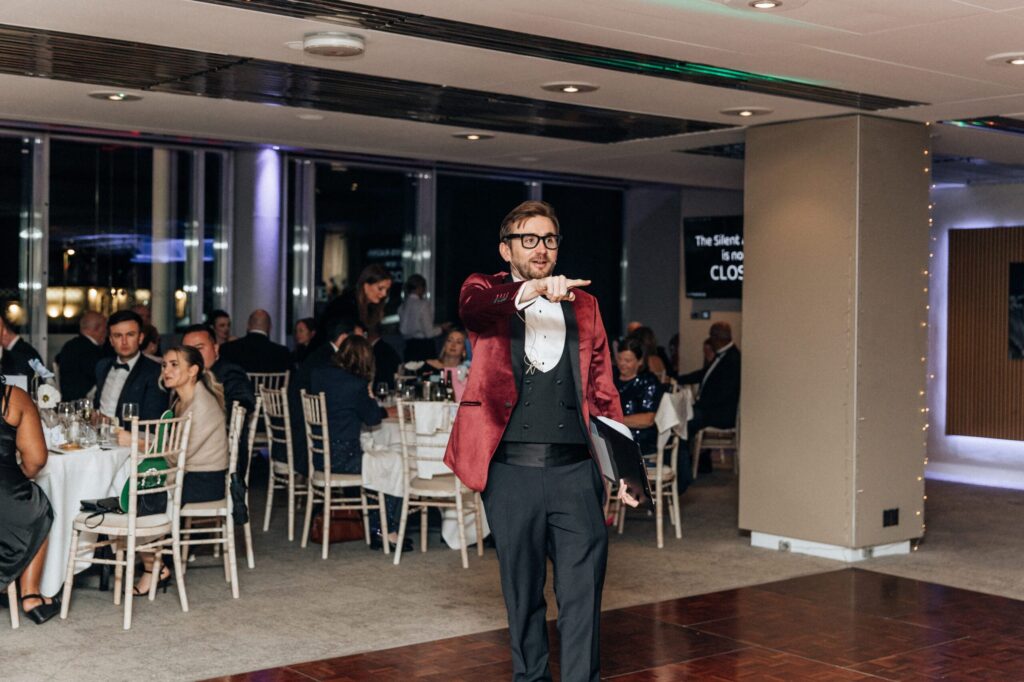
It is worth bringing in a professional when the room is big, the lots are experiences, and joint bids could come from anywhere. In those rooms, the job is to spot a bidding battle turning into a partnership and keep the lot moving without confusion. Bidding momentum is a skill, not luck. I keep every lot introduction short and weave the terms into it: how many seats, which dates, what is not included. A table deciding whether to pool needs exactly that.
I also get the room before I sell anything, even if that means standing on a chair. A table cannot agree a ceiling if it cannot hear the lot. On my reviews page, Naomi Chaning Pearce of Jigsaw Trust wrote that Kevin “owned the room as he conducted the live auction”. Kind words, though the Jigsaw team did the real work. Holding the room is simply the part that lets a table make up its mind. The rest of what I do sits on my auctioneer services page.
If you get in touch, have three things ready: the date, how many guests and tables you expect, and your draft lot list, especially any experiences with seats. Call me on 07596 851647 and we can work out which lots will bring a table together.

Kevin Durham
Charity auctioneer & event host