
In short
- Hold the debrief within a week or two, while memories and receipts are fresh, with everyone who ran a part of the night.
- Ask five questions and finish with a one-page list of decisions, each with an owner and a date.
- Read the money in layers: gross, costs, net, then per head, per lot and the pledge share.
- Record what the room did, not only the total.
- Report back promptly, and claim Gift Aid while the paperwork is complete.
A charity event debrief is a structured meeting, held within a week or two of a fundraising evening, where the people who ran it compare what happened with what was planned and agree what changes next year. Most committees skip it. The total is announced, the thank-yous go out, and the lessons stay in people’s heads until someone leaves the committee.
I’m Kevin Durham, a charity auctioneer and event host. To be plain about what follows: the method is general practice, drawn from the guidance and event-review guides linked below, not a service I run. The Jigsaw Trust and MS UK figures are from events I hosted.
When should a charity event debrief happen, and who should be there?
Hold the debrief seven to fourteen days after the event, once the final payments are in. A guide for school fundraisers from PTA+ says within seven days, “before you lose momentum”, and a 2015 piece in the Chronicle of Philanthropy says at least a week but no more than a month. Ten days is a sensible middle.
Invite the chair, the treasurer, whoever ran ticketing, sponsors and volunteers, the venue contact and your host or auctioneer. Send a short form to anyone who cannot come. Southwark Council, updated in October 2026, also suggests asking partners, performers and stallholders as well as the audience.
PTA+ adds a good rule: let someone who was not involved analyse the answers, so nobody defends their own corner. And trustees have a stake. The Charity Commission’s CC20 guidance, updated in February 2026, tells trustees to discuss fundraising at their meetings, so the one-page result belongs on the next board agenda.
Which five questions change next year’s event?
Five questions do most of the work, because each one ends in a decision rather than a discussion.
- Did we reach the net target, and which income line missed? Compare every line with its budget, not only the total.
- What did the room do? Where did attention fall, who left early, which lots were fought over?
- Was each cost worth it? Set every cost line against the income it helped produce.
- What did guests experience? Sound, queues, seating, food timing, complaints, anything a guest said to a volunteer.
- Who must be told what, and by when? Donors, bidders, sponsors, the venue, the board.
End the meeting by writing down three things to change and three to keep. That is your one-page output. Anything longer will not be read in October next year. If you need the planning side, my guide to planning a gala covers the sequence.
How do you read the numbers after a charity gala?
Read them in layers: gross raised, then costs, then net, then per-head and per-lot figures, and last the split between pledge and auction. The net is what the charity receives, and it is the only figure to hold against the target. My guide to setting a target covers the other end of that comparison.
Here is the arithmetic with made-up round numbers, not a real event:
| Measure | How to work it out | Example |
|---|---|---|
| Gross raised | All income, on the night and after | £48,000 |
| Costs | Everything spent, including card fees | £11,000 |
| Net | Gross minus costs | £37,000 |
| Gross per head | Gross divided by 120 guests | £400 |
| Net per head | Net divided by 120 guests | £308 |
| Cost to raise | Costs divided by gross | 23p per £1 |
Published commentary on fundraising ratios, updated in July 2026, puts established charities with large regular giving bases at 10p to 20p per £1 raised, and newer or growth-investing charities at 40p to 60p or more. Those are whole-organisation figures. For one evening, the trend against your own last two years tells you more.
The split matters as much as the total. Jigsaw Trust expected £14,000 from their live auction. The auction made £27,000, and a live pledge they had not planned added £30,600. Of the £57,600, the pledge was 53%. A debrief that only recorded the total would have missed that the pledge was the biggest line, which changes how you build next year’s programme. I explain the mechanics in a live pledge.
For lots, record the hammer price as a percentage of the estimate. Lots that sell far under tell you the estimate or the audience was wrong. Lots far over tell you what to find more of.
How do you capture what the room did?
Ask the people who watched it, within a day or two, because nobody remembers clock times a week later. Give the host, the table captains and the front-of-house volunteers three lines each: when attention dropped, which lots drew competition, and who left before the auction.
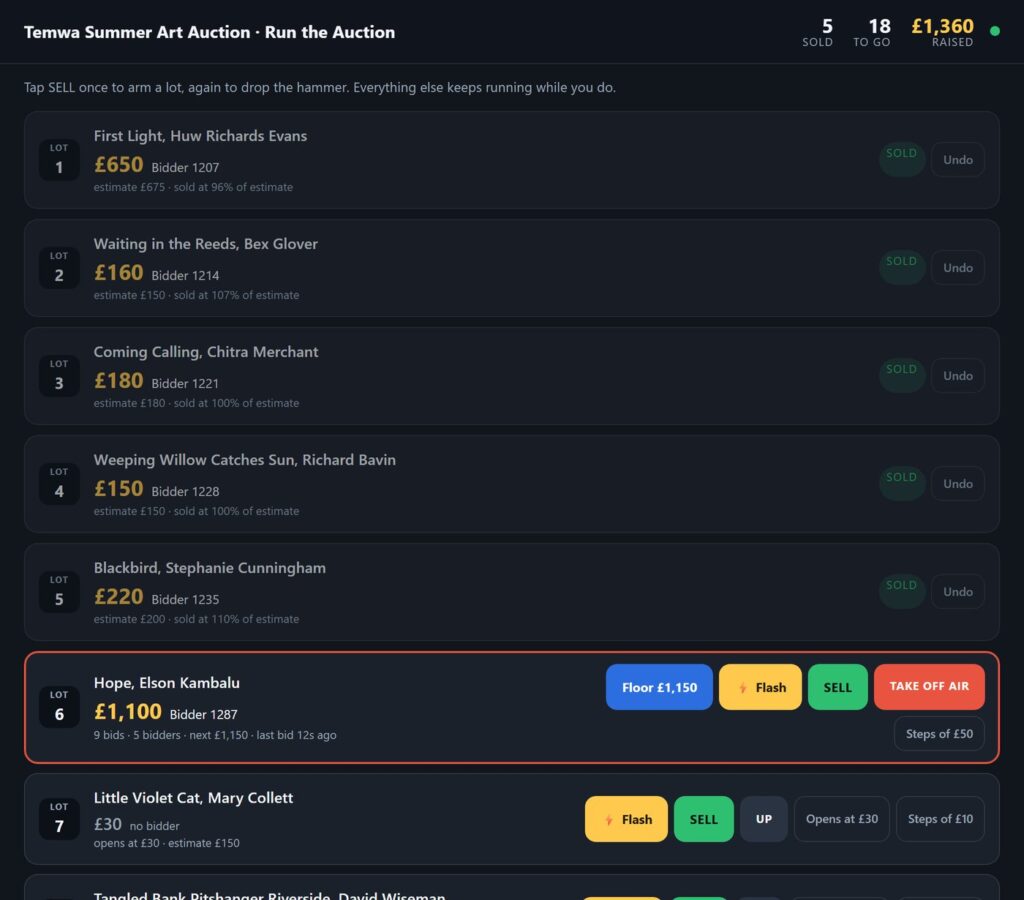
Then build a timeline with clock times: doors, first course, speeches, auction start, pledge, last bid. Lay the money over it: each lot’s hammer price against its estimate, how many bidders it drew, and which tables gave nothing. The console on the platform I use shows each lot’s sale as a percentage of its estimate as it sells, so the lot-by-lot sheet exists before the guests have gone home.
What should you tell donors and bidders afterwards?
Tell them what the night raised and what it will do, within about a week, then claim Gift Aid. Specific beats warm: name what the net pays for. My guide to thanking donors covers the thank-you itself, so this is the reporting half.
At MS UK I told the room at the start where every pound was going, and which lots gave the charity 100%. The report back is the same promise kept, so quote the net, not the gross. Two rules in the Fundraising Regulator’s Fundraising Code, effective 1 November 2025, bear on it. Standard 1.2.2 says that when you collect for a restricted purpose you must say what happens if you raise more or less than the target. Standard 1.2.3 says you need evidence for claims about costs. Your debrief figures are that evidence.
On Gift Aid, HMRC’s claiming guide says you must claim within four years of the end of the financial period you received the donation in, and keep records for a further two. Ticket payments generally do not qualify. For auctions, only the excess over an item’s value can, and HMRC says the value must be made clear to bidders before each item is sold. Four years is the deadline, not the plan. I would claim within weeks. One caution on data: a thank-you is not permission to market, so check consent before guests join a mailing list.
When is it worth bringing in a professional?
For a small first event, such as a quiz or school fair, a volunteer can run this debrief with the template below. A professional earns the fee when totals have plateaued and nobody can say why: the room is warm, but bidding stalls at the same amounts every year. In my experience that is rarely the lots. It is that nobody is managing the room’s energy, and the difference shows in the final total.
Gabriel Dos Santos of OCU Foundation put it on my reviews page this way: “We hosted just over 300 guests and raised more than double what we achieved last year. Kevin’s key suggestion, the live pledge alone, brought in nearly £20,000.” Those are their words and their numbers, and the work after the money lands is theirs. My part is small next to it.
If you do get in touch, have ready the date, room size, running order, last year’s net figure and what stalled. The auction platform is included when you hire me: I build it around your event, and it stays live for a month afterwards, long enough to run the debrief from the lot-by-lot record.
A charity event debrief template
Copy this onto one page and fill it in at the meeting.
| Section | Fill in |
|---|---|
| Result | Gross, costs, net, target, variance |
| Income lines | Each line against its budget |
| Ratios | Per head, cost to raise, pledge share |
| Room | Timeline, stall points, early leavers |
| Guests | Complaints and feedback themes |
| Decisions | Three changes, three keeps, owner, date |
| Telling | Donors, bidders, sponsors, Gift Aid claim date |
Run it within two weeks, write one page, and put the three changes in the diary before anyone leaves the room. If you want a second pair of eyes on last year’s figures before the next gala, call 07596 851647. You can also see my auctioneer services.

Kevin Durham
Charity auctioneer & event host