
In short
- A charity event ticket price settles two things: who walks in, and how much they have left when the bidding starts.
- Price to fill the room with people who can give, not to clear the catering invoice.
- Gift Aid does not apply to a ticket. HMRC treats admission as payment for goods or services.
- Tables of ten are bought by one person on behalf of nine. Price them as a single decision.
- Comps are not lost income. The right non-paying guest earns the seat back several times over.
I work 60 to 80 rooms a year, and I can usually guess the ticket price before anyone tells me. A charity event ticket price is not a revenue decision. It is a decision about who comes, and how much room is left in their evening when I stand up after dinner and ask them for money.
What should a charity event ticket price actually cover?
At the very least, the cost of the person in the seat: their food, their service charge, their share of the room. Everything above that line is a judgement, not a sum.
Most committees start from the catering quote, divide by headcount, add a little for contingency and call that the price. It produces a number. It does not produce a room.
Catering quotes also keep moving under you. In the ONS figures released in October 2026, restaurants and hotels ran at 3.8% over the twelve months to September 2026, against overall CPI of 3.5%. A venue pricing a November dinner back in March is pricing into that, and so are you.
The Charity Commission sets no ceiling. Its guidance on trustee duties, revised in February 2026, says there is “no set amount that a charity should spend on its fundraising”, only that the decision “must be in the charity’s best interest”. A cheap ticket is not automatically the responsible choice.
Does a high charity event ticket price raise more or less on the night?
In most rooms, less. Not because expensive guests are mean, but because of arithmetic that happens in their heads before I open my mouth.
Someone who paid £180 has already filed the evening under “given”. They arrive square with the cause. Someone who paid £85, told plainly that it covers their dinner, arrives with the giving still ahead of them. When the live auction starts, those two people behave completely differently.
There is a real exception. Where the price is doing a job other than revenue, a high one lifts the total. A £500 ticket screens for people who can bid at £5,000, and it signals the level of the evening to everyone who reads the invitation. That works when your fundraising target rests on twenty serious bidders rather than two hundred warm ones, and it fails when a committee prices for the room it wishes it had.
Admission income has never carried a fundraising evening I have worked. Jigsaw Trust expected £14,000 from their live auction. It generated £27,000, and a live pledge nobody had planned for added £30,600 on top. Their team had filled that room with the right people. All I had to do was work it.
Which is why I would rather have 180 guests at £85 than 120 at £150: the same ticket income, and sixty more people holding paddles.
How do tables of ten change the ticket price?
They turn ten decisions into one, and the person making it is rarely buying dinner.
Companies buy tables for reasons sitting between marketing and goodwill, and they decide in a different part of the building from the one that buys single seats. Price accordingly: a shallow discount or none at all, with the value delivered as visibility rather than money off. That is what tiered sponsorship packages are for.
One thing to know before you quote a corporate table. HMRC denies a trading-profit deduction for business entertaining, while a straight gift to charity is generally deductible if made wholly and exclusively for the business. Your invoice should make plain which part is which.
Are early-bird and tiered prices worth the complexity?
An early-bird price earns its keep. Four tiers do not.
Early pricing buys you information at the only point where it is still useful. Eight weeks out, knowing you have sold 40 of 200 seats lets you ring table captains and change the plan. Two weeks out the same number tells you nothing you can act on.
Past two prices you are mostly manufacturing admin and giving people a reason to wait. Whatever you land on, quote it honestly. The CAP Code requires quoted prices to include non-optional fees that apply to all or most buyers. If your platform adds a booking fee at checkout, that fee belongs on the poster.
What do you do about supporters who cannot afford the price?
Decide before you publish the price, and handle it quietly enough that nobody could point at who was helped.
Affordability is not an edge case. The Charities Aid Foundation’s UK Giving work puts total giving at £14 billion in 2025 and reports that one in five people say they cannot afford to give to charity at all. Some of them are your most loyal volunteers.
What works: hold back six or eight seats before tickets go on sale, offer them by direct invitation, never label them on a booking page, seat those guests on ordinary tables. A published “supporter rate” does the opposite, telling half the room they are the cheap half.
The Code of Fundraising Practice, in force since November 2025, sets the floor. Standard 1.1.1 requires fundraising to be “legal, open, honest and respectful”.
Who should never pay for a ticket?
Four groups, and you should budget their covers as a cost line rather than hoping nobody notices.
- Your auctioneer and host. I am working, and I rarely eat much of it anyway.
- The beneficiary or service user who is speaking. Charging someone to tell the room about the worst year of their life is not a good look.
- Press and photographers, if you want the coverage.
- The guests of your largest donor, where those guests are why your largest donor came.
Ten free covers at £55 is £550 of catering against a speaker whose three minutes sets up the whole live pledge. I know which side of that I take.
Does Gift Aid apply to a charity event ticket price?
No. A ticket buys admission, admission is a payment for goods or services, and Gift Aid cannot be claimed on it.
HMRC’s guidance on Gift Aid, last updated in October 2019, lists payments for goods and services among those you cannot claim on, and says a qualifying payment must not be compulsory for attending an event. The detailed guidance is blunter. Chapter 3, updated in October 2026, says at paragraph 3.4.6 that “payments to a charity in return for services, rights or goods are not gifts to charity”, using admission to a concert as its example.
Two things follow for your booking page. First, a voluntary donation alongside the ticket can qualify, as long as people can genuinely attend without making it: separate line, optional in fact and not only in wording, declaration collected.
Second, the admission-to-charity-property rule will not rescue you, the one where a donation 10% above the normal entry charge qualifies. Chapter 3 excludes rights going beyond viewing the property at 3.19.3. A gala dinner is squarely one of those.
On VAT, admission charges to a qualifying fundraising event fall under the events exemption, updated in April 2026, with conditions that deserve their own hour with your finance lead. This is general information rather than advice: take your own before you publish a price.
Showing people where the ticket money goes
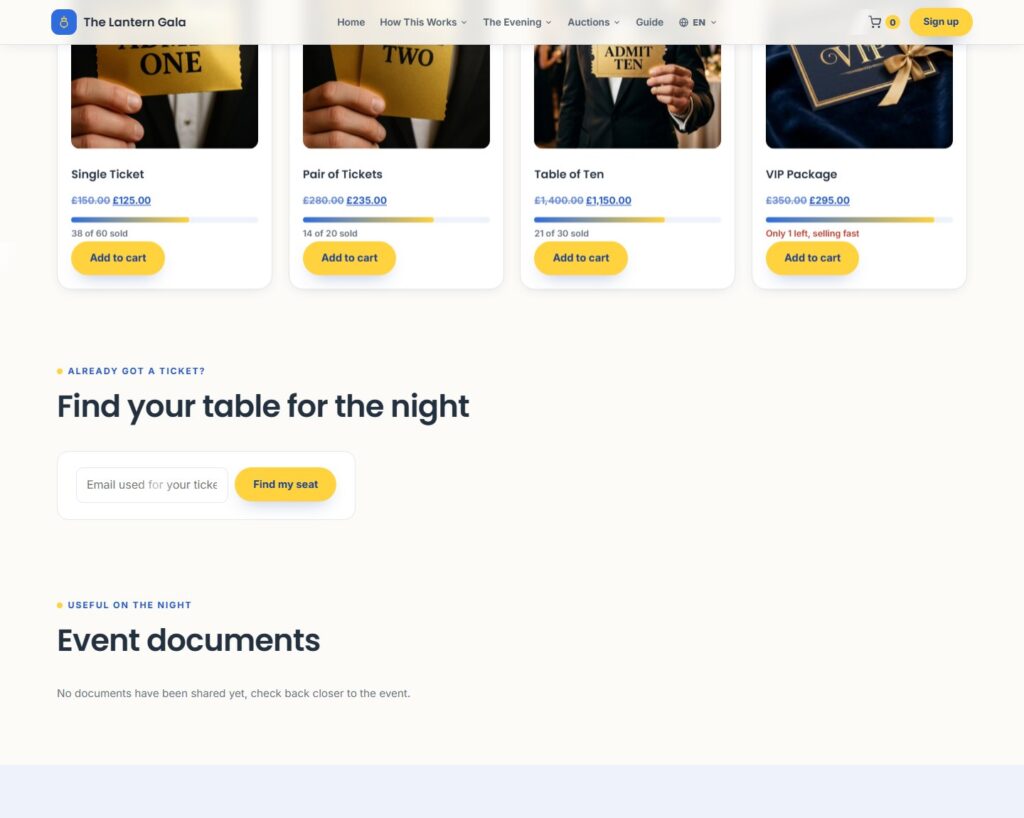
Put it on the booking page in one sentence, in pounds, before anyone reaches for a card. “Your £95 covers dinner, service and the room. Everything raised on the night goes to the service.”
CC20 says a charity “must be open and accountable about its fundraising”, and that appeals should explain whether any of the money will go on fundraising costs, and what proportion. The Code asks the same of events at standard 10.2.1.
It is also the cheapest thing you can do to the total. The year before I worked with MS UK, an external auction company grossed around £13,000 and the charity saw about £1,300 of it. I told the room at the start exactly where every pound was going: which lots paid the charity 100%, which only paid out above the reserve. The company grossed around £3,500 that year, and the live pledge I ran raised £8,300, all of it to the charity. I turned the lights on and the money followed.
The honest arithmetic of one ticket
Run the numbers before the committee falls in love with a price. Say the ticket is £95 and the venue charges £58 a head for three courses and service. Another £12 covers that guest’s share of the room, the AV and the print. You are left with about £25 a head.
Two hundred guests, and the entire ticket exercise has contributed roughly £5,000. One well-placed lot does that. A live pledge, set up properly in your running order, does it several times over.
The ticket is not your fundraising. It is the invitation to it.
Set the price for the room you want
Work backwards. Decide who needs to be there, ask what price gets them through the door with money unspent, then check it at least covers their dinner. If it does not, that gap is a sponsorship conversation, not £40 on everyone’s ticket. The sequence around it sits in my guide to how to plan a gala.
To talk a price through before you publish it, call 07596 851647.

Kevin Durham
Charity auctioneer & event host