

In short
- CC20 opens with six things trustees must do, and every one applies to a single gala.
- You can delegate running the event. You cannot delegate being accountable for it.
- Paying someone to fundraise brings due diligence, and sometimes a written agreement the law wants in place first.
- You must be able to show you acted in the charity’s best interests: a record, not a recollection.
Most people join a board because they care about the cause. Then the charity books a venue, and somebody mentions that the trustees are responsible for the fundraising. If that was news to you, you are in good company: the charity trustee fundraising responsibilities attached to one evening are more specific than most boards expect.
I’m Kevin Durham, and I run live auctions and pledge drives at charity events. What follows is my plain reading of the official guidance, for volunteers rather than lawyers. I’m an auctioneer and not a solicitor, so treat it as general information and take your own advice.
What are a trustee’s fundraising responsibilities under CC20?
CC20, the Charity Commission’s guide to trustee duties, opens with six. It covers England and Wales; Scotland and Northern Ireland have their own regulators. You must comply with the law, raise funds only for your charity’s purposes, use those funds only for the purposes they were raised for, manage the charity’s resources responsibly, keep the charity open and accountable, and act with reasonable care and skill in its best interests.
This version dates from 3 February 2026, so board papers still citing the older six principles are an edition behind.
Those sit on the general duties in CC3, which adds a reassuring line: trustees are not expected to be perfect, and charity law generally protects those who act honestly and reasonably.
Fundraising responsibilities are shared by the whole board
Every properly appointed member of the governing body is a charity trustee in law, whatever the charity calls them, and CC3 says they share equal responsibility. The treasurer does not absorb the money duties on everyone else’s behalf.
You can still delegate the work. CC20 lets you hand the management of fundraising to a committee, a staff member or a volunteer, but asks for clear written terms of reference: what that person can and cannot do, and when and how they report back. The Code of Fundraising Practice frames it as a duty to act reasonably and carefully in all fundraising matters, delegated ones included (standard 2.1.1). So it belongs on your agenda all year, not once when the invitations go out and again when the total is announced.
What due diligence do you owe before booking a fundraiser?
Proportionate checks on whoever will raise money in your charity’s name. CC20 lists the areas: their record on fundraising law and standards, how they run their business, the methods they use, their quality and reliability, and their financial health. It suggests asking other charities that have worked with them.
The Code puts it in a line at 6.1.1: check them first, so you are reasonably satisfied they can do what you expect and will not damage your reputation. Three references and a conversation covers most of it. A board that rings two past clients before booking anyone is a board doing its job.
CC20 also asks you to agree a fee that is reasonable and to know how you will manage the risks. If your auctioneer takes a percentage of the total rather than a fee agreed up front, that is a decision to make with your eyes open, and I set out the models in my piece on auctioneer commission.
When does the law require a written agreement?
When the person you pay is a professional fundraiser or a commercial participator in the legal sense. Section 59 of the Charities Act 1992 makes it unlawful for them to solicit funds for your charity except under an agreement in the prescribed form, and CC20 says it must be in place before the fundraising begins.
Three things section 59(7) requires are the ones boards tend to leave out:
- any voluntary standard the fundraiser has agreed to follow, such as the Code
- how they will protect vulnerable people and the public from undue pressure, persistent approaches and intrusion
- the arrangements that let your charity monitor whether they are complying
Section 59(5) has a sharp edge: if the agreement does not meet the requirements, the fundraiser is not entitled to their fee or expenses under it, except by order of the court.
Whether a particular paid auctioneer falls inside the definition in section 58 depends on the facts, and belongs with your adviser. One detail is worth checking yourself: the thresholds were uprated on 30 September 2026 to £15 a day, £1,500 a year or £1,500 for a single venture, while CC20 as I read it on 27 October 2026 still showed the older £10 and £1,000 figures. Go to the Act for the numbers. My guide to the fundraising Code covers what a solicitation statement has to say.
Protecting the charity’s reputation on the night
Mostly this looks like somebody from the board being in the room, paying attention to how the money is being asked for.
Auctions and pledges run late, after dinner and after drinks, in a crowd warmed up on purpose. That is the setting the law has in mind when it talks about undue pressure. The Code requires you to be able to show you acted in the charity’s best interests (2.1.4), and to protect your own fundraisers from harm and harassment (2.1.2).
My own line is simple. A live pledge is an invitation to a whole room, never a chase of one guest who has already said no. It should not be sombre either, because the excitement as the money comes in is half of what makes it work. Whoever takes pledges needs to know what to do if a guest clearly is not in a state to be deciding anything, and that briefing comes from the charity, not from me.
How do trustees show they monitored the event?
With a record made at the time. CC20 is explicit that you must regularly monitor fundraising agreements: that they are being followed, that the law and standards are being met, that the arrangement is still in the charity’s best interests, and that you can act if something goes wrong. Code standards 6.3.1 and 6.3.2 say the same about third-party fundraisers.
A professional fundraiser or commercial participator must also keep the books and records about your charity and the agreement, and hand them over on request. Ask while everyone still remembers the evening.
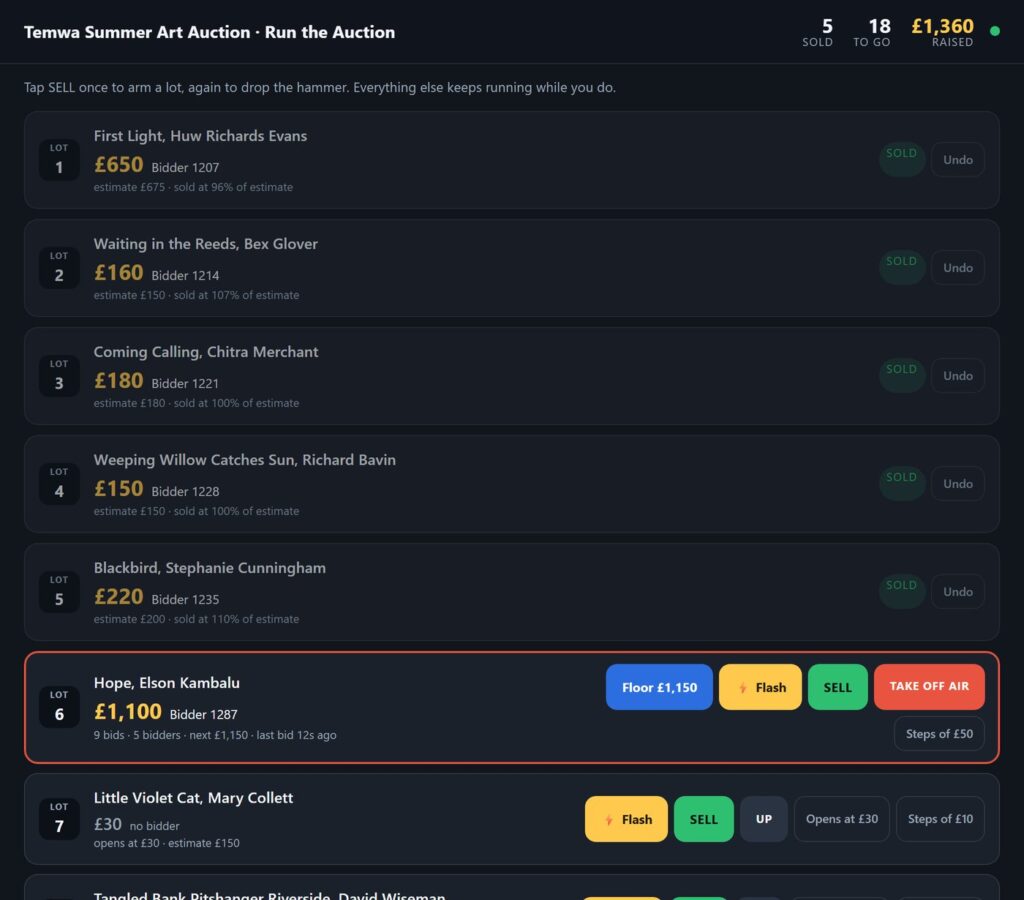
The evidence a board needs is modest. A minute recording the decision to go ahead and why. The signed agreement. A note of the checks. The lot-by-lot result against estimate. Any complaint, and what happened next. None of it can be reconstructed in March.
The spend, and whether the board can justify it
CC20 sets no limit on what a charity may spend on fundraising, and says costs vary between causes and methods. What it asks is that the decision is in the charity’s best interests, which is a question about the quality of the decision rather than the size of the number.
It names the risk plainly: investing in a campaign that is not as successful as you expected. A gala can underperform for reasons nobody controls, and trustees who recorded a reasoned decision beforehand are in a different position from trustees who nodded a budget line through. My guide on how to plan a gala covers the sequence.
What must larger charities report about fundraising?
Charities whose accounts must be audited include six fundraising statements in the trustees’ annual report, under section 162A of the Charities Act 2011: the approach taken to fundraising and whether a professional fundraiser or commercial participator was involved, any voluntary scheme the charity is bound by, any failure to comply with it, whether and how the charity monitored fundraising done on its behalf, the number of complaints received, and what it did to protect vulnerable people and the public.
Audit kicks in under section 144: from 30 September 2026, gross income over £1.5 million, or income over the £500,000 accounts threshold with assets over £5 million. Smaller charities may disclose the same information voluntarily.
Read that list beside your own gala. Four of the six are things you can only report if somebody wrote them down on the night.
Questions a board should ask before booking an auctioneer
These tell me a board is doing its job, and I am glad to be asked:
- What is your fee, how is it calculated, and does it move with the total?
- Will you be making a solicitation statement, and what will it say?
- What do you need from us in writing before the night?
- How do you handle a guest who is clearly not in a fit state to bid?
- Who is your point of contact at the charity on the day?
- What will you give us afterwards for the record?
One duty no board paper discharges for you is the complaints route. The Code requires a clear, publicly available fundraising complaints procedure that fundraisers can explain to donors, and a published way for staff and volunteers to raise concerns (2.3.1 and 2.3.3). A partner without a suitable procedure of their own must agree to follow yours.
A trustee who has never been to the event cannot sensibly sign any of this off. Come to the dinner, watch how the ask is made, and you will learn more in an evening than three years of board papers.
If you want to talk through an auction and a pledge your board can stand behind, pound for pound, call me on 07596 851647. I would rather talk it through than trade emails.

Kevin Durham
Charity auctioneer & event host