
In short
- A game show fundraiser raises money only when a round has a money mechanism: a buy-in, a paid lifeline or a handover to the ask. Without one, it is entertainment you pay for.
- At £5 a head, 200 guests bring in £1,000. The bigger gain is a warm room before the auction.
- Charging to play can fall under UK gambling rules, so decide which category your round fits first.
- Keep the game away from dinner talk and never straight after the pledge.
- Hire a host when the game must be written about your charity and handed to the ask.
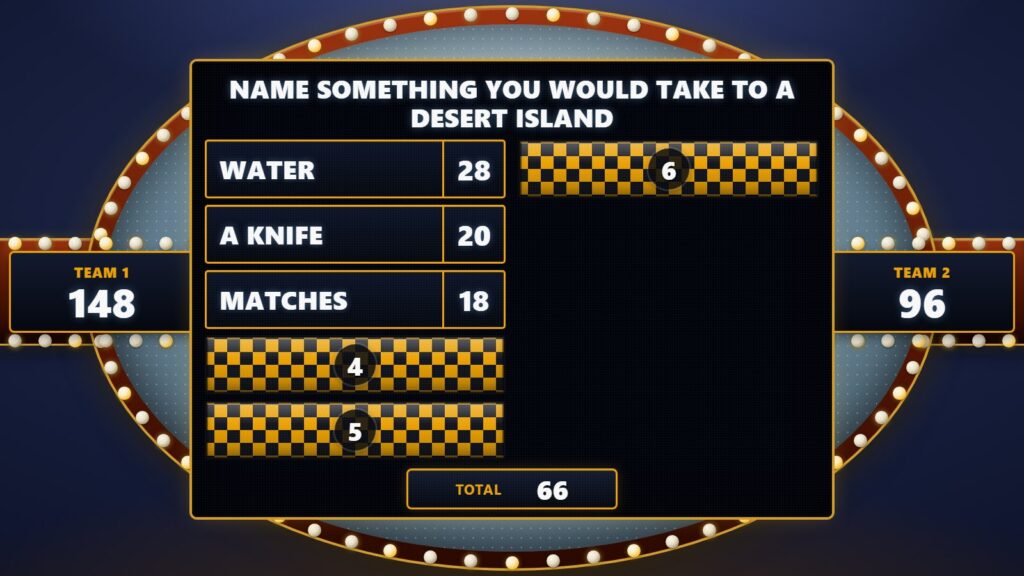
A game show fundraiser is a hosted, TV-style quiz or game round at a charity event, played by tables or by the whole room, where the guests’ taking part is tied to giving. I host fundraising nights and run their auctions as Kevin Durham, The Charity Auctioneer. In 2026 I relaunched every entertainment package around customised game software, so this is what I would check before booking one.
Does a game show fundraiser raise money or just fill time?
A game show fundraiser raises money when guests pay to play, pay for an advantage, or are asked to give straight after a round. A free show that guests simply watch is entertainment you pay for, however loud the room gets.
Do not assume fun alone lifts giving. A 2023 online experiment in PLOS One found no significant overall effect of positive incidental emotions on donation levels. It did shift donations towards the charity running the study. So build the money into the round and treat the good mood as a help.
Competition has a cost too. A door-to-door field experiment of about 4,500 households found an all-pay auction raised less than anonymous giving, because fewer people took part. Keep games team-based and easy to join.
Which game show formats work at a charity event?
The formats that work are the ones where a whole table can play at once and the rules take one sentence to explain. Table teams on a survey board, higher or lower, and table-side rounds all fit a seated room.
| Format | Where the money can come from | Length |
|---|---|---|
| Survey game, tables as teams | A table buy-in, paid lifelines | 15 to 20 minutes |
| Higher or lower, table against table | A small stake per table | 15 to 20 minutes |
| Heads Up between courses | A table fee, or none | 4 to 5 minutes |
| Quiz played on phones | Optional paid lifelines | 15 to 20 minutes |
| Heads or tails | A £5 or £10 buy-in per guest | About 4 minutes |
The lengths come from my own entertainment packages page. Family Fortunes asks teams to guess the answers of a survey of 100 people, and Play Your Cards Right has couples call higher or lower on cards. I run my own versions in that style, written around your charity’s people. You can see them on my game show hire page, and the surveys on personalised game shows.
Where a game round sits, and how it feeds the ask
A game round should sit before the ask, not instead of it. Open with a short game, keep dinner light, and put a table challenge just before the live auction, so a room that has competed together bids harder.
My view is that a night needs balance. Ask too little and you leave money on the table. Ask every 15 minutes and guests feel fleeced and stay away next year. It is fine to run a silent auction, a fundraising game, a live auction and then the pledge, as in my running order guide. The Fundraising Regulator’s code, effective 1 November 2025, says not to put undue pressure on a person to donate.
Between courses, someone can go round the tables, a magician or me, and play Heads Up with people. Otherwise, let the room breathe. Never put a game straight after the live pledge, because the pledge runs straight after the auction and is the peak of the night.
I also use an opening game as a test. Low take-up tells me the room will need more work by the time we reach the auction. My fundraising games page covers the shorter ones.
What does a game show fundraiser cost, and what prizes do you need?
A game show fundraiser costs the host’s fee, which is agreed individually and which I do not quote here, plus prizes, which donors can supply. Ask for the fee in writing before you plan on the game paying for itself.
Here is arithmetic to test any proposal against, with 200 guests on 20 tables of ten. Treat it as a worked example, not a forecast.
- £5 a head to play is £1,000. A £50 buy-in per table is the same.
- Ten tables buying one £20 lifeline each adds £200.
- A £10 buy-in for heads or tails, with 180 players, is £1,800.
I found no published total for a game show night to compare against, so none is quoted. The sums show the round on its own raises a modest amount. Its bigger job is warming the room for the auction and pledge, and hosting from the start also builds trust, so guests feel more comfortable giving later.
Donated prizes keep the cost down and keep every pound with the cause. A gift voucher or an experience will do, because people play for the fun.
Can you charge guests to play a game show at a charity event?
You can charge guests to play, provided the game fits a legal category. A round decided by skill is a prize competition. A round decided by chance is a lottery, and at an event it can run as an incidental lottery within strict limits.
The Gambling Commission’s prize competition guidance, updated 23 October 2024, says the outcome must depend on skill, judgement or knowledge. If you charge to play, check which category your round falls into and ask the Commission or your council if you are unsure. The Fundraising Regulator’s prize competition rules also require the organiser’s name and terms to be published.
For chance, such as higher or lower, the Commission’s incidental lottery page says tickets must be sold at the event, while it is on, and the lottery cannot be its main purpose. It allows £100 of expenses and £500 of purchased prizes, with no limit on donated ones. My raffle guide has the rest.
If guests stake money on outcomes, different rules apply. The Commission’s race night page caps non-commercial equal chance gaming at £8 per player per day. I do not run casino-style games. Ask your council or the Commission, because this is general information, not legal advice.
On Gift Aid, HMRC says payment for admission to events and for raffle tickets is not a gift. A buy-in cannot attract it, but a pledge from a UK taxpayer can.
Do guests need an app or a signal to play?
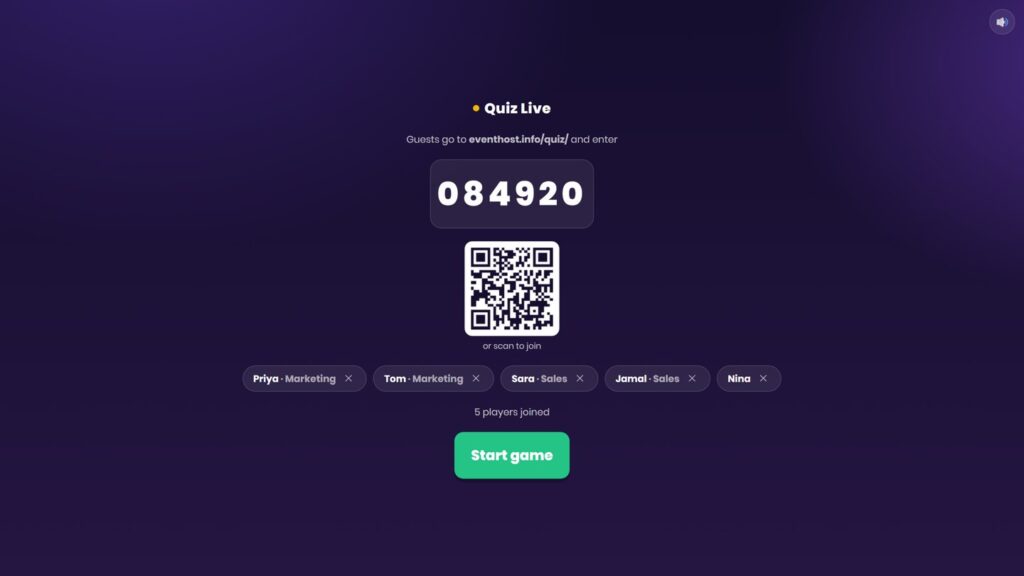
Guests do not need an app for my phone games. They scan a QR code or type a six-digit PIN on the phone they hold, and the big screen shows the question and scores. They do need a signal, so ask the venue.
Venue wifi is one of the biggest problems that recur at the events I attend. A venue says it is fine, and the client finds out on the night. For a large fundraising room where payments must be taken quickly, I suggest hiring Starlink for a day. Table games like Heads Up need no signal.
When is it worth hiring a host for a game show fundraiser?
It is worth hiring a host for a game show fundraiser when the room is bigger than a few tables, the questions must be about your charity, and the game has to hand over cleanly to the auction. A host writes, paces and fixes it live.
A handful of times a year a client hires a separate MC and then hires me as the auctioneer, when hiring me for both would save them a fair amount of money. I wrote about that in host or auctioneer.
Do it yourselves when it is a small supper with a confident volunteer, as in my quiz night post. Book early for December: early December brings a flurry of last-minute game show bookings, and October and November are among my busiest months. Kerry of The Pallet Network said on my reviews page:
“Everything was very upbeat during the event, getting very involved with everybody. It wasn’t just standing on the stage, it was all very interactive and engaging.”
Before you get in touch
Have ready your date, venue, guest and table numbers, the slot you have in mind, the screen and sound available, and a few facts about your charity’s people for the questions. You can also look at how to hire Family Fortunes or the higher or lower game.
Call me on 07596 851647. When you hire me, I build the auction software around your event in your branding, with your lots and tickets. It is included for the event and stays live for one month afterwards.

Kevin Durham
Charity auctioneer & event host