

In short
- Naming rights put a donor’s name on something the charity controls, for an agreed term, in return for a gift.
- Price from the full cost of the item plus upkeep, never below it, and fix a term with a renewal point.
- Adopt a gift acceptance policy first and keep a right to withdraw the name in the agreement.
- A simple acknowledgement is not a Gift Aid benefit. A company’s advertising is sponsorship.
- Sell one name, once, as the top level of a live pledge, with the reserve said out loud.
Naming rights are the right to attach a donor’s name to part of a charity’s work for an agreed period, in return for a gift. I sell these from the stage as pledge levels, so here is what a charity can offer as naming rights, how I would price the lot and how I would sell it. The sell is permanence, and permanence cuts both ways. This is general information, not tax or legal advice.
What can a charity offer as naming rights?
A charity can offer naming rights over anything it owns or controls and a donor can point to: a room, a bed, a bench, a piece of equipment, a programme, a fund, a lecture or an annual award. The test is whether the charity can honour the name for the whole term.
| Item | What the donor is buying | Watch for |
|---|---|---|
| Room | A plaque on the door | Who owns the building |
| Bed or bay | A named place in a ward or hospice | Fittings wear out |
| Bench | The cheapest, often a memorial | Site permission |
| Equipment | A named scanner or minibus | Its working life |
| Programme | A named year of a service | A term matching the funding |
| Fund | A named bursary or grant pot | Restricted-fund rules |
| Lecture | A yearly named event | Running costs every year |
| Annual award | A prize with a name | Donor reputation over time |
My big-money ideas post lists naming rights as a single row. This is the design work behind that row.
How do you value and price a naming gift?
Price a naming gift from the cost of the item upwards, not from what a donor might pay. Take the full cost, add what keeping the name costs you, and call that the floor. Then ask what else the donor could do with the money.
An illustration, not a market rate. RNOH Charity lists a patient room at £25,000 (read October 2026), so use that as the item cost.
- Item cost: £25,000
- Plaque, upkeep and admin over ten years: £2,000 (assumed)
- Floor: £27,000
- Ask for a ten-year name: £30,000, or £3,000 a year
The donor could fund an unnamed room for £25,000, so the name is what the extra buys. A name for the life of the room hands away your renewal ask, and a donor who wants that should pay more, not less.
How long should a naming term last, and what happens at renewal?
A naming term should be a fixed number of years in the agreement, with a renewal point. Perpetual naming is the hardest to exit, says law firm Maurice Turnor Gardner (September 2022), which suggests a blanket maximum term, such as the Smithsonian’s 20 years, so a limit is policy rather than a verdict on one donor.
At the end you have three options: renew with a fresh gift, rename, or retire the name to a donor wall. Match the term to the life of the thing. A scanner’s name should not outlast the scanner.
Before a charity offers naming rights: gift acceptance and the right to withdraw
Write a gift acceptance policy before you advertise a naming lot. The Charity Commission’s guidance on donations (published 4 March 2024, read November 2026) says to start from accepting a gift, to weigh harm to reputation, and that you may want a policy, reviewed regularly. It lists naming rights out of proportion to the gift as a cost to weigh.
The Fundraising Regulator’s Code (effective 1 November 2025) says in 2.2.2 that you must do due diligence proportionate to the size of the gift. Refusing or returning a gift is for exceptional circumstances, documented, and decided by the governing body (2.2.1). CC20 (updated 3 February 2026) asks staff and volunteers to report large, unexpected or anonymous gifts, or unusual conditions, to trustees or senior staff.
Then keep the right to withdraw. Westminster’s donor policy (May 2024) reserves the right to return a gift and remove recognition if later evidence conflicts with its values. The law firm advises defined triggers and saying what happens to the money. Returning money can need Commission permission, so take advice first.
Is a naming gift a Gift Aid benefit or sponsorship?
A simple naming acknowledgement is not a Gift Aid benefit, so it does not by itself defeat Gift Aid. HMRC’s Gift Aid chapter 3 (updated 20 October 2026, read November 2026) says at 3.19.8 that naming a building or part of one after an individual donor is not a benefit, provided it does not advertise or sponsor a business.
At 3.19.1 it says a plaque recording the donor’s name is fine but a sign promoting a business is an advert, and so a benefit. A right to a benefit counts even if unused (3.18.2), so a dinner thrown in is measured against the usual limits.
That is the sponsorship line. HMRC’s sponsorship notice (701/41, last updated 8 May 2019) treats naming a building, wing or area after a donor as an insignificant acknowledgement. But naming an event after a sponsor, where that promotes its brand, is a significant benefit. GOV.UK says a company that gets something back related to its business is sponsoring. A family name on a room is a gift. A logo and a campaign drift towards sponsorship.
The VAT and benefit-limit detail is in my sponsorship packages and corporate donations posts. Check your own case with an accountant.
What goes in a written naming agreement
Put every point in writing, signed by both sides:
- The exact name, and exactly what it is attached to.
- The start date, the term and the renewal route.
- The gift, when each payment falls due and what happens if one is missed.
- The right to withdraw the name, the triggers and what happens to the money.
- The charity’s right to move, rebuild or close the item.
- Who approves the wording, and a line saying the donor gets nothing beyond what is listed.
- Whether Gift Aid is claimed.
How do you sell a naming rights lot live?
Sell a naming rights lot as one name, with a visible reserve, asked as the top level of a live pledge. One lot, one name, one winner. Bidding it against others leaves every underbidder with nothing to give to.
The reserve is the item’s full cost, said aloud, so the room sees where the money goes. Pledge mechanics apply: tell the story first, call the top level, then work down the levels with the early givers setting the tone, as in my live pledge approach.
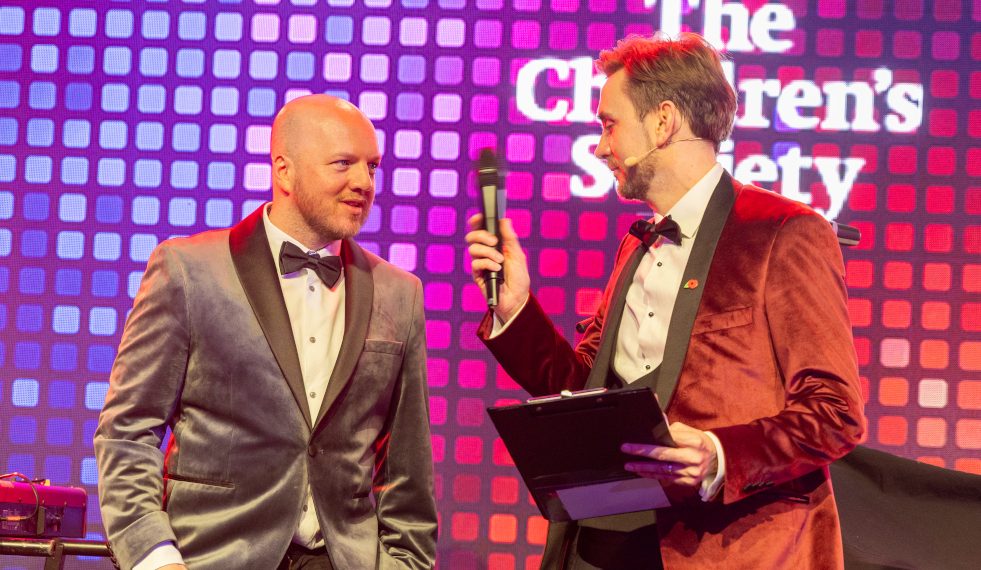
Here is how I would run it: the top level is the naming gift, the levels below fund parts of it, and one hand at the top takes the name. The story carries it. At one gala a pledge stalled while it was just me at the front asking, so I brought up people the charity had helped to speak, and after that the pledge really ran.
What a naming lot must never promise
Never promise a name the charity does not control. A name is the one thing you can only sell once, so check you own it. If a hospital trust owns the wing, the charity cannot give it away, so get the owner’s written consent before you advertise. Do not sell the same name twice. Do not price below cost, offer it for ever or accept a donor you have not checked.
When is it worth hiring a charity auctioneer for this?
It is worth hiring a charity auctioneer when the naming lot is a large gift asked for in a full room. A bench for a village hall needs a letter and a webpage, not me. A £25,000 room asked in front of 200 guests needs timing, a briefing and someone to hold the room.
Naomi Chaning Pearce of Jigsaw Trust says on my reviews page: “Kevin owned the room as he conducted the live auction, more than doubling our target. It was not just during the event where Kevin showed his skills, but also in guiding our planning.” I’m grateful for that, but the result belongs to the team behind the charity.
Have ready the date, the room size, the item and its full cost, your acceptance policy, a draft agreement and the running order. When you hire me I build the auction software around your event, included for the event and live for a month afterwards. See my charity auctioneer services. Call 07596 851647 and we can design the lot together.

Kevin Durham
Charity auctioneer & event host