

In short
- Let hands do the asking and cards do the paperwork.
- A Gift Aid declaration needs a proper tax explanation. “I am a UK taxpayer” on its own is not enough.
- Keep the original cards. HMRC says typing them into a database is not an auditable record.
- Chase unpaid pledges once, politely, then let them go.
Pledge cards are small printed cards that let a guest write down a promise to give: who they are, how much, and whether the charity can claim Gift Aid. Used well at a charity gala, they catch money the room wants to give. Used badly, they turn the most emotional ten minutes of the night into a form-filling exercise.
I’m Kevin Durham, a charity auctioneer and event host, and I always tell charities to run a live pledge. This guide is about the card itself: what to print, when it comes out, and how to collect the money. For the ask from the stage, read my guide to the live pledge.
What are pledge cards, and why use them at a gala?
Pledge cards are a written record of a promise to donate. At a gala they do two jobs a raised hand cannot: they show exactly who promised what, and they collect the details the charity needs to claim Gift Aid.
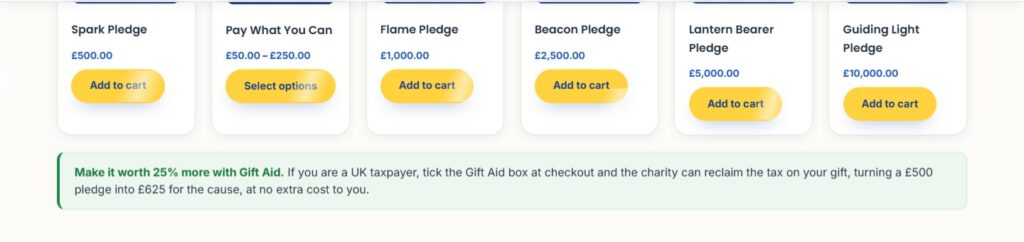
That second job is real money. Gift Aid lets a charity claim 25p for every £1 an eligible UK taxpayer gives, and a pledge is a gift, not a purchase.
But the card is the paperwork, not the ask. The ask is the story, the levels and the energy, which my guide to the fund-a-need covers.
When do pledge cards beat a show of hands?
Pledge cards beat a show of hands when guests need privacy, or when you need details more than theatre. A raised hand is public, fast and contagious. A card is quiet.
Cards win when guests would rather not give in front of colleagues, want an amount that wasn’t called, or when you need every donor’s Gift Aid details.
For most galas, do both: hands during the ask, cards at the table straight afterwards. My comparison of a pledge drive and a live auction explains why that momentum matters.
What should go on a pledge card?
Less than most people print. As one fundraising consultancy puts it, less is more.
- The cause in one line. What tonight’s money pays for.
- The amount. The levels called from the stage as tick boxes, plus “other”.
- Name, email and phone. One donor per card.
- How they’ll pay. Tonight, by link or by transfer.
- Gift Aid. The declaration below, with its own tick box.
- Marketing permission as a separate unticked box. The ICO says pre-ticked boxes are not valid consent.
Word the cause with care, because the card is part of your fundraising appeal. The Code of Fundraising Practice says you must not promise money for one specific thing if it might be used for another (1.2.1), and you should say what happens if you raise more or less than the target (1.2.2).
Leave card numbers off: the Regulator’s guide to cashless donations says card payments must meet the PCI DSS security standards.
How do you put a Gift Aid declaration on pledge cards?
You print HMRC’s required wording next to a tick box. Under HMRC’s detailed guidance, as checked on 19 October 2026, a valid declaration must:
- give the donor’s name and home address (in the UK, house number or name and postcode is enough)
- name the charity
- identify the gift, for example “my pledge at tonight’s gala”
- confirm the donor wants it treated as a Gift Aid donation
- not use a company name or joint names
The charity must also explain that donors who pay less Income Tax or Capital Gains Tax than the Gift Aid claimed on all their donations that year must pay the difference. HMRC’s model declaration has the full wording and fits on the back of a card. No signature is needed, but a date helps. And because joint names invalidate a declaration, a couple’s card needs one name: the person whose money it is.
Three more rules catch galas out:
- Auction bids are not gifts. HMRC treats a winning bid as a purchase, and there is no Gift Aid on payments for goods or services. The box covers the pledge, not the ticket or the lots.
- Keep the original cards. HMRC says typing them into a database isn’t an auditable record on its own. Keep declaration records for six years after the most recent donation you claimed on.
- A missed box can be fixed later. A declaration can be given after the donation.
Donation envelopes work the same way: HMRC lets you print the declaration on the envelope. For cash or contactless gifts of £30 or less with no declaration, the small donations scheme may give you a top-up instead.
The Code says to claim Gift Aid only when all the conditions are met. I’m an auctioneer, not a tax adviser, so check your card with your finance team.
Getting the cards out and back without killing the mood
Hand out cards in the middle of the ask and every head goes down to a pen. The story the room just heard is gone.
The pledge should feel warm, never sombre: it’s not a funeral, and the excitement builds as the money comes in. At the Jigsaw Trust, a live pledge they hadn’t even planned for added £30,600 on top of a £27,000 auction. That was their team and their guests, and it’s exactly the moment to protect. The paperwork can wait ten minutes.
- Before the ask, put cards on the tables or in the programme.
- During the ask, it’s hands, not pens. Whoever holds the room holds the total.
- Straight afterwards, volunteers take cards to the tables where hands went up.
- When collecting: never approach someone with food going into their mouth. Give them a minute.
Brief the volunteers. The Code says you must not take advantage of a donor’s mistake (1.2.4), so if a card says £5,000 and the hand went up at £500, check. Nor should you accept a gift from someone you believe cannot make an informed decision (5.2.3).
Should you use pledge cards, a card reader or phones?
Use whatever turns a promise into money fastest without stopping the room. Usually that’s a mix.
| Option | Strength | Watch out for |
|---|---|---|
| Paper pledge cards | Quiet, private, Gift Aid in writing | Money arrives later, if at all |
| Card reader | Payment taken on the night | Queues, fees, training |
| Phone or QR code | Fast, donors type their own details | Not every guest wants their phone out |
Whichever you pick, the Regulator’s guide says to know the fees, train whoever uses it, and enter only the amount the donor agreed. You can see how I run the pledge itself on my live pledge page.
Following up unpaid pledges
- The next morning, send a thank-you with the amount, the cause and a payment link, and ask for any missing Gift Aid details.
- About a week later, send one friendly reminder.
- Then stop. The Code rules out unreasonably persistent approaches (1.1.2).
If a declaration turns out to be incomplete, HMRC lets a charity validate it with a written statement that gives the donor 30 days to cancel. And bank the money promptly, as Code standard 3.1.1 asks.
The thank-you matters more than the reminder, so thank donors properly.
Before you print your pledge cards
Three checks: can a guest fill it in within a minute, does the Gift Aid wording match HMRC’s, and does every volunteer know when the cards come out?
To talk through the pledge for your own gala, call me on 07596 851647. I’d rather talk it through than trade emails.

Kevin Durham
Charity auctioneer & event host