
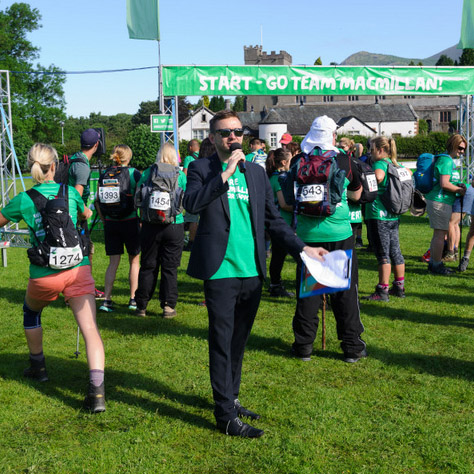
In short
- Walk your route before you publish it. Maps do not show locked gates or the stile that ends an accessible route.
- Footpaths let people walk, not park, marshal or pitch a gazebo. Anything off the path needs the landowner’s permission.
- You must conduct a risk assessment beforehand and should keep it in writing. Public liability insurance is not compulsory in law, but councils and landowners usually insist on it.
- Staff the finish line. That is where totals and next year’s walkers are decided.
A sponsored walk is the most forgiving fundraising event there is. The kit list is a pair of boots, and a wet Saturday in a country park can out-raise a dinner that cost thousands to stage.
It is also the event most often planned backwards: the date goes out, the posters go up, and only then does somebody ask whose field the eleven-mile stretch crosses.
I am Kevin Durham. I work the floor as a charity auctioneer and host, twenty years in and more than £10 million raised. What follows is the organiser’s side of a sponsored walk: route, permissions, and the finish line, where the money is either collected or quietly lost. It is guidance, not legal or insurance advice.
How do you choose a route for a sponsored walk?
Pick a distance your least fit walker can finish, then build the route around the practicalities: parking, toilets, a surface that drains, and a start and finish that is not a blind bend.
Three questions sort most of it:
- Who is this walk for? A school walk and a 20-mile moorland trek need different everything, and my school fundraising post covers the younger end.
- Loop or line? Loops need one car park. Linear routes need transport at the far end.
- What happens in bad weather? Decide the shortened version now and put it on the entry form.
Loops around a park, a reservoir or a canal towpath do the heavy lifting, because walkers can drop out anywhere and still be near their car. Out of town, the Countryside Code asks people to keep to paths, leave gates as they find them, and face oncoming traffic where there is no pavement.
Do you have to walk the route before the day?
Yes. Recce the whole route on foot, in the season you will walk it, ideally twice: once to plan, once a fortnight before to check nothing has changed.
A map will not tell you the second gate is padlocked, or that 200 feet turn a soft verge into mud. Walking it will.
Record as you go:
- Timings at a realistic pace, not yours.
- Every road crossing, with sight lines both ways, and where a marshal can stand safely.
- Mobile signal, which decides how marshals talk to each other.
- Toilets, water, and the nearest point an ambulance could reach.
Photograph each junction. Those photos become your marshal briefing, route map and risk assessment evidence in one go.
What permissions does a sponsored walk need?
You need permission from whoever controls the land for anything beyond walking along a right of way, and from the council to close or manage a road.
In England and Wales a footpath, bridleway, restricted byway or byway open to all traffic is recorded on the council’s definitive map. You can also roam on open access land: moors, heaths, common land. Beyond that you are on private ground unless the owner has given permissive access.
A right of way is a right of passage. It does not cover a registration gazebo, a water station or 80 cars on the verge. Ask in writing, and give the landowner the date, the numbers, the route and your plan for litter and gates.
Then the council. The Cabinet Office guide to voluntary events says most authorities want 4 to 6 weeks of notice for a small closure, and a busy road several months. Larger walks may go to a Safety Advisory Group, which cannot approve or ban anything: the HSE is blunt that organisers retain the principal duties for public safety.
Do you need a risk assessment for a sponsored walk?
Yes, and for a charity event it is a requirement rather than a nicety. The Fundraising Regulator says you must carry one out beforehand, and should keep it in writing even where the law does not demand it.
If your charity employs at least one person, the assessment sits under the Health and Safety at Work etc Act 1974 and the Management of Health and Safety at Work Regulations 1999. At five or more employees the written record is a legal requirement. With no employees you still owe volunteers a duty of care.
The HSE’s method is simple enough to do over a coffee: identify what could cause harm, decide how likely and how serious it is, then eliminate or control it. Its free risk assessment template records who might be harmed, what you do already, and what else you will do.
For a walk the hazards are predictable: traffic, trips, livestock, water, heat, cold, lost children, lone walkers. Write the control next to each one. A risk assessment in a drawer protects nobody, and trustees remain accountable for fundraising even when volunteers run it.
What insurance do you need for a sponsored walk?
No law requires insurance for a voluntary event, but the Fundraising Regulator says you must make sure adequate cover is in place, and whoever lends you the land will want proof.
| Cover | Why it comes up |
|---|---|
| Public liability | The one councils and landowners ask for. Cover starts at £1 million, sometimes for £50 to £60 |
| Employers’ liability | Required if your charity has employees involved on the day |
| Personal accident | Often excluded. Check for marshals |
Two traps. Exceeding your stated maximum attendance can invalidate a policy, so count entries and cap them. And where a third party is involved, the Regulator’s challenge events guidance says a written agreement should set out who insures what.
Marshals, first aid and the sweep walker
Marshals are your event. The Fundraising Regulator expects stewards to have relevant training or experience for the task, which means a briefing, a map, a tabard, a phone number and clear instructions on what they must not do.
One marshal per road crossing is the floor, not the target. Add a start marshal, a finish marshal and a roamer with a car.
Now the two roles organisers forget: a sweep walker at the back, so nobody is left out there alone, and a route closer to collect the signage before it annoys the people who gave you permission.
For first aid, match the cover to the distance, terrain and numbers, and buy it from people who do this for a living. St John Ambulance covers more than 8,500 events a year and is regulated by the Care Quality Commission. Sixty people on a park loop is not the same ask as 400 on open hillside.
How do you make a sponsored walk accessible?
Decide on an accessible option while you are still planning the route, because you cannot retrofit one onto a route with three stiles. Then describe the surface honestly, so people can judge it themselves.
Sensory Trust’s path guidance gives usable numbers: 1.2 metres is the minimum width, 1.8 metres lets two people walk or wheel side by side, passing places every 50 metres help on anything 1.5 metres or narrower, and any gradient steeper than 1:20 counts as a ramp. Avoid loose gravel and soft bark.
Publishing the detail matters as much as the design. Give the distance, ascent, surface, number of gates and stiles, and where the toilets, benches and shorter loop are. The Regulator warns against refusing participation where that would be unreasonable, because it can be discriminatory in law. A short accessible loop costs almost nothing and brings families who would otherwise stay home.
The sponsorship paperwork, kept short
Participants raise money on paper forms, an online giving page, or both, and the charity can claim Gift Aid of 25p per £1 on qualifying donations where it holds a valid declaration.
Get three things right and you can stop worrying: each sponsor’s full name and home address, the declaration wording on every sheet, and a named person and date for returning the money. Family sponsorship on a charity-funded trip has its own rules, so check before promising anything.
Put one person in charge of the running total. Everyone else walks.
The finish line is where a sponsored walk makes its money
The bit the planning spreadsheets miss: a finish line is a fundraising moment, not a car park.
Twenty years of working rooms has taught me one thing above all: command the room before you ask for money. I learned it the hard way at a gala where I announced a live auction into a room that was still talking, and only a fraction of it heard me. The same applies on grass. A crowd of tired, pleased walkers holding a cup of tea is the warmest audience you will get all year, and almost nobody uses it.
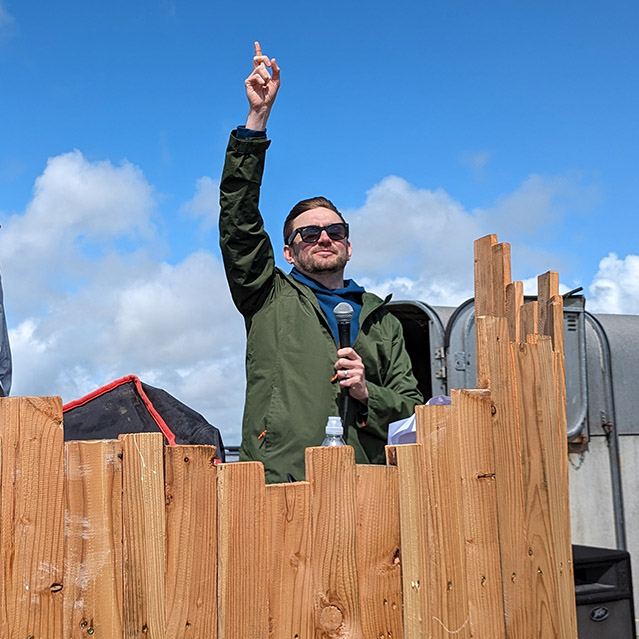
So use it. Someone on a microphone reading out names as walkers cross. A fundraising thermometer showing the total climbing. A raffle drawn at a published time, so people stay. A beneficiary thanking them, which lands harder than anything I say.
Now do the maths on what comes next. A walk is a reach event: hundreds of people, modest sums. An evening event is a depth event: fewer people, bigger gifts, and a live pledge that in my experience out-raises a lot-based auction at most galas. Charities that run both, using the walk to fill the room for the dinner, do better than those that run either alone. The same holds for a charity football match.
My guide to fundraising ideas runs through where a walk sits alongside the rest. You can also see how I work as a charity auctioneer and host, or call 07596 851647 for a free fundraising consultation.

Kevin Durham
Charity auctioneer & event host