

In short
- Two spotters cover most charity auctions. Three or four past 250 guests, or where the room bends round a corner.
- Spotters never accept a bid. They relay it. That one rule prevents almost every argument.
- Position them on the long sides, facing the tables, never in a gangway. Agree three signals before the doors open.
- When two bids land together, the auctioneer decides. Published auction terms give the auctioneer that discretion.
- Recruit people who already know the room, brief them for ten minutes, and never let a spotter lean on a guest.
Auction spotters are the people who work the floor during a live charity auction, catching the bids the auctioneer cannot see and getting them to the front before the hammer falls. A good bid-taking team makes the auction faster, cleaner and higher. A bad one quietly loses you money that never appears on any report, because nobody counts a bid that was never taken.
I am Kevin Durham, a professional charity auctioneer and event host working 60 to 80 events a year. I work the floor myself, wireless mic in hand, rather than standing at a podium. So spotters are not my only eyes on a room I cannot reach. They are the extra pairs of hands in a room I am already in.
What are auction spotters?
Auction spotters are floor staff who watch a section of the room during the live auction and pass every bid back to the auctioneer. In the wider auction trade the same person is called a ringman, and the two words are used interchangeably in benefit and charity work.
The job has one hard boundary. A spotter relays a bid. A spotter does not accept one. Only the auctioneer takes a bid, and under the Sale of Goods Act 1979 the sale is complete when the auctioneer announces it, by the fall of the hammer or in another customary manner, with any bidder free to retract until that moment.
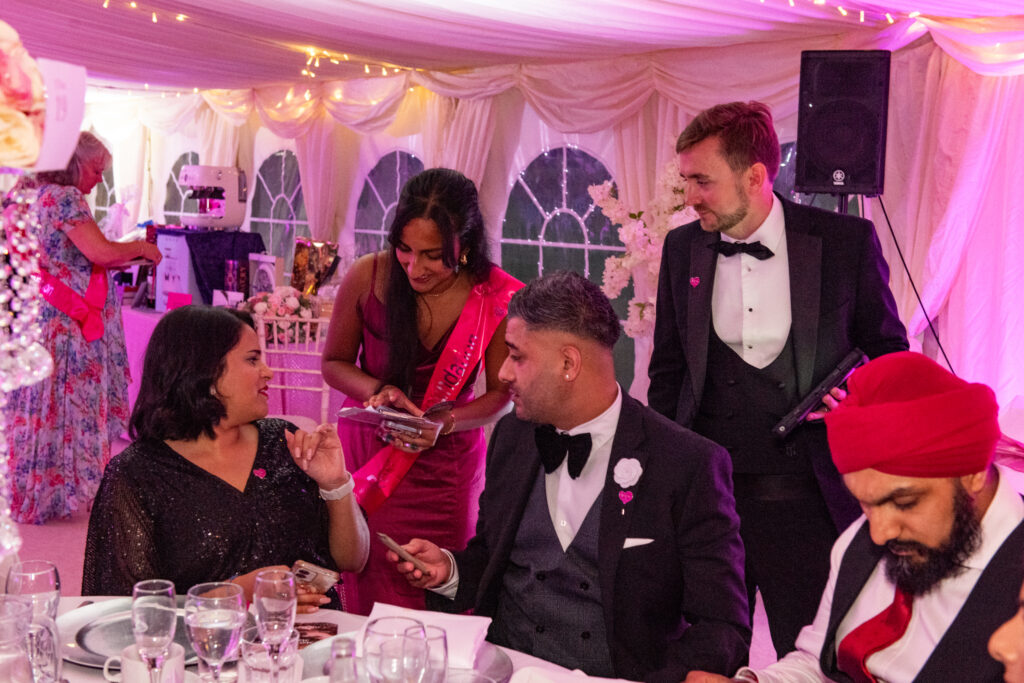
A spotter has one job for twenty minutes: every raised hand in their section reaches the front.
How many auction spotters does a room need?
Two spotters cover most charity auctions, and you want three or four once the room gets serious. No standard exists, so here is how I size it.
| Room | Spotters | Why |
|---|---|---|
| Up to 100 guests, one clear space | 1 | The auctioneer sees almost everyone |
| 100 to 250 guests, rounds of 10 | 2 | One per long side, nobody behind a pillar |
| 250 to 500 guests | 3 to 4 | Depth of room, not width, is the problem |
| Balcony or an L-shaped room | Add 1 per blind area | An unwatched blind area is money you never see |
Count blind spots, not heads. A flat ballroom of 200 needs fewer spotters than 140 split across two levels.
Walk the room before guests arrive and find every seat you cannot see from where you will stand. Those seats tell you the number.
Where auction spotters should stand in the room
Spotters should stand on the long sides, facing the tables, roughly a third and two thirds of the way back. That puts eyes ahead of and behind the middle of the room, both in the auctioneer’s eyeline.
A few rules I hold to:
- Face the guests, never the stage. A spotter watching the auctioneer is watching the one person who does not bid.
- Stay out of the gangways. Under the Regulatory Reform (Fire Safety) Order 2005, emergency routes and exits must be kept clear at all times. Stand at a table corner.
- Stand still during a lot. Movement reads as a bid.
- Do not cluster. Two spotters ten feet apart are one spotter.
What signals pass between a spotter and the auctioneer?
Three signals cover almost everything: new bid, bidder’s number, lost the bidder. Agree them before the doors open and do not add a fourth on the night.
Spotters relay a bid with a short call, a hand signal or eye contact, without breaking the auctioneer’s flow:
- New bid. Flat hand above the head, held there until the auctioneer acknowledges it. Held, not waved.
- Bidder number. Fingers, then point at the bidder. If the room uses paddles, the paddle does this for you.
- Lost the bidder. Flat hand across the chest: the bidder has gone, stop looking.
I add a fourth that travels the other way, from me to the spotters. A flat palm pushed down means stop working that table, I am closing the lot.
What happens when two bids land together?
The auctioneer decides, and that is the end of it. Two bidders at the same number is not a tie, because only the bid the auctioneer has taken is live.
This is not just convention. A UK charity auction’s published terms put it plainly: in the case of error or dispute, during or after the sale, the auctioneer may determine the successful bidder, continue the bidding or re-offer and resell the lot, and the auctioneer’s sale record is conclusive. Sotheby’s Conditions of Business for Buyers (London, 2 July 2024) use the same mechanism, giving the house sole discretion to decide who the buyer is or re-open the bidding, even after the hammer.
On the floor it takes four seconds. I name the bidder I have taken, out loud. Then I turn to the other one: are you going to take that? How are you going to respond? Nine times out of ten they bid, and the charity ends up better off than if the hands had gone up in sequence.
I will not split the difference or pretend I did not see it. Two hands at once is good news. Say so.
How do spotters work a table that is hesitating?
They catch the eye of the person who is nearly there and give them one clear moment to commit. Spotters watch for the small tells, a slight nod, a finger lifted off the table, and they encourage rather than press.
The line between encouragement and pressure is regulated. The Code of Fundraising Practice requires reasonable steps to avoid putting undue pressure on anyone to donate, and accepting a request to end an interaction. So the brief is simple: ask once, warmly, then move on. If a guest says no, that table is finished for that lot.
One other rule, nothing to do with the Code. Never approach someone with food going into their mouth. Let the room breathe during dinner and work it during the live auction, when the energy is up.
Who should you recruit as auction spotters?
Recruit people who already know the room: committee members, the fundraising team, corporate hosts from last year. Familiarity does more for a hesitant bidder than confidence does.
My rough order of preference:
- Committee and board members first. They know the guests by name, which beats anything you can teach in ten minutes.
- Then fundraising or events staff: reliable, briefed on the cause, able to answer a question about a lot.
- Volunteers who genuinely like people. The quiet, meticulous one is better on the payment desk.
- Younger guests from a corporate table, who are usually delighted to be given a job.
Who to leave out: anyone who cannot stand for half an hour, and anyone who will be bidding themselves. The Code of Fundraising Practice also requires appropriate checks that on-behalf-of volunteer fundraisers are suitable, and that they get training and support.
How to brief your spotters on the night
Ten minutes, in the room, before the doors open. Not an email.

NCVO’s guidance on a volunteer induction is the right shape for it: check they understand the role and what you expect, show them where they will be working, and tell them who to go to with a problem. A one-page role description covering tasks and boundaries takes five minutes.
Cover these, in this order:
- Which section is yours, and where you stand in it.
- The three signals, demonstrated twice, with the spotters doing them back to you.
- You relay bids. You never accept one.
- If you lose a bidder, signal it. Do not chase.
- Who records the winning bidder number, and where that paper goes.
- The sentence to use when a guest says no.
Point five matters. The Code requires procedures for counting and recording donations that set out who does what, and when it will be monitored. A bidder number scribbled on a napkin and pocketed by a spotter is how a £3,000 lot becomes an awkward phone call on Monday.
Name the spotters in your event paperwork too. The Code expects a risk assessment beforehand, and a plan where everyone involved knows what is expected of them.
Getting the team right for your room
No bid-taking team can rescue an auctioneer who has not commanded the room first. I know, because I have been that auctioneer. A big event, running late, no speech or video to tee up the auction. I announced the live auction over a room that was still talking and did not stop to get them quiet. One man bid on a lot he could not hear clearly. No spotter can fix that, because there is nothing to spot.
When the room is held, the floor team compounds everything. At a Jigsaw Trust event the committee expected £14,000 from the live auction. It generated £27,000, and a live pledge they had not planned for added another £30,600. That was a powerful team behind a powerful charity, and bidding momentum in a room where every hand got seen.
Spotters cost almost nothing. Sizing the team for your venue is part of what I do before an event, alongside lot selection and the running order. Have a look at my auctioneer services, or call 07596 851647 and tell me about the room.

Kevin Durham
Charity auctioneer & event host