

In short
- Match funding means a funder agrees to give in proportion to what others give, usually £1 for every £1.
- Research on more than 50,000 donors found that simply announcing a match lifted revenue per appeal by 19%. A 1:1 match worked as well as 2:1 or 3:1.
- At a gala, the best use is a matched pledge: a sponsor or trustee commits a capped pot before the night, and you spend it during the live pledge.
- Company matched giving schemes and Big Give campaigns are the two other routes worth knowing.
- Gift Aid follows the person who gives. You can claim it on your supporters’ pledges, but not on a company’s match.
Match funding is the simplest way to make one gift do the work of two. A sponsor, trustee or company agrees to match what your supporters give, and every pound that goes in comes out doubled. Used well at a gala, it is the closest thing fundraising has to a shortcut.
On any fundraising night I work as a professional charity auctioneer, the live pledge is the segment I care most about, and a match is the strongest thing you can bolt onto it. Here is what match funding means, why it works, and how to make it land in the room.
What is match funding?
Match funding is money a funder promises to give in proportion to what is raised from other people. In practice that almost always means pound for pound: you raise £10,000, the funder adds another £10,000.
The term covers a few different arrangements:
- A matched appeal or pledge. A donor or sponsor doubles public gifts up to a cap, for a set window.
- Employer matched giving. A company matches what its own staff give or raise.
- Matching grants. A foundation awards a grant on condition that the charity first raises a set sum elsewhere.
The first two are the ones that raise your total on the night.
Why does match funding make people give more?
Match funding makes people give more because it changes the price of doing good. A £50 pledge suddenly does £100 of work. Most people find that hard to turn down.
The best evidence comes from a large field experiment by economists Dean Karlan and John List. They sent appeal letters to over 50,000 previous donors. Announcing a match raised the revenue per letter by 19% and the chance of someone giving by 22%. The surprise was that 3:1 and 2:1 matches did no better than 1:1.
A second study by Daniel Rondeau and John List adds a twist. Announcing a lead gift that was already committed brought in 23% more donors and 18% more money than saying nothing. In that test, the match itself added no extra lift on top.
The lesson for a gala: donors respond to a committed, visible sum that someone has already put on the table. A match gives you that, plus a reason to give now.
How does a matched pledge work at a gala?
A matched pledge works by doubling every pledge made in the room, up to a cap agreed in advance. The funder commits, say, £10,000 before the night, and every pound pledged is matched until the pot runs out.
The live pledge is already the most powerful segment of any fundraising night. Structured properly, a pledge drive beats a lot-based auction at most galas, and a match gives it a headline.
A well-run live pledge can out-earn the auction with no match in sight. Put a match behind it and every hand counts twice.
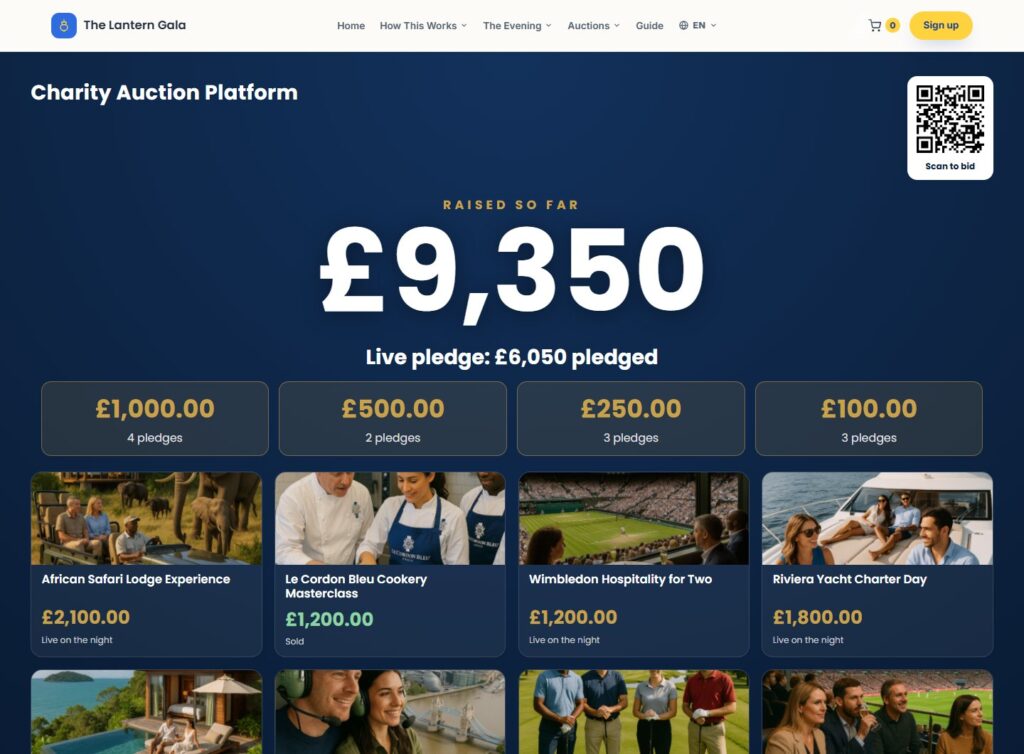
Here is how I’d set one up:
- Announce the match before the first hand goes up. Name the funder if they are happy to be named, and say the cap out loud.
- Tie the levels to the cause. “£500 funds a week of support. With the match, that is two weeks.” My fund-a-need guide covers setting the levels.
- Count the match down. Telling the room how much is left creates real urgency. No fake pressure needed.
- Thank the funder, then go back to the cause. The match is the reason to give now, not the reason to give. Keep it warm and hopeful rather than heavy.
One client doubled their fundraising target. Their team did the hard work; what I added was structure, a plan for the auction and the pledge agreed well before dinner. A match belongs in that plan from day one.
Securing your match before the night
The match has to be confirmed before the event. A pledge that is “probably matched” is not one you can announce.

Your best prospects are already close to you:
- Your headline sponsor. A match gives them something more visible than a logo on a banner.
- A trustee or major donor. Used as a match, their gift gets seen and multiplied instead of banked quietly.
- A corporate partner. Some will treat a match as part of their charity partnership, and my corporate fundraising guide covers how to pitch it.
Agree four things in writing: the ratio, the cap, the window (usually the pledge segment), and what happens if the room falls short of the cap. Some funders give the full amount either way; others only match what comes in. Ask, because it changes how you word the announcement.
Set the cap against your overall fundraising target. Too small and it runs out in the first minute. Too large and the room never gets close, which takes the edge off.
How does company match funding work?
Company match funding is when an employer matches what its staff donate or raise for charity. The CAF guide to matched giving (August 2025) lists the usual models: 1:1, doubling, a cap per employee such as up to £50 a month, or matching during a specific campaign or event.
Schemes can cover payroll giving, fundraising events and personal donations. The company also gets tax relief, because it can deduct donations from its profits before tax.
For a gala, this is money sitting at your corporate tables. Ask table hosts before the night whether their employer runs a matched giving scheme. If they do, mention it during the pledge and follow up afterwards with whatever the scheme asks for.
How does Big Give match funding work?
Big Give match funding works by pairing a charity’s appeal with Champions: philanthropists, foundations and companies who give in advance so that public donations are doubled during a campaign week.
Its flagship Christmas Challenge raised a record £57.4m in one week in December 2025, for 1,591 charities, including £25.8m in match funding. It runs in early December, timed to coincide with Giving Tuesday. Applications for the 2026 campaign closed at 5pm on 15 July 2026. Big Give lists the 2027 window as 10 May to 2 July 2027.
Taking part? Then an early December gala is a natural partner. Tell guests from the stage that gifts through your Big Give page that week are doubled while the match lasts.
Big Give also lets charities run their own match campaigns outside the big challenges. You set up a campaign, send your match funders a pledge form, and upload proof of the funds afterwards. These dates are from Big Give’s Christmas Challenge page as at 3 November 2026, so confirm current terms with them.
Can you claim Gift Aid on matched donations?
You can claim Gift Aid on the part each individual gives from their own money, but not on a company’s match. Gift Aid follows the person who actually gives.
Here is how the HMRC rules apply to a matched pledge:
- Your supporters’ pledges. You can claim 25p on every £1, as long as the donor is a UK taxpayer who has paid enough tax and has made a Gift Aid declaration.
- A company’s match. HMRC says you cannot claim Gift Aid on company donations of money. The company gets its own tax relief instead.
- A trustee or donor matching personally. Their gift is a donation from an individual, so it can qualify on the same terms as anyone else’s.
- Tickets and auction lots. Ticket money does not qualify, and an auction purchase only qualifies on any amount paid above the lot’s value.
That makes the pledge the cleanest segment of the night for Gift Aid.
So put a declaration on every pledge card.
Five ways to waste a match
Matches that disappoint usually fail in one of these ways:
- Announcing it too late. If the room hears about the match halfway through the pledge, you’ve missed the moment it was built for.
- Overclaiming. The Fundraising Regulator’s code says your fundraising must not mislead donors. If the cap is £10,000, do not say “everything tonight is doubled”.
- Chasing a bigger ratio. 1:1 does the job. Ask for a bigger pot, not a 3:1 headline.
- Talking more about the funder than the cause. Thank them warmly. Then get back to the cause: that is what people give to. The match only multiplies it.
- No follow-up plan. Pledges and employer matches need chasing afterwards. Decide who does it before the night.
Putting match funding to work at your gala
Match funding works best when it is part of the plan from the start, not a bonus mentioned on the night. Secure the pot, agree the terms in writing, and give the live pledge the room it needs. My comparison of a pledge drive and a live auction explains why the pledge deserves that slot.
Planning a gala and want to talk through a matched pledge? Call 07596 851647. I’d rather talk it through than trade emails.

Kevin Durham
Charity auctioneer & event host