
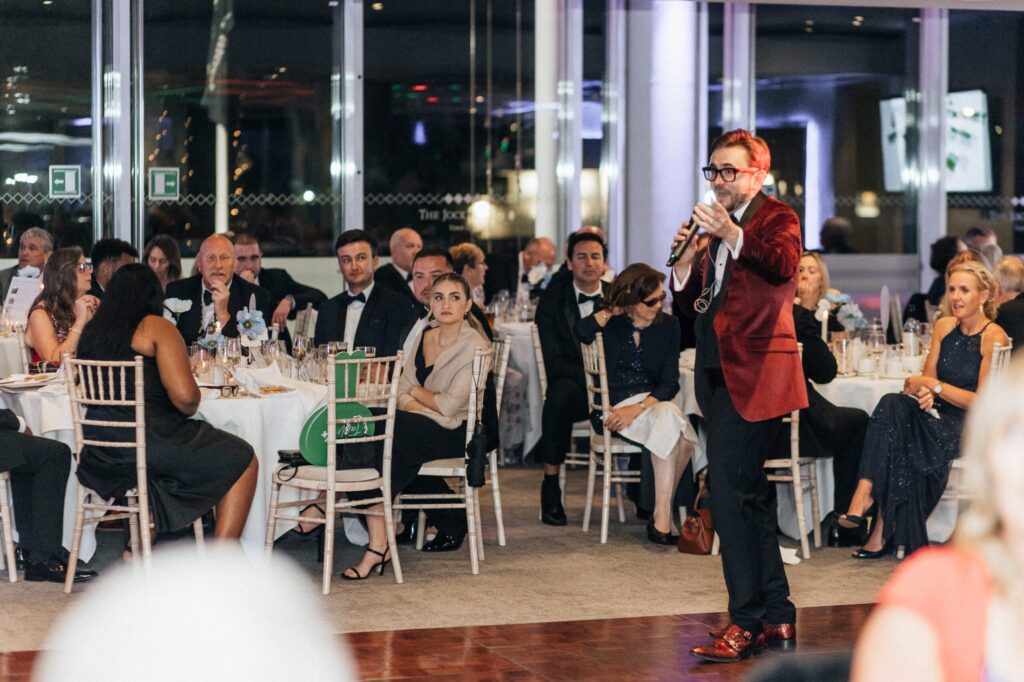
In short
- A microphone fails at an event when the handheld carrying the host’s voice goes silent, crackles or cuts out. At a charity gala that hits the auction and the pledge, because guests cannot bid on a price they cannot hear.
- The fix is made before the night: a second handheld, tested and at the sound desk, a named person to carry it over, fresh batteries and a walk of the room with the microphone live.
- If no spare arrives, the host must be heard anyway. I would stand on chairs or raise my voice until it gave out.
- A host cannot repair a radio microphone. What a professional changes is the minute after it fails.
A microphone fails at an event when the handheld that carries the host’s voice goes silent, crackles or cuts out while a room is waiting to hear it. At a charity gala that is rarely a small embarrassment. Guests cannot bid on a price they cannot hear, and they cannot answer a pledge ask that has not reached the back tables.
I am Kevin Durham, a charity auctioneer, and a microphone has failed on me at a gala. This is the plan I would want in place before it happens to you, and what I do when it does.
What happens when a microphone fails at an event?
When a microphone fails at an event, guests stop hearing the host within seconds and the room starts to talk. At a gala the damage lands on the live auction and the pledge, the two segments where the money is made and where every guest needs to hear the lot, the price or the ask.
Hearing is not a given even when the kit works. RNID’s prevalence page, read in November 2026, says over 18 million people in the UK are deaf, have hearing loss or tinnitus, and that 55 per cent of people over 50 have hearing loss. It adds that these are estimates and probably undercount. If your guest list leans older, my inference is that the back tables lose out first.
What did I do when the microphone failed?
I keep people hearing me by whatever the room needs. The microphone has dropped out on me a few times. Normally the AV team has a backup ready to put in my hand, and most guests never know. One or two times that did not happen.
My principle is that I am responsible for everyone being able to hear me. If it takes standing on chairs, or raising my voice so far that I might lose it, so be it. I would rather lose my voice than have people not hear and the event go badly.
In a big room, a failed microphone at a gala means running all over the room and taking responsibility for people hearing me. I will not add a venue or a figure, because that is the whole story. In a big room I already run among the guests far more than in a small one, so that everyone knows the lot and the current price.
It works, but it is exhausting, and a second microphone in the right hand is better.
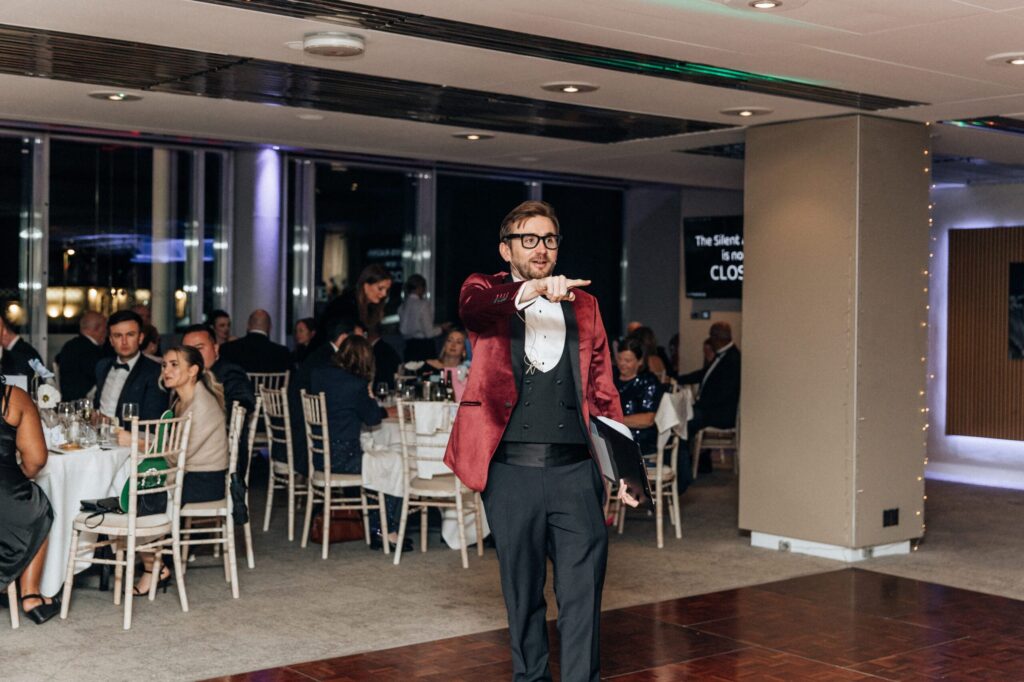
The first minute: what the host and the room do
Keep the auction going, get closer to the guests and send for the spare. This is general advice, not a rule of mine.
- Leave the stage. Move towards the tables that cannot hear. Raise your voice, slow down and do not shout at the microphone.
- Say it in one sentence. Tell the room the microphone has dropped out, the sound team are bringing another and the auction carries on.
- Say the price more often. Repeat the lot and the current bid after each increase, not only at the start.
- Use the spotters. In a large room spotters must be loud when there is a bid, so the host never misses one. I call that imperative. See my guide to auction spotters.
- Point at the screen. If your plan shows the lot and current bid on a screen, that is a second channel when sound is the weak one.
- Let the AV person swap the microphone. Do not stop for it unless the room cannot follow.
A noisy room and a dead microphone have the same effect on bidding, which is why I wrote separately about getting the room quiet.
Who should hold the spare microphone at event time?
A named member of the AV team should hold a second handheld, switched on and tested, where they can see the host, with instructions to walk it over the moment the sound drops. Somebody has to own the walk.
A spare is only a spare if it works with a receiver. Shure’s troubleshooting chart, in its educational publication on wireless systems (copyright 2014), lists a transmitter and receiver tuned differently as one cause of complete silence. Toastmasters’ magazine, February 2017, tells a solo speaker to bring two microphones. An Irish Times piece from October 2018 gives the same advice in one line: have a plan B ready, since the AV may not work.
| Symptom | Common cause, per Shure | First move |
|---|---|---|
| No sound at all | Low battery, muted transmitter, out of range | Swap in the spare, then check battery and mute |
| Cuts out in one part of the room | A multipath dropout | Avoid the spot; AV repositions the equipment |
| Distorted or crackly | Low battery or too high an input level | New battery or lower the level |
The diagnosis belongs to your AV supplier. The host’s move is the same every time: pick up the spare.
What should you check at event set-up so a microphone does not fail?
You plan by making the failure boring: spare ready, batteries fresh, the room walked and one named person on duty. These are general steps, sourced where I can.
- Fresh batteries, checked again. Shure says to always use fresh batteries, and to check their condition before use and periodically during it. Toastmasters, December 2020, puts it plainly: never expect a battery to be fully charged.
- Walk the room live. Shure’s pre-show checklist includes a listening test around the performance area, one system at a time, to verify there are no dropouts. For a gala, walk the route the host will take between the tables, including the corners.
- A wired fallback. A wired handheld on a long lead takes the radio out of the equation. That is my suggestion, not a standard.
- An operator on duty all evening. My guide to the event venue says the same: the operator should be present during the event, not only at set-up.
- Sound check before guests arrive. My standard contract asks the client to provide a working PA, a wireless microphone and sound check access before guests arrive, as set out in the auctioneer contract.
I am usually among the first people at the venue, well ahead of the organisers, and I rehearse on the stage before anyone arrives. One client wrote this on my reviews page: “He came early to do a run through and meet guests.” (Luke Holmes, Noah’s Ark)
Venue wifi is one of the biggest recurring problems at the events I attend: the venue says it is fine, and the client finds out on the night. For a big fundraising room that must take payments quickly, I suggest looking into hiring Starlink for a day.
How can you stop microphone feedback at an event?
Keep the microphone out of the loudspeakers’ line of fire and keep the gain down. Shure lists the usual causes of feedback as a microphone too close to a loudspeaker, a microphone too far from its sound source, excessive gain and several open microphones at once. Its fixes include lowering the output, moving the loudspeakers farther from the microphones and turning off any microphone not in use. For a host who walks the room, that means asking the AV team to test the whole route before doors, because squeal tends to appear where the microphone passes a speaker. Feedback is a set-up fault for your AV supplier to fix, not something a host can cure mid-lot.
Why the radio frequency of a microphone matters
It matters, and it is your AV supplier’s job to check. Ofcom’s page on wireless microphones, last updated March 2023, says the licence-exempt ranges of 173.8 to 175 MHz, 863 to 865 MHz and 2400 to 2483.5 MHz are also used by other low-power equipment, so can be subject to interference.
Co-ordinated frequencies, licensed for a specific site, give the best protection, says the same page. Ofcom also offers short-term licences for programme making and special events. On 27 October 2025 it published a statement deciding to create a new licence exemption for audio equipment of this kind in the 1785 to 1805 MHz range.
Ask the supplier which bands their kit uses and whether the venue needs co-ordination. This is general information, not technical advice.
When is it worth hiring a charity auctioneer for this?
It is worth hiring a charity auctioneer when your auction and pledge depend on a large room hearing one voice, because a professional is there to be heard whatever the kit does. He cannot repair a radio channel. He changes what happens in the next minute.
I am not an AV engineer, so that fault is for your AV team. What I take off your committee is the room: keeping the auction moving, getting the price to every table and carrying the responsibility for being heard. At the conferences I host, AV failure and an under-staffed venue are the most common problems, so ask a gala venue about both. My guide to working with auctioneers covers the wider room and AV brief.
A volunteer can be the right call for a small supper where the chair is heard without amplification and there is no pledge. Once the room is large and the live pledge matters, do not rely on luck.
When you get in touch, have ready the date, the room and its size, the AV supplier and whether they will bring a spare, plus the running order. Call me on 07596 851647. Free auction software is included when you hire me through my auctioneer services: I build it around your event, and it stays live for one month afterwards.

Kevin Durham
Charity auctioneer & event host