
Sports memorabilia at a charity auction: how to source and sell signed lots
In short
- A sports memorabilia charity auction works because a signed shirt carries a story, a rivalry and a bit of pride, and all three lift the bidding.
- The lot is only half the job. A signed shirt read out flatly raises a fraction of what the same shirt raises when the story is told and the room is worked.
- Source in-house wherever you can: local clubs, players, testimonial committees, official club charity requests and your own supporters. Every donated lot keeps more with the cause.
- Authentication is not optional. A certificate of authenticity protects your value, your reputation and the buyer’s trust.
- Pair a few strong signed lots in the live auction with a silent auction of smaller pieces, and set reserves only where you genuinely need to.
Ask a room to bid on a plain framed shirt and you get polite interest. Ask them to bid on the shirt their team wore the day they beat their rivals, signed by the player who scored, and the whole thing changes. That is the quiet power behind a good sports memorabilia charity auction: you are not selling fabric and ink, you are selling a memory people already own.
I have spent twenty years on stage at fundraising events, from village halls to a Monaco gala that raised over €1,000,000 in a single evening, and signed sports lots come up again and again. They are among the most reliable items I sell, but only when they are sourced properly, backed by real authentication and, above all, sold rather than simply announced. This is how I do it.
Why do signed sports memorabilia make strong charity auction lots?
Signed sports memorabilia make strong charity auction lots because they combine emotional pull, tribal loyalty and genuine scarcity, and those three things are exactly what drive competitive bidding. A signed shirt is not a commodity you can price online in ten seconds, which is what gives it room to run in the room.
Think about who is actually bidding. Sports fans do not buy memorabilia coldly. They buy the club they have followed for forty years, the final they stood at, the player their dad idolised. That attachment is worth more than the object, and a live auction is the one place you can turn it into money on the night.
There is a practical point too. Compared with a holiday or a case of wine, a signed shirt is cheap or free to source and it photographs beautifully for your marketing. When you are choosing the best auction items for a mixed crowd, one or two signed sports pieces almost always earn their place. They give the room a moment of proper theatre.
The catch is that their value is soft. A signed shirt is worth what the two most determined fans in the room will pay, and that number depends entirely on how well the lot is presented. Get that right and a modest shirt can outperform a far more expensive prize.
How do you source sports memorabilia for a charity auction?
You source sports memorabilia for a charity auction by asking, directly and locally, before you ever pay a supplier. The best lots come in through relationships, not catalogues, and in-house sourcing keeps far more of the final bid with the charity.
Here is where I look first, roughly in order of value:
- Local clubs. Your nearest professional or semi-professional club almost always has a community or foundation department that handles donation requests. A signed home shirt from the local side often out-raises a bigger-name lot, because the room actually supports that team.
- Individual players. A polite, specific ask to a player or their agent works more often than people expect, especially for a cause with a local or personal connection. One signed boot or shirt from a well-liked player can anchor your whole live auction.
- Testimonial committees. When a long-serving player has a testimonial year, their committee is actively gathering and giving memorabilia. They are used to charity requests and often generous with them.
- Official club charity schemes. Most Premier League and EFL clubs run a formal online process for charity donation requests. Apply early, be clear about your cause, and follow their rules exactly.
- Fans and supporters. Your own guest list is a goldmine. Season-ticket holders and collectors will often donate a signed piece from their own collection when they know it is going under the hammer for a cause they care about.
Whichever route you use, get the provenance in writing at the point of donation. Note who signed it, when, where and in whose presence. That paper trail is what turns a nice object into a saleable lot, and it saves you an awkward conversation later. For a fuller method across every category of prize, I have written separately on sourcing lots for charity events.
Why does authentication matter, and what should a certificate cover?
Authentication matters because a signature you cannot prove is a signature nobody will pay full value for. A certificate of authenticity is what lets a bidder commit real money with confidence, and it protects the charity’s reputation if anyone ever questions the lot.
The memorabilia market has a genuine forgery problem, and experienced bidders know it. If you cannot show where a signature came from, a cautious buyer either drops out or bids low to cover the risk. Either way you lose money that a piece of paper would have saved.
A useful certificate of authenticity should cover:
- Who signed it, named in full, and ideally the event or session where it was signed.
- The date and location of the signing.
- A photograph of the item, and where possible of the signing itself.
- The issuing party, whether that is the club, the player’s representative, a recognised authentication company or the donor, with contact details.
- A unique reference or hologram where the club or authenticator provides one.
When a lot comes with solid documentation, say so out loud when you sell it. On stage I will hold up the certificate and name the source, because that single sentence removes the doubt that quietly caps the bidding. When a piece has no paperwork, be honest about it and price your expectations accordingly, rather than implying a certainty you cannot back.
How do you sell a signed shirt live to a mixed room?
You sell a signed shirt to a mixed room by telling its story first and reading out the details last. The value is in the memory the item unlocks, so you lead with the memory, then let two rival fans do the rest.
A room at a sports dinner or gala is rarely all one team. That is your opportunity, not your problem. When I sell a signed shirt, I find the fans of that club early, get a cheer, and then gently set them against the supporters of their rivals. A bit of pride in the room is worth more than any starting price I could name. This is the heart of what I do at a sports dinner, and it is why the same lot raises so differently in different hands.
The story comes first. Not “lot fourteen, a signed shirt, who will start me at £100”, but the season it is from, what the club did that year, why that signature means something. Give the room a reason to care before you ask them to bid, and the opening bid arrives higher and climbs faster.
A few things I do every time with a signed lot:
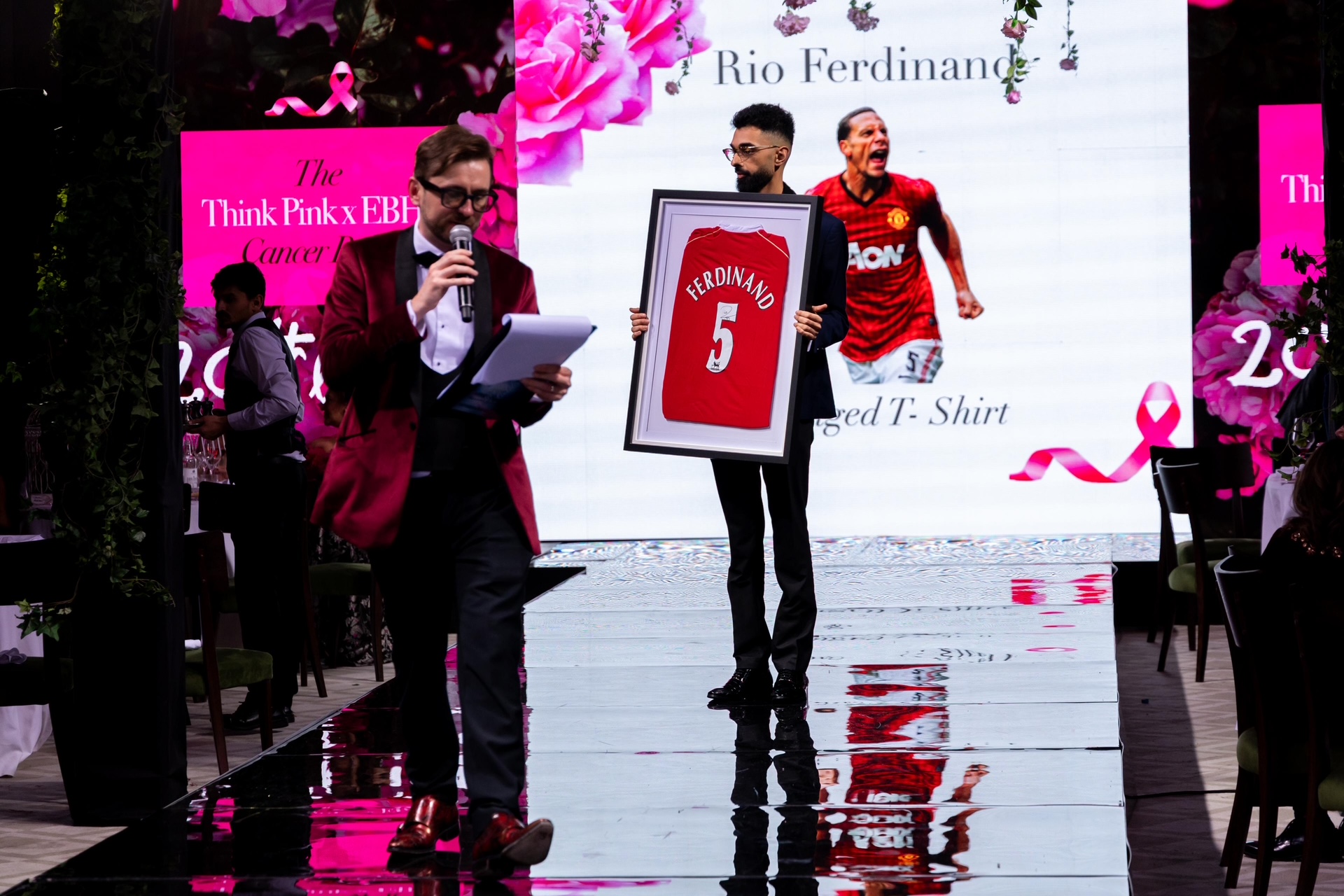
- Get it up and visible. Frame it, hold it up, walk it to the front tables. People bid on what they can see.
- Name the rivalry. A friendly dig at the opposing fans keeps the energy up and the paddles moving.
- Slow the last stretch. When two determined bidders are left, I take my time. Rushing the finish is how you leave the biggest money on the table.
Should you set a reserve on a sports memorabilia charity auction lot?
For most donated sports memorabilia, no, you should not set a reserve, because the whole point is to let the room decide and a reserve can stall a lot before the bidding warms up. A donated shirt that sells for £180 raises £180 for the cause, and there was no cost to protect in the first place.
The exception is a genuinely high-value piece, or one the charity has paid for. If a lot cost you real money to acquire, or a donor has asked that it not go for less than a certain figure, then a modest reserve is sensible. Set it low enough that it never becomes the reason the lot fails to sell.
On pricing, resist the urge to over-value from the stage. If I announce a shirt as “worth £500” and it sells for £250, the room feels the gap and the cause looks short-changed. I would rather let the bidding find its own level and be pleasantly surprised. The market in that room is the only valuation that matters on the night.
Where you do want a floor, a silent auction is often the better tool than a hard reserve, because it lets a lot build quietly to a fair number without a public failure to sell.
The story is what sells the shirt, not the shirt
I keep coming back to this because it is the single biggest difference between an average result and a strong one. Two identical signed shirts, sold on the same night by different people, will not raise the same amount. The one sold with its story, to a room that has been worked and warmed, will comfortably beat the one that is simply read out.
I have watched generous, well-off rooms give a fraction of what they could, because the memorabilia was announced like a shopping list. The lots were good. The signatures were real. Nobody found the rivalry, told the story or drove the finish. That is not the item failing, it is the selling failing, and it is entirely fixable.
Bidding momentum is a skill, not luck. It is also the reason a professional auctioneer usually pays for themselves several times over on a night built around memorabilia, where so much of the value lives in the presentation rather than the object.
How do you pair signed lots with a silent auction?
You pair signed lots with a silent auction by putting your few strongest pieces under the hammer and letting the rest run quietly on the silent tables alongside. A live auction can only carry a handful of lots before the room tires, so that split lets you offer far more memorabilia without slowing the main event.
Put your two or three best signed lots in the live auction, the ones with the strongest stories and the widest appeal. Everything else, the smaller signed photos, mini-bats, gloves and lower-profile shirts, goes on the silent auction tables or a mobile bidding platform where guests can browse and bid across the evening.
The silent auction also does quiet work for you. It captures the guest who would never raise a paddle in front of a crowd but will happily outbid a neighbour on a phone. And it keeps mid-value pieces moving that would otherwise clog up a live running order and drain the room’s energy before your headline lots.
Time it so the silent auction closes just before or during the meal, then bring the live memorabilia in when the energy peaks. Sequenced well, the two formats feed each other rather than compete.
Where to start
Start with two or three signed lots you can genuinely stand behind: sourced in-house where possible, documented with a proper certificate of authenticity, and chosen because the room will care about them. Build a silent auction of smaller pieces around them, keep reserves to the few lots that truly need one, and plan who is going to tell each story from the stage.
That last part is where a sports memorabilia charity auction is won or lost. If you would like to talk through your lots and how to get the most from them on the night, I offer a free initial consultation through my auctioneer services. Bring the shirts, and we will work out how to sell them properly.

Kevin Durham
Charity auctioneer & event host
Let’s talk
Bring this to your event
Book a free consultation with a charity auctioneer who has raised over £10 million.