
Home About Kevin Auctions Virtual auctioneer Pledges Hosting Entertainment Free software Software examples Case studies Reviews Other services Fees Fundraising games Fundraising consultant Get in touch Blog Podcast

How to take part in Children in Need properly: a charity-event guide

Kevin Durham on the microphone with a clipboard, hosting a charity evening

In short

  • The Appeal Show is on Friday 13 November 2026, but the charity’s pages set no fundraising deadline, so your event need not fall that night.
  • No street or door-to-door collections without a licence, and no tins supplied. Hold an event instead.
  • Pay in online, through JustGiving, at the Post Office or by cheque. Never post cash.
  • Pudsey and the logo need a formal licence, and a business selling goods or running promotions needs a written agreement.
  • Ticket sales do not qualify for Gift Aid. Sponsorship can.

Taking part in Children in Need properly means raising money for BBC Children in Need in line with the charity’s own fundraiser guidance. You pay the money in safely, stay inside the rules on collections, raffles and Pudsey, and tell supporters honestly where the money goes. Most groups get the fun part right and the admin wrong.

I run charity auctions and host fundraising nights, and I do not speak for the BBC. What I know is how an evening raises money, so this guide treats a quiz, an auction or a dinner as the vehicle and the charity’s rules as the road. Everything about the appeal comes from its own pages, read on 1 November 2026.

When is the Children in Need Appeal night in 2026?

The BBC Children in Need Appeal Show is on Friday 13 November 2026, according to the Appeal Show page, read on 1 November 2026. The show is held in November each year, so check that page for any later year.

The charity also lists a fundraising week, BBC Children in Need Week, as 9 to 13 November, and Run with Pudsey and Joe Wicks starts on 1 November. Challenge Yourself 2026 gives no end date.

Your own event can sit before or after the broadcast. My view, not the charity’s: a quiz or auction held on the night competes with the television, so a week either side often suits guests better.

What can you do for Children in Need properly, and what can’t you?

You can fundraise at any age and in almost any way, but BBC Children in Need’s fundraising FAQs draw firm lines around collections, raffles, business promotions and children. It does not authorise individual fundraisers or supply free prizes or merchandise.

ActivityWhat the charity’s FAQs say
Street or door-to-door collectionNot encouraged. Public collections need a licence, and no tins or buckets are supplied.
Collection boxCollector must be 16 or over.
Collecting at a private venueSuggested instead, with the owner’s permission.
RaffleA lottery under the Gambling Act 2005, so it must follow the law. Under 16s cannot sell tickets for licensed lotteries.
Business sales or promotionsA written agreement with the charity is required.
Splitting with another charityAllowed if supporters are told the split and which charities benefit.
Under 16sWritten consent from a parent or guardian, and no counting the final total.

The Fundraising Regulator adds a risk assessment, which must be in writing by law for organisations with five or more employees, plus checking your insurance covers the event and the venue’s maximum attendance.

Telling the charity what you are doing is optional, but its tell us form may get you featured on BBC TV, radio or social media. It cannot promote individual events itself.

How do you pay the money in?

The charity says the safest route is its online pay-in system. Money can also go through a JustGiving page, at a Post Office as the charity’s official cash partner, or by cheque payable to BBC Children in Need. Its pay-in page is explicit: do not post cash.

Money donated through JustGiving or similar platforms is paid to the charity at regular intervals. The pages I read give no bank transfer details and no pay-in deadline, so bank cash the day you collect it and ask the charity if you need an exact date.

Can you use Pudsey or the logo?

Not without a formal licensing agreement. The FAQs say Pudsey is a trademark copyrighted by the BBC, so anyone using his logo needs a licence. The page I read gives no wording template for “in aid of”, so ask the fundraising team on pudsey@bbc.co.uk before printing anything.

This post carries no logo or Pudsey imagery for that reason. Posters can say what the money is for in plain words.

Choosing the vehicle: quiz, auction of promises or dinner

Pick the format by the size of the room and the lead time, not by what sounds fun.

  • Lunchtime or evening quiz. Right for a workplace or club with a week to plan. Charge per team, find a proper host and keep one clear target. My quiz night guide covers pacing.
  • Auction of promises. Colleagues donate a favour or a skill, never a person. It needs a host with some pace, and my auction of promises post explains the format.
  • A dinner or ball. Only if you have weeks, because a venue, ticketing and lots cannot be built in a few days.
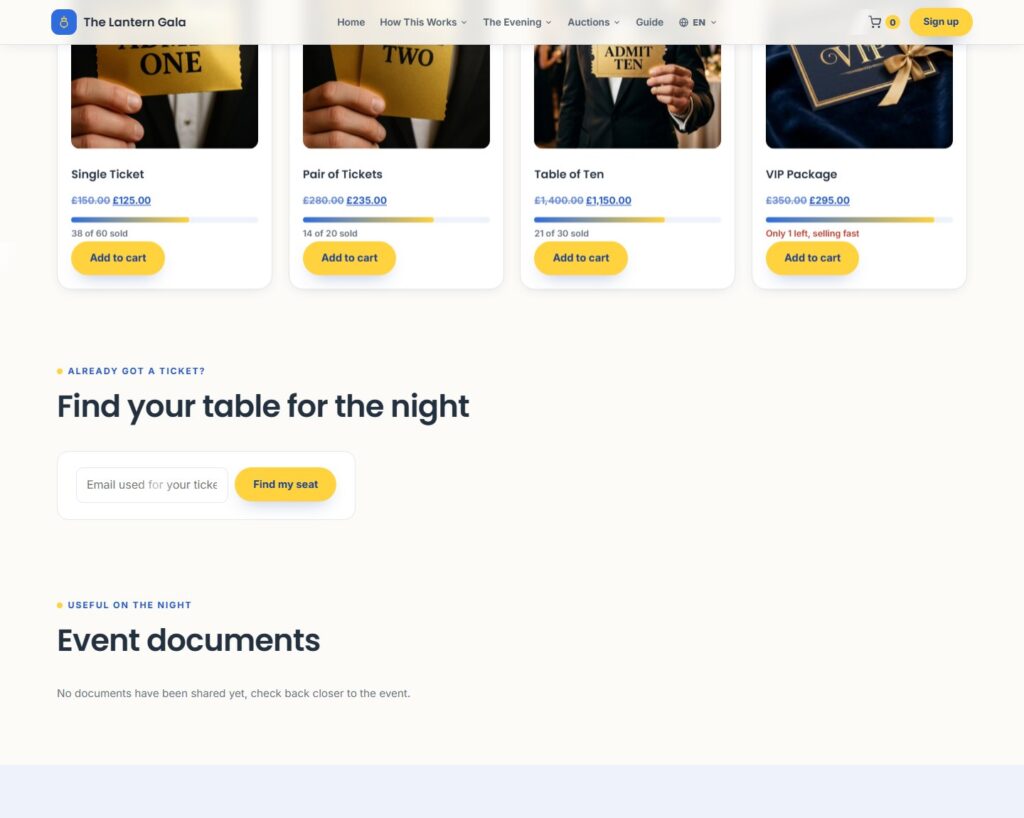
Ticket tiers and table sales on a charity event page in the auction software

Whichever you choose, say plainly where the money goes. The Fundraising Regulator’s events guide says marketing should accurately explain how money raised will be used. Here is the arithmetic. Sixty guests at £25 is £1,500. If catering costs £900, then £600 reaches the charity, and “all proceeds go to Children in Need” would be wrong.

Either get the costs donated and say so, or print the split. The year before MS UK hired me, an external auction company grossed about £13,000 and the charity saw about £1,300. I told the room at the start where every pound was going, and the money followed the transparency.

Where do raffles and Gift Aid catch groups out?

A raffle at a charity evening needs no licence if it is an incidental lottery, but the rules are narrow. The Gambling Commission’s incidental lottery guidance says tickets are sold only at the event while it is happening, never online or beforehand.

The raffle cannot be the main reason for the event. Up to £500 of proceeds can buy prizes and up to £100 can cover running costs, while donated prizes have no value limit. My charity raffle rules post has the detail.

Gift Aid trips up more groups. HMRC says event tickets for a fundraising dinner do not qualify as donations, and an auction purchase does not qualify where the item’s retail value exceeds the benefit limits. As a concession, though, the winner may treat part of the payment as buying the item at its value and claim Gift Aid on the excess, if it can be bought elsewhere and its value was known when they bid.

Sponsorship does qualify. BBC Children in Need must have each sponsor’s first name or initials, surname, full home address and postcode, and says £10 of sponsorship can add £2.50. Twenty sponsors at £10 is £200, which could become £250.

Is a charity auctioneer worth hiring to do Children in Need properly?

For a lunchtime quiz or an auction of promises, usually not: a confident colleague and a clear target will do. A professional earns the fee when you have a room of tables, one night to hit a number and a live auction or pledge that needs momentum.

A professional changes three things. The room is quiet before anyone is asked for money, the pace never drops, and a live pledge is built in. In my experience, most event planners do not realise how much a pledge can raise.

Naomi Chaning Pearce of the Jigsaw Trust put it more kindly than I would on the reviews page: “Kevin owned the room as he conducted the live auction, more than doubling our target. It was not just during the event where Kevin showed his skills, but also in guiding our planning.” The Trust built that room. My job was small next to theirs.

If you hire me for a Children in Need evening, the auction software is included. I build the platform around your event, in your branding, with your lots and tickets. It stays live for a month afterwards. See my charity auctioneer services for how it works.

If your night is in the next ten days

  1. Today. Choose one format and one target, and tell the charity what you are doing.
  2. Tomorrow. Set up a JustGiving page, so nobody holds a tin of cash.
  3. This week. Collect donated prizes, and print the plain-words poster showing what the money does.
  4. On the night. Sell raffle tickets only at the event, and collect sponsor details for Gift Aid.
  5. Next morning. Pay in, then send thanks with the total.

When you get in touch, have the date, number of guests, venue, running order and what went wrong last time to hand. Call me on 07596 851647.

Kevin Durham, charity auctioneer

Kevin Durham

Charity auctioneer & event host

20years£10m+raised60–80events/yr
Check availability07596 851647

Let’s talk

Bring this to your event

Book a free consultation with a charity auctioneer who has raised over £10 million.

How to start a fundraiser: the decisions you make before you pick an idea

Kevin Durham on stage with a microphone, holding up a card to a seated black-tie audience

In short

  • Decide who gets the money before you ask for any. Raise first, choose later, and the charity may not be able to accept it.
  • Fundraising for a charity and for a person differ in law. Only one can claim Gift Aid.
  • You do not need permission to raise money in aid of a charity, but you must say that is what you are doing.
  • Donations belong in a platform or a dedicated account, never your current account.
  • What you raise is capped by who is in the room and whether anyone makes a real ask.

Almost everything written about how to start a fundraiser begins with a list of ideas. Bake sale, quiz night, sponsored walk, pick one and go. That is the wrong end of the job.

I auction at 60 to 80 charity events a year, and by the time I arrive the total is half decided, settled weeks earlier by choices nobody thought of as decisions.

How do you start a fundraiser?

You start a fundraiser by settling five things, in this order: who the money is for, whether that beneficiary is a charity or a person, how much you want to raise, where donations will be held, and what you are promising donors. Only then do you choose a format.

Do it the other way round and you end up where most first-timers do: a lovely event, a hundred people, a cash tin, and a total that feels small for the effort.

The number matters most, because it picks the format for you. £500 is a cake sale and a raffle. £50,000 is a room of the right people and a structured ask, and no amount of cupcakes gets you there. Say it out loud and give it a deadline, which the regulator expects stated at the start rather than retrofitted. I cover the maths of a fundraising target separately.

Set it knowing the public gave about £14 billion in 2025 against £15.4 billion in 2024, with 55% giving at all against 69% in 2016.

What are you raising for, and who gets the money?

Name the beneficiary first, in writing, before you promote anything. The Fundraising Regulator is blunt: raise money before you have chosen a charity and the charity may be unable to accept it, leaving the regulator to decide where it goes.

Be careful with specifics too. “For the new minibus” raises more than “for the charity”. It also binds you. Money given for a named project becomes a restricted fund and can only be spent on what the appeal said, which is why Charity Commission guidance updated in February 2026 tells charities to name a secondary purpose from the start.

Are you fundraising for a registered charity or for an individual?

A fundraiser for a registered charity sits inside the UK fundraising rules. A fundraiser for a named person does not. That fork changes the paperwork, the tax, and what you have to say out loud.

Raising money for a neighbour, a family’s medical costs or a pet’s operation is a personal cause, and the Fundraising Regulator says it falls outside its remit. The catch is honesty: donors must be told the appeal is personal before they give, and implying it is charitable could amount to fraud.

Three consequences.

  • Gift Aid is off the table. It applies to gifts to charities, so nothing collected for an individual gets topped up by 25%.
  • A misdescribed appeal can be reclassified. Dress a personal appeal up as charitable and the Charity Commission may direct the money to a charity, or tell you to register one.
  • Large appeals may have to become a charity. You must register a charity in England and Wales once annual income passes £5,000: trustees, usually three, and a governing document.

Most people here are better off supporting an existing charity, so somebody else carries the governance.

Do you need the charity’s permission to fundraise for them?

No, not if you are raising money in aid of a charity on your own initiative. You do need to be accurate about your role, to check it is on the charity register, and to tell them anyway.

The regulator’s FAQs draw the line. Raising money in aid of a charity means you organised it and you carry the responsibility, so you must make clear you are not acting on behalf of the charity. On behalf of means they asked you, and the charity holds the control.

Tell them for selfish reasons. Charities hand volunteers branded materials, a named contact, a Gift Aid route and sometimes a speaker who explains the cause better than you can. Trustees also stay accountable for fundraising in their name, so a charity that knows nothing about your event cannot help when it goes wrong.

Where the money sits until it reaches the charity

In a reputable giving platform, or an account that exists only for this fundraiser. Not in your current account.

The Fundraising Regulator advises against personal bank accounts: they can look like personal gain and can create tax problems for you. If you cannot avoid one, move the money on quickly and keep records showing it arrived where you promised.

Read the platform’s terms first: its fees and any optional tip at checkout must be disclosed to donors.

What do you have to tell donors before they give?

Who benefits, what the money is for, what happens if the plan changes, and what comes off the top. The regulator expects fundraising to be open and honest, with no undue pressure to give.

A checklist for the page, the poster and the night:

  • The charity’s name and registered number, or a clear statement that this is a personal appeal.
  • Whether it is for the charity generally or one named project, and your deadline.
  • A secondary purpose: what the donations do if the thing you described cannot happen. Without one you need every donor’s permission to spend it differently.
  • Platform fees, tips, and any expenses you will deduct.
  • For a sponsored challenge, whether donations stand if you do not finish. Say nothing, and you refund every sponsor.

Say what you deduct, too: quiet deductions found out later turn a well-meant appeal into an accusation of fraud.

Transparency is also where the money is. Say out loud which lots give the charity every penny and which only pay above a reserve. People give more freely when they can see where it lands.

The three early decisions that set the ceiling

None is the idea. The first is who is in the room: fifty people who care and can write a cheque out-raise three hundred passers-by. Build the guest list like it is the fundraiser, because it is.

Guests at round tables filling the room at the MAG-FEST charity gala, stage lit at the far end

The second is whether anyone makes a real ask. Most first fundraisers sell things: tickets, cakes, raffle strips, a tombola. Selling raises the float. Asking raises the money. A structured ask, where one person stands up, explains what a specific amount buys and invites the room to give at that level, is the biggest lever anyone has. In my experience a well-run live pledge beats a lot-based auction, and it costs nothing to run.

Jigsaw Trust expected £14,000 from their live auction. The auction did £27,000. The live pledge they had not planned for added £30,600. Same room, same night, same guests.

The third is the shape of the evening: a speech or film that explains the cause, a quiet room, and a host with control of it. Get those into the running order early, as my charity gala guide sets out.

The rules people miss when they start fundraisers at home

Two legal traps catch nearly every first-timer, both involving tickets.

Raffles are lotteries. Run one at an event and it is normally an incidental lottery, needing no licence, but the conditions are tight: tickets sold only at the event while it is happening, never in advance or online, only £100 of the proceeds taken for expenses and up to £500 for bought prizes, and no rollovers. Donated prizes have no cost limit, which is why good fundraisers ask for them. Sell tickets in the weeks beforehand and that exemption is gone: you need a small society lottery registered with your local licensing authority, and my guide to a charity raffle covers that paperwork.

The other trap is Gift Aid on the wrong things. Payments for admission and raffle tickets are purchases, not gifts, so keep the ticket modest and invite guests to give more on top. The Code of Fundraising Practice also expects a risk assessment and any permissions the event needs.

What mistakes do people make when they start fundraisers?

These are the common ones, and every one is avoidable.

  • Choosing the format first, then working backwards to a reason.
  • Spending on a venue and a band before a ticket is sold, so the charity gets whatever survives.
  • Inviting everyone, because a big crowd feels like success, and filling a room that cannot give.
  • Running the ask after dessert, or never asking at all.

One from my own worst night. A big event, running late, no speech or film to tee up the auction. I announced the live auction while people were still talking and did not stop to get them quiet. Only part of the room heard the lots. One man bid on an item he could not hear properly. Since then, nothing gets sold until the room is quiet.

So: write down the beneficiary and the number, call the charity, and open the account the money will sit in. Then, and only then, go browsing fundraising ideas and event formats for the room you can fill.

If your fundraiser is big enough to need a proper ask, call 07596 851647 for a free fundraising consultation.

Kevin Durham, charity auctioneer

Kevin Durham

Charity auctioneer & event host

20years£10m+raised60–80events/yr
Check availability07596 851647

Let’s talk

Bring this to your event

Book a free consultation with a charity auctioneer who has raised over £10 million.

What is a fundraiser? Fundraiser meaning, the main types and which raise most

Kevin Durham at the lectern under a screen welcoming him as host of the MAG-FEST charity gala

In short

  • A fundraiser is either an event that raises money for a cause or a person who raises it. All four major dictionaries checked here give both.
  • In England and Wales, the Charities Act 1992 gives “professional fundraiser” a legal meaning: someone paid to ask for money for a charity who isn’t its employee or trustee.
  • The main types of fundraiser range from cake sales and sponsored challenges to raffles, auctions and gala dinners.
  • Formats where everyone is in one room, giving at the same moment, usually raise the most per guest. In my experience the live pledge is the strongest of them.
  • Raffle tickets and event tickets are payments, not gifts, so they do not qualify for Gift Aid.

The fundraiser meaning has two halves. A fundraiser is an event held to raise money for a cause, usually a charity, and it is also the person who does the raising. The sentence tells you which: “we are holding a fundraiser” is the event, “she is a brilliant fundraiser” is the person.

The first kind is my day job: I work 60 to 80 events a year as a charity auctioneer. So here are both meanings, the main types, and where the live auction and the live pledge sit among them.

What is the fundraiser meaning in the dictionary?

The dictionary fundraiser meaning is a person or an event that collects money for a particular purpose, especially a charity. Four dictionaries, four slightly different wordings:

  • Cambridge Dictionary combines both: “a person or event involved in collecting money for a particular purpose, especially a charity”.
  • Oxford Learner’s splits it into a person who collects money for a charity, and a social event or entertainment held to collect it.
  • Collins lists the event first and the person second.
  • Merriam-Webster puts the person first, and dates the word to 1881 in that sense.

In the rooms I work in, “a fundraiser” nearly always means the event.

The second fundraiser meaning: the person doing the asking

The person who raises the money is the older fundraiser meaning on record, and it covers a wide group. A parent shaking a bucket at the school gate is a fundraiser. So is a charity’s head of major gifts, and so is the volunteer selling raffle tickets at a dinner. On a gala night, those volunteers are as much a part of the total as anyone holding a microphone.

The law in England and Wales draws a sharper line. The Charities Act 1992 defines a “professional fund-raiser” as someone who runs a fundraising business, or who is paid to ask for money for a charity. A charity’s own employees, officers and trustees are excluded, and so are people paid below small thresholds set in the Act.

It matters because trustees carry the can. The Charity Commission’s trustee guidance says they must carry out due diligence on professional fundraisers, and they stay accountable for fundraising they delegate.

Fundraiser, fund-raiser or fundraising?

Fundraiser is the noun, fundraising is the activity, and fundraise is the verb. The hyphenated “fund-raiser” still turns up: Merriam-Webster and Collins’s American entry list it as a variant, and the 1992 Act uses it. All four dictionaries above give the single word as the main spelling.

Guests at their tables in an aircraft hangar while Kevin Durham hosts the MAG-FEST charity gala from the stage

What makes an event a fundraiser?

An event becomes a fundraiser when raising money for a cause is its purpose, not a side effect. A quiz night that donates its leftover kitty is a quiz night. One sold, run and timed around the money is a fundraiser event.

Most fundraiser events bring money in through several routes on the same night:

  • Tickets, which usually just cover the costs.
  • A raffle or tombola: small sums from almost everyone.
  • An auction, where a handful of lots go to a few bidders.
  • A live pledge or appeal, straight donations at set levels, and often the biggest number of the night.

HMRC doesn’t treat them the same. Its Gift Aid guidance says payment for admission to an event, and the price of a raffle ticket, are payments rather than gifts, so neither qualifies. An auction bid is a purchase too, though part of it can count as a donation when the bidder knowingly pays over the shop price. A pledge is a gift, so it can qualify.

What are the main types of fundraiser?

The main types of fundraiser fall into events, challenges, draws and direct asks. The Chartered Institute of Fundraising’s library lists types of fundraising from corporate partners and grants to auctions, events and crowdfunding. These are the ones a charity can run itself:

Type of fundraiserHow the money comes inEffortWhat limits the total
Cake sale, coffee morning, quiz nightSmall payments from a local crowdLowHeadcount
Sponsored challengeFriends and family sponsor a participantMediumHow many people take part
Raffle or tombolaTicket sales, prizes donatedLowTicket price times people in the room
Online appeal or crowdfunderDonations from a wide networkMediumReach of the people sharing it
Charity auctionBidders compete for donated lotsMediumThe lots, and who is bidding
Live pledgeGuests give at set levels in one momentLow on paper, high on the nightThe case for the cause, and how it is led
Gala dinner or ballTickets, raffle, auction and pledge in one eveningHighWho is in the room, and how the night runs

The auction and the live pledge rarely stand alone. They are the two big moments inside a charity gala, a charity ball, or even a boxing night.

Which fundraiser activities raise the most?

The fundraiser activities that raise the most per guest are the ones that put generous people in one room and ask them at the same time: the live auction and, above all, the live pledge.

The UK Giving report from the Charities Aid Foundation estimated that in 2024 the public gave £951 million at fundraising events, against £514 million on raffle tickets. Only 21% of people sponsored someone for charity in 2024, down from 32% in 2019.

At a single event, the gap between formats is wider still. When I worked the Jigsaw Trust gala, the charity expected £14,000 from the live auction. The auction made £27,000, and a live pledge they hadn’t even planned raised another £30,600. The credit goes to their team, and it’s why every client of mine hears the same advice: run a pledge. An auction raises money from the few people who win lots. A pledge asks the whole room, so it often raises more than the auction. It’s serious, yet the excitement still builds as the hands go up. No format guarantees a figure, though. The room, the cause and the running order decide it.

The rules every UK fundraiser runs under

Fundraising by UK charities and third-party fundraisers sits under the fundraising code. Its 2025 edition came into effect on 1 November 2025, with standards for events and for volunteers.

Raffles have their own rules in Great Britain. Under Gambling Commission guidance, a raffle at an event needs no licence, but tickets can only be sold at the event while it is running. You can spend up to £500 of ticket money on prizes and £100 on costs, and donated prizes have no limit.

Kevin Durham in a burgundy velvet dinner jacket speaking from the lectern at a charity gala

Where an auctioneer fits in

At a fundraiser event, the host decides how much of the room’s goodwill turns into money. My job is to command the room before the first lot, keep the auction tight, and then lead the pledge while the energy is still high.

Still choosing what kind of fundraiser to run? My list of fundraising event ideas is a good next step, and my page on running a pledge explains the segment that usually raises the most. To talk through your event, call 07596 851647.

Kevin Durham, charity auctioneer

Kevin Durham

Charity auctioneer & event host

20years£10m+raised60–80events/yr
Check availability07596 851647

Let’s talk

Bring this to your event

Book a free consultation with a charity auctioneer who has raised over £10 million.

Fundraising ideas for big money: the formats that raise thousands, not hundreds

Charity auctioneer Kevin Durham in a burgundy velvet jacket, microphone in hand, pointing out into the room at a gala

In short

  • Big money comes from big asks made to the right people. The format sets up the moment.
  • A gala with a short live auction, then a live pledge, is the most reliable big-money format I know.
  • A major-donor dinner raises a lot from a few people, especially with an announced lead gift.
  • Match funding, challenge events and sponsorship add thousands, but each has costs or conditions.
  • Raffles and cake sales have built-in ceilings. Keep them as add-ons.

The best fundraising ideas for big money have one thing in common: they put a large ask in front of people who can say yes to it. A cake sale asks two hundred people for £3. A gala pledge asks the same two hundred people for £100, £500 or £5,000, and gives them a reason to say yes in front of each other.

Big totals are my day job as a charity auctioneer: 60 to 80 events a year, and over £10 million raised for charity so far. This guide ranks the formats that raise thousands, not hundreds.

What counts as big money in fundraising?

Big money in fundraising means an event or appeal that nets thousands or tens of thousands for the charity after costs, not one that grosses a big number and keeps little of it.

Net is the only figure that matters.

Every fundraising idea has a ceiling: how many people you reach, times how much you ask each one for. Raise both and the total jumps.

A raffle shows the problem. Under the event raffle rules, you can spend up to £500 of proceeds on prizes and sell tickets only at the event, while it is happening. It’s a fine add-on, but every ticket is a small ask.

Which fundraising ideas raise big money?

The fundraising ideas that raise big money are built around large individual gifts. Here is how the main formats compare.

FormatWhere the money comes fromEffortWhat caps it
Gala with live auction and pledgeBids and pledges in the roomHighWho is in the room, and how it is run
Major-donor dinnerA few large giftsMediumYour contacts with wealthy supporters
Matched pledge or appealPublic gifts, doubled by a funderMediumThe size of the match pot
Challenge eventParticipants’ sponsorshipMediumPlaces, and the event’s own costs
Corporate sponsorshipCompanies buying tables or naming rightsMediumYour local business network
Raffle, tombola, cake saleMany small paymentsLowTicket price times headcount

Most of the great fundraising ideas on long online lists sit in that bottom row. Use them as extras around a big-money format, not instead of one.

The gala: a live auction, then a live pledge

A gala is the format I see raise the most: a room of willing supporters, a whole evening, then the ask. Balls, concerts and boxing nights work the same way. The ticket covers the evening, and the money is made in the room.

The order is everything. Run a short, sharp live auction of around 10 strong lots, not the 50 to 100 that some commission-based lot suppliers roll in with. Then go straight into a live pledge, where every guest can give at a level that suits them.

On a big-money night, the pledge does more of the lifting than any single lot. Lisa Thewsey of the OCU Group, after an evening for Teenage Cancer Trust: “We’ve raised over £75k this evening. I highly recommend Kevin and can’t wait to have him back next year.”

In Monaco, I hosted a single-evening gala that raised over €1,000,000. The work started long before the night: which lots, in what order, and a structured pledge. On the night, it was about keeping a multilingual room’s energy up. My guide to European galas covers events like it.

The pledge has a tax advantage too. HMRC says a payment at a charity auction is a purchase, not a gift, so a winning bid usually carries no Gift Aid. A pledge is a donation. If the donor is a UK taxpayer and signs a declaration, the charity can claim 25p on every £1. For the full planning checklist, see my gala guide.

How does a major-donor dinner raise big money?

A major-donor dinner raises big money by inviting a few people who could each make a large gift, telling them about the cause over a meal, then asking.

The money is out there. The Charities Aid Foundation estimates that people with at least £1 million in investable assets gave £7.96 billion in 2023. The British public as a whole gave an estimated £14bn in 2025, and one in five people say they cannot afford to give.

Three things make the dinner work:

  • A lead gift, announced early. In a field experiment, announcing a challenge gift brought in 23% more donors and 18% more money than the same appeal without one. Ask your biggest supporter if you can name their gift.
  • The cause in the room. A beneficiary, a nurse or a project lead talking for a few minutes does more than any brochure.
  • A clear, gentle ask. The fundraising code says you must not put undue pressure on anyone to donate. The ask should come from the heart: warm, sincere and never a hard sell.

There is a Gift Aid wrinkle. HMRC treats a dinner that also raises money from other guests as a fundraising event, but a private dinner for one donor and a few friends counts as a benefit to that donor. Check with your accountant.

Can match funding double a big night?

Yes, match funding can double what a pledge raises, as long as the funder’s pot is big enough and you tell the room the truth about the cap. A sponsor or trustee agrees in advance to match pledges pound for pound, up to a set amount.

The evidence is solid. In a study of over 50,000 previous donors, simply announcing a match raised revenue per letter by 19%, and 2:1 or 3:1 matches did no better than 1:1. At national scale, Big Give’s Christmas Challenge raised £57.4m in one week in December 2025 for 1,591 charities, including £25.8m in match funding.

At a gala, the match works best behind the live pledge. One client doubled their fundraising target: their team did the hard work, and I added a plan for the auction and pledge agreed well before the night. A match belongs in that plan from day one.

Are challenge events worth the effort?

Challenge events are worth it when the sponsorship minimum is high and you know how much the charity keeps. Part of every pound pays for the event itself.

The scale at the top is huge. By May 2026, the London Marathon had raised more than £87.5 million for charities that year, a world record for an annual one-day fundraising event. On 31 May 2026, Soccer Aid raised £16,462,353 for Unicef, helped by a live TV appeal and a foundation matching donations up to £6 million.

Look at the net per person, though. On 18 October 2026, the Cardiac Risk in the Young Kilimanjaro trek page asked for a £499 deposit and a minimum of £4,150 in sponsorship, and said the charity would receive at least £1,975 for each fundraiser. That is still thousands, but not £4,150. Gift Aid on overseas challenges also depends on who pays the costs (section 3.38 of HMRC’s guidance).

A fun run, football match or fight night works the same way on a smaller scale. Gather the participants and their supporters at the end, and you have a room to ask.

Sponsorship and selling tables

Corporate sponsorship turns a good gala into a profitable one. A headline sponsor who covers the venue or the food means more of every ticket goes to the cause.

Kevin Durham on stage at MAG-FEST, the Manchester Airport Group's charity gala, with screens naming the headline sponsor, category sponsors and four charity partners

Sell tables to companies, not just seats to individuals. A company table bids and pledges together, and a little rivalry between tables is gold in the live auction. Offer your biggest sponsor the match, so their name is said every time a pledge is doubled.

What stops a big format raising big money?

A big format fails to raise big money when costs or commission eat the total, or when nobody holds the room for the ask. Both are fixable before the night.

Costs first. The year before MS UK hired me, an external auction company grossed around £13,000 at their event and the charity saw only about £1,300. When I came in, I told the room at the start exactly where every pound was going. The company grossed around £3,500 that year, and the live pledge raised £8,300, all of it for the charity. I didn’t criticise anyone. I just turned the lights on, and the money followed the transparency.

Then the room. Here’s the night I’d rather forget. I once announced a live auction at a big event that was running late, with no speech or video to set it up, and I didn’t stop to get the room quiet. Only a fraction of the guests heard the lots. I’ve never repeated it. Command the room first, and stand on a chair if you have to.

How do you choose the right idea for your charity?

The best answer to how to raise money for charity is the format that fits the people you already know. Whatever the lists of ways to raise money for charity say, ask who among your supporters could give £1,000 or more, and who could fill a table.

  • A few wealthy supporters. Start with a major-donor dinner. Then invite them to the gala.
  • A loyal community. A gala with a live pledge, so everyone gives at their own level.
  • Sporty supporters. Challenge events, with the costs worked out before anyone signs up.
  • A business network. Sponsorship and table sales, and ask your biggest sponsor to fund a match.

How to fundraise for charity well is mostly about doing fewer things properly. My guide to choosing ideas covers the wider options, and raising more covers the levers inside the night.

Where to start

Pick one big-money format for the year and build everything else around it. Set the target, name your lead gift, and plan the auction and pledge before you book the band.

That’s where I come in. I host the whole evening or just the fundraising, and I plan the lots, the order and the pledge with you beforehand. To talk through a big night, call 07596 851647.

Kevin Durham, charity auctioneer

Kevin Durham

Charity auctioneer & event host

20years£10m+raised60–80events/yr
Check availability07596 851647

Let’s talk

Bring this to your event

Book a free consultation with a charity auctioneer who has raised over £10 million.

Fundraising strategy for charities: where events fit, and where they don't

Kevin Durham in a burgundy velvet jacket on the microphone, reading from his running notes on stage at a charity ball

In short

  • A fundraising strategy is a two to three year plan that sets out how much you need, where it will come from, and who does what.
  • UK charities get just under half their income from the public. Events are one slice of that, alongside regular giving, grants, legacies, trading and major donors.
  • Events are good at raising unrestricted money fast, finding new supporters and lifting a whole campaign. They are bad at steady monthly income.
  • Run fewer, bigger events, and plan what happens to every guest after the night.
  • The Fundraising Regulator’s Code sets event standards, and HMRC rules decide what can carry Gift Aid and VAT relief.

A good fundraising strategy treats events as one income stream among several, not as the plan itself. Events are brilliant at some jobs and poor at others, and it is easy to lean on them too hard or write them off too quickly.

My living is 60 to 80 events a year as a professional charity auctioneer, so you might expect me to tell you to run more of them. I won’t. Here is where an event earns its place in your plan, where it doesn’t, and how to build the year around the one night that matters.

What is a fundraising strategy?

A fundraising strategy is a written plan for how your charity will raise the money its work needs over the next few years. It names your target, the mix of income you will chase, the activities and dates, the budget, and who is responsible.

NCVO suggests matching it to your organisation’s plan, usually two to three years, with SMART objectives and a review built in. The Charity Commission is blunter: trustees should plan the approach, and must identify and manage the risks that come with it.

A strategy is not a calendar of nice ideas. It starts with a number, a real one in pounds. If you have not set one yet, start with setting a target and work backwards.

Where does UK charity income actually come from?

Just under half of UK voluntary sector income comes from the public. NCVO’s Almanac puts it at 48% of £69.1bn in 2021/22, with government at 26%, other charities and foundations at 12% and investments at 9%.

“The public” covers a lot of ground: donations, legacies, membership, charity shops, and events.

So events are a slice of a slice.

The public slice is also under pressure. CAF estimates the British public gave £14bn in 2025, and one in five people say they cannot afford to give. CAF’s own consultant writes that the sector has lost around 600,000 donors a year over the past decade.

That is the honest backdrop, and I’d rather you planned with it than around it. How to fundraise in 2026 comes down to the mix. There is no magic method.

Where do events fit in a fundraising strategy?

Events fit in a fundraising strategy as the place where you raise unrestricted money quickly, meet new supporters face to face, and give a campaign a moment people remember. They work best as a few high points in the year, with steadier income streams doing the daily work.

Here is roughly how the main streams compare:

Income streamGood atWeak at
Regular givingPredictable monthly incomeSlow to build, needs constant recruitment
Trusts and grantsLarge sums for set projectsOften restricted, competitive, slow
Major donorsBig gifts from few peopleTakes years of relationship
LegaciesLarge, transformational giftsUnpredictable timing
EventsFast unrestricted money, new contactsHeavy on time, risk and volunteers

CAF’s March 2026 analysis gives two useful examples. A small Sussex charity found community fundraising events among its most effective tools, both for income and local ties. And Great Ormond Street Hospital Charity grew events, trading, major gifts and individual giving together on the back of one capital campaign. The event was part of the story. It wasn’t the whole story.

Where events don’t fit

An event will not give you reliable monthly income. It happens once, and a wet weekend or a clash with a big match can dent it.

Events also cost more than the venue invoice. Staff time, volunteer hours, ticket sales, lot sourcing and follow-up all come out of the same small team that should be stewarding donors. The Charity Commission notes there is no set amount a charity must spend on fundraising, but every pound and hour has to be in the charity’s best interests.

There are tax limits too. Fundraising events can be exempt from VAT, but HMRC caps it at 15 events of the same kind in the same place each financial year. Hold 16 and all of them become taxable. HMRC also says an event should be out of the ordinary, not business as usual.

Put simply: if your events are plugging a gap that regular giving or a grant should fill, the problem is the strategy, not the event.

How do you write a fundraising plan that includes events?

You write a fundraising plan by auditing what you raise now, choosing your income mix, setting objectives, then putting activities, budgets and owners on a calendar. Events go into that calendar after the steady streams, not before.

  1. Audit last year. What did each stream raise, and what did it cost in money and hours?
  2. Check the mix. NCVO warns that relying on a single source of income puts you at risk.
  3. Set objectives per stream. A number, a date and an owner for each.
  4. Choose your channels. The CIoF guide for small charities lists events, online campaigns, direct mail and face-to-face as options to weigh.
  5. Build the calendar and budget. Place your flagship event where it supports a campaign or a key date.
  6. Review quarterly. Add event risks to your risk register.

If you want a second pair of eyes on where the event sits, that is what my fundraising consultant work is for. Most of the extra money is made before the night, in the planning.

How many fundraising events should a charity run a year?

Most small and medium charities are better off with one flagship event and a handful of light community fundraising activities than with a packed events diary. One big night done properly usually beats six done tiredly.

The flagship might be a gala dinner, a ball or an auction evening. Around it, supporters run their own community fundraising: bake sales, sponsored challenges, quiz nights. Those cost the charity little and keep people involved between the big moments.

Spacing matters. Put the flagship where it does a job, such as launching an appeal or closing a capital campaign, and keep at least a few months between big asks to the same crowd.

Getting more from the one big night

If you are going to run one main event, make it count. This is my patch, so here are the opinions I hold most firmly.

Most charity auctions underperform not because of the lots, but because nobody is managing the room’s energy. Bidding momentum is a skill, not luck.

Kevin Durham in a burgundy velvet jacket on the microphone, pointing out into the room at the Jigsaw charity gala

The live pledge is the most underused tool in the room. One gala I worked in Monaco raised over €1,000,000, and it was built on planning before the event: which lots, in what order, and a structured pledge drive on the night. The credit belongs to the people behind that cause, not me, but the lesson stands: put the live pledge in the plan from the start. It’s a serious moment, yet the excitement still builds as the money comes in.

There is a tax reason too. HMRC treats auction wins and raffle tickets as purchases, not gifts, so they cannot carry Gift Aid. A genuine donation on top of a ticket can, if it is clearly optional. A pledge is a straight donation, so collect Gift Aid declarations on the night.

And source your lots in-house. A commission-based lot supplier who rolls in with 50 to 100 lots is mostly serving itself. Ten great lots and a room driven to compete will keep far more with the charity. For more on the night itself, see how to raise more money at a charity event.

What do the rules say about fundraising events?

The main rules are the Fundraising Regulator’s Code of Fundraising Practice, which has an events section, plus your trustees’ legal duties and HMRC’s tax rules. The new Code came into effect on 1 November 2025.

Section 10 of the Code says you must carry out a risk assessment before an event, have the permissions and licences you need, and be clear in your promotion about how the money raised will be used.

Under CC20, trustees must make sure fundraising complies with the law and protects the charity’s reputation.

Fundraising tips to build the year around

A few fundraising tips that hold up whatever size you are:

  • Start with the number, then pick the streams that can reach it.
  • Give each event one job: new supporters, unrestricted cash, or a campaign launch. Not all three by accident.
  • Plan the follow-up before the night. Every guest is a possible regular donor. CAF’s advice is to cherish the supporters you have, and that starts with how you thank donors.
  • Count the hours, not just the costs.
  • Judge the event against the plan. Last year’s total is the wrong yardstick.

If you’d like to talk through where an event fits in your own fundraising strategy, call me on 07596 851647. The first consultation is free, and I’d rather talk it through properly than trade messages.

Kevin Durham, charity auctioneer

Kevin Durham

Charity auctioneer & event host

20years£10m+raised60–80events/yr
Check availability07596 851647

Let’s talk

Bring this to your event

Book a free consultation with a charity auctioneer who has raised over £10 million.