
In short
- Book a speaker when the name sells tables or the audience expects one. Skip it when the fee would swallow a big share of the total.
- Put the speaker after the main course and before the auction and pledge. Never after them.
- Expect to pay from around £2,000 for a professional, plus VAT, travel and a hotel. Genuine charity rates are rare.
- Brief them in writing four weeks out: the cause, the audience, a hard stop, and what follows them.
- Your host introduces them in under a minute and takes the room back straight after.
An after dinner speaker can make a charity dinner, or quietly cost it money. The good ones lift the room just before you ask it to give. The badly placed ones eat the time and the energy your auction and pledge needed.
I’m a charity auctioneer, not an after dinner speaker, but I am often the person on the microphone either side of one. Here is when a speaker is worth the fee, where they belong, and how to brief them.
What does an after dinner speaker do at a charity dinner?
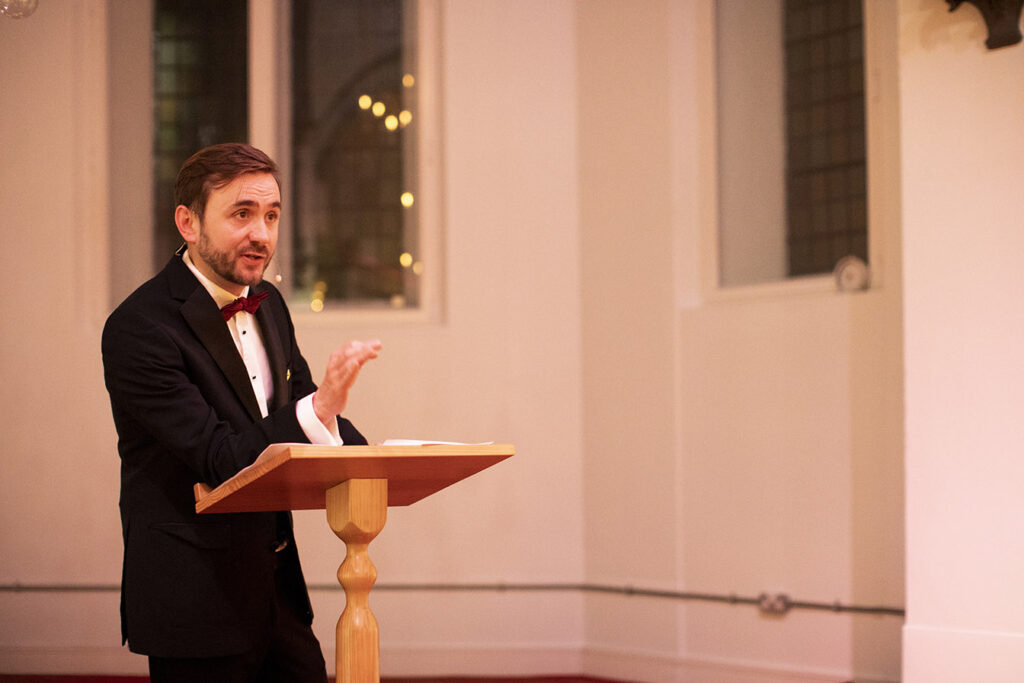
An after dinner speaker tells stories for around half an hour once the meal is over, to leave the room entertained, informed or inspired.
NMP Live’s comparison of a speaker and comedian puts a speaker at about 30 minutes, often dining with guests and speaking after coffee from a lectern. A comedian usually arrives at the end of the meal and does 20 to 30 minutes of material designed to make the room laugh throughout.
At a charity dinner the speaker has a second job nobody writes into the contract: handing a warm room over to whoever runs the fundraising.
When is an after dinner speaker worth booking?
An after dinner speaker is worth booking when they bring something your evening cannot get any other way: a name that sells tickets, or an audience that expects one.
Book one when:
- The name sells tables. The Speakers Agency notes that a well-known face can help drive ticket sales, which can justify stretching the budget.
- The format expects it. A sports dinner without a guest speaker feels incomplete.
- A sponsor will cover the fee. Then the speaker costs the charity nothing.
Think twice when the dinner is small, the fee is a large slice of the expected total, or the programme is already full. Every 30 minutes you add comes out of somewhere, usually the auction.
Where should an after dinner speaker go in the running order?
An after dinner speaker goes after the main course and before the live auction and pledge. They lift the room, and the fundraising catches that lift while it is still there.
This is the order I would build around one:
- Arrivals and drinks reception.
- Seated welcome from the host, with a line about the cause.
- Dinner. The speaker can eat with guests if their contract says so.
- The after dinner speaker, once plates are cleared.
- The host takes the room back, then a short story or film about the cause.
- Live auction.
- Live pledge.
- Thanks and the total.
Formal dinners already work this way. The CII’s sample running order for an annual dinner puts the main guest speaker or entertainer last in the speeches, and notes a trend towards fewer, shorter speeches. At a charity dinner, the fundraising simply follows on.
Never put the speaker after the auction and pledge. By then people are thinking about taxis, and a 30-minute talk drags the night out. My full gala running order explains why the ask belongs at the room’s peak. The live pledge gets the warmest slot of all, because that is where the real money lives.

When the evening runs late
Programmes slip. Dinner runs over, a sponsor speech doubles in length, and the speaker and the fundraising end up fighting for the same 40 minutes.
Decide in advance what gives. Never the auction or the pledge.
I learned this the hard way. At one big event the night was running late and there was no inspiring speech or video to tee up the auction. I announced it into a room that was still talking, and only a fraction of guests heard the lots. Since then I command the room before a single lot goes up. A room that can’t hear can’t give, so I ask for a protected fundraising slot, and a speaker with a hard stop is part of that.
How much does an after dinner speaker cost in the UK?
An after dinner speaker in the UK typically costs from around £2,000 to £3,500 for an experienced professional, and well into five figures for a household name. VAT, travel and accommodation are usually on top.
| Speaker | Typical fee | Source |
|---|---|---|
| Local speaker | Expenses, a donation, or a few hundred pounds | NMP Live |
| Experienced professional | From around £2,000, budget £2,500 to £3,500 | NMP Live |
| Recognisable name | £3,000 to £10,000 | Gordon Poole |
| Household name | Over £10,000, some over £20,000 | Gordon Poole |
These figures come from NMP Live’s fee guide (checked in October 2026) and Gordon Poole’s cost bands (May 2023). NMP Live adds that you should expect VAT, return travel and an overnight hotel where needed.
Do after dinner speakers offer charity rates?
Most after dinner speakers do not have a fixed charity rate, but many will consider a small reduction for a good cause. Ask, but do not build your budget around it.
The same NMP Live guide says very few speakers have genuinely quotable charity rates, though most will consider a slight reduction. Some local speakers will speak for expenses or a donation.
Two better levers: ask a sponsor to cover the fee, and ask whether the speaker would offer a signed item or an experience as a lot. If they are a sporting name, read my notes on verifying sports memorabilia first.
How do you brief an after dinner speaker?
You brief an after dinner speaker in writing, at least four weeks before the dinner, covering the audience, the cause, the exact length and what comes next.
A speaker agency’s brief template recommends sending it four weeks ahead, or six to eight for high-profile bookings, and lists topics to include and avoid alongside timing and hard stops. Gordon Poole stresses that the speaker should be on a similar wavelength to the audience.
For a charity dinner, add these:
- The cause in two sentences, so they can mention it warmly.
- That the auction and pledge follow them, so they finish on a high.
- Not to make the ask. That belongs to whoever runs the fundraising.
- Topics to avoid, including anything close to the charity’s work that could land badly.
- Whether they dine, the dress code, and when to arrive.
Then repeat the timing. A simple timing rule works: confirm the length a month out, again a fortnight out, and once more on the day. Agencies capture much of this up front: NMP Live’s booking process asks for aims, timings, audience and dress code before the contract is issued.
The handover either side of the speaker
The two most fragile moments are the introduction and the minute after the speaker sits down. Both belong to your host.
Keep the introduction short. Agency advice on introducing speakers says 60 seconds is plenty for almost all of them.
Afterwards, the host thanks the speaker and moves the room straight on to the cause and the auction before conversation takes over. When I host a whole evening that hand back is mine, which is why the host and auctioneer question matters.

The sportsman’s dinner: where the speaker is the draw
At a sportsman’s dinner the speaker is often the reason people buy a ticket. Darlington FC’s sportsmen’s dinner in 2016 paired a former player as guest speaker with a comedian, then added an auction, a raffle and a run of table games. Nairn County calls its sportsman dinner its main fundraising event each year, with a guest speaker, an auction and a raffle, and tables of ten at £1,000 for the 2023 dinner.
That is a lot of segments for one evening, so the order matters even more: speaker first, then the fundraising.
A speaker, entertainment, or both?
You rarely need a speaker and a full entertainment set at the same charity dinner. Both compete with the fundraising for the room’s best moment.
If the speaker is there to sell tickets, keep the rest of the programme lean. If you mainly want the room laughing before the auction, my event entertainment is built to sit inside the fundraising rather than beside it.
Whichever you choose, protect the live auction and the live pledge. The speaker is there to warm the room for the cause, not to replace the ask. If you want a second opinion on where a speaker fits in your programme, call 07596 851647.

Kevin Durham
Charity auctioneer & event host