
In short
- The auctioneer chant (also called bid calling or the cattle rattle) repeats the current bid and the next one, joined by filler words.
- It is built for speed and for buyers who know the trade: a tobacco sale could move 500 to 600 lots an hour.
- A charity auction is different. Every guest needs to hear every amount, or the bidding never builds.
- So a charity auctioneer talks to the room: clear numbers, names and banter.
The auctioneer chant is the rolling, rhythmic call you hear at a livestock sale: two numbers stitched together with filler words, fast enough to sound like music. It is a real craft, judged at championship level. It is also something I almost never use at a charity gala, and the reason has nothing to do with skill.
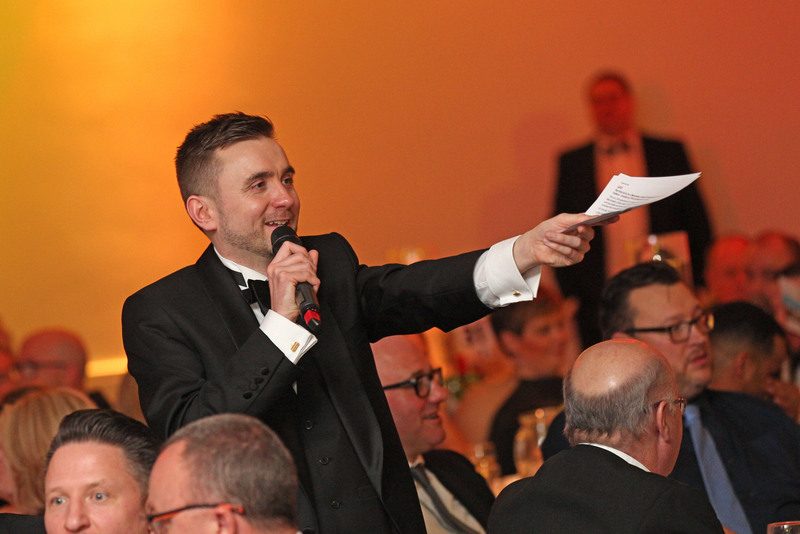
I’m Kevin Durham, the charity auctioneer who works the floor, not the podium, wireless mic in hand. Here is where the chant comes from, and why a fundraising room needs something different.
What is the auctioneer chant?
The auctioneer chant is a rhythmic repetition of numbers and filler words used to take bids. It also goes by bid calling, the auction cry or the cattle rattle.
Every chant carries two numbers: the bid already on, and the bid needed next. Grafe Auction calls it a statement and question: “I have 10 dollars. Would you bid 15?” Everything else is filler, words such as “dollar bid”, “now” and “will ya give me” that keep the rhythm moving.
A National Auctioneers Association guide says filler words carry the numbers, repeat the last bid so buyers remember it, and give bidders a moment to decide.
Where does the auctioneer chant come from?
Nobody knows for certain where the auctioneer chant comes from. The same NAA guide says only that it probably grew out of the need to sell faster.
Babbel calls it distinctly North American, with one popular theory tracing it to tobacco auctioneers in mid-19th-century Virginia. Art salerooms tend to keep a quieter, slower European style.
Tobacco is where the chant became famous. The loose-leaf tobacco auction premiered in Danville, Virginia, in 1858 and became the main way bright leaf was sold in North Carolina.
Its best-known voice was Lee Aubrey “Speed” Riggs, who reportedly became the world’s youngest tobacco auctioneer at 18 and, from 1937, was the radio voice of Lucky Strike, ending every chant with “Sold American”. He is said to have reached 469 words a minute. My favourite detail on that Hall of Fame page: he raised nearly $220 million for charities.
Why do auctioneers talk fast?
Auctioneers talk fast because the chant was built to sell a great many lots, quickly, to buyers who already know what they are looking at. The NAA guide puts it at roughly 60 items an hour at an estate sale, 125 to 175 cars an hour at a wholesale car auction, and 500 to 600 lots an hour at a tobacco sale.
Fast does not mean careless, though. One auction school’s guide to the chant says clarity is essential, and the speed depends largely on what is being sold.
Who has the best auctioneer chant?
The best auctioneer chants are decided in competition, and the best known is the World Livestock Auctioneer Championship. The Livestock Marketing Association held the first one in June 1963 in Denver, where 23 auctioneers from the US and Canada sold the same 20 head of cattle over and over. It still runs every June.
Werner Herzog filmed the 1976 contest for a documentary and called auctioneering “the last poetry possible”.
Judges are not scoring speed alone. When the National Auctioneers Association named its junior champion in July 2026, contestants were assessed on bid calling, professionalism, communication and industry knowledge. That is a proper craft, and I respect it.
Why does a charity auctioneer talk to the room instead?
A charity auctioneer talks to the room because at a gala every guest needs to hear every amount, and many have never bid at a live auction before. A sale ring is full of professionals who know the price of what is in front of them. A charity dinner is full of guests who came for the cause, mid-conversation.
My job there is to get people competing and enjoying it, not to sell quickly. Bidding momentum only builds when the whole room can hear the numbers climb.
Under UK law a sale by auction is complete on the fall of the hammer, and until then any bidder can retract. Everyone should know what they are agreeing to before that moment.
The night I lost the room
I learned how much hearing matters the hard way, and I was not even talking fast. It was a big event, running late, with no inspiring speech or video to tee up the auction. I walked into the middle of the room and announced the live auction while people were still talking, and I did not stop to get them quiet.
Only a fraction of the room heard the lots. One man bid on an item he could not even hear clearly.
The lesson I have never repeated since: command the room first. Stand on a chair if you have to. The shush is a powerful tool. Whoever holds the room holds the total.
What does a charity auctioneer say instead?
A charity auctioneer says the amount clearly, says who bid it, and gives the room a reason to beat it. The auctioneer phrases that work at a gala are conversational, not rhythmic. I open with “Ladies and gentlemen, it’s time for the live auction”, and it always gets a round of applause.

After that, banter does the job filler words do in a chant: it holds the number in the air while someone decides.
- “Sir, you could be the hero. They’d sing songs about you around the campfire. Is that not worth another hundred pounds?”
- “Look at him. He’s in your eyeline. Can you see him?”
If your guests are new to auctions, send them my note on how bidding works before the night.
When should you hire a charity auctioneer?
Hire a charity auctioneer when your event includes a live auction and you want bidders engaged rather than hurried. A charity auctioneer talks to the room, uses humour and builds competition between bidders instead of chanting at speed, which suits a gala audience.
If your event has only a silent auction and no live bidding, you do not need one. Have ready your date, room size, lot list, the kind of audience you expect and whether the room has heard an auctioneer before.
How to talk like an auctioneer at a charity gala
You don’t need a chant to sound like an auctioneer. You need the room’s attention. These are the habits I rely on:
- Get quiet before the first lot. Never sell to a room that is still talking.
- Borrow the chant’s best idea. Give the current bid and the next one together, so nobody has to guess.
- Say the number twice. Once for the bidder, once for the back of the room.
- Name the bidder. A table number or a first name turns a figure into a contest.
- Pause after a big bid. Let the room react.
That is most of what an auctioneer does at a gala. The full running order is in my guide to the live auction, and if you are picking up the mic yourself, start with becoming a great charity auctioneer.
The chant is the right voice for a sale ring. A charity room needs every guest to hear every bid. If you want an auction like that, call 07596 851647.

Kevin Durham
Charity auctioneer & event host