
In short
- A bid increment is the step between one bid and the next. Most salerooms run at roughly 10% of the current bid, and the auctioneer can change it at will.
- Open with a bigger step than feels comfortable and close with a smaller one: the money is made in the middle and protected at the top.
- A lot lands one increment above the second-keenest bidder’s ceiling, so the under-bidder is the person you are really calling to.
- Jumping too fast knocks out the mid-table bidders you need to carry the lot.
- Halving the step late (“splitting the bids”) is the cheapest few hundred pounds you will ever add. Halving it early tells the room the lot is struggling.
Nobody books an auctioneer for a lecture on arithmetic. But the numbers you call out at a charity auction, and the gaps between them, decide more of the final total than the lots on the sheet do. Here is how I set increments, when I move them, and what it costs when they are wrong.
What are bid increments at a charity auction?
A bid increment is the fixed step by which bidding rises, and at a charity auction the auctioneer sets it live rather than reading it off a table. Commercial salerooms publish theirs in advance: Christie’s glossary describes bidding that opens below the low estimate and advances in increments of 10%, subject to the auctioneer’s discretion. Auction houses treat these as predefined steps that determine the next acceptable bid.
That 10% convention is a useful starting point and a poor finishing point. In an art sale the room is full of trade buyers who know the ladder before they sit down. In a charity gala it is full of people who came for dinner, have never raised a paddle, and are taking their cue from the voice on the microphone. The ladder is whatever I say it is, and they will believe me.
What I never do is let the step go unsaid. Every call names the number I want next, because a guest who has to work out their own bid hesitates, and hesitation at the wrong second ends a lot early.
Where should the opening bid and the first increment sit?
Open below what you expect the lot to make, and make the first two or three steps large. The opening bid is bait, not a valuation, and the first increment is where you set the room’s sense of scale.
On a lot I expect to make £2,000, I will usually open near £500 and move in £250s. Five or six paddles go up at £500 because it feels like nothing. By £1,250 I have lost most of them, which is fine: the opening round is a casting call, not the auction. What matters is arriving at £1,250 in four calls rather than fifteen, with the energy still intact.
Two things govern the opening. One is the reserve price, if the donor set one, because opening far below it means a long climb in public. The other is pace. A commercial saleroom whips through 60 to 80 lots an hour. At a gala I have eight or ten lots and forty minutes between the main course and the pledge. Climbing from £500 to £4,000 in £50 steps takes seventy calls. The room will not survive it and neither will the programme.
The arithmetic of where a lot actually lands
This is the bit nobody expects. In an ascending auction the winner does not pay what the item is worth to them. They pay one step above the point where the second highest bidder stopped. The under-bidder sets the price.
Work it through. Say the two keenest bidders would privately go to £2,400 and £2,300, and the bidding stands at £2,000. Call £500 and the next number is £2,500, above both ceilings, so the lot sells at £2,000. Call £100 and the bidding walks up through £2,100, £2,200, £2,300 and £2,400 before it dies. Same lot, same two people, £400 more.
That £400 is not a rounding error. Across ten lots it is the difference between a respectable auction and one the charity still talks about next year. It is also why the step should narrow as the number climbs, the opposite of what published ladders do. Online platforms widen the increment as the price rises, as eBay’s increment table shows, because software optimises for speed. I am optimising for the last £400.
When should an auctioneer halve the increment?
Halve the step when you are down to two bidders and one has just hesitated. The trade calls this splitting the bids, and auction houses do it for the reason I do: a smaller step encourages a bid the larger one had priced out.
A bidder who has gone quiet is not saying no. They are saying not at that number. Dropping from £250 to £100 hands them a cheaper way to stay in without losing face in front of their table, and I offer it directly: “I will take a hundred. One hundred pounds and you are back in.”
Two rules. I split once, not repeatedly, because a ladder that keeps shrinking tells the room the lot has run out of road. And I never split while three paddles are still moving: if there is still competition the room will pay the full step, and splitting early gives away money that was already on the table.
What jumping too fast does to a room
Jumping too fast does two kinds of damage, and only one is visible on the night.
The visible damage is depth. Open at £500, then call £1,500, and you have skipped every guest whose ceiling sat between those numbers. They do not come back. Since the lot lands one step above the under-bidder, thinning the middle of the room removes the people who carry the price. Research on internet auctions found that early jump bidding deters entry later on, and a gala room behaves the same way: a lot that looks settled attracts nobody new.
The invisible damage is shading. The bigger the step, the further below their true limit people bid: a field experiment that varied the minimum increment on a live auction site found bid shading rose as the increment rose. People do not refuse the number. They quietly stop short of it, and nobody in the room can tell.
When a guest jumps of their own accord, take it gratefully. Research on charity silent auctions found that jumping and sniping pull in opposite directions: jump bids tend to lift revenue, late sniping tends to lower it. If a bidder puts £5,000 on a £1,500 lot, I repeat it twice, name them as the hero of the room, and rebuild the ladder above them. What I do not do is carry on in £250s as if nothing happened.
How do increments work on phone, absentee and silent bids?
An absentee or telephone bid runs on the same ladder as the room, executed at the lowest hammer price the reserve and the other bidders allow. A limit is a ceiling, not an offer: if the room stops at £1,200 and the limit is £2,000, they win at the next step up.
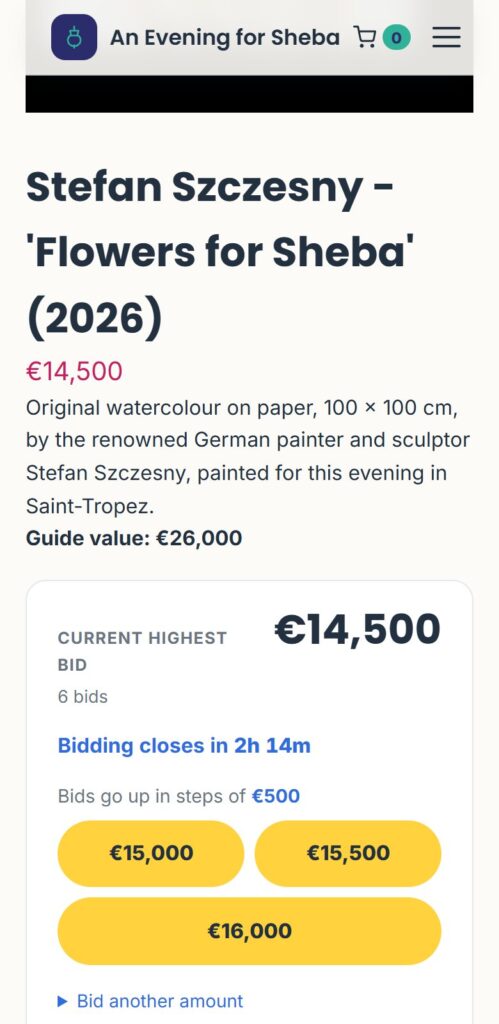
That changes how you call the lot. The step has to be clean enough for the person relaying it to keep up, so I give the phone a full beat and announce it as a bid from outside the room. The floor competes harder against a stranger than against the table next door.
A silent auction is a different animal. Nobody is pacing it, so the increment does all the work alone: too large and sheets stay blank, too small and a popular lot collects thirty tiny bids and still closes below value. I set silent increments near 10% of realistic value and print them on the sheet. A live step is the engine of bidding momentum. A silent sheet has none.
Where the increment meets Gift Aid
Increments are also where a charity auction quietly becomes a donation. Under HMRC’s Gift Aid rules at section 3.40, where an auction item is commercially available and the bidder knows its value when they bid, the amount paid above that value can qualify as a Gift Aid donation. The guidance’s own example is a £30 bid on a £10 item: £20 can be gift aided, because the room was told at the start what the item cost.
So every increment above market value on that kind of lot is worth more than the number I call, provided the announcement was made properly and the paperwork follows. Put the detail past your own finance team, but take it as a reason to tell the room the real price rather than keeping it quiet.
What does this look like on the mic at a real charity auction?
It looks like me arguing with myself about £100 while 300 people eat dessert.
At Jigsaw Trust they had budgeted £14,000 from the live auction. The auction finished on £27,000, and a live pledge they had not planned for raised a further £30,600. Their team had built a room that wanted to give. My part was holding big steps through the first half of each lot and splitting late, instead of crawling up in small steps and running out of time.
The lesson I learned the hard way came from an event where I announced the live auction into a room that was still talking, never got it quiet, and called numbers only part of the room could hear. Increments only work if people can hear them. Command the room first, state every step, then worry about the ladder.
The full mechanics of what happens when a paddle goes up are a separate read. If you have a gala coming up and want to talk through where your steps should sit, call 07596 851647, or see what a professional charity auctioneer does on the night.

Kevin Durham
Charity auctioneer & event host