

In short
- A charity auction with fewer than 100 guests works, because a live auction needs competing bidders, not a crowd.
- What changes with size is the mechanics: how bids get seen, how loud the spotters are, and how far the auctioneer moves among the tables.
- What never changes: every guest should be able to bid, know which lot is being sold, and know the current price.
- Small rooms make giving visible, and research suggests donors take their cue from what others give.
- I read every room early, with a fundraising game at the top of the night. Low take-up tells me the auction will need more work.
Yes. You can run a charity auction with fewer than 100 guests, and it can be a cracking night. A small-room charity auction is a live auction sold to a room of tens rather than hundreds, where every bidder is within sight of the auctioneer. My smallest auction room was about 40 guests. My biggest was several hundred, around 600 to 700.
The size of the room changes how I work. It does not change whether the auction is worth running.
Can you run a charity auction with fewer than 100 guests?
You can run a charity auction with fewer than 100 guests, because the price of a lot is set by competition between bidders, not by the size of the audience. Two people who both want the same lot will push it higher than a room of 600 where nobody does. My smallest auction room was about 40 guests.
The economics agrees. In their paper on auctions versus negotiations, Jeremy Bulow and Paul Klemperer showed that a public auction beats negotiation provided it attracts at least one extra bidder. Competition matters more than negotiating skill.
So the question for a small room is not “are there enough people?” It is “is there a second bidder for each lot?” In a room of 50, every serious bidder counts. My job is to make sure nobody who might bid gets left out.
What changes between a room of 40 and a room of 600?
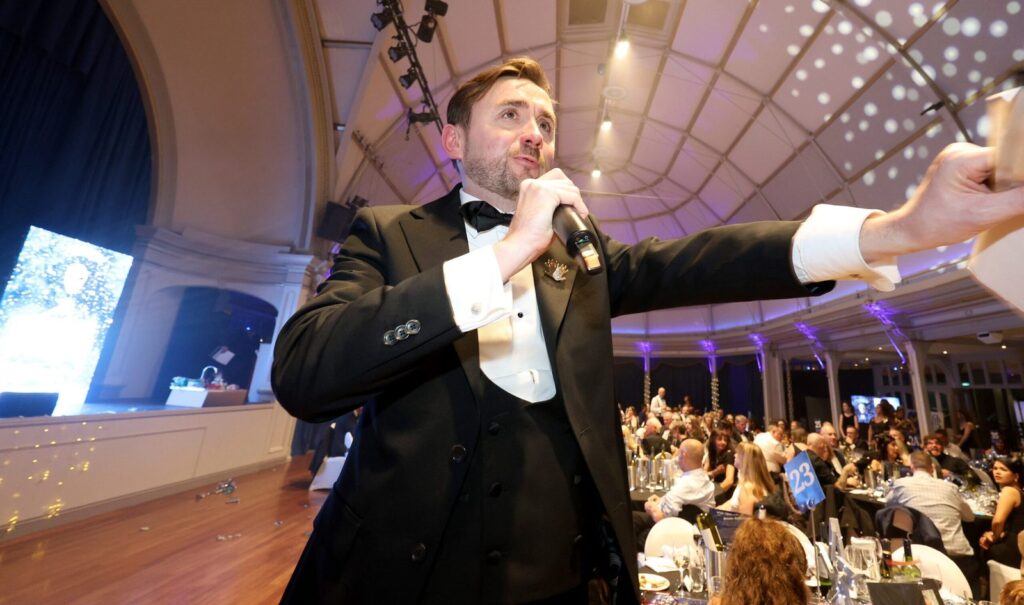
Between a room of 40 and a room of 600, the goal stays the same and the mechanics change. I am committed to every guest having a chance to bid, knowing which lot I am on and knowing the current price. Only the effort it takes goes up.
| What I look at | In any room | What changes in a big room |
|---|---|---|
| Seeing the bids | Every bid gets seen | Spotters must be loud on every bid, so I never miss one |
| My energy | Matched to the room | It has to go up |
| Moving among the tables | I work the floor, not the podium | I run among the crowd far more |
| Lot and price | Everyone knows both | I take them out to the tables |
| Reading the room | Starts at the top of the night | No change |
The spotters are where I am strictest. In a large room it is imperative that a spotter is loud when there is a bid. My guide to auction spotters covers how many to have and where they stand.
Why does a big room need loud spotters and a moving auctioneer?
A big room needs loud spotters and a moving auctioneer because sound and sightlines both fade with distance. A guest at the back hears less, sees less and is easier to miss. Miss their bid and the lot sells to someone else, for less.
The physics is simple. Under the inverse-square law, sound pressure from a point source halves each time the distance doubles, a drop of about 6 dB. A table 20 metres away is two doublings further than one at 5 metres, so it hears roughly 12 dB less from an unamplified voice.
The law adds a reason not to miss anyone. Under section 57 of the Sale of Goods Act 1979, an auction sale is complete when the auctioneer announces it, and a bid can be withdrawn until then. A bid the auctioneer never acknowledged was never taken.
In a room of 40, most of this never bites. Small is not the hard version.
Where a small room has the edge
A small room makes generosity visible. When the room is 40 or 60 people, everyone sees who bids, who raises and who gives in the pledge.
A study of online fundraising pages by Sarah Smith, Frank Windmeijer and Edmund Wright on peer effects found that a £10 rise in the average of earlier donations increased giving by £2.50 on average. Their explanation is that donors look at what others gave to decide what is appropriate. That was online, not in a ballroom, but the instinct is the same: people judge their gift against the people around them.
Visibility cuts both ways. In a small room, a guest who says no is as visible as one who says yes. The fundraising code’s behaviour standards require you not to put undue pressure on anyone to donate, and to accept a request to end an interaction. So ask warmly, once, and let people off the hook with good grace. I am playful with a room, but I never punch down at a guest.
Reading the room from the first game
Because I usually host the whole night as well as running the auction, I read the room early. One of my first tests is a fundraising game at the top of the night, for example heads or tails.

A low take-up tells me the room will need a lot more work by the time we reach the auction. Better to learn that at the top of the night than at lot one.
Hosting from the start does something else. It builds trust with the guests, so they feel more comfortable giving later in the evening.
My heads and tails guide explains how to run it. At a UK event it will normally count as an incidental lottery. The Gambling Commission’s event lottery rules say tickets can only be sold at the event while it is taking place, with up to £500 of proceeds for prizes and £100 for expenses. This is general information, not legal advice.
How many lots does a charity auction for under 100 guests need?
A charity auction for under 100 guests needs fewer, better lots chosen for the people actually in the room. There is no magic number for a small room. The general principle in my guide to live auctions holds at any size: a short list of strong lots beats a long catalogue.
In a small room, fit beats prestige. A niche lot needs a niche buyer, and with 40 guests that buyer may not be there. One lot that fell flat for me was a bouncy castle hire, at an event full of middle-aged guests. To want it you need a child with a party coming up and room for a bouncy castle. Too niche for that crowd.
Two general points help:
- Ask who is coming before you choose lots. A guest list of 50 tells you far more than a guest list of 500.
- Add a live pledge. A pledge needs no lots at all. HMRC’s Gift Aid guidance says that an auction purchase cannot carry Gift Aid where the item’s value exceeds the benefit limits, while a voluntary donation can. As a concession the winner may treat part of the payment as buying the item at its value and claim Gift Aid on the excess, if it can be bought elsewhere and its value was known when they bid.
Whatever the room size, tell guests where the money goes. The code’s events standard asks you to be clear about how the money raised will be used.
Is a professional charity auctioneer worth it for a small room?
A professional charity auctioneer is worth it for a small room when the total genuinely matters, when the auction and pledge are the heart of the evening, or when you want one person to host the whole night. If the auction is five minutes of fun among friends, a confident volunteer with a loud voice is the right call, and I will happily tell you so.
My fees flex with the size of the event, and there is no minimum event size. A room of 40 gets the same preparation as a ballroom.
I work the floor in every room, whatever its size. Kerry from The Pallet Network put it kindly in a client review: “It wasn’t just standing on the stage, it was all very interactive and engaging.”
When you get in touch, have these handy:
- the date and the venue
- your guest numbers, and who is likely to come
- the lots you have, or the ones you are chasing
- your running order, even a rough one
- last year’s total, if there was a last year
Hire me and I build the auction platform around your event, in your branding and loaded with your lots and tickets. It is included for your event and stays live for one month afterwards.
The credit on a good night belongs to the charity’s team and a generous room. My part is making sure every one of those guests is in the game. Tell me about your room, 40 guests or 400: call 07596 851647.

Kevin Durham
Charity auctioneer & event host