

In short
- A tight year does not cancel a gala. It makes guests more careful, so give them more ways in.
- Cost of living pressure is the main reason people give for giving less, in the Charity Commission’s July 2026 trust research.
- World events reach the auction room through your guests’ businesses and moods, not just their bank balances.
- A pledge with a low entry level, and honesty about where the money goes, matter more than glamorous lots.
Can you still run a charity gala when money is tight? Yes. A charity gala in a tight year is one planned for guests who still want to give but are watching every pound, and that changes the lots, the ticket and the shape of the ask rather than the decision to hold the night.
I kept auctioneering through the cost of living squeeze, so I have seen rooms tighten and recover. Below, what I have seen in rooms is kept apart from general planning advice, which is a reasoned starting point rather than proof.
Can you still run a charity gala when money is tight?
Yes, you can still run a charity gala when money is tight. A well-run room still gives in a hard year. What shrinks is the margin for a badly planned night.
The ONS opinions survey, run in August 2026, found 55% of adults saying their cost of living had gone up in the past month, and 59% of those were spending less on non-essentials. A gala ticket is a non-essential. So, I am sorry to say, is a bid. NCVO’s June 2026 Spring Briefing, written with Zurich, says donations are dropping “because people don’t have as much to give”.
The Charity Commission’s trust research, published 8 July 2026, puts it plainly: “The cost-of-living crisis is the primary reason given for reduced donations.” It adds that giving to causes with personal relevance is more likely to be protected. Remember that when you build the guest list. Its trustee survey found 46% of trustees saying their charity had adapted to the cost of living crisis in the past year.
From where I stand, with a microphone in my hand, the cost of living crisis really did hit rooms hard for a while. Then they picked up again. Through that period I was still beating targets and raising a lot of money. The credit sits with the charity teams behind those nights.
When money tightens, what changes in the auction room?
When money tightens, the auction room gets tighter. Guests still come and still care about the cause, but they think harder before raising a hand. In my rooms, the clearest trigger has been world events landing on top of the squeeze on living costs.
Global events filter down. Straight after the war involving Iran, a few of my rooms were much tighter. One was an auction for a group from the property sector, with some really big, glamorous lots, and the room was fairly tight. Afterwards someone told me the war had had a huge impact on their business.
When the Israel and Gaza conflict flared again, it was another factor that affected one or two of the charities I work with.
The general point is about confidence, not generosity. Economists who studied the last big recession found sharp declines in giving that income and wealth changes alone did not explain. People give less when they feel less sure, even before their own finances move. So look at who is in your room, where their money comes from, and how this year’s news has landed on them.
Which lots still sell when money tightens?
Lots that a table can share, and lots at more than one price level, tend to hold up best when money tightens. That is planning logic rather than research: in a careful room, fewer people go it alone at the top.
- Spread the price points. Keep a few headline lots, and add several a couple could buy without a long chat at the table.
- Favour experiences with seats. I have seen tables pool their money and bid together, most often on experiences with plenty of places, such as a dinner for eight. I have never seen it go wrong.
- Cut the niche lots. I once watched a bouncy castle hire go nowhere in a room of middle-aged guests. In a tight year, every lot needs an obvious buyer.
Should you cut the ticket price?
You should not cut the ticket price by reflex. Prices are still climbing under you: ONS inflation figures show CPI rose 3.5% in the 12 months to September 2026, up from 3.1% the month before. A cheaper ticket can leave you subsidising dinner.
My general advice is to hold the headline price and protect access quietly, with a few seats offered by invitation to loyal supporters. My guide to setting a ticket price goes further. When a charity shows me last year’s figures, I check how many came and what they paid. Plenty of guests on a high ticket with a low fundraising total means a lot of room to improve, whatever the economy is doing.
Giving guests more ways to give
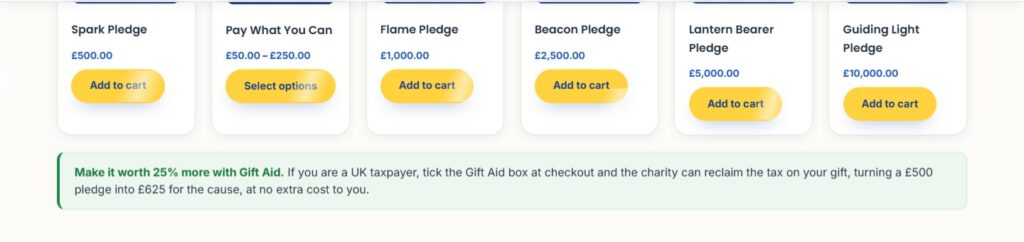
The live pledge is where a careful room can still be generous. In my experience a well-structured pledge consistently outperforms the lot auction at most galas, in any year, because it gives everyone in the room a level they can say yes to. Here is how a live pledge works.
The most common reason I have not run a pledge is a committee stopping it because someone worried the ask would be too much. I always make sure the ask is well balanced and refined, and I think my results back that up. Expect that worry to be louder in a hard year, and settle it with the committee before the night. Four general suggestions:
If the room is tight and the auction lots are getting little engagement, my view is that the pledge normally still picks up. Do not be too despondent, and do not cancel the live pledge because of a slow auction. If more money than expected has flowed into the live auction, have a plan B ready for the pledge, and consider asking for a little rather than a lot, which can still bring surprising results.
- Add a low entry level. A “give what you can” step lets guests on a budget join in rather than look away.
- Make small gifts count. HMRC’s small donations scheme lets an eligible charity claim a top-up on cash and contactless gifts of £30 or less without a Gift Aid declaration, on up to £8,000 of small donations a tax year, subject to a matching rule. Check eligibility first.
- Ask a sponsor to match. A match pot makes a smaller gift feel bigger.
- Never push. The Fundraising Regulator’s code, in force from 1 November 2025, requires no undue pressure on anyone to donate. A tight room notices pressure fast.
Why does transparency matter more in a hard year?
Transparency matters more in a hard year because guests who are cutting back want proof their money reaches the cause. In the Commission’s 2026 research, 55% named money being spent directly on the cause as a driver of trust, the top answer, and 40% said it helps to see how money raised has been spent.
That matches what I have seen. At one event my live pledge was going nowhere with just me at the front, so I brought up people the charity had helped to speak, and the pledge then really ran. In a lean year, put the figure and what it buys on the screen, and say which lots give the charity everything.
A tight-year checklist
Here is the same advice in one place, short enough for a single committee meeting.
| Lever | What to do in a tight year |
|---|---|
| Guest list | Check which guests’ businesses this year’s news has hit |
| Lots | Fewer lots, more price points, experiences a table can share |
| Ticket | Hold the price, protect access quietly |
| Pledge | A balanced top level, a low entry level, agreed with the committee in advance |
| Small gifts | Contactless taps of £30 or less, recorded for the small donations scheme |
| Sponsors | Ask for a match on the pledge rather than a bigger table |
| Honesty | Say where every pound goes, from the stage and on the screen |
When is it worth hiring a charity auctioneer when money tightens?
A professional auctioneer is worth it when money tightens if the night depends on a live auction and a pledge, because a careful room needs more work to reach the same figure. Bidding momentum is a skill, not luck, and a cautious room shows the difference. If your gala is small, the guests know the cause well and last year’s total was still growing, a confident volunteer may be enough.
Because I usually host the whole night as well as the auction, I read the room early. A fundraising game at the top of the evening, heads or tails for example, is one of my first tests: a low take-up tells me the room will need a lot more work by the auction.
Kristen Kemmet, Group Charity Coordinator, wrote on my reviews page: “Kevin had incredible enthusiasm and was a great source of advice in our planning.” Kind words, and I am grateful. The real work belongs to the charity teams who keep going through years like this.
When you get in touch, have ready your date, guest numbers, ticket price, last year’s figures and what worried the committee. The auction software is included when you hire me: I build it around your event, and it stays live for one month afterwards. My auctioneer services page has the detail.
If your gala is going ahead in a tight year, call 07596 851647 and we will talk it through.

Kevin Durham
Charity auctioneer & event host