
In short
- Recruit one volunteer for every 10 to 15 guests: 13 to 20 for 200 guests, 27 to 40 for 400.
- At least half of them should be spread round the room as spotters during the auction.
- During the live pledge, every volunteer works the room, because that is where money gets left on the table.
- It can look like overkill. Over-preparing costs you a few spare helpers; under-preparing costs you pledges.
How many volunteers do you need for a charity gala? My answer is one volunteer for every 10 to 15 guests. Gala volunteers are the unpaid helpers who check guests in, sell raffle tickets, spot bids and capture pledges, and the number you recruit decides how much of the room’s generosity actually reaches the bank.
I run 60 to 80 charity events a year, usually hosting the whole night as well as the auction, so I see exactly where a thin team costs money.
How many volunteers do you need for a charity gala?
A charity gala needs one volunteer for every 10 to 15 guests. That is my rule of thumb from the floor, not an industry standard, and it works out at roughly 13 to 20 volunteers for 200 guests and 27 to 40 for 400. Use the lower figure as your floor.
The arithmetic is simple. Divide your guest number by 15 for the minimum and by 10 for the comfortable figure.
| Guests | Divide by 15 | Divide by 10 | Volunteers to recruit |
|---|---|---|---|
| 100 | 6.7 | 10 | 7 to 10 |
| 200 | 13.3 | 20 | 13 to 20 |
| 300 | 20 | 30 | 20 to 30 |
| 400 | 26.7 | 40 | 27 to 40 |
Round up, never down, and recruit a couple of reserves on top, because volunteers have lives too.
I know 40 people in charity T-shirts for a 400-guest dinner can look like overkill. I would still rather over-prepare, every time. A spare pair of hands costs you a sandwich. A missing one can cost you a pledge.
The live pledge is why the number is so high
A gala needs a big volunteer team because the live pledge is frantic. Many hands go up at once, and every one has to be captured, and paid, as quickly as possible. With too few people taking payments, selling raffle tickets and supporting the fundraising, there is no time to collect everyone, and money is left on the table.
That’s the whole case. If any job is going to run short on the night, don’t let it be the pledge.
Picture a pledge level being called and hands going up across the room at once. If only a handful of volunteers are trying to reach all of them, some guests sit with an arm in the air, then lower it. Nobody counts the pledge that was never taken, so the loss never shows on a report. It shows up in the final total instead.
Where should charity gala volunteers stand during the auction?
During the live auction, at least half of your gala volunteers should be spread around the room as spotters, helping the auctioneer see and capture every bid. In a 200-guest room with 16 volunteers, that is eight or more people watching sections of the tables.
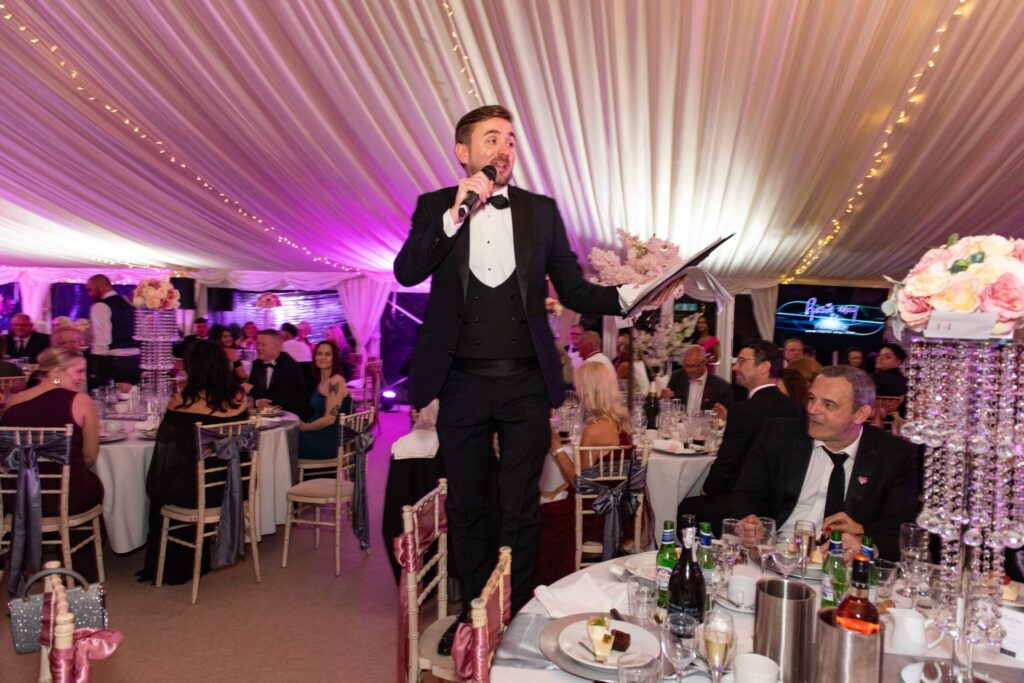
In a big room, spotters must be loud when there’s a bid, so I never miss one. I run among the crowd far more in a large room than a small one, and even then nobody can see every seat from one spot.
My guide to auction spotters covers where they stand, the signals they use and how to brief them in ten minutes. I won’t repeat it here. Keep spotters out of the gangways, though: the fire safety order requires routes to emergency exits to be kept clear at all times.
What do volunteers do during the live pledge?
During the live pledge, every gala volunteer is on the floor capturing hands. It’s all hands on deck: the registration team, the raffle sellers and the spotters all move into the room, because the pledge is the moment with the biggest risk of money being left on the table.
Each volunteer needs to capture four things quickly: who gave, which table, how much, and whether they want Gift Aid. A Gift Aid declaration has to include the donor’s full name and home address, the charity’s name and a statement that they want Gift Aid to apply, so pre-printed pledge cards with those boxes already on them are worth the print bill.
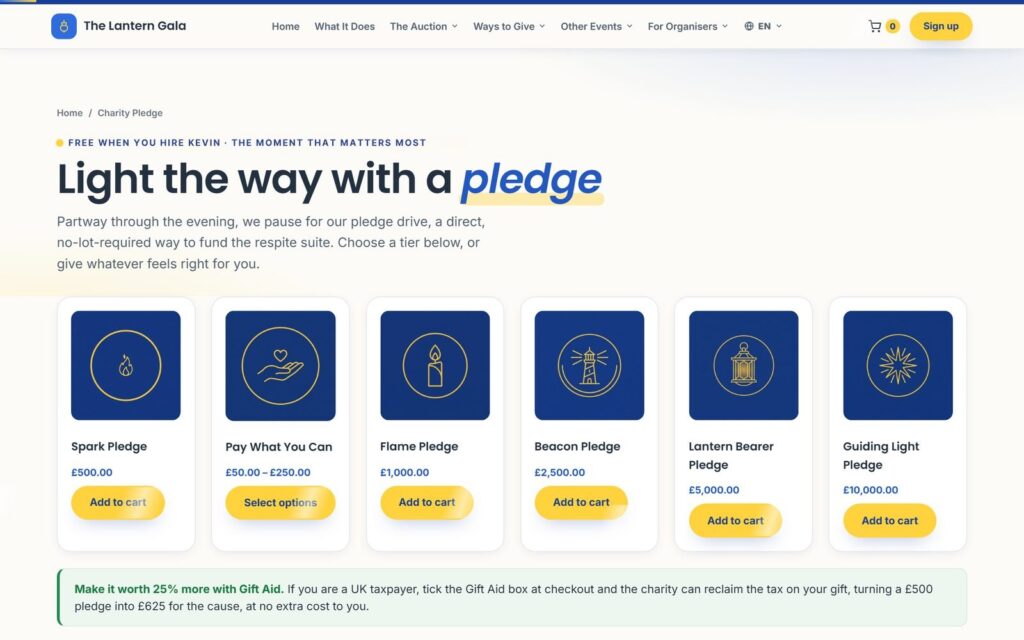
A pledge page on guests’ phones takes some of the load. It doesn’t replace a volunteer walking to the raised hand, so staff the floor as if the page didn’t exist. And never let a volunteer jot a card number on a pledge card: my donor data checklist explains why.
If you have never run one, start with why a live pledge so often out-earns the auction. It’s why I staff for it first.
What other jobs need volunteers at a gala?
The other jobs that need gala volunteers are check-in, the raffle, the payment desk and looking after tables. They matter, but they’re quieter than the auction and the pledge. There’s no fixed split: share people out according to your venue and your running order.
American galas often publish their rotas. A 2016 Minneapolis gala’s volunteer sign-up asked for 85 volunteers across greeters, registration, bid assistants, spotters, recorders and check-out. A UK dinner rarely needs that level of division, but the list is a useful prompt.
- Check-in. Guests arrive in a wave, so this team is busiest at the start of the night and then free to join the floor.
- Raffle. Sellers work during the event only: the Gambling Commission says tickets for an incidental raffle can only be sold at the event while it is taking place. My charity raffle guide covers the rest.
- Payment desk. The Charity Commission’s CC8 guidance says at least two people should handle and record cash. My posts on collecting payment and handling cash go further.
- Tables. Table captains are guests rather than crew, but on the night they act like part of your team.
Briefing and looking after your volunteers
Brief gala volunteers in person on the day, give every one a named job for each part of the evening, and tell them who to go to with a problem. A volunteer who knows they move to the floor when the pledge starts will be there. One who was told “help out” won’t.
The Code of Fundraising Practice says charities must give volunteers training and support, including on handling donations, and must not pay them for fundraising, though reasonable expenses are fine. On GOV.UK, volunteer expenses usually cover food, drink and travel. Feed your team.
NCVO’s guidance on a volunteer induction adds two easy wins: show them around the room, and tell them when their breaks are.
There’s a welfare argument for a bigger team too. NCVO’s Time Well Spent research found the share of volunteers who felt their organisation had unreasonable expectations of how much they did rose from 17% in 2018 to 24% in 2022. Twenty people sharing a night’s work is a better evening than eight people running between jobs.
Put the volunteer plan in your risk assessment. The code’s events standard expects a plan for all the situations you could reasonably expect, and a guest who can’t find anyone to take their pledge is one of them.
When is a professional worth it for a charity gala?
A professional charity auctioneer is worth it once your gala has a live auction and a live pledge, because a big volunteer team only raises more if someone is running the room it works in. If the night is a raffle and a handful of lots, a well-briefed committee and a confident host can manage, and you should save the fee.
My spotters are there to help me see and capture bids, and I work with them all the way through the auction. Because I usually host the whole night, I’ve read the room well before the pledge, and the guests have had time to trust me.
Gabriel Dos Santos of the OCU Foundation said this on my reviews page: “We hosted just over 300 guests and raised more than double what we achieved last year. Kevin’s key suggestion, the live pledge alone, brought in nearly £20,000.” Kind words, and I’m grateful for them, but that night belonged to their team. My part was the suggestion and the microphone.
Before you get in touch, have your date, your guest number, the room layout and a rough count of volunteers ready. Free auction software is included when you hire me: I build the platform around your event, with your branding, lots, tickets and pledge page, and it stays live for one month afterwards. See my auctioneer services, or call 07596 851647 and tell me how many guests you’re expecting.

Kevin Durham
Charity auctioneer & event host