

In short
- A sealed bid auction is one where each guest submits a single private bid on a lot, nobody sees the others, and the highest bid wins.
- It suits a lot that guests may not want to be seen chasing, such as a holiday home week or a private dinner, and a lot the donor can supply more than once.
- A 2008 field experiment found first price raised more than second price or all-pay. It did not test sealed against live.
- A live lot still wins when the room’s attention is the asset: guests answer each other and the price keeps climbing.
- Every sealed lot needs a closing time, a tie rule and someone announcing it, or it sits unnoticed.
A sealed bid auction is an auction where every bidder gives one private bid, none of them can see the others, and the highest bid takes the lot. At a charity event it is the quietest way to sell something, so committees reach for it when a lot feels awkward to sell in public.
I am Kevin Durham, and I sell lots live from the stage at charity galas, so I lean towards the microphone. Here is the fair version: how it works, what the research says, and which lots belong in the box rather than the room.
How does a sealed bid auction work at a charity event?
A sealed bid auction at a charity event gives each guest one chance to bid on a lot, on paper or online, before a fixed closing time. Nobody sees anyone else’s bid, and when the box closes the highest bid wins.
UK charity guidance describes the paper version plainly: a bid box where bidders write their highest bid on a sheet of paper and post it in. That is the difference from an ordinary silent auction, where bids are visible and guests keep topping each other. In a sealed auction there is no topping. You get one go.
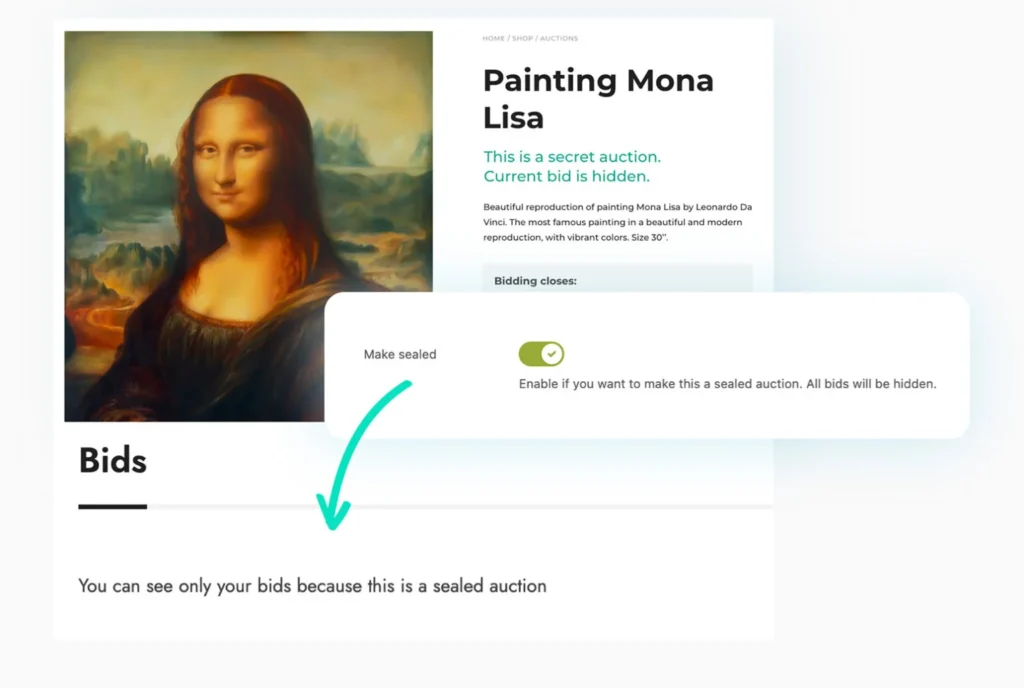
Software can do the same job: this example listing hides every bid except your own.
The main types of sealed bid auction
There are three sealed formats worth knowing, and they differ in what the winner pays and who pays at all. First price is the usual charity version: the winner pays what they bid.
| Format | Who pays | What it asks of a guest |
|---|---|---|
| First price | The winner pays their own bid | Guess what the others will bid |
| Second price | The winner pays the second-highest bid | Bid what the lot is worth to you |
| All-pay | Every bidder pays their bid, one wins the lot | Risk money on losing |
The second-price format is named after the economist William Vickrey. The highest bidder wins but pays the second-highest bid, which gives bidders a reason to bid their true value. In first price there is no such incentive, so a careful guest bids below what they would really pay, and a sealed lot can close under the keenest guest’s limit.
Some providers sell identical lots to several top bidders. One UK fundraising company describes ten identical lots going to the top ten bidders, each paying their own bid. That is the company’s account (July 2022), not a tested result.
What does the research say about sealed bid charity auctions?
The research says first price raised more than second price or all-pay in the field experiment that compared sealed formats for charity. It does not say a sealed bid beats a live auction, because it never compared the two.
Carpenter, Holmes and Matthews reported their field experiments in the Economic Journal in 2008: both the all-pay and second-price formats were dominated by first price. They put the gap down to differential participation: the format changes who takes part, not only how much they bid. Theory had expected the opposite: the working paper notes the small literature suggested all-pay should raise more than winner-pay formats.
My reading is that guests dislike risking money on losing. Two cautions: it compared sealed formats only, so it is silent on live against sealed, and it is one study. Treat it as a reason to choose first price for a sealed lot, not to move your best lots out of the room.
Which lots suit a sealed bid, and which belong in the room?
A lot suits a sealed bid when public bidding would put guests off, or when the donor can supply more than one. Everything else belongs in the live auction or an open silent one, as I set out in live against silent.
| The lot | Where it goes | Why |
|---|---|---|
| A high-value lot guests may not want to be seen chasing | Sealed | The bid is private between guest and charity |
| Identical lots, such as ten dinner places | Sealed with several winners, or the live twist | The top bidders each win |
| A showpiece experience with a story | Live | The room can feel it and keep bidding |
| Mid-value items with a clear price | Open silent | Guests see the price and raise it |
If privacy is the only worry, bidding by number may be enough, and I cover how in anonymous bidding. Keep the sealed table short. I recommend about ten live lots, 14 at most, and the same discipline helps here.
When does a live lot still beat a sealed bid?
A live lot beats a sealed bid when it can carry the room’s attention, because guests can answer each other and the price can keep climbing. A sealed bid ends the conversation after one bid per guest.
In an ascending auction the winner pays about the second-highest bidder’s value, so a rival who stays in lifts the price. In a sealed lot, the guest who would have gone £200 higher is never asked. In theory the formats can raise the same. In a room, live adds what theory leaves out: banter, a rival in your eyeline, a full table watching.
I like big round tables for that reason: everyone can see how much each person bids, which adds a little peer pressure. A sealed bid removes it, and other things I have seen live. At one event two guests started out bidding against each other on a shooting experience, swapped some banter and decided to bid together.
A sealed box cannot do that.
For a lot the donor can supply twice, sealed bidding with several winners is one route. The other is the live twist: take the bidding as high as it goes, then drop the price a little and sell to the top two. I wrote that up in my post on two bidders.
Whichever you choose, the live pledge follows the auction and does the heavy lifting. A short lot list is fine.
Sealed bid rules to settle before the box opens
Settle five things before the box opens: the closing time, how ties are broken, whether the lot has a reserve, who may not bid, and how winners pay. Print them beside every lot. For ties, one PTA guide suggests asking tied bidders for a fresh sealed bid.
Section 57 of the Sale of Goods Act 1979 says a sale by auction may be notified as subject to a reserve, and that the seller may not bid unless a right to bid is reserved. Whether that Act governs a sealed-bid sale is a question for your solicitor. The safe habit is the same: state any reserve, and keep donors and committee members out of the bidding. My post on reserve prices covers the first.
On tax, HMRC’s guidance, as at November 2026, says a payment for an item at a charity auction is a purchase, not a gift. Part of a bid may qualify for Gift Aid if the benefit rules are met. That is general information, not advice. I cover collecting the money in winning bidder payment.
When is it worth hiring a charity auctioneer for sealed lots?
It is worth hiring a charity auctioneer when the sealed lots are worth real money and you want them announced, closed and read out on the night, or when you are unsure which lots belong in the room. A sealed lot nobody mentions is easy to miss.
FundEd’s guide says a silent format lacks a live auction’s competitive edge, so you need an MC to inject some drama. If you book me as host as well as auctioneer, one person can announce the sealed lots, call the close and read the winners, then run the live lots and the pledge. That can also save money against booking two people.
A small sealed table at a school or village event is different: volunteers can run it with a bid box and a clear close. You do not need me for that.
Kristen Kemmet, Group Charity Coordinator, put it this way on my reviews page: “Kevin had incredible enthusiasm and was a great source of advice in our planning.”
Have ready your lot list with each donor’s stated value, which lots could be supplied twice, your date, room size and last year’s total. When you hire me I build your auction platform around the event, with your branding, lots and tickets. It is included for the event and stays live for one month afterwards. See what a charity auctioneer does, or call 07596 851647.

Kevin Durham
Charity auctioneer & event host