

In short
- Silent auction items on display at a charity event, meaning the real lots on tables in the room, usually beat a phone catalogue alone, because guests can see what they are bidding on.
- Lots in the room also cut admin: a winner can take the item or voucher home that night, so nothing needs posting afterwards.
- Not every lot can sit on a table. Big, fragile, dated or high-value lots need a stand-in card and a plan.
- Decide who looks after the lots from delivery to hand-over, and who insures them, before the night.
- Phones still win for remote bidders and very long lot lists. You can do both.
Silent auction items on display at a charity event are the actual lots, set out on tables in the room, not just photographs in a list on a phone. If your committee is deciding between the two, my advice is simple: have the lots in the room where you can, and use phones to take the bids.
On the night I mostly run the live auction and the pledge, while the silent auction ticks along in the background. I will mark clearly where I move from my own experience to general advice.
Should silent auction items be on display at a charity event or only on phones?
Put silent auction items on display in the room if you can. Guests take more interest in an item they can see, the lot feels personal rather than like a listing, and a physical lot carries less admin afterwards. Use phones for bidding, not as the shop window.
That is my own view from the events I host. A thumbnail on a screen asks guests to imagine the item. The real thing gets looked at, talked about and pointed out to friends.
I have no bid-sheet or screen count to give you. For rules, increments and closing, see my silent auction guide. This post is only about where the lots live.
What the item in the room saves you afterwards
When a winner can walk away with the item, or the voucher, at the end of the night, there is nothing to post out. That is the quiet advantage of lots in the room: the admin finishes when the evening does.
Posting means addresses to collect, parcels to wrap and a winner who has paid but is still waiting. Those jobs tend to land on the one volunteer who is already exhausted.
My general advice, not a rule: hand over only once payment is recorded. Winners settle at one desk and collect from the same desk, with the lot number as the link between the two. My piece on collecting payment sets out that desk, and the lot donation form is where you agree in advance who delivers each item and by when.
A sale is also a contract. Section 57 of the Sale of Goods Act 1979, read November 2026, treats each lot as a separate contract and says an auction sale is complete at the fall of the hammer or in another customary manner. For a silent lot, that is your published close time, so put it on the card.
Which lots can you put on show?
Most donated lots can go on a table: framed shirts, hampers, art, small gifts. Others need a stand-in, such as a printed card or a photograph, because they are too big, too fragile, too valuable to leave out, or are not objects at all.
General advice, not a record of any one night:
| Lot type | On the table | Stand-in and plan |
|---|---|---|
| Framed memorabilia, art | Yes, propped and labelled | Keep within sight of a volunteer |
| Hampers, gifts | Yes, with a lot number | Check contents match what the donor promised |
| Gift vouchers | A copy, or the card in a sleeve | Keep the originals at the payment desk |
| Experiences, stays | A card with photo and terms | Voucher handed over on payment |
| Large or heavy items | No | Photo card, collect after the event |
| Food, flowers, anything perishable | Only if it lasts the evening | Collection date on the card |
| Very high value | No | Sell it in the live auction instead |
If you would worry about leaving a lot on a table, it probably belongs on the stage, where one auctioneer can sell it to the whole room.
How do you keep silent auction items safe at a charity event?
Name one person who is responsible for each lot from delivery until a winner takes it home, and be clear who insures it. It is a paperwork job more than a security operation.
The Fundraising Regulator’s code, section 10.1, says you must carry out a risk assessment before an event and be clear about who insures each risk, for example you or the owner of the building. It also asks for a plan covering situations you could reasonably expect, and a lot going missing is one.
On insurance, the Charity Commission’s guidance on charity insurance says charities should have a suitable policy for contents, and that public liability is normally recommended for major events and advisable for smaller ones. Ask your insurer whether donated lots on display are covered, and get the answer in writing. My piece on gala insurance goes through the risks one by one.
Then the practical habits, again my general advice:
- Number every lot and log it in when it arrives, then log it out when it leaves. The Charity Commission’s guidance on financial controls asks for records of each fundraising event and says trustees have a duty to safeguard assets.
- Keep small valuables and original vouchers out of reach, with a copy on the table.
- Ask the venue where tables may go, and keep them clear of exits. Fire safety belongs to the premises’ responsible person, so their plan decides the layout, not yours.
- For heavy lots, ask who is carrying them. The HSE says employers must avoid hazardous manual handling so far as reasonably practicable and sets no fixed weight limit in law, so decide in advance, not on the night.
What goes on the card beside each lot
Each card should carry the lot number, a plain description, the item’s value, the minimum next bid and the closing time. A guest should be able to bid without asking anyone.
The value is not decoration. HMRC’s Gift Aid guidance, paragraphs 3.40.7 and 3.40.8, says a bidder may Gift Aid the excess over an item’s value only if the item can be bought separately and they knew its value when they bid. HMRC also says an auction payment is a purchase, not a gift. Print the value, and check it with the donor first.
Increments belong on the card too: my notes on bid increments explain how to set them. For wording the description, see what goes in a lot catalogue.
When is a phone catalogue the better choice?
A phone catalogue is the better choice when guests cannot be in the room, when the lot list is too long to lay out, or when most of your lots cannot be shown. For everyone else, the best answer is both: items in the room, bidding on phones.
My rule of thumb, which is general advice: if most lots fit on tables without crowding the room, display them. If there are too many, or the venue will not allow tables, or half the bidders are not there, lead with the phone catalogue and display your best few items as a taster.
This is what a remote guest sees on a phone.
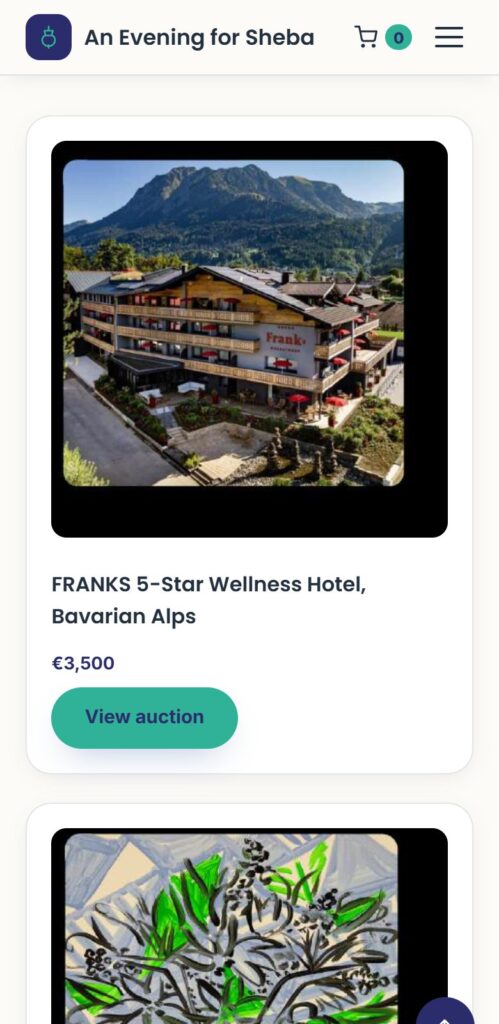
If you need the platform side, the silent auction software is included when you hire me to host or auction your event. It is built around your event, in your branding, with your lots loaded, and it stays live for one month afterwards.
When is it worth hiring a charity auctioneer for this?
For the silent auction alone, doing it yourself is usually the right call. Displaying lots, writing cards and logging them in is organising work, and a committee can do it well. A professional earns the fee in the live auction and the pledge, where the biggest totals are decided.
Where I help is the wider programme: which lots go on the table, which are saved for the stage, and when the silent auction closes so it does not compete with either. When you get in touch, have ready the date, the venue and room size, a rough list of lots, and what happened last time.
Where to start
Start with the lot list. Mark each lot as table, stand-in or live auction. Then name the person who owns the log, and ask your insurer one question about donated items on display.
If you would like to talk it through, call me on 07596 851647, or look at my auctioneer services. The first fundraising consultation is free.

Kevin Durham
Charity auctioneer & event host