Home About Kevin Auctions Virtual auctioneer Pledges Hosting Entertainment Free software Software examples Case studies Reviews Other services Fees Fundraising games Fundraising consultant Get in touch Blog Podcast

How to run a charity event debrief that changes next year's gala

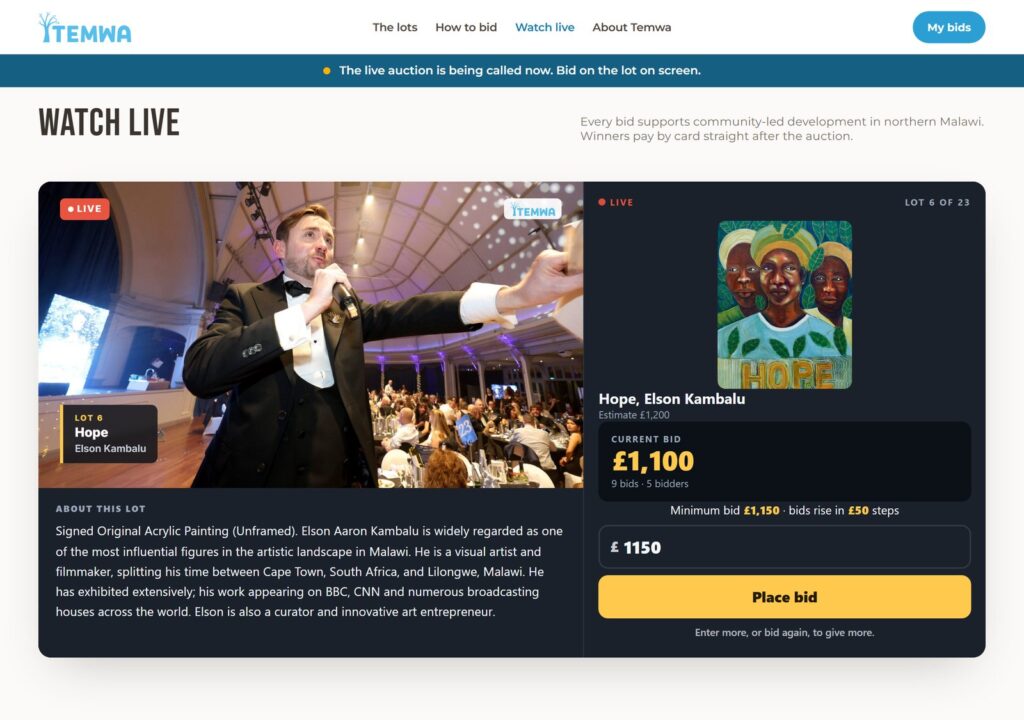
The live auction page on a charity's auction site, with Kevin Durham calling a lot on the video stream

In short

  • Hold the debrief within a week or two, while memories and receipts are fresh, with everyone who ran a part of the night.
  • Ask five questions and finish with a one-page list of decisions, each with an owner and a date.
  • Read the money in layers: gross, costs, net, then per head, per lot and the pledge share.
  • Record what the room did, not only the total.
  • Report back promptly, and claim Gift Aid while the paperwork is complete.

A charity event debrief is a structured meeting, held within a week or two of a fundraising evening, where the people who ran it compare what happened with what was planned and agree what changes next year. Most committees skip it. The total is announced, the thank-yous go out, and the lessons stay in people’s heads until someone leaves the committee.

I run the auction and pledge on the night, but to be plain about what follows: the debrief method is general practice, drawn from the guidance and event-review guides linked below, not a service I run. The MS UK figures are from an event I hosted.

When should a charity event debrief happen, and who should be there?

Hold the debrief seven to fourteen days after the event, once the final payments are in. A guide for school fundraisers from PTA+ says within seven days, “before you lose momentum”, and a 2015 piece in the Chronicle of Philanthropy says at least a week but no more than a month. Ten days is a sensible middle.

Invite the chair, the treasurer, whoever ran ticketing, sponsors and volunteers, the venue contact and your host or auctioneer. Send a short form to anyone who cannot come. Southwark Council, updated in October 2026, also suggests asking partners, performers and stallholders as well as the audience.

PTA+ adds a good rule: let someone who was not involved analyse the answers, so nobody defends their own corner. And trustees have a stake. The Charity Commission’s CC20 guidance, updated in February 2026, tells trustees to discuss fundraising at their meetings, so the one-page result belongs on the next board agenda.

Which five questions change next year’s event?

Five questions do most of the work, because each one ends in a decision rather than a discussion.

  1. Did we reach the net target, and which income line missed? Compare every line with its budget, not only the total.
  2. What did the room do? Where did attention fall, who left early, which lots were fought over?
  3. Was each cost worth it? Set every cost line against the income it helped produce.
  4. What did guests experience? Sound, queues, seating, food timing, complaints, anything a guest said to a volunteer.
  5. Who must be told what, and by when? Donors, bidders, sponsors, the venue, the board.

End the meeting by writing down three things to change and three to keep. That is your one-page output. Anything longer will not be read in October next year. If you need the planning side, my guide to planning a gala covers the sequence.

How do you read the numbers after a charity gala?

Read them in layers: gross raised, then costs, then net, then per-head and per-lot figures, and last the split between pledge and auction. The net is what the charity receives, and it is the only figure to hold against the target. My guide to setting a target covers the other end of that comparison.

Here is the arithmetic with made-up round numbers, not a real event:

MeasureHow to work it outExample
Gross raisedAll income, on the night and after£48,000
CostsEverything spent, including card fees£11,000
NetGross minus costs£37,000
Gross per headGross divided by 120 guests£400
Net per headNet divided by 120 guests£308
Cost to raiseCosts divided by gross23p per £1

Published commentary on fundraising ratios, updated in July 2026, puts established charities with large regular giving bases at 10p to 20p per £1 raised, and newer or growth-investing charities at 40p to 60p or more. Those are whole-organisation figures. For one evening, the trend against your own last two years tells you more.

The split matters as much as the total. A debrief that only records the total can miss that the pledge, or a single lot, was the biggest line, and that changes how you build next year’s programme. I explain the mechanics in a live pledge.

For lots, record the hammer price as a percentage of the estimate. Lots that sell far under tell you the estimate or the audience was wrong. Lots far over tell you what to find more of.

How do you capture what the room did?

Ask the people who watched it, within a day or two, because nobody remembers clock times a week later. Give the host, the table captains and the front-of-house volunteers three lines each: when attention dropped, which lots drew competition, and who left before the auction.

Then build a timeline with clock times: doors, first course, speeches, auction start, pledge, last bid. Lay the money over it: each lot’s hammer price against its estimate, how many bidders it drew, and which tables gave nothing. The console on the platform I use shows each lot’s sale as a percentage of its estimate as it sells, so the lot-by-lot sheet exists before the guests have gone home.
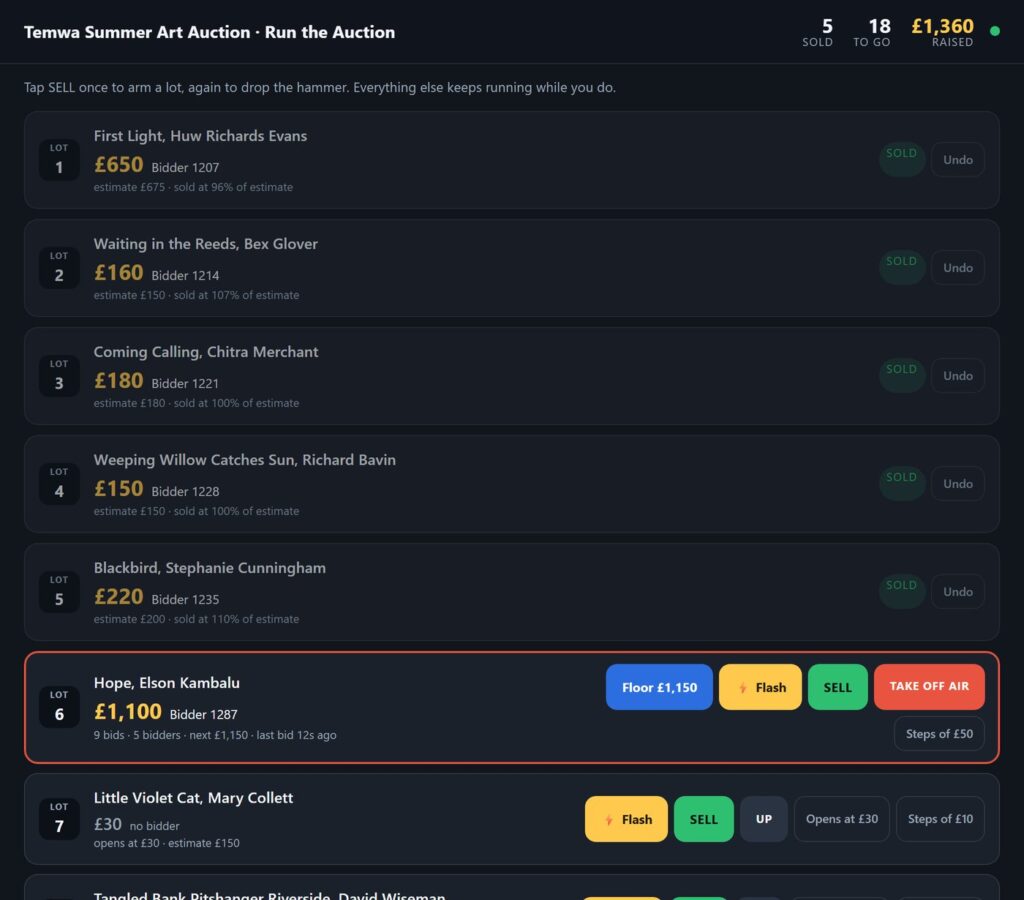
The auctioneer's console showing five sold lots, each with its hammer price as a percentage of estimate

What should you tell donors and bidders afterwards?

Tell them what the night raised and what it will do, within about a week, then claim Gift Aid. Specific beats warm: name what the net pays for. My guide to thanking donors covers the thank-you itself, so this is the reporting half.

At MS UK I told the room at the start where every pound was going, and which lots gave the charity 100%. The report back is the same promise kept, so quote the net, not the gross. Two rules in the Fundraising Regulator’s Fundraising Code, effective 1 November 2025, bear on it. Standard 1.2.2 says that when you collect for a restricted purpose you must say what happens if you raise more or less than the target. Standard 1.2.3 says you need evidence for claims about costs. Your debrief figures are that evidence.

On Gift Aid, HMRC’s claiming guide says you must claim within four years of the end of the financial period you received the donation in, and keep records for a further two. Ticket payments generally do not qualify. For auctions, only the excess over an item’s value can, and HMRC says the value must be made clear to bidders before each item is sold. Four years is the deadline, not the plan. I would claim within weeks. One caution on data: a thank-you is not permission to market, so check consent before guests join a mailing list.

When is it worth bringing in a professional?

For a small first event, such as a quiz or school fair, a volunteer can run this debrief with the template below. A professional earns the fee when totals have plateaued and nobody can say why: the room is warm, but bidding stalls at the same amounts every year. In my experience that is rarely the lots. It is that nobody is managing the room’s energy, and the difference shows in the final total.

Gabriel Dos Santos of OCU Foundation put it on my reviews page this way: “We hosted just over 300 guests and raised more than double what we achieved last year. Kevin’s key suggestion, the live pledge alone, brought in nearly £20,000.” Those are their words and their numbers, and the work after the money lands is theirs. My part is small next to it.

If you do get in touch, have ready the date, room size, running order, last year’s net figure and what stalled. The auction platform is included when you hire me: I build it around your event, and it stays live for a month afterwards, long enough to run the debrief from the lot-by-lot record.

A charity event debrief template

Copy this onto one page and fill it in at the meeting.

SectionFill in
ResultGross, costs, net, target, variance
Income linesEach line against its budget
RatiosPer head, cost to raise, pledge share
RoomTimeline, stall points, early leavers
GuestsComplaints and feedback themes
DecisionsThree changes, three keeps, owner, date
TellingDonors, bidders, sponsors, Gift Aid claim date

Run it within two weeks, write one page, and put the three changes in the diary before anyone leaves the room. If you want a second pair of eyes on last year’s figures before the next gala, call 07596 851647. You can also see my auctioneer services.

Kevin Durham, charity auctioneer

Kevin Durham

Charity auctioneer & event host

20years£10m+raised60–80events/yr
Check availability07596 851647

Let’s talk

Bring this to your event

Book a free consultation with a charity auctioneer who has raised over £10 million.

Charity event ticket price: what to charge, and what it costs you

A gala ticketing page offering single tickets, a pair, a table of ten and a VIP package at early-bird prices

In short

  • A charity event ticket price settles two things: who walks in, and how much they have left when the bidding starts.
  • Price to fill the room with people who can give, not to clear the catering invoice.
  • Gift Aid does not apply to a ticket. HMRC treats admission as payment for goods or services.
  • Tables of ten are bought by one person on behalf of nine. Price them as a single decision.
  • Comps are not lost income. The right non-paying guest earns the seat back several times over.

I work 60 to 80 rooms a year. A charity event ticket price is not a revenue decision. It is a decision about who comes, and how much room is left in their evening when I stand up after dinner and ask them for money.

What should a charity event ticket price actually cover?

At the very least, the cost of the person in the seat: their food, their service charge, their share of the room. Everything above that line is a judgement, not a sum.

Most committees start from the catering quote, divide by headcount, add a little for contingency and call that the price. It produces a number. It does not produce a room.

Catering quotes also keep moving under you. In the ONS figures released in October 2026, restaurants and hotels ran at 3.8% over the twelve months to September 2026, against overall CPI of 3.5%. A venue pricing a November dinner back in March is pricing into that, and so are you.

The Charity Commission sets no ceiling. Its guidance on trustee duties, revised in February 2026, says there is “no set amount that a charity should spend on its fundraising”, only that the decision “must be in the charity’s best interest”. A cheap ticket is not automatically the responsible choice.

Does a high charity event ticket price raise more or less on the night?

Often, less. Not because expensive guests are mean, but because of arithmetic that happens in their heads before I open my mouth.

Someone who paid £180 has already filed the evening under “given”. They arrive square with the cause. Someone who paid £85, told plainly that it covers their dinner, arrives with the giving still ahead of them. When the live auction starts, those two people behave completely differently.

There is a real exception. Where the price is doing a job other than revenue, a high one lifts the total. A £500 ticket screens for people who can bid at £5,000, and it signals the level of the evening to everyone who reads the invitation. That works when your fundraising target rests on twenty serious bidders rather than two hundred warm ones, and it fails when a committee prices for the room it wishes it had.

Admission income rarely carries a fundraising evening. When a charity shows me last year’s figures, one of the first things I check is how many came and what they paid. Plenty of guests on a high ticket price next to a modest fundraising total tells me there is a lot of room to improve.

Which is why I would rather have 180 guests at £100 than 120 at £150: the same ticket income, and sixty more people holding paddles.

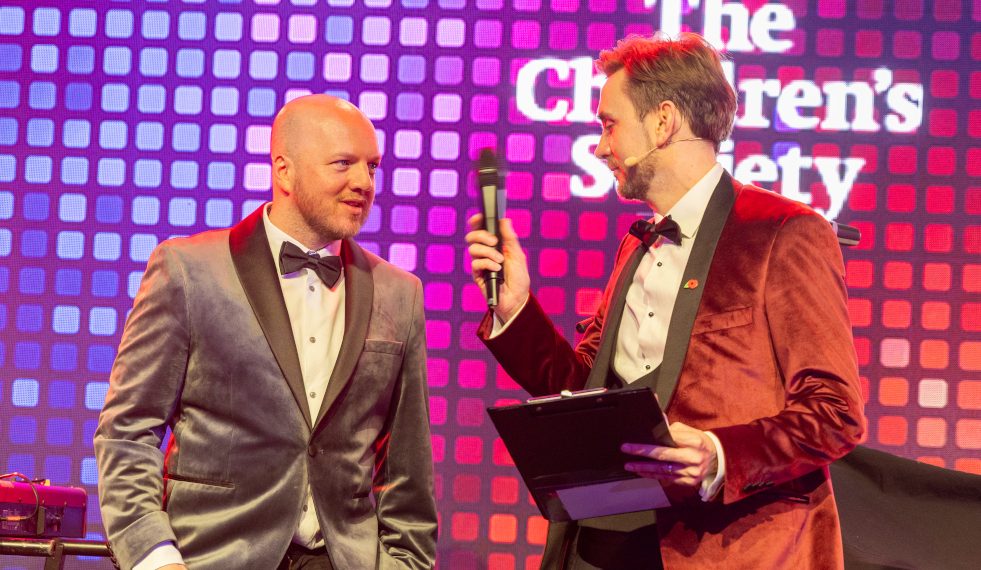
Kevin Durham on stage with an organiser at a Children's Society gala, microphone in one hand and running-order notes in the other

How do tables of ten change the ticket price?

They turn ten decisions into one, and the person making it is rarely buying dinner.

Companies buy tables for reasons sitting between marketing and goodwill, and they decide in a different part of the building from the one that buys single seats. Price accordingly: a shallow discount or none at all, with the value delivered as visibility rather than money off. That is what tiered sponsorship packages are for.

One thing to know before you quote a corporate table. HMRC denies a trading-profit deduction for business entertaining, while a straight gift to charity is generally deductible if made wholly and exclusively for the business. Your invoice should make plain which part is which.

Are early-bird and tiered prices worth the complexity?

An early-bird price earns its keep. Four tiers do not.

Early pricing buys you information at the only point where it is still useful. Eight weeks out, knowing you have sold 40 of 200 seats lets you ring table captains and change the plan. Two weeks out the same number tells you nothing you can act on.

Past two prices you are mostly manufacturing admin and giving people a reason to wait. Whatever you land on, quote it honestly. The CAP Code requires quoted prices to include non-optional fees that apply to all or most buyers. If your platform adds a booking fee at checkout, that fee belongs on the poster.

What do you do about supporters who cannot afford the price?

Decide before you publish the price, and handle it quietly enough that nobody could point at who was helped.

Affordability is not an edge case. The Charities Aid Foundation’s UK Giving work puts total giving at £14 billion in 2025 and reports that one in five people say they cannot afford to give to charity at all. Some of them are your most loyal volunteers.

What works: hold back six or eight seats before tickets go on sale, offer them by direct invitation, never label them on a booking page, seat those guests on ordinary tables. A published “supporter rate” does the opposite, telling half the room they are the cheap half.

The Code of Fundraising Practice, in force since November 2025, sets the floor. Standard 1.1.1 requires fundraising to be “legal, open, honest and respectful”.

Who should never pay for a ticket?

Four groups, and you should budget their covers as a cost line rather than hoping nobody notices.

  • Your auctioneer and host. I am working.
  • The beneficiary or service user who is speaking. Charging someone to tell the room about the worst year of their life is not a good look.
  • Press and photographers, if you want the coverage.
  • The guests of your largest donor, where those guests are why your largest donor came.

Ten free covers at £55 is £550 of catering against a speaker whose three minutes sets up the whole live pledge. I know which side of that I take.

Does Gift Aid apply to a charity event ticket price?

No. A ticket buys admission, admission is a payment for goods or services, and Gift Aid cannot be claimed on it.

HMRC’s guidance on Gift Aid, last updated in October 2019, lists payments for goods and services among those you cannot claim on, and says a qualifying payment must not be compulsory for attending an event. The detailed guidance is blunter. Chapter 3, updated in October 2026, says at paragraph 3.4.6 that “payments to a charity in return for services, rights or goods are not gifts to charity”, using admission to a concert as its example.

Two things follow for your booking page. First, a voluntary donation alongside the ticket can qualify, as long as people can genuinely attend without making it: separate line, optional in fact and not only in wording, declaration collected.

Second, the admission-to-charity-property rule will not rescue you, the one where a donation 10% above the normal entry charge qualifies. Chapter 3 excludes rights going beyond viewing the property at 3.19.3. A gala dinner is squarely one of those.

On VAT, admission charges to a qualifying fundraising event fall under the events exemption, updated in April 2026, with conditions that deserve their own hour with your finance lead. This is general information rather than advice: take your own before you publish a price.

Showing people where the ticket money goes

Put it on the booking page in one sentence, in pounds, before anyone reaches for a card. “Your £95 covers dinner, service and the room. Everything raised on the night goes to the service.”

CC20 says a charity “must be open and accountable about its fundraising”, and that appeals should explain whether any of the money will go on fundraising costs, and what proportion. The Code asks the same of events at standard 10.2.1.

It is also the cheapest thing you can do to the total. One plain sentence about where the money goes, and the room bids knowing the charity keeps it.

The honest arithmetic of one ticket

Run the numbers before the committee falls in love with a price. Say the ticket is £95 and the venue charges £58 a head for three courses and service. Another £12 covers that guest’s share of the room, the AV and the print. You are left with about £25 a head.

Two hundred guests, and the entire ticket exercise has contributed roughly £5,000. One well-placed lot does that. A live pledge, set up properly in your running order, does it several times over.

The ticket is not your fundraising. It is the invitation to it.

Set the price for the room you want

Work backwards. Decide who needs to be there, ask what price gets them through the door with money unspent, then check it at least covers their dinner. If it does not, that gap is a sponsorship conversation, not £40 on everyone’s ticket. The sequence around it sits in my guide to how to plan a gala.

To talk a price through before you publish it, call 07596 851647.

Kevin Durham, charity auctioneer

Kevin Durham

Charity auctioneer & event host
20years£10m+raised60–80events/yr
Check availability07596 851647

Let’s talk

Bring this to your event

Book a free consultation with a charity auctioneer who has raised over £10 million.

Charity event budget: what to spend, and what comes back

Kevin Durham on stage at a Children's Society gala, clipboard of notes in one hand and the microphone in the other

In short

  • A charity event budget is half a budget until the income lines sit next to the cost lines.
  • The forgotten costs are AV, licences, card processing, print, insurance and a real contingency.
  • The Charity Commission sets no spending limit, but trustees must be able to justify the decision.
  • Ticket income rarely carries a fundraising evening. The auction and the live pledge usually do.
  • Cost-to-raise is a judgement, not a rule: published ranges run from 10p to 60p per £1.

I stand at the front of 60 to 80 rooms a year. What decides a night is rarely the total spend. It is what the spend was aimed at. A charity event budget that treats the evening as a cost to be controlled almost always underperforms one that treats it as an investment with a specific return.

What belongs in a charity event budget?

A charity event budget needs two columns of equal detail: everything you will spend, and everything you expect to raise, line by line, with a name against each. Too many budgets have a beautifully itemised cost side and an income side that says “auction: £15,000” with nothing underneath it.

The Charity Commission’s guidance on trustee duties says a fundraising plan can include “how much you will spend on fundraising (your fundraising budget)” alongside how much you intend to raise and how you will monitor it. Both halves belong in the same document. If yours sit in separate spreadsheets owned by different people, fix that first. My guide on how to plan a gala covers the sequence around it.

Which cost lines do organisers forget?

Venue and catering are never forgotten. Nearly everything that makes the venue work gets missed.

AV and production. Sound, lighting, a screen and someone competent on the desk. The line I defend hardest, for a reason I come back to below.

Licences. Play recorded or live music in a public space and you generally need TheMusicLicence, run by PPL PRS. Sell raffle tickets in a way that counts as a small society lottery and you register with your local council: the Gambling Commission’s guidance on small lotteries gives a £40 registration fee and a £20 renewal after the first year, with at least 20% of proceeds going to the cause.

Card processing. Every pound pledged on a card arrives slightly smaller. Stripe’s published UK rate in October 2026 is 1.5% plus 20p on standard domestic cards and 3.15% plus 20p on non-EEA cards. In-person readers sit in a similar band: SumUp’s comparison page lists 1.69% against 1.75% for Zettle and Square in October 2026. On a £60,000 night that is around £1,000 nobody budgeted for.

Print. Lot sheets, pledge cards, menus, signage, a programme. Small amounts that total up.

Insurance. Public liability is not legally required for a UK charity event, but venues frequently ask for it. One broker quotes cover from £69 for a one-off event, moving with guest numbers and cover level.

The auctioneer and host. A real figure, not an afterthought. Fees are bespoke, so get a quote early: I have written separately on what shapes an auctioneer’s fee.

Contingency. Five to ten per cent of the cost side, untouched until something breaks. Something usually breaks.

Can your trustees justify the spend?

They need to be able to, and the test is the quality of the decision rather than the size of the number. The Commission is explicit that “there is no set amount that a charity should spend on its fundraising”.

What there is, in the essential trustee guidance, is a duty to act “responsibly, reasonably and honestly” and to make decisions that are “balanced and adequately informed”. It also advises trustees to record how they made more significant decisions, so they can explain them afterwards.

In practice that means a short paper: what you are spending, what you expect back, what you are comparing it against, what happens if you come in 30% short. Guidance on financial controls, last updated in November 2024, adds the event-level discipline: keep records for each event, identify what was collected and what it cost, reconcile ticket receipts against tickets sold.

One more line belongs in it. Pay anyone more than £15 a day or £1,500 a year (the section 58 thresholds since 30 September 2026) to fundraise for you and the Fundraising Regulator’s guidance on the solicitation statement requires them to tell the room who they are raising for, what they are paid and how that is calculated.

How do you set a target you can defend?

Build the target from the income lines upwards, never from last year’s total plus a percentage. Tables sold at a price you have actually achieved, sponsorship already in conversation, an auction figure built from the lots you have in hand, a pledge figure built from the size and profile of the room. Then subtract the cost side and state the net. The net is what the charity receives, and it is the only number worth putting in a board paper. My guide to setting a fundraising target goes deeper on that.

Two tax lines move the net. HMRC’s guidance on Gift Aid treats ticket money as payment for goods or services, so it does not qualify, though a voluntary donation alongside it, or the amount paid above an auction item’s value as an “excess donation”, can. And the fundraising events exemption is “restricted to 15 events of the same kind in a financial year at any one location”. Run a 16th and none of them qualify.

Where the money actually comes from on the night

Overwhelmingly from the auction and the live pledge, not from tickets. Ticket and table income usually covers the cost of feeding the room, and sometimes not even that. The fundraising happens in a twenty-five minute window after dinner.

Kevin Durham pointing out a pledge from the stage, clipboard in hand, under red stage lighting at a corporate charity gala

Charles Balchin wrote after his first charity auction: “Kevin was absolutely fantastic at running our event. He added a pledge element we hadn’t considered and it became hugely successful.” A pledge belongs in the budget as its own income line, even when nobody has planned one yet.

That is the pattern I see most often, and it is why I argue with budgets that spend heavily on the room and nothing on the fundraising mechanics. A live pledge costs almost nothing to run. It needs a cause explained properly, a working microphone, people who can see and hear, and someone driving it. All four are budget decisions.

Gross is not net on the income side either. If a silent auction company brings lots with high reserves, budget what the charity keeps after the reserves and the company’s share, not the gross on the night. In my experience that is the single biggest drain on a charity’s total, and in-house lots with a strong pledge behind them keep far more.

What should your cost-to-raise ratio be?

There is no official answer, and anybody offering you a single number is guessing. Published commentary on fundraising ratios, updated in July 2026, puts established charities with large regular giving bases at roughly 10p to 20p per £1 raised, and newer charities or those investing in growth at 40p to 60p or more, while noting that UK charity law sets no maximum.

Those are whole-organisation figures. One night with fixed costs is a different animal. The direction of travel matters more than the number. If the event costs more and raises less than it did two years ago, that is the finding. If it costs slightly more and raises a lot more, a rising ratio is not a problem.

The budget decisions that pay for themselves

The spend that pays for itself buys attention. The spend that does not buys decoration.

What earns its money back, in my experience:

  • Sound that works everywhere in the room. I once walked into a late-running event, announced the auction while people were still talking, and did not stop to get them quiet. Only a fraction of the room heard the lots. One man bid on something he could not clearly hear. Every guest has to hear every lot, and that starts with the sound.
  • A short, well-made case for support, placed immediately before the pledge. A two-minute film, or a speech from someone the cause has touched. On most budgets this is the highest-return line there is.
  • Ten lots a room will fight over, instead of fifty nobody wants. Sourcing in-house keeps more of the money too: see my guide to sourcing lots.
  • A professional on the microphone. I would say that, so judge it on the final total and not on my opinion of myself. The platform comes with my hire, in your branding and loaded with your lots, which takes a software line out of the budget.

What rarely pays for itself: elaborate table dressing, a glossy brochure nobody opens, an act booked into the slot where the pledge should be, and a long consignment catalogue of lots that mostly serves the company supplying it.

Start your charity event budget from the income side

Write the income lines first. Put a name and a method against each. Then ask of every cost line whether it makes one of those income lines bigger, and be ruthless about the ones that do not. If you want a second pair of eyes before the numbers reach your board, I offer a free fundraising consultation: call 07596 851647 or email hello@thecharityauctioneer.uk.

Kevin Durham, charity auctioneer

Kevin Durham

Charity auctioneer & event host

20years£10m+raised60–80events/yr
Check availability07596 851647

Let’s talk

Bring this to your event

Book a free consultation with a charity auctioneer who has raised over £10 million.

Fundraising strategy for charities: where events fit, and where they don't

Kevin Durham in a burgundy velvet jacket on the microphone, reading from his running notes on stage at a charity ball

In short

  • A fundraising strategy is a two to three year plan that sets out how much you need, where it will come from, and who does what.
  • UK charities get just under half their income from the public. Events are one slice of that, alongside regular giving, grants, legacies, trading and major donors.
  • Events are good at raising unrestricted money fast, finding new supporters and lifting a whole campaign. They are bad at steady monthly income.
  • Run fewer, bigger events, and plan what happens to every guest after the night.
  • The Fundraising Regulator’s Code sets event standards, and HMRC rules decide what can carry Gift Aid and VAT relief.

A good fundraising strategy treats events as one income stream among several, not as the plan itself. Events are brilliant at some jobs and poor at others, and it is easy to lean on them too hard or write them off too quickly.

My living is 60 to 80 events a year as a professional charity auctioneer, so you might expect me to tell you to run more of them. I won’t. Here is where an event earns its place in your plan, where it doesn’t, and how to build the year around the one night that matters.

What is a fundraising strategy?

A fundraising strategy is a written plan for how your charity will raise the money its work needs over the next few years. It names your target, the mix of income you will chase, the activities and dates, the budget, and who is responsible.

NCVO suggests matching it to your organisation’s plan, usually two to three years, with SMART objectives and a review built in. The Charity Commission is blunter: trustees should plan the approach, and must identify and manage the risks that come with it.

A strategy is not a calendar of nice ideas. It starts with a number, a real one in pounds. If you have not set one yet, start with setting a target and work backwards.

Where does UK charity income actually come from?

Just under half of UK voluntary sector income comes from the public. NCVO’s Almanac puts it at 48% of £69.1bn in 2021/22, with government at 26%, other charities and foundations at 12% and investments at 9%.

“The public” covers a lot of ground: donations, legacies, membership, charity shops, and events.

So events are a slice of a slice.

The public slice is also under pressure. CAF estimates the British public gave £14bn in 2025, and one in five people say they cannot afford to give. CAF’s own consultant writes that the sector has lost around 600,000 donors a year over the past decade.

That is the honest backdrop, and I’d rather you planned with it than around it. How to fundraise in 2026 comes down to the mix. There is no magic method.

Where do events fit in a fundraising strategy?

Events fit in a fundraising strategy as the place where you raise unrestricted money quickly, meet new supporters face to face, and give a campaign a moment people remember. They work best as a few high points in the year, with steadier income streams doing the daily work.

Here is roughly how the main streams compare:

Income streamGood atWeak at
Regular givingPredictable monthly incomeSlow to build, needs constant recruitment
Trusts and grantsLarge sums for set projectsOften restricted, competitive, slow
Major donorsBig gifts from few peopleTakes years of relationship
LegaciesLarge, transformational giftsUnpredictable timing
EventsFast unrestricted money, new contactsHeavy on time, risk and volunteers

CAF’s March 2026 analysis gives two useful examples. A small Sussex charity found community fundraising events among its most effective tools, both for income and local ties. And Great Ormond Street Hospital Charity grew events, trading, major gifts and individual giving together on the back of one capital campaign. The event was part of the story. It wasn’t the whole story.

Where events don’t fit

An event will not give you reliable monthly income. It happens once, and a wet weekend or a clash with a big match can dent it.

Events also cost more than the venue invoice. Staff time, volunteer hours, ticket sales, lot sourcing and follow-up all come out of the same small team that should be stewarding donors. The Charity Commission notes there is no set amount a charity must spend on fundraising, but every pound and hour has to be in the charity’s best interests.

There are tax limits too. Fundraising events can be exempt from VAT, but HMRC caps it at 15 events of the same kind in the same place each financial year. Hold 16 and all of them become taxable. HMRC also says an event should be out of the ordinary, not business as usual.

Put simply: if your events are plugging a gap that regular giving or a grant should fill, the problem is the strategy, not the event.

How do you write a fundraising plan that includes events?

You write a fundraising plan by auditing what you raise now, choosing your income mix, setting objectives, then putting activities, budgets and owners on a calendar. Events go into that calendar after the steady streams, not before.

  1. Audit last year. What did each stream raise, and what did it cost in money and hours?
  2. Check the mix. NCVO warns that relying on a single source of income puts you at risk.
  3. Set objectives per stream. A number, a date and an owner for each.
  4. Choose your channels. The CIoF guide for small charities lists events, online campaigns, direct mail and face-to-face as options to weigh.
  5. Build the calendar and budget. Place your flagship event where it supports a campaign or a key date.
  6. Review quarterly. Add event risks to your risk register.

If you want a second pair of eyes on where the event sits, that is what my fundraising consultant work is for. Most of the extra money is made before the night, in the planning.

How many fundraising events should a charity run a year?

Most small and medium charities are better off with one flagship event and a handful of light community fundraising activities than with a packed events diary. One big night done properly usually beats six done tiredly.

The flagship might be a gala dinner, a ball or an auction evening. Around it, supporters run their own community fundraising: bake sales, sponsored challenges, quiz nights. Those cost the charity little and keep people involved between the big moments.

Spacing matters. Put the flagship where it does a job, such as launching an appeal or closing a capital campaign, and keep at least a few months between big asks to the same crowd.

Getting more from the one big night

If you are going to run one main event, make it count. This is my patch, so here are the opinions I hold most firmly.

Most charity auctions underperform not because of the lots, but because nobody is managing the room’s energy. Bidding momentum is a skill, not luck.

Kevin Durham in a burgundy velvet jacket on the microphone, pointing out into the room at the Jigsaw charity gala

The live pledge is the most underused tool in the room. One gala I worked in Monaco raised over €1,000,000, and it was built on planning before the event: which lots, in what order, and a structured pledge drive on the night. The credit belongs to the people behind that cause, not me, but the lesson stands: put the live pledge in the plan from the start. It’s a serious moment, yet the excitement still builds as the money comes in.

There is a tax reason too. HMRC treats auction wins and raffle tickets as purchases, not gifts, so they cannot carry Gift Aid. A genuine donation on top of a ticket can, if it is clearly optional. A pledge is a straight donation, so collect Gift Aid declarations on the night.

And source your lots in-house. A commission-based lot supplier who rolls in with 50 to 100 lots is mostly serving itself. Ten great lots and a room driven to compete will keep far more with the charity. For more on the night itself, see how to raise more money at a charity event.

What do the rules say about fundraising events?

The main rules are the Fundraising Regulator’s Code of Fundraising Practice, which has an events section, plus your trustees’ legal duties and HMRC’s tax rules. The new Code came into effect on 1 November 2025.

Section 10 of the Code says you must carry out a risk assessment before an event, have the permissions and licences you need, and be clear in your promotion about how the money raised will be used.

Under CC20, trustees must make sure fundraising complies with the law and protects the charity’s reputation.

Fundraising tips to build the year around

A few fundraising tips that hold up whatever size you are:

  • Start with the number, then pick the streams that can reach it.
  • Give each event one job: new supporters, unrestricted cash, or a campaign launch. Not all three by accident.
  • Plan the follow-up before the night. Every guest is a possible regular donor. CAF’s advice is to cherish the supporters you have, and that starts with how you thank donors.
  • Count the hours, not just the costs.
  • Judge the event against the plan. Last year’s total is the wrong yardstick.

If you’d like to talk through where an event fits in your own fundraising strategy, call me on 07596 851647. The first consultation is free, and I’d rather talk it through properly than trade messages.

Kevin Durham, charity auctioneer

Kevin Durham

Charity auctioneer & event host

20years£10m+raised60–80events/yr
Check availability07596 851647

Let’s talk

Bring this to your event

Book a free consultation with a charity auctioneer who has raised over £10 million.