Home About Kevin Auctions Virtual auctioneer Pledges Hosting Entertainment Free software Software examples Case studies Reviews Videos Other services Fees Fundraising games Fundraising consultant Brochure printing Recommended suppliers Get in touch Blog Podcast

Match funding for charities: how to use it to double your gala total

Kevin Durham on the microphone at the MAG-FEST charity gala as the organisers applaud on stage

In short

  • Match funding means a funder agrees to give in proportion to what others give, usually £1 for every £1.
  • Research on more than 50,000 donors found that simply announcing a match lifted revenue per appeal by 19%. A 1:1 match worked as well as 2:1 or 3:1.
  • At a gala, the best use is a matched pledge: a sponsor or trustee commits a capped pot before the night, and you spend it during the live pledge.
  • Company matched giving schemes and Big Give campaigns are the two other routes worth knowing.
  • Gift Aid follows the person who gives. You can claim it on your supporters’ pledges, but not on a company’s match.

Match funding is the simplest way to make one gift do the work of two. A sponsor, trustee or company agrees to match what your supporters give, and every pound that goes in comes out doubled. Used well at a gala, it is the closest thing fundraising has to a shortcut.

On any fundraising night I work as a professional charity auctioneer, the live pledge is the segment I care most about, and a match is the strongest thing you can bolt onto it. Here is what match funding means, why it works, and how to make it land in the room.

What is match funding?

Match funding is money a funder promises to give in proportion to what is raised from other people. In practice that almost always means pound for pound: you raise £10,000, the funder adds another £10,000.

The term covers a few different arrangements:

  • A matched appeal or pledge. A donor or sponsor doubles public gifts up to a cap, for a set window.
  • Employer matched giving. A company matches what its own staff give or raise.
  • Matching grants. A foundation awards a grant on condition that the charity first raises a set sum elsewhere.

The first two are the ones that raise your total on the night.

Why does match funding make people give more?

Match funding makes people give more because it changes the price of doing good. A £50 pledge suddenly does £100 of work. Most people find that hard to turn down.

The best evidence comes from a large field experiment by economists Dean Karlan and John List. They sent appeal letters to over 50,000 previous donors. Announcing a match raised the revenue per letter by 19% and the chance of someone giving by 22%. The surprise was that 3:1 and 2:1 matches did no better than 1:1.

A second study by Daniel Rondeau and John List adds a twist. Announcing a lead gift that was already committed brought in 23% more donors and 18% more money than saying nothing. In that test, the match itself added no extra lift on top.

The lesson for a gala: donors respond to a committed, visible sum that someone has already put on the table. A match gives you that, plus a reason to give now.

How does a matched pledge work at a gala?

A matched pledge works by doubling every pledge made in the room, up to a cap agreed in advance. The funder commits, say, £10,000 before the night, and every pound pledged is matched until the pot runs out.

The live pledge is already the most powerful segment of any fundraising night. Structured properly, a pledge drive beats a lot-based auction at most galas, and a match gives it a headline.

A well-run live pledge can out-earn the auction with no match in sight. Put a match behind it and every hand counts twice.
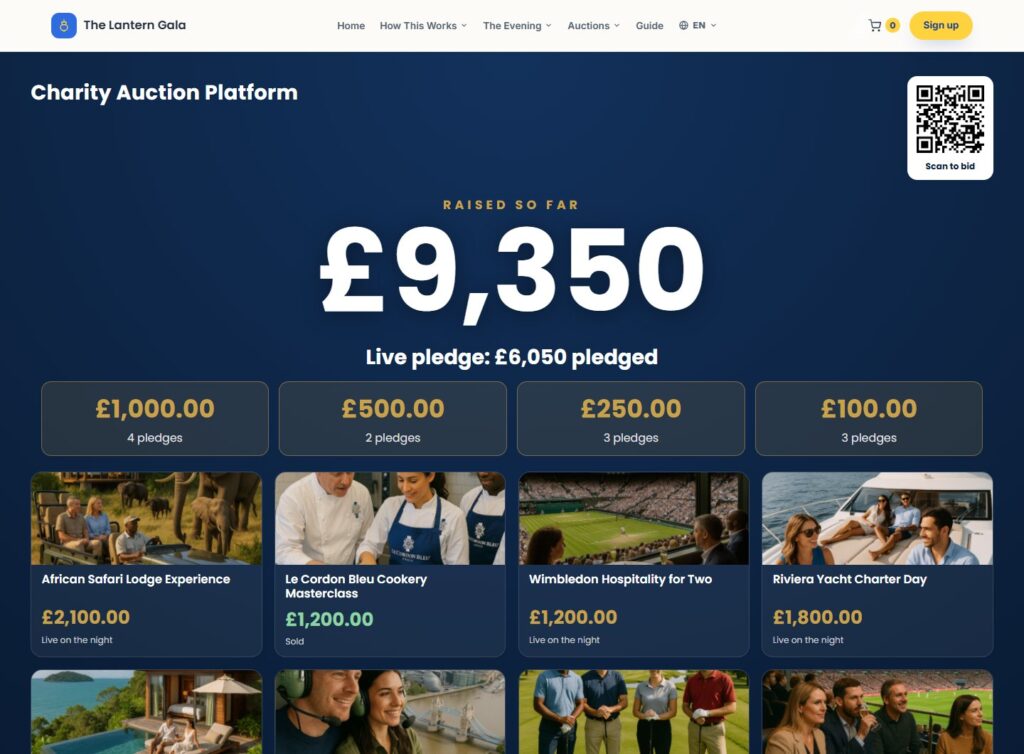
Big screen at a charity gala showing the total raised so far and the live pledge tiers

Here is how I’d set one up:

  1. Announce the match before the first hand goes up. Name the funder if they are happy to be named, and say the cap out loud.
  2. Tie the levels to the cause. “£500 funds a week of support. With the match, that is two weeks.” My fund-a-need guide covers setting the levels.
  3. Count the match down. Telling the room how much is left creates real urgency. No fake pressure needed.
  4. Thank the funder, then go back to the cause. The match is the reason to give now, not the reason to give. Keep it warm and hopeful rather than heavy.

One client doubled their fundraising target. Their team did the hard work; what I added was structure, a plan for the auction and the pledge agreed well before dinner. A match belongs in that plan from day one.

Securing your match before the night

The match has to be confirmed before the event. A pledge that is “probably matched” is not one you can announce.

Kevin Durham on stage with the MAG-FEST organisers, in front of the sponsor and charity screens

Your best prospects are already close to you:

  • Your headline sponsor. A match gives them something more visible than a logo on a banner.
  • A trustee or major donor. Used as a match, their gift gets seen and multiplied instead of banked quietly.
  • A corporate partner. Some will treat a match as part of their charity partnership, and my corporate fundraising guide covers how to pitch it.

Agree four things in writing: the ratio, the cap, the window (usually the pledge segment), and what happens if the room falls short of the cap. Some funders give the full amount either way; others only match what comes in. Ask, because it changes how you word the announcement.

Set the cap against your overall fundraising target. Too small and it runs out in the first minute. Too large and the room never gets close, which takes the edge off.

How does company match funding work?

Company match funding is when an employer matches what its staff donate or raise for charity. The CAF guide to matched giving (August 2025) lists the usual models: 1:1, doubling, a cap per employee such as up to £50 a month, or matching during a specific campaign or event.

Schemes can cover payroll giving, fundraising events and personal donations. The company also gets tax relief, because it can deduct donations from its profits before tax.

For a gala, this is money sitting at your corporate tables. Ask table hosts before the night whether their employer runs a matched giving scheme. If they do, mention it during the pledge and follow up afterwards with whatever the scheme asks for.

How does Big Give match funding work?

Big Give match funding works by pairing a charity’s appeal with Champions: philanthropists, foundations and companies who give in advance so that public donations are doubled during a campaign week.

Its flagship Christmas Challenge raised a record £57.4m in one week in December 2025, for 1,591 charities, including £25.8m in match funding. It runs in early December, timed to coincide with Giving Tuesday. Applications for the 2026 campaign closed at 5pm on 15 July 2026. Big Give lists the 2027 window as 10 May to 2 July 2027.

Taking part? Then an early December gala is a natural partner. Tell guests from the stage that gifts through your Big Give page that week are doubled while the match lasts.

Big Give also lets charities run their own match campaigns outside the big challenges. You set up a campaign, send your match funders a pledge form, and upload proof of the funds afterwards. These dates are from Big Give’s Christmas Challenge page as at 3 November 2026, so confirm current terms with them.

Can you claim Gift Aid on matched donations?

You can claim Gift Aid on the part each individual gives from their own money, but not on a company’s match. Gift Aid follows the person who actually gives.

Here is how the HMRC rules apply to a matched pledge:

  • Your supporters’ pledges. You can claim 25p on every £1, as long as the donor is a UK taxpayer who has paid enough tax and has made a Gift Aid declaration.
  • A company’s match. HMRC says you cannot claim Gift Aid on company donations of money. The company gets its own tax relief instead.
  • A trustee or donor matching personally. Their gift is a donation from an individual, so it can qualify on the same terms as anyone else’s.
  • Tickets and auction lots. Ticket money does not qualify, and an auction purchase only qualifies on any amount paid above the lot’s value.

That makes the pledge the cleanest segment of the night for Gift Aid.

So put a declaration on every pledge card.

Five ways to waste a match

Matches that disappoint usually fail in one of these ways:

  • Announcing it too late. If the room hears about the match halfway through the pledge, you’ve missed the moment it was built for.
  • Overclaiming. The Fundraising Regulator’s code says your fundraising must not mislead donors. If the cap is £10,000, do not say “everything tonight is doubled”.
  • Chasing a bigger ratio. 1:1 does the job. Ask for a bigger pot, not a 3:1 headline.
  • Talking more about the funder than the cause. Thank them warmly. Then get back to the cause: that is what people give to. The match only multiplies it.
  • No follow-up plan. Pledges and employer matches need chasing afterwards. Decide who does it before the night.

Putting match funding to work at your gala

Match funding works best when it is part of the plan from the start, not a bonus mentioned on the night. Secure the pot, agree the terms in writing, and give the live pledge the room it needs. My comparison of a pledge drive and a live auction explains why the pledge deserves that slot.

Planning a gala and want to talk through a matched pledge? Call 07596 851647. I’d rather talk it through than trade emails.

Kevin Durham, charity auctioneer

Kevin Durham

Charity auctioneer & event host

20years£10m+raised60–80events/yr
Check availability07596 851647

Let’s talk

Bring this to your event

Book a free consultation with a charity auctioneer who has raised over £10 million.

How to organise a charity concert that raises more than ticket sales

Kevin Durham on the microphone on a concert stage, with a drum kit and keyboard behind him and sponsor logos on the screens, at the MAG-FEST charity gala

In short

  • Treat ticket sales as the way to cover costs. The real fundraising happens during the interval.
  • An interval auction of a few strong lots, followed by a live pledge, can outraise the box office.
  • Sell sponsorship before the night so the costs are covered before a single ticket goes.
  • In the UK, sort the music licence, any Temporary Event Notice and the raffle rules early.
  • Gift Aid can’t be claimed on tickets or winning bids, only on voluntary donations. One more reason to run a pledge.

A charity concert is one of the easiest fundraising events to sell and one of the hardest to make pay. The tickets go, the band plays, everyone has a lovely night, and then the costs come off and the cause gets a modest cheque.

I work 60 to 80 fundraising events a year as a charity auctioneer and have helped raise over £10 million for charity. This guide shows how to organise a charity concert where the room, not the box office, does the heavy lifting.

What is a charity concert?

A charity concert is a live music event where the proceeds go to a cause. You’ll also hear it called a benefit concert, a fundraising concert or, at the smaller end, a charity gig in a pub or a church hall.

It scales from a school choir to a full band in a theatre. Like any charity fundraiser event, what you raise is what’s left after the venue, the sound, the licences and the performers’ costs. To compare it with other formats first, my list of fundraising events has fifteen more.

Why do ticket sales alone rarely raise enough?

Ticket sales rarely raise enough because most of that money is spent before the doors open. Venue hire, production, staff and the music licence all come out of the box office.

Some costs even grow with the ticket price. Under the PRS tariff for ticketed popular music concerts, effective from 11 June 2025, the charge is 4% of receipts from admissions, with a £20 minimum per event unless you meet the reporting rules. Ticket money also can’t carry Gift Aid, which we’ll come to.

So the ticket price should do one job: cover the night. The fundraising has to come from somewhere else, and at a concert that somewhere is the interval.

How do you organise a charity concert?

You organise a charity concert by setting a fundraising target, then building the venue, line-up, tickets and running order backwards from it:

  1. Set the target and the break-even. Know what the night costs and what it must raise on top.
  2. Choose music the audience wants. Save The Music’s advice is to pick performers your audience will enjoy. An engaged room gives more.
  3. Ask the venue to donate. The same guide suggests asking whether the venue will give its space, or offering it a sponsorship credit for a lower rate.
  4. Book performers early, and pick a date that doesn’t clash with holidays or big local events. You can’t sell tickets properly until the line-up is confirmed.
  5. Plan the interval as a fundraising slot. Decide now what happens in it, who runs it and how long it gets.
  6. Promote the cause, not just the line-up. People come for the band, but they bid and pledge for the cause. My guide on how to promote an auction covers previewing lots before the night.

The interval is where a charity concert makes its money

A concert gives you one natural break with a seated, warmed-up audience. Don’t let it drift away in small talk. Here is a running order that works:

  • Before the doors. Sell raffle tickets as people arrive and find their seats.
  • End of the first half. A short, sincere word about the cause from the stage, ideally from someone the charity helps.
  • Interval auction. Around ten strong lots, sold quickly. Signed setlists, a meet-the-band pass or a private performance suit a music crowd, and my arts gala guide has more lots for a creative audience.
  • Live pledge. Straight after the auction, while the room is still listening. Guests raise a hand to give at set levels, from a big number down to something everyone can manage. Keep it heartfelt without letting it turn heavy, and let the excitement build as the hands go up.
  • Second half, then the total. Announce what the night raised before the encore, not after the house lights come up.

The pledge is the part most organisers leave out, and the one that makes them nervous. Jo from Temwa said on the night: “Tonight has been record-breaking in terms of how much money we made in the auction. I was so nervous about doing this live pledge. What an incredible auctioneer.” My guide to the live pledge shows how it runs.

One catch. At the interval, a concert audience is mid-conversation and halfway out of their seats. I once started a live auction at a big event without getting the room quiet first, and only a fraction of the guests heard the lots. One man bid on an item he couldn’t even hear properly. “Ladies and gentlemen, it’s time for the live auction” only works if the room is listening, so command the room first, even if you have to stand on a chair.

Sponsorship, raffles and the other income streams

Sponsorship lifts what a charity concert raises because every pound a sponsor covers is a pound the box office keeps for the cause. Sell packages for parts of the night: the headline act, the sound and lighting, the programme, the printed tickets. Agree in writing what the sponsor gets.

Kevin Durham interviewing guests on stage in front of screens listing the headline sponsors, category sponsors and charity partners at MAG-FEST

A raffle adds small sums from almost everyone. Run as part of the concert, it can spend a maximum of £500 of raffle money on prizes and £100 on expenses, and tickets can only be sold at the event while it is happening. Donated prizes have no limit.

Then the small things: a bucket at the exit, a text-to-give number on the screen, and an optional donation on the ticket page, kept separate from the ticket price.

What licences does a charity concert need in the UK?

A charity concert in the UK usually needs a music licence, may need a Temporary Event Notice, and needs a risk assessment and insurance. Check them when you book the venue.

  • Music licence. You usually need TheMusicLicence from PPL PRS to play live or recorded music in public. Ask the venue first what it already holds.
  • The charity discount. PPL PRS offers a charity discount if the form arrives at least 14 days before. It doesn’t apply to popular music events with an admission charge or classical events under their own tariff, so a ticketed pop concert won’t qualify.
  • Ticketed pop and rock. The PRS popular music tariff asks for an application at least 30 days before the event and a set list within 30 days after it.
  • Entertainment licence. Under the Live Music Act changes, live or recorded music needs no entertainment licence between 8am and 11pm at an alcohol-licensed venue with an audience of up to 500. Unamplified live music needs none anywhere in those hours.
  • Temporary Event Notice. At an unlicensed venue in England or Wales, a Temporary Event Notice covers live music and the bar. It costs £21, covers fewer than 500 people (staff included) and must go in at least 10 clear working days before.
  • Safety and insurance. The Fundraising Regulator says you must do a risk assessment, have adequate insurance and stay within the venue’s maximum numbers.
  • VAT. Concert tickets can fall under the fundraising events VAT exemption if the event is promoted as fundraising and you keep the evidence. Speak to your accountant.

These are the rules as of October 2026. Check each page again when you plan.

Can you claim Gift Aid on charity concert tickets?

No, you can’t claim Gift Aid on charity concert tickets. HMRC lists payment for admission to events, including concerts, as not a gift, and the same guidance says an auction payment is a purchase rather than a gift.

What you can claim on is voluntary donations. Macmillan notes Gift Aid only applies to personal, voluntary donations, so pledges and online donations can qualify. Each one must come from an individual who makes a declaration, and company donations don’t count.

So have Gift Aid declarations ready for pledgers, and keep donations separate from ticket sales.

Where an auctioneer fits in

A good committee can organise almost all of a charity concert, and the performers and the cause do most of the work. The part that is hardest to do from the inside is the interval: getting a music crowd quiet, selling the lots at pace and turning the room to the pledge before the second half.

That is my small part of it. I can host the fundraising slot or the whole evening, and help choose the lots and the running order beforehand. If you are planning a charity concert, call 07596 851647 and we can talk it through.

Kevin Durham, charity auctioneer

Kevin Durham

Charity auctioneer & event host

20years£10m+raised60–80events/yr
Check availability07596 851647

Let’s talk

Bring this to your event

Book a free consultation with a charity auctioneer who has raised over £10 million.

Fundraising thermometer: how to use a live totaliser at your event

Kevin Durham in a burgundy velvet jacket on the microphone on stage at the MAG-FEST charity gala, with LED screens behind him

In short

  • A fundraising thermometer works because people give more as a target gets close. Researchers have measured it.
  • Never reveal it at zero. Open with money already committed, so the first thing the room sees is progress.
  • Update it after the big moments, then let it climb live during the pledge.
  • Have the next target ready before you pass the first one, because giving drops once a goal is reached.
  • Say what the number is. Pledged tonight, paid, and “including Gift Aid” are three different totals.

A fundraising thermometer is the simplest piece of kit at a charity event, and one of the easiest to get wrong. Put it on screen at the right moment and it pulls the room towards your target. Put it up too early, showing a low number to a full room, and it tells everyone the night is struggling.

I have spent twenty years as a charity auctioneer and helped raise over £10 million. Here is when to reveal a live totaliser, how to run it through the auction and pledge, and what the number should include.

What is a fundraising thermometer?

A fundraising thermometer is a graphic that fills up towards a target as money comes in, usually drawn as a thermometer or a progress bar. In the UK it is also called a totaliser or a fundraising totaliser.

You will find them in three forms:

  • Paper or board. A drawn thermometer on an easel, coloured in by hand. Fine for a school fair or a sponsored walk.
  • Online. A progress bar on a giving page, often called a fundraiser thermometer.
  • Live on screen. A totaliser on the projector at a gala, updated as bids and pledges land. This is the one that changes how a room behaves.

A thermometer fundraiser, any campaign built around one visible target, works the same way. The live version squeezes it into one evening.

Why does a fundraising thermometer make people give more?

People give more readily when a target is close, because their gift feels like it makes the difference. Researchers call this the goal-gradient effect.

A well-known coffee-card study found café customers bought coffee more often the closer they got to a free one. A later paper on helping behaviour found the same pattern in charity: people are more likely to give as a campaign nears its goal, and they feel their late gift has more impact.

Seeing what others have given helps too. In a radio fundraising experiment, telling callers about a previous high gift raised contributions by 12% in the best-performing condition. A totaliser is that social information, shown to the whole room at once. It is bidding momentum made visible.

When should you reveal the totaliser?

Reveal the totaliser once it already shows real progress, never at zero. The first number the room sees sets their sense of whether the night is going well.

There is good evidence for starting high. In a university campaign, raising the announced seed money from 10% to 67% of the goal produced a nearly sixfold increase in contributions. The coffee study found the same thing in miniature: a 12-stamp card with two stamps already filled was completed faster than a plain 10-stamp card.

So before the doors open, count what is already in: ticket income, sponsorship, gifts pledged in advance, and silent auction bids so far. Reveal it with that number on, ideally just after the first strong moment of the night.

After that, update it in steps. Children in Need announced its 2013 total five times through the night, from £6.9m at 20:50 to £31.1m at 2am. Five announcements, each one bigger than the last.

How to run it through the auction and the pledge

The totaliser earns its keep in the two big money segments of the night. Here is the shape I use.

  1. During the live auction, keep the screen on the lot. Bring the totaliser up after each headline lot sells, so the jump is the story.
  2. Before the pledge, show the total and the gap to the target. A gap the room can close is a reason to give.
  3. During the pledge, let the thermometer climb live as hands go up, so the room watches its own generosity fill the tube. The pledge comes from the heart, and it can still be joyful: the excitement builds with every hand, and the screen shows it. A live pledge is usually the highest-earning part of the night.
  4. Name the number out loud. A screen on its own is wallpaper. “We are £4,000 away” from the stage is an ask, and only a voice can make it.

When you book me, this is built in. The auction software that comes with me has a live gala screen for the projector, showing the lots, animated bid alerts, the running total and how far the pledge has climbed. Guests pledge from their phones, and the total climbs for the whole room to see.

The live gala screen showing the lot on the block, its current bid, the total raised so far and the Gift Aid uplift

What happens when you pass the target?

Giving tends to drop once a target is reached, so have the next one ready before you get there. A large study of Kickstarter found support rises as a project nears its goal and drops significantly once it gets there.

That is why I plan a public target and a private stretch goal, as my guide to setting targets explains. Celebrate the moment you pass the first number, then put the new one straight up while the room is still cheering. One charity I worked with came in with a target and, with a strong team behind it, finished the night on double. That only happens if the room is given somewhere to go next.

Should the total include Gift Aid and unpaid pledges?

It can include both, as long as the screen says so. The Fundraising Regulator code says fundraising must not mislead donors, including by giving unclear information or exaggerating details.

Gift Aid lets a charity claim 25p for every £1 an individual taxpayer donates. It does not apply to goods or services, so most winning bids will not qualify while pledges from UK taxpayers may. If you add it, label it “including Gift Aid on eligible gifts”.

Be clear about pledged versus paid as well. The 2012 Children in Need appeal raised £26m on the night and £46m in the months that followed. The 2025 appeal raised £45.5m on the night in November 2025. On-the-night and final totals are different numbers, so say which one your screen shows.

Fundraising thermometer templates for paper and screen

If you just need a printable fundraising thermometer template, some charities publish free ones. Dementia UK’s printable thermometer marks a quarter, half and three quarters of the way, which is the right idea: give people milestones to celebrate.

For a gala screen, keep it bold and simple:

  • One big number, readable from the back table.
  • The target shown alongside, so the gap is obvious.
  • Your charity’s colours, not a clip-art thermometer.
  • Round numbers on screen. Exact figures belong in the thank-you email.

The live pledge screen showing £11,300 pledged, a progress bar at 57% of a £20,000 target and the number of pledges at each level

Your totaliser checklist

  • Count the committed money before the doors open.
  • Agree two numbers: the public target and the private stretch goal.
  • Label what the total includes.
  • Plan the reveals: after the first big moment, after the headline lots, then live through the pledge.
  • Someone on stage reads it out. Every time.

A thermometer will not raise money on its own. The person holding the microphone has to turn the number into a reason to give. That part is my job. My guide to running a pledge shows where it fits in the night. To talk your night through, call me on 07596 851647.

Kevin Durham, charity auctioneer

Kevin Durham

Charity auctioneer & event host

20years£10m+raised60–80events/yr
Check availability07596 851647

Let’s talk

Bring this to your event

Book a free consultation with a charity auctioneer who has raised over £10 million.

After dinner speaker for a charity dinner: when to book one and where they fit

Kevin Durham in black tie speaking from a wooden lectern at a charity fundraising dinner

In short

  • Book a speaker when the name sells tables or the audience expects one. Skip it when the fee would swallow a big share of the total.
  • Put the speaker after the main course and before the auction and pledge. Never after them.
  • Expect to pay from around £2,000 for a professional, plus VAT, travel and a hotel. Genuine charity rates are rare.
  • Brief them in writing four weeks out: the cause, the audience, a hard stop, and what follows them.
  • Your host introduces them in under a minute and takes the room back straight after.

An after dinner speaker can make a charity dinner, or quietly cost it money. The good ones lift the room just before you ask it to give. The badly placed ones eat the time and the energy your auction and pledge needed.

I’m a charity auctioneer, not an after dinner speaker, but I am often the person on the microphone either side of one. Here is when a speaker is worth the fee, where they belong, and how to brief them.

What does an after dinner speaker do at a charity dinner?

An after dinner speaker tells stories for around half an hour once the meal is over, to leave the room entertained, informed or inspired.

NMP Live’s comparison of a speaker and comedian puts a speaker at about 30 minutes, often dining with guests and speaking after coffee from a lectern. A comedian usually arrives at the end of the meal and does 20 to 30 minutes of material designed to make the room laugh throughout.

At a charity dinner the speaker has a second job nobody writes into the contract: handing a warm room over to whoever runs the fundraising.

When is an after dinner speaker worth booking?

An after dinner speaker is worth booking when they bring something your evening cannot get any other way: a name that sells tickets, or an audience that expects one.

Book one when:

  • The name sells tables. The Speakers Agency notes that a well-known face can help drive ticket sales, which can justify stretching the budget.
  • The format expects it. A sports dinner without a guest speaker feels incomplete.
  • A sponsor will cover the fee. Then the speaker costs the charity nothing.

Think twice when the dinner is small, the fee is a large slice of the expected total, or the programme is already full. Every 30 minutes you add comes out of somewhere, usually the auction.

Where should an after dinner speaker go in the running order?

An after dinner speaker goes after the main course and before the live auction and pledge. They lift the room, and the fundraising catches that lift while it is still there.

This is the order I would build around one:

  1. Arrivals and drinks reception.
  2. Seated welcome from the host, with a line about the cause.
  3. Dinner. The speaker can eat with guests if their contract says so.
  4. The after dinner speaker, once plates are cleared.
  5. The host takes the room back, then a short story or film about the cause.
  6. Live auction.
  7. Live pledge.
  8. Thanks and the total.

Formal dinners already work this way. The CII’s sample running order for an annual dinner puts the main guest speaker or entertainer last in the speeches, and notes a trend towards fewer, shorter speeches. At a charity dinner, the fundraising simply follows on.

Never put the speaker after the auction and pledge. By then people are thinking about taxis, and a 30-minute talk drags the night out. My full gala running order explains why the ask belongs at the room’s peak. The live pledge gets the warmest slot of all, because that is where the real money lives.

Kevin Durham on the microphone on stage with the charity partners' names on the big screen at the MAG-FEST charity gala

When the evening runs late

Programmes slip. Dinner runs over, a sponsor speech doubles in length, and the speaker and the fundraising end up fighting for the same 40 minutes.

Decide in advance what gives. Never the auction or the pledge.

I learned this the hard way. At one big event the night was running late and there was no inspiring speech or video to tee up the auction. I announced it into a room that was still talking, and only a fraction of guests heard the lots. Since then I command the room before a single lot goes up. A room that can’t hear can’t give, so I ask for a protected fundraising slot, and a speaker with a hard stop is part of that.

How much does an after dinner speaker cost in the UK?

An after dinner speaker in the UK typically costs from around £2,000 to £3,500 for an experienced professional, and well into five figures for a household name. VAT, travel and accommodation are usually on top.

SpeakerTypical feeSource
Local speakerExpenses, a donation, or a few hundred poundsNMP Live
Experienced professionalFrom around £2,000, budget £2,500 to £3,500NMP Live
Recognisable name£3,000 to £10,000Gordon Poole
Household nameOver £10,000, some over £20,000Gordon Poole

These figures come from NMP Live’s fee guide (checked in October 2026) and Gordon Poole’s cost bands (May 2023). NMP Live adds that you should expect VAT, return travel and an overnight hotel where needed.

Do after dinner speakers offer charity rates?

Most after dinner speakers do not have a fixed charity rate, but many will consider a small reduction for a good cause. Ask, but do not build your budget around it.

The same NMP Live guide says very few speakers have genuinely quotable charity rates, though most will consider a slight reduction. Some local speakers will speak for expenses or a donation.

Two better levers: ask a sponsor to cover the fee, and ask whether the speaker would offer a signed item or an experience as a lot. If they are a sporting name, read my notes on verifying sports memorabilia first.

How do you brief an after dinner speaker?

You brief an after dinner speaker in writing, at least four weeks before the dinner, covering the audience, the cause, the exact length and what comes next.

A speaker agency’s brief template recommends sending it four weeks ahead, or six to eight for high-profile bookings, and lists topics to include and avoid alongside timing and hard stops. Gordon Poole stresses that the speaker should be on a similar wavelength to the audience.

For a charity dinner, add these:

  • The cause in two sentences, so they can mention it warmly.
  • That the auction and pledge follow them, so they finish on a high.
  • Not to make the ask. That belongs to whoever runs the fundraising.
  • Topics to avoid, including anything close to the charity’s work that could land badly.
  • Whether they dine, the dress code, and when to arrive.

Then repeat the timing. A simple timing rule works: confirm the length a month out, again a fortnight out, and once more on the day. Agencies capture much of this up front: NMP Live’s booking process asks for aims, timings, audience and dress code before the contract is issued.

The handover either side of the speaker

The two most fragile moments are the introduction and the minute after the speaker sits down. Both belong to your host.

Keep the introduction short. Agency advice on introducing speakers says 60 seconds is plenty for almost all of them.

Afterwards, the host thanks the speaker and moves the room straight on to the cause and the auction before conversation takes over. When I host a whole evening that hand back is mine, which is why the host and auctioneer question matters.

Kevin Durham hosting CRIS Cancer Foundation's A Night to Dream charity gala from the stage

The sportsman’s dinner: where the speaker is the draw

At a sportsman’s dinner the speaker is often the reason people buy a ticket. Darlington FC’s sportsmen’s dinner in 2016 paired a former player as guest speaker with a comedian, then added an auction, a raffle and a run of table games. Nairn County calls its sportsman dinner its main fundraising event each year, with a guest speaker, an auction and a raffle, and tables of ten at £1,000 for the 2023 dinner.

That is a lot of segments for one evening, so the order matters even more: speaker first, then the fundraising.

A speaker, entertainment, or both?

You rarely need a speaker and a full entertainment set at the same charity dinner. Both compete with the fundraising for the room’s best moment.

If the speaker is there to sell tickets, keep the rest of the programme lean. If you mainly want the room laughing before the auction, my event entertainment is built to sit inside the fundraising rather than beside it.

Whichever you choose, protect the live auction and the live pledge. The speaker is there to warm the room for the cause, not to replace the ask. If you want a second opinion on where a speaker fits in your programme, call 07596 851647.

Kevin Durham, charity auctioneer

Kevin Durham

Charity auctioneer & event host

20years£10m+raised60–80events/yr
Check availability07596 851647

Let’s talk

Bring this to your event

Book a free consultation with a charity auctioneer who has raised over £10 million.

Giving Tuesday: how UK charities can use it, and where a live event fits

Charity auctioneer Kevin Durham hosting MAG-FEST, the Manchester Airport Group's charity gala, running the live auction and live pledge in aid of Medcare, Magic Breakfast, The Children's Society and Blessings in a Backpack.

In short

  • Giving Tuesday 2026 is on Tuesday 1 December. It is always the Tuesday after US Thanksgiving.
  • In the UK it has been led by the Chartered Institute of Fundraising since 2022. Anyone can take part and nobody owns it.
  • UK totals have hovered around £20m a year, and the day is noisy. A plain “please donate” email struggles to stand out.
  • The day works hard as a launch: gala tickets, an auction preview or a matched pledge that you then close in the room.
  • Ask for donations, not purchases, if you want Gift Aid on top.

Giving Tuesday is a global day of giving that falls on the Tuesday after American Thanksgiving. In 2026 that is Tuesday 1 December. UK charities use it to ask, to thank and to launch things, and it works best when the day points supporters towards something bigger than a single online donation.

I don’t run Giving Tuesday campaigns. I work as a charity auctioneer and event host, and my job is the room on the night. So this guide covers the basics and the UK numbers, then how to make the day feed into a live event.

What is Giving Tuesday?

Giving Tuesday is a day that encourages people to give money, time or skills to good causes. It was created in 2012 as a simple idea: one day to do good, set after the shopping rush of Black Friday and Cyber Monday.

It started in New York at the 92nd Street Y, with the UN Foundation as co-founder. The UK site says it is now celebrated in over 60 countries.

If you’ve seen it called “giving back Tuesday”, it’s the same day. The global brand writes it as one word, GivingTuesday. The UK site uses two words.

When is Giving Tuesday 2026?

Giving Tuesday 2026 is on Tuesday 1 December 2026, as confirmed on the official UK site. It always lands on the Tuesday after US Thanksgiving, so it moves between 27 November and 3 December each year. In 2025 it fell on 2 December.

In 2026 it also opens Generosity Week, which runs from 1 to 5 December and ends on International Volunteer Day.

How does Giving Tuesday work in the UK?

In the UK, Giving Tuesday is an open campaign that any charity, business or individual can join for free. The UK became a full global partner in 2014 with 800 partners, and it now has thousands.

The Charities Aid Foundation led it for its first seven years. In March 2022 the Chartered Institute of Fundraising took over as UK lead, and it still runs the UK site.

Here are the UK numbers worth knowing, with their dates:

FigureWhat it shows
An estimated £20mn raised in 2022The UK total, as reported by the Chartered Institute of Fundraising in March 2023
35% of 2,000 adultsSaid a recognised day would make them more likely to donate (same report)
About £20m for three years runningEnthuse’s July 2023 verdict that the day had stagnated in the UK
4.2% (2020) down to 3.5% (2022)Giving Tuesday’s share of pre-Christmas giving, from the same Enthuse report
50%People who gave in the past year, the lowest since 2019, per CAF research quoted in December 2025

So, is Giving Tuesday still a thing? Yes. The catch is that every charity in the country emails on the same morning, and Enthuse found the day noisy and hard to cut through.

How can a UK charity use Giving Tuesday?

A UK charity can use Giving Tuesday to ask for donations, thank the people who already give, recruit volunteers or launch a campaign. The UK site’s charity page lists all of these, plus sharing stories from the people you help.

The ones that do the most for a December fundraiser:

  • Thank people first. A short film or a story from a beneficiary, sent before you ask for anything else.
  • Launch something. Tickets, a campaign or a challenge. A launch gives people a reason to open the email.
  • Match it. Line up a business, trustee or major donor to double gifts made in a set window. The Christmas Challenge is run by Big Give, and it is timed to coincide with Giving Tuesday. It raised £57.4m for more than 1,500 charities in 2025.
  • Reassure donors. Show your charity number and, if you have it, the Fundraising Regulator badge. The Charity Commission and the regulator used Giving Tuesday 2025 to tell people to check the register before they give.

There are more fundraising ideas here if you want something for the rest of the year.

Where a live event fits into Giving Tuesday

Giving Tuesday is mostly online. A gala is the opposite: a room full of your supporters, together, for one night. Use the first to fill the second.

Three ways to do it:

  1. Open gala tickets on Giving Tuesday. If your gala or Christmas dinner is in the new year or the spring, the day is a ready-made launch date. You already have a reason to email everyone, so let the email do two jobs.
  2. Preview the auction lots. Show your two or three headline lots online on the day, then sell them in the room. My guide to promoting your auction covers how to tease lots without giving the night away.
  3. Announce a match you’ll close at the gala. Secure a match pot from a sponsor, announce it on Giving Tuesday, and tell supporters the pledge on the night is when it gets spent. Then run that pledge in the room.

Kevin Durham with a wireless microphone and clipboard running the live auction from the floor at Jigsaw Trust's charity gala

That third one is the one I’d push hardest. The live pledge is the most powerful segment of any fundraising night, because every guest can give at a level that suits them. Bolt a match onto that and every hand that goes up counts twice.

If your gala is in the first week of December, you can go further: mention Giving Tuesday from the stage and give the room a moment where they’re part of something global.

Can you claim Gift Aid on Giving Tuesday donations?

Yes, you can claim Gift Aid on Giving Tuesday donations if the donor is eligible and has signed a declaration. Charities can claim an extra 25p for every £1 given, at no cost to the donor.

What Gift Aid doesn’t cover is buying something. HMRC says payments for event admission and raffle tickets are not gifts, so they don’t qualify. That’s one more reason to make your Giving Tuesday ask a pure donation, and to collect Gift Aid declarations at the gala when the pledge happens.

A six-week Giving Tuesday plan for a December gala

You don’t need a big team for this. You need dates in a diary.

  • Six weeks out: Set your fundraising target and decide what Giving Tuesday is for: tickets, a match or a lot preview. Pick one.
  • Four weeks out: Approach your match funder. Write the email and the social posts.
  • Two weeks out: Choose the headline lots you’ll preview. Get a short film or story from the people your charity helps.
  • On the day: Send in the morning, post through the day, and thank everyone who gives within 24 hours.
  • At the gala: Remind the room what happened on Giving Tuesday, then run the auction and the pledge while they’re still listening.

Kevin Durham in a red velvet jacket on stage with guests and organisers at MAG-FEST, the Manchester Airport Group's charity gala

Where I come in

Most of this plan sits with your team. The part I handle is the night itself: the auction, the pledge, and keeping the room with you from the first lot to the final total.

If you’re planning a gala around Giving Tuesday, or any time after it, have a look at my auctioneer services or call 07596 851647 and we can talk it through.

Kevin Durham, charity auctioneer

Kevin Durham

Charity auctioneer & event host

20years£10m+raised60–80events/yr
Check availability07596 851647

Let’s talk

Bring this to your event

Book a free consultation with a charity auctioneer who has raised over £10 million.

Charity ball: how to organise one that raises real money

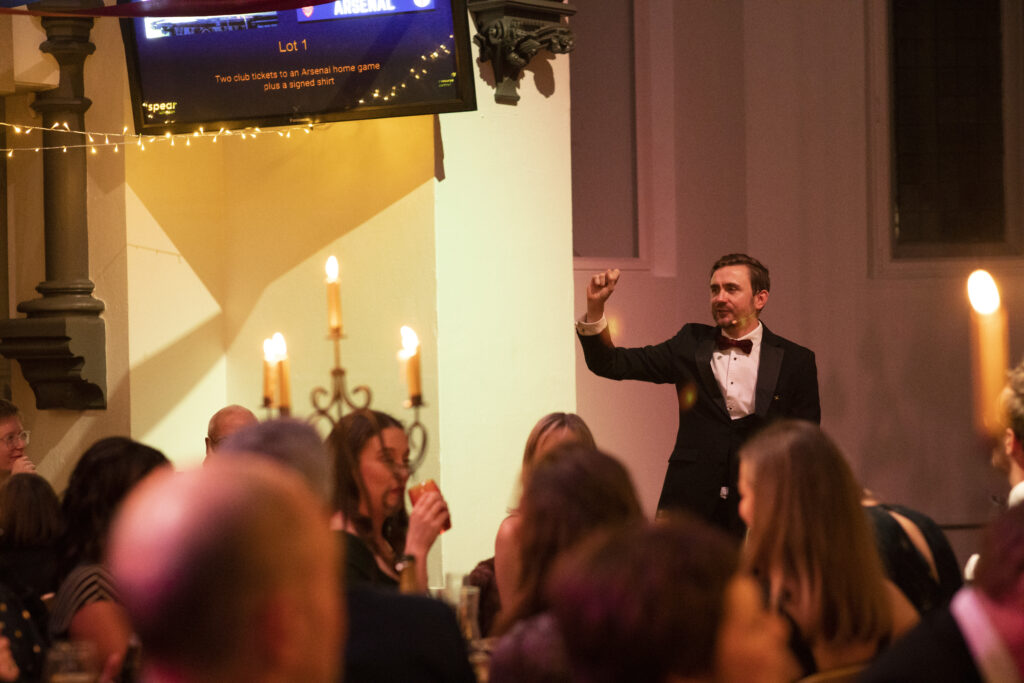
Auctioneer taking a bid as a signed Arsenal shirt and match tickets lot shows on the screen behind him

In short

  • A charity ball is a gala with a dance floor. That dance floor changes your running order.
  • Tickets should cover the costs. The money is made in the room, through the auction, the pledge and the raffle.
  • Do all the fundraising before the band starts. Once people are dancing, you won’t get them back in their seats.
  • In the UK, check your licences early: music and dancing, the bar, the raffle and the music licence all have rules.
  • Set a target first and build the plan backwards from it.

A charity ball is a formal evening of dinner and dancing where every ticket, lot and pledge goes towards a cause. Organising one that raises real money comes down to a few decisions most committees make too late: what the night is for, where the money will come from, and what happens before the band starts.

I host balls and run their auctions as a charity auctioneer, 60 to 80 events a year, and have helped raise over £10 million for charity. The ball format has one trap that is easy to miss, so this guide is built around avoiding it.

What is a charity ball?

A charity ball is a formal fundraising event built around dinner followed by dancing. The word comes from the Latin ballare, “to dance”, and a ball has long meant a formal dance, often a banquet followed by a social dance.

That is the only real difference from the alternatives. A charity dinner usually ends at coffee and speeches. A fundraising gala is the broader term for any formal fundraising evening, and plenty of galas include dancing too. If you want the full planning checklist for that wider format, my gala guide covers it. This post is about the ball specifically, and the money.

How do you organise a charity ball?

You organise a charity ball by setting a fundraising target first, then building the budget, venue, tickets and running order backwards from it. Macmillan’s advice is to set a target and work out how many tickets you need to sell for the event to make money at all.

  1. Set the target and the break-even. Know what the night costs and what it must raise. Everything else follows.
  2. Build a small committee. Give each person one job they are good at: tickets, venue, lots, sponsors.
  3. Pick the date carefully. The British Heart Foundation suggests you avoid clashing dates with big sporting or cultural events that could pull your guests elsewhere.
  4. Book the venue, then the band. Tell every supplier it’s for charity. Some will offer a better rate.
  5. Sell tables, not just tickets. Local businesses buying a table fill the room faster than single sales, and a group discount helps.
  6. Sell sponsorship. Price packages for parts of the night (the drinks reception, the band, the programme) and offer advertising in return.
  7. Source a few great lots. Around ten strong lots and a room driven to compete will beat 50 average ones.

Where does the money at a charity ball come from?

The money at a charity ball comes from five places: ticket margin, sponsorship, the live auction, the live pledge and the raffle. The tickets should cover your costs. The rest is where the night is won.

SourceWhat it doesWatch out for
Tickets and tablesCovers the venue, food and bandNot eligible for Gift Aid
SponsorshipPays for parts of the night up frontAgree what the sponsor gets in writing
Live auctionA handful of headline lots, sold hardToo many lots and the room drifts
Live pledgeGuests give at set levels, from the heartNeeds a strong case for the cause
RaffleSmall sums from almost everyoneStrict rules on prizes and sales

On Gift Aid, Macmillan notes you cannot claim it on ticket sales, but you can on voluntary donations on the night. HMRC treats a winning bid as a purchase too: an auction payment is not a gift. That is one more reason the pledge matters.

The pledge is the one most committees leave out. Gabriel Dos Santos of the OCU Foundation summed up their night: “We hosted just over 300 guests and raised more than double what we achieved last year. Kevin’s key suggestion, the live pledge alone, brought in nearly £20,000.” That was a powerful team behind a powerful charity, and a live pledge given room to work. Keep the pledge heartfelt but never sombre: it’s not a funeral, and the excitement should build as the hands go up.

The charity ball running order: fundraise before the band starts

Here is the trap. A ball has a dance floor, and once the band strikes up, your fundraising is over. Nobody leaves the dance floor to bid on a holiday.

So every fundraising moment has to land before the first dance. Here is a running order that works:

  • Arrival and drinks reception. Sell raffle tickets while guests are standing and waiting.
  • Seated, before the starter. A quick icebreaker such as Heads or Tails warms the room and lifts the mood.
  • Dinner. Let the room breathe. A light touch only, and never approach someone with food going into their mouth.
  • The cause. A short talk or film. Anthony Nolan suggests a three-minute presentation on why you are fundraising.
  • Live auction, then live pledge. Straight after the cause, while the room is still listening.
  • Raffle draw and the total. Announce what you raised, then hand over to the band.

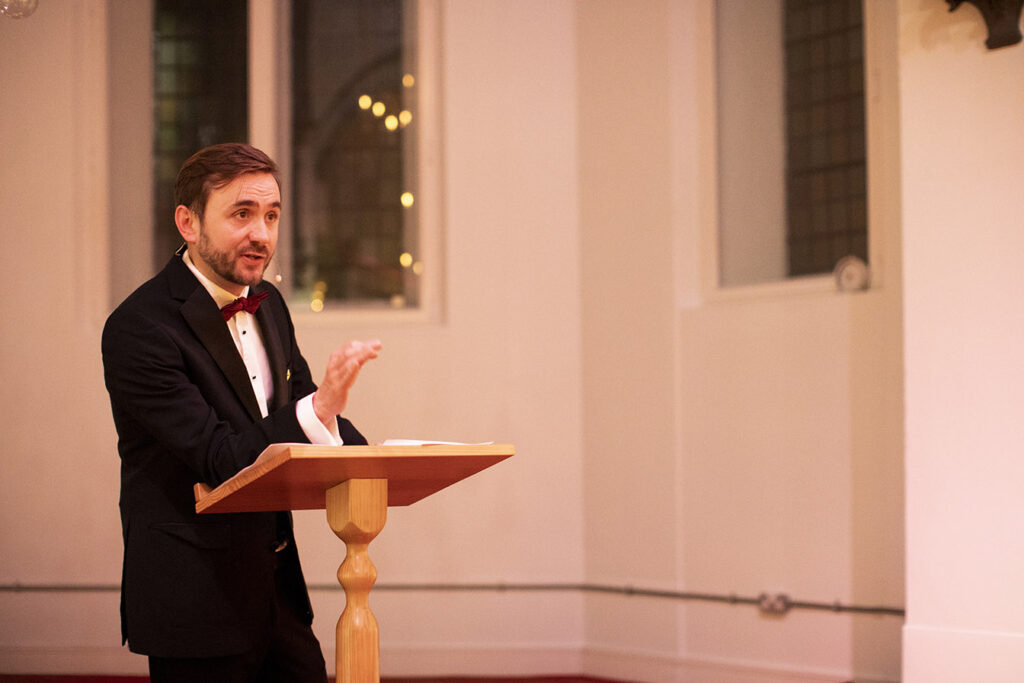
Kevin Durham at the lectern on stage at the MAG-FEST charity ball, with the band's drum kit and mic stands set up beside him

Getting the room quiet is the part people underestimate. I once announced a live auction at a big event that was running late, with no speech or video to set it up, and I didn’t stop to get the room quiet first. Only a fraction of the guests heard the lots. One man bid on an item he couldn’t even hear properly. I have never repeated that mistake. “Ladies and gentlemen, it’s time for the live auction” only works if the room is listening, so command the room first, even if you have to stand on a chair. My running order guide has timings for each segment.

What should you wear to a black tie fundraiser?

At a black tie fundraiser, men wear a dinner suit with a black bow tie, and women wear an evening gown or other formal evening wear. Black tie is less formal than white tie but more formal than business dress, and it is the default dress code for most charity balls.

Put the dress code on the ticket and the invitation, so nobody spends the week before guessing.

Guests in black tie and evening dress mingling at a candlelit charity gala reception

Charity ball ideas that keep the money coming

A theme gives guests a reason to buy a ticket and gives your lots a story. Masquerade, winter ball, a decade, a film: pick one that suits your supporters, then let it shape the décor, the lots and the games. There are more theme ideas here.

A few charity ball ideas that raise money as well as atmosphere:

  • Get the band sponsored. A local business pays for the music and gets a mention from the stage.
  • A best-dressed or best-dancer award, which the BHF suggests. Charge a small amount per nomination and let tables put their friends forward.
  • Matched giving: ask guests and helpers whether their employer will match what they give.
  • Save your best lot for last, when the room is at its warmest.

What licences and rules apply to a charity ball in the UK?

A charity ball in the UK may need a temporary event notice, a music licence and a properly run raffle, plus a risk assessment and insurance. Check each one when you book the venue, not the week before.

  • Music, dancing and the bar. At an unlicensed venue in England or Wales, a Temporary Event Notice costs £21, covers fewer than 500 people (staff included) and must go in at least 10 clear working days before.
  • Music licence. Charities can apply for a charity discount on TheMusicLicence, but the form must arrive at least 14 days before the event.
  • The raffle. A raffle run as part of the ball can spend a maximum of £500 of ticket money on prizes and £100 on expenses, and tickets can only be sold at the event, on the night. Donated prizes have no limit.
  • Safety and insurance. The Fundraising Regulator says you must do a risk assessment and have adequate insurance, and going over the venue’s maximum numbers could invalidate it.
  • VAT. For the fundraising events VAT exemption, HMRC says the event must be promoted as fundraising, with documentary evidence to back it up. Speak to your accountant.

All of it sits under the fundraising code, the current version of which came into force on 1 November 2025. Afterwards, count the money in front of a witness and bank it promptly.

Do you need an auctioneer for a charity ball?

A charity ball needs a professional auctioneer if it includes a live auction or pledge. The band, dinner and speeches compete for attention, so the host moves the room to the ask smoothly and keeps bidders engaged. A ball with only a raffle can manage with a committee member.

If your ball is mostly dinner and dancing, doing it yourself is fine. Have ready your date, venue, guest numbers, a running order with the dinner and band times, and the sum you want to raise.

Where an auctioneer fits in

A ball committee can do almost all of this themselves. The part that is hardest to do from the inside is holding the room for the stretch that matters: the cause, the auction and the pledge, before the music takes over.

That is the job I do. I host the whole evening or just the fundraising, and I help with the lots and the running order before the night. If you are planning a charity ball, call 07596 851647 and we can talk it through.

Kevin Durham, charity auctioneer

Kevin Durham

Charity auctioneer & event host
20years£10m+raised60–80events/yr
Check availability07596 851647

Balls I have run

A themed ball, a sixtieth anniversary, and a record-breaking night.

Professor Durham Hosts a Harry Potter Themed Charity Ball
A Harry Potter themed charity ball
"We Had the Best Night": SCCCC's 60th Gala
We had the best night, the SCCCC sixtieth gala
A Bidding War Breaks Out on the Dancefloor
A bidding war breaks out on the dancefloor

Let’s talk

Bring this to your event

Book a free consultation with a charity auctioneer who has raised over £10 million.