
In short
- A live pledge not working is rarely a cold room. It is usually a room that cannot see the cause, cannot reach the level, or has nobody to take its hand.
- Do not ask harder. Change what the room is looking at: bring in a person the charity has helped, drop to a reachable level, name the progress.
- Beneficiary speakers must have agreed beforehand. Never ask someone to speak for the first time on the night.
- One volunteer for every 10 to 15 guests, so every hand that goes up is captured.
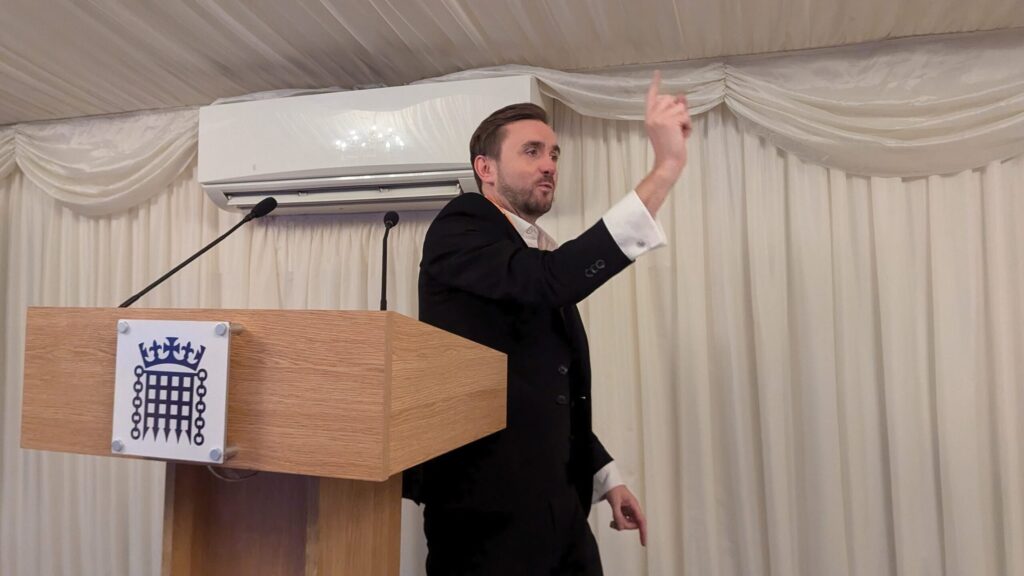
A live pledge not working is the moment the host has asked, the room has gone quiet and the hands are not rising. I am Kevin Durham, a charity auctioneer, and I run the live pledge at the galas I host. One of them, an event for Spear Islington, went quiet with only me at the front. This is what I did, and what I would check.
How do you know a live pledge has stalled?
A live pledge has stalled when two levels in a row draw no hands and the room has stopped looking at the stage. A pause after the first ask is normal. A stall is a second silence, with guests looking at their plates.
Act then, not after five more minutes of repeating the same ask. The earlier you change the picture, the less ground you lose. For how the pledge should run when it is healthy, see my guide to the live pledge.
Why is a live pledge not working in the room?
A live pledge stops working when the guests cannot see who they are giving to, cannot reach the level, cannot see anyone else giving, or cannot get their hand counted. Read the symptom first, because each one needs a different move.
This table is general advice for diagnosing a lull. The research notes are sourced; the moves are my judgement.
| What you see | Likely cause | Move |
|---|---|---|
| Polite silence, no questions | The cause feels abstract | Bring a person into the room |
| Hands at the lower levels only | The top level is out of reach | Restart one level lower |
| Hands go up, then drop | Nobody arrives to take them | Volunteers move in at once |
| Everyone waits for someone else | Nobody can see anyone giving | Say what is already given |
The research backs the first, second and fourth causes in outline. Small, Loewenstein and Slovic found that money is often concentrated on a single identifiable victim, which is why one person beats a statistic. In a public radio campaign, Shang and Croson found the most influential gift figure quoted to callers came from the 90th to 95th percentile of earlier gifts, not the very top. That is a radio study, not a gala, so treat it as a hint about reachable levels, not a rule.
The Spear Islington pledge that went quiet
I stopped asking from the front and brought up people the charity had helped to speak. At that event the live pledge was not going well, and it was just me trying to get people to give. Once they spoke it made a huge difference. The pledge then really ran, and they raised an awful lot of money.
I will not give you a total, because I have none I would stand behind. What I can say is what changed: who the guests were listening to. A host asking for money is a request. A person the money has helped is the reason.
How do you fix a live pledge that is not working?
You fix a stalled live pledge by pausing the ask and changing what the room is looking at. The people, the level and the progress are what you can change. Repeating the same words louder is the one thing that does not work, and the Fundraising Regulator’s Code, rule 1.1.2, says fundraisers must avoid undue pressure.
Here is the order I would use. Only step two is from my own experience; the rest is general advice.
- Stop and reset. Thank what has been given and take a breath. Do not cover the silence with a louder ask.
- Bring the cause into the room. Invite a person the charity has helped to say, in their own words, what it meant. This is what worked for me.
- Drop a level. Restart one level below where hands stopped, and say what that level buys, so more tables can reach it.
- Name the progress. Say what the room has already given. In a university capital campaign, List and Lucking-Reiley raised announced seed money from 10 to 67 per cent of the goal, and contributions rose nearly sixfold. A pledge is not a seeded campaign, but it shows why a visible total matters.
- Capture every hand. Volunteers move to the tables the moment a hand rises.

On the screen above, the guests can see the total and the number of pledges at each level, which does step four for you. The wording of the levels is in my fund-a-need guide.
How do you involve beneficiaries without putting them under pressure?
You ask them well before the night, you check they are willing, and you let them decline. A beneficiary who speaks to rescue a pledge is doing the charity a favour, and it must not become a burden.
The Bond guidelines say consent must be informed and freely given, that people can withdraw it, and that their wellbeing comes before the need for a story. The Chartered Institute of Fundraising’s guidance on children adds that consent is checked again and again, and that declining must not affect the support a family receives. The Charity Commission’s page on trustees’ safeguarding duties, updated 8 October 2026, says trustees must take reasonable steps to protect people who come into contact with the charity.
In practice, that means the charity decides who speaks, agrees what they will say, and has someone supporting them on the night. Never ask a guest from the floor on the spot. This is general information, not legal advice.
Before the night: what to prepare
Prepare a reachable ladder, two or three willing speakers, a tight film and enough volunteers. A stall you have planned for takes a minute to fix. One you have not planned for takes the night.
- Speakers. Have two or three people agreed beforehand, even if you never use them.
- The film. I would keep it to three to four minutes: past five, the ask can feel too heavy. See video length.
- Volunteers. My rule of thumb is one for every 10 to 15 guests, so 13 to 20 for 200 guests. All hands go to the pledge, because many hands go up at once and each must be captured and paid quickly. At least half the volunteers should already be spotting bids around the room.
- Payment. The Fundraising Regulator says volunteers should be trained in the payment method and that only the agreed amount is entered. Rehearse it.
- The ask. If there has been a lot of fundraising before the pledge, a watered-down version is fine: one tier and a smaller target. The Fundraising Regulator also says guests’ decisions should be freely made.
The pledge runs straight after the auction, so the room should reach it warm. My notes on pledge cards cover what to capture, and my live pledge page shows how I run it.
When is it worth hiring a charity auctioneer for the pledge?
Hire one when the pledge is a large share of your target and the room is too big for any one volunteer to know everyone. The person at the front has seconds to read a stall and change course.
Doing it yourselves can be right for a small supper where the chair knows every guest and the ask is a conversation. If your committee is nervous about the pledge, that is a reason to talk, not a reason to drop it.
Jo Temwa says in a video review on my reviews page: “I was so nervous about doing this live pledge. What an incredible auctioneer.”
When you get in touch, have ready the date, the number of guests, the room, your target, the running order and what went wrong last time. Call me on 07596 851647. Free auction software is included when you hire me through my auctioneer services: I build it around your event, with your branding, lots and pledge page, and it stays live for one month afterwards.

Kevin Durham
Charity auctioneer & event host