In short
- When an auction lot donor pulls out, confirm in writing what was promised, then decide the same day whether to replace, substitute or drop the lot.
- A substitute needs the donor’s agreement, and the agreement of any bidder who has already bid on the original.
- Until the hammer falls there is no sale, so a lot can generally be withdrawn. The bigger risk is advertising a lot you know has gone, which the Code of Fundraising Practice says must not mislead.
- Remove the lot from every place it appears, and tell everyone who was told it would be there.
An auction lot donor pulls out when the person or business that promised an item withdraws it, or cannot deliver it, after it has been listed in your catalogue, programme or bidding platform. Most galas meet this sooner or later, and printing something you cannot deliver does more harm than losing the lot. Everything below is general advice as at November 2026, not legal advice.
What should a charity do first when an auction lot donor pulls out?
A charity should act the same day, in this order: confirm in writing what was promised, ask once whether the donor can still help, then remove or replace the lot everywhere it appears and tell anyone who was expecting it. Do the written confirmation first: every later step leans on that record.
- Confirm what was promised. Pull the signed lot donation form and check the description, exclusions and expiry. No form? Write down what you were told, by whom and when. Then email the donor to confirm they are withdrawing, so the record is clean.
- Ask once whether anything can be saved. A later date, a smaller version, a different gift from the same donor. Then accept the answer, whichever it is.
- Decide: replace it, substitute it, or drop it.
- Remove it everywhere, using the table below.
- Tell the people who were told. Ticket buyers who booked for it, bidders with pre-bids, a table host, a sponsor, a journalist.
- Thank the donor anyway. Withdrawing honestly three weeks out beats going quiet, and a gracious reply keeps next year’s door open. My piece on thanking donors covers the wording.
Can you swap in a substitute lot of equal value?
A charity can offer a substitute lot only when the donor agrees to it and, if anyone has already bid on the original, the bidder agrees too. Equal or greater value is the minimum, and the replacement should be described as fully as the original was.
Nobody has bid: you need the donor’s consent and a fresh description. Someone has pre-bid: ask them, and let them walk away. Never quietly move a bid to a different item, because a bid is for the thing described.
Do not buy a replacement and present it as a donation. If the room was told about the original, say the lot has changed.
Where a withdrawn lot has to come out
A withdrawn lot has to come out of every place it appears, because one leftover mention is how it gets announced in error.
| Where it appears | What to do |
|---|---|
| Printed catalogue or programme | Add an insert slip or reprint; if already printed, announce it from the stage |
| Bidding platform or app | Unpublish the lot, then contact every pre-bidder |
| Run of show and auctioneer’s lot sheet | Strike the line, re-time the segment, hand the host the new sheet |
| Screens and slides | Remove the slide so the numbering does not jump |
| Ticket page, emails, social posts | Correct the wording; if it was the headline draw, say what changed |
| Donor credits and sponsor logos | Take them off the lot slide |
Your run sheet is the document most likely to be forgotten, and the one that decides what the host says.
Can an auction lot be withdrawn before the hammer falls?
In general, yes. Under section 57 of the Sale of Goods Act 1979 (read November 2026), a sale by auction is complete when the auctioneer announces it by the fall of the hammer, and until then any bidder may retract. The Act does not use the word withdraw, so the right to pull a lot comes from case law.
In Harris v Nickerson (1873), as summarised there, a notice that goods would be auctioned was held not to be an offer that they would be put up, so withdrawing them beforehand gave the disappointed buyer no claim.
There is a limit. In Barry v Davies (Court of Appeal, 2000), an auctioneer withdrew no-reserve machines after genuine bids and was held bound to sell, because a lot cannot be pulled simply because the price is low. So withdraw before bidding opens, for a real reason, and never after the first bid because you dislike the number.
Once the hammer has fallen, a contract exists. If a winner has paid or been told they have won, tell them at once, offer a refund or an agreed substitute, and take advice.
What do the fundraising rules say about a lot you cannot deliver?
The Code of Fundraising Practice says fundraising must not mislead donors, including by giving inaccurate or unclear information, so a charity should not keep advertising a lot it knows has gone. The Code does not mention withdrawn lots, so that is my reading of it, not a ruling.
Three nearby standards back it up, all read November 2026:
- Section 8.1.3 says information about fundraising activities must be accurate.
- Section 10.2.1 says every communication about an event must be clear and accurate.
- Section 10.1.3 says you have a plan for all situations reasonably expected. A donor dropping out is one.
The Charity Commission’s CC20, updated 3 February 2026, says trustees must identify, review and manage fundraising risks. It does not mention auction lots either, but an undeliverable lot is a fundraising risk, and a written plan is the answer.
What does the auctioneer say if a withdrawn lot was announced in error?
The auctioneer should say it once, in one plain sentence, name nobody and move straight to the next lot: “Lot 7 has been withdrawn, so please cross it out of your catalogue. Lot 8 is…” Use your own words, but keep it that short.
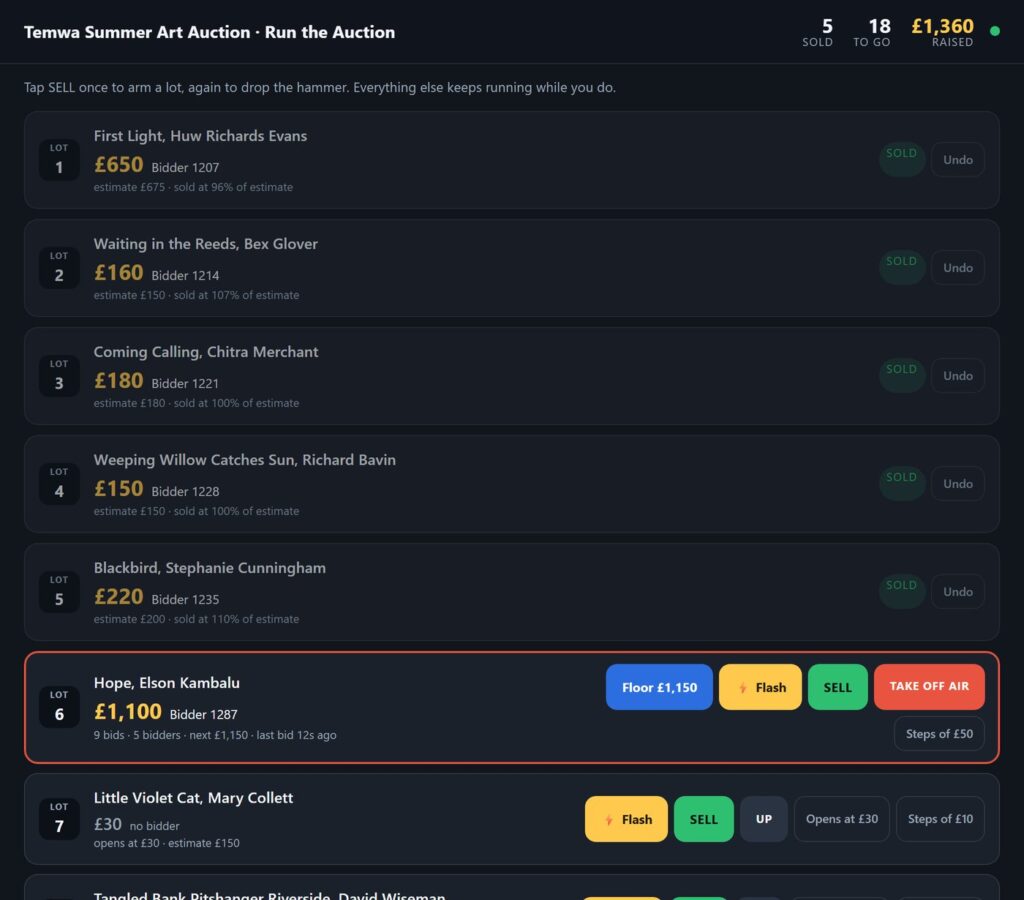
Skip the apology speech, the reason and any joke at the donor’s expense. If someone had pre-bid, a team member should speak to them before that lot would have come up.
My view is that you never let a lull sit, and a long explanation is a lull. Say it, move on, and let the next lot rebuild the pace; my post on bidding momentum says why.
Preventing the next time a donor pulls out
When a donor pulls out, three things limit the damage: a lot donation agreement signed when the gift is made, a confirmation date set before anything is printed, and a held backup lot ready to drop in.
- Agreement. The donation form records what was promised and what happens if the donor cannot honour it.
- Confirmation date. Pick a date a few days before the print deadline and ask every donor to reconfirm in writing. Nothing unconfirmed goes to print.
- Held backup. One genuinely donated lot, fully described, kept off the printed list and out of the running order. Use it only if it is a fair match.
I would rather run about ten great lots than fifty or a hundred. With a short catalogue every lot carries weight, so a lost one stings more and each is worth confirming.
When is it worth hiring a charity auctioneer for this?
Doing it yourself is the right call when a lot goes weeks before print: reword the catalogue and nobody notices. A charity auctioneer earns the fee when a withdrawal lands in the final days or on the night, because someone has to reorder the programme and hold the room.
After 20 years on the mic, my rule is to get the room quiet first, then rebalance the order around whatever has gone. A Jigsaw Trust organiser said on my reviews page: “Kevin owned the room as he conducted the live auction, more than doubling our target. It was not just during the event where Kevin showed his skills, but also in guiding our planning.” (Naomi Chaning Pearce, Jigsaw Trust.) That is kind of them. The work that made the night was theirs.
To get a quick answer, have ready: your event date, room size, current lot list, which lot has gone, what is already printed, and when you found out.
If a donor has pulled out and you want a second pair of eyes on the running order, call 07596 851647. If you hire me as your charity auctioneer, I build the auction software around your event, with your branding and lots, included for the event and live for a month afterwards.

Kevin Durham
Charity auctioneer & event host