
In short
- A testimonial dinner auction can raise money for the player, for charity, or both. Decide which lot pays whom before invitations go out.
- HMRC’s manuals, read in November 2026, say non-contractual testimonial income is the sportsperson’s earnings, with a one-off exemption on the first £100,000.
- Ten lots is about the right length, 14 at most, and the live pledge can carry the night if the list is short.
- Tell the room in plain words how much goes to charity. The Fundraising Regulator says statements should.
- Bring in a professional when the host is a friend of the player and the room is a mix of sponsors, fans and former teammates.
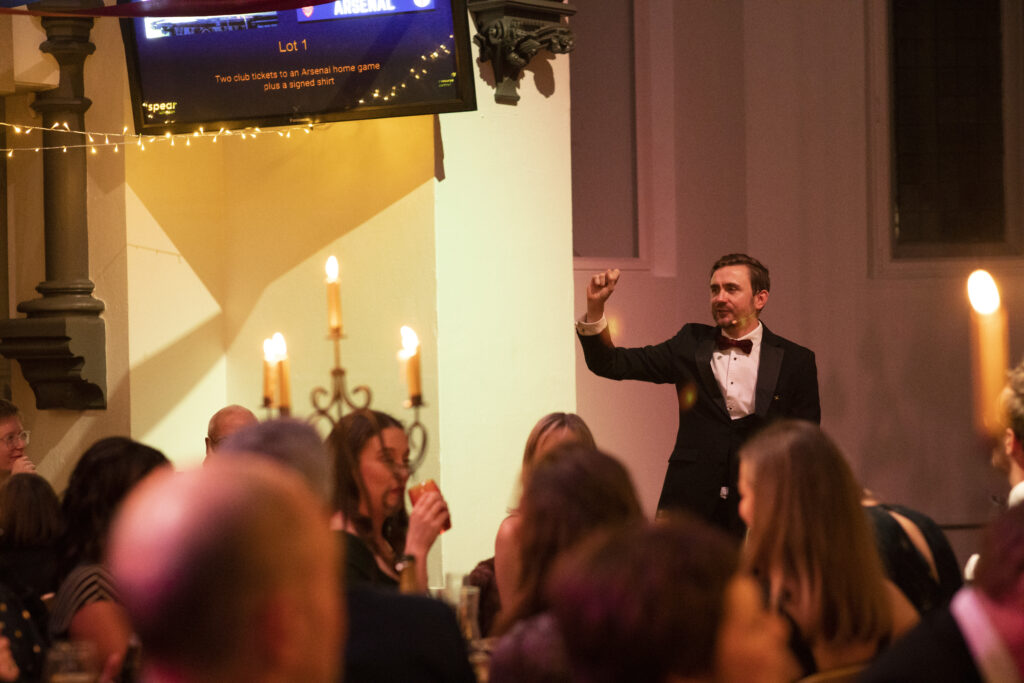
A testimonial dinner auction is the live auction at a dinner held in a sportsperson’s testimonial or benefit year, where memorabilia and experiences raise money for the player, for charities, or for both. I have worked a sports testimonial dinner as well as plenty of golf club dinners. This is written for the committee chair or club commercial team deciding how to run one.
Who gets the money from a testimonial dinner auction?
The money from a testimonial dinner auction goes wherever the committee has said it goes, so it must be said in writing before anyone buys a ticket. A testimonial committee usually raises funds for the person honoured and sometimes for their nominated charities, according to HMRC’s company taxation manual.
The pattern is visible in cricket’s benefit years. One county testimonial year names the Surrey Cricket Foundation as one of its beneficiary charities and opened with a dinner on 27 March 2025. The page does not say how proceeds are divided, and that is the gap a committee should close.
| Model | Who benefits | What to watch |
|---|---|---|
| All to the player | The sportsperson, after tax | Tax and PAYE rules below |
| Chosen lots to charity | Charity, lot by lot | Donor agreement; the room must know which lots |
| All to charity | The charity | Payroll Giving route; a written agreement |
My rule of thumb, which is general advice and not law: one lot, one destination. A lot whose price is half the player’s and half the charity’s confuses the room and the paperwork. Mark each lot on the sheet, and tell the room at the start where each pound goes.
How is testimonial money taxed?
Money from a non-contractual sporting testimonial is taxed as the sportsperson’s earnings, with a one-off exemption. This is general information from HMRC and the statute book in November 2026, not tax advice, and the committee needs its own accountant.
HMRC’s Employment Income Manual says section 226E of the Income Tax (Earnings and Pensions) Act 2003 charges tax on income from non-contractual testimonial events, and the legislation is up to date to 11 November 2026. A one-off exemption covers the first £100,000, for one event or a series within 12 months, for testimonials announced on or after 25 November 2015. Where gross income passes £100,000 and the committee controls the money, the committee must operate PAYE.
The committee has its own tax position. HMRC says activities organised on commercial lines might amount to trading, and that a ticket price labelled a “suggested donation” is likely still a trade receipt.
The charity route is different. In HMRC’s worked example, a committee that raises £700,000 and gives all of it through a Payroll Giving agency pays no tax or Class 1A National Insurance, and the sportsperson never receives the money. Without Payroll Giving, tax and Class 1A are deducted on the amount above £100,000, though the charity may still claim Gift Aid. A law firm’s 2019 note made a similar point, but check current HMRC wording.
What must you tell guests about the charity share?
Tell guests which charity receives money and how much. The Fundraising Regulator says commercial participators must give statements that include the charity’s name and how much it will receive.
The Charity Commission’s CC20 guidance, updated 11 November 2026, says a commercial participator is a person or company stating that money from its activity will go to charity, and that trustees must enter a written agreement before fundraising begins. Whether a committee counts is a question for the charity, so ask it early.
A winning bid is also a purchase. HMRC’s Gift Aid guidance says payments for goods are not gifts, so do not tell bidders their lot price is Gift Aid eligible. The same goes for the player’s share, which is not charitable money.
How many lots should a testimonial dinner auction have?
A testimonial dinner auction needs about ten lots, and 14 is the most I would recommend. That is my current view, and a very short list is fine, because the live pledge can do the heavy lifting.
Build them around the player, and keep the introductions short. In general, experiences beat objects: a day with the player, a seat somewhere guests cannot buy. If the player’s own kit is a lot, a signing the committee witnessed is the strongest evidence, as I explain in signed memorabilia authentication. My guide to sports memorabilia covers sourcing, and the wider sports dinner piece covers the evening.
Keep the lot list open until the auction starts. At an event this year the former footballer Vinnie Jones was a guest. I asked whether he could put something in, and he donated a shooting experience that raised £6,000. A room of former teammates and supporters is exactly where that can happen.
If a donor can supply a second one, as with a pair of football VIP tickets, you can sell it twice.
Running the auction on the night
Run it on big round tables with a firm hold on the room. I recommend tables of 10 or 12, because everyone at a round table can see what each person bids. Experiences with many seats also tend to be bid on jointly: in the shooting experience, two guests who started out against each other joined forces.
Get the room quiet before the first lot. A testimonial crowd comes to see the honoured player, so keep speeches tight and the video to three or four minutes.
Plan the payments. I advise one volunteer for every 10 to 15 guests, which is 20 to 30 volunteers for 300 guests, because a pledge is frantic and every hand has to be captured and paid. Ideally everything is paid on the night, since people forget once they leave. Thank sponsors from the stage and in the programme.
The tone can need care. At memorial and club events I rein in the comedian in me, and a testimonial may call for the same. My live pledge page explains the ask. A pledge suits the charity’s share; whether to ask a room to give to the player directly is the committee’s decision.
When is it worth hiring an auctioneer for a testimonial dinner?
Hiring an auctioneer is worth it when the person who would hold the microphone is a friend of the player and the room mixes sponsors, supporters and former teammates. A friend can introduce the guest of honour. A professional carries the ask, keeps the lots moving and says clearly what each one pays.
What I change in a room is the pace: I take the room first, keep each introduction short and weave the terms into every lot, so nobody is unsure what they are buying. The committee keeps the decisions about the money.
Do it yourselves if the dinner is small, you have five or six lots and a respected speaker. Plenty of club nights run that way.
Nicola Briscoe of IBA / Electrical Industries Charity left this review of a sportsman’s dinner:
“He’s really professional, engaged the room and took control where we needed it. Highly recommend him if you need him to host any event.”
More are on my client reviews page.

Before you get in touch
Have ready the date and venue, headcount, the committee’s written split between player and charity, your draft lot list with donors, the running order and what went wrong last time.
Call me on 07596 851647, or see how to hire an auctioneer. The auction software is included when you hire me: I build it around your event, in your branding with your lots and tickets, and it stays live for one month afterwards.

Kevin Durham
Charity auctioneer & event host