Home About Kevin Auctions Virtual auctioneer Pledges Hosting Entertainment Free software Software examples Case studies Reviews Other services Fees Fundraising games Fundraising consultant Get in touch Blog Podcast

Charity cricket: the format, the square, and where the money is

Kevin Durham running an auction lot in a sports club room after a daytime charity sports day

In short

  • Pick a short format and play it twice. A side that drives an hour to field for three hours does not come back.
  • The square is hand-prepared and in short supply, and the groundsman picks your strip. Ask in the winter.
  • The ECB’s hard-ball safety rules are mandatory for under-18s. No parental waiver.
  • Rain is a certainty, not a risk. Book a reserve date and keep the money indoors.

A charity cricket day hands you something a football match never will: six hours of other people’s time. Both the opportunity and the problem. Long enough to feed a crowd, sell a programme, run a raffle and still get everyone sat down for dinner. Long enough, too, for the rain to arrive and the whole day to clear £400.

I run charity auctions at 60 to 80 events a year, mic in hand, out on the floor rather than behind a podium. This guide covers what is specific to cricket: the format, the club, the square, the hard ball and the weather. Then the part that decides your total.

What format should a charity cricket day use?

Use the shortest format your players will take seriously, and run it as a tournament rather than one long match. Four teams playing short games keeps four sets of sponsors, players and families on site all day. One eleven-a-side fixture keeps 22 players and a thin crowd.

FormatShape
T2020 overs a side, about three hours
100-ball100 balls an innings, ends change every 10
SixesSix overs a side, one bowler two overs
Celebrity XIOne fixture, names on the card

The ECB’s own Club T20 runs on the generic 20-overs playing conditions, so a club side knows where it stands. If half your crowd has never sat through a full innings, borrow The Hundred’s rules: 20 balls per bowler, a 25-ball powerplay.

The sixes model is the quiet fundraising winner. Sticky Wicket, the events industry’s cricket day, puts teams of up to ten into five-over matches and charges for team sponsorship rather than tickets. In July 2026 it raised £60,086 for the Lord’s Taverners, its best year in 19.

A celebrity XI sells tickets, but get every name in writing with reserves lined up.

How do you get a club and a square for a charity cricket match?

Ring the club over the winter and ask for a date in the shoulder of the season, because mid-July Saturdays belong to the league. Expect to be treated as a hirer, not a guest, because that is what you are.

An ECB registered club carries £15,000,000 of public liability for the year to 31 January 2027, covering the club’s own activities. The same certificate tells clubs that when they hire facilities to a third party, insurers require them to check that party’s public liability, at least £5,000,000. Have your charity’s certificate ready before the first call.

Then the square. A club table holds a handful of strips, cut and rolled by hand for league fixtures, and the groundsman works to a programme: define and cut the pitch, then roll, groom and manage moisture, then the final cut, marking out and the stumps. Get your day into that plan months out, not sprung on him in May.

Ask about the room while you are there. A clubhouse that seats 80 for dinner is worth more than the strip, as at a sports dinner in any other sport.

What do the ECB rules say about hard-ball safety and age groups?

They are mandatory, not advisory, and they bite hardest on anyone under 18. A hard ball weighs 140 to 166 grams and arrives fast, which is why the ECB writes it down in such detail.

From the safety regulations in force since 17 December 2025:

  • Under-18s batting against a hard ball must wear a helmet meeting BS7928:2013, and male players a box. A parental note waiving it is not accepted.
  • Wicketkeepers under 18 standing up to the stumps need a helmet or a face protector.
  • Fielders aged 13 or under stand at least 11 yards from the striker, 14 and 15 year olds 8 yards.
  • Fast bowlers are capped by their actual age, not their age group: four overs a spell and eight a day at 11 and under, up to seven and 18 at 18 or 19.
  • A junior cannot play open age cricket before their 12th birthday, and then only with written parental consent.

Adults get recommendation rather than regulation: a helmet when batting, keeping up to the stumps, or fielding inside 8 yards. If the day is really a family fun event, use a soft ball: none of the protective equipment regulations apply to softball cricket.

Who officiates, scores and provides first aid on the day?

Two umpires, a scorer for each side and at least one first aider, all booked weeks ahead.

In the ECB’s Club T20, umpires are arranged locally by the host club, and from the national stages they are full ECB Association of Cricket Officials members with current DBS clearance. Ask the club to source ACO umpires and pay them properly. Each team also brings its own non-playing scorer, and a side arriving without one loses a player to the job all match.

The ECB also wants a first aider present whenever cricket is on: an adult who has done an in-person course of at least three hours in the last three years.

The Fundraising Regulator expects a written risk assessment covering set-up, the event and the pack-down, insurance including cancellation cover, and a written agreement with every third party who contributes, paid or free.

Rain is the one thing cricket cannot shrug off

Football plays through a shower. Cricket stops. Worse, as the Grounds Management Association points out, play is often held up after the rain has stopped, because a wet pitch dries slowly. That is what covers are for.

So build the weather in rather than hoping:

  • Book the reserve date when you book the first one. The ECB does that in its own competition, pairing 9 August with 16 August and 30 August with 6 September.
  • Shorten instead of scrapping. The ECB tells clubs facing a washout to play even a few overs rather than settle it on a coin.
  • Move the money under a roof. Lose the cricket at three, keep the evening, keep the total.

Where does a charity cricket day make its money?

Not at the gate. The gate pays for the ground, the officials and the balls. The money comes from sponsorship sold weeks earlier, and from the hour after everyone sits down.

Income streamHow it works
Team entryEach side pays or finds a sponsor to enter
Sponsored oversA business buys an over, read out at the change of ends
ProgrammeLocal firms buy space, players buy a copy
AdmissionNot a gift in Gift Aid terms, so no claim on it
RaffleEvent raffle tickets must be physical and sold only at the event
Auction and pledgeAt the dinner, with someone driving it

Sponsored overs are the best thing cricket has that other sports do not: twenty sellable moments with the announcement built into the game, and every pound reaching the cause with nothing deducted.

Keep the lot list open until the auction starts. At an event earlier this year the former footballer Vinnie Jones was among the guests. I asked whether he could put anything into the auction, and he donated a shooting experience that raised £6,000 for the charity. A pavilion full of players is worth the same question.

Running the long day without losing the room

Treat the tea interval as the one moment the whole site sits still. That is when raffle tickets sell and silent auction sheets get signed, so have volunteers moving with a float and a clipboard. Let people breathe while they eat, and never approach someone with a fork on its way to their mouth.

A shape that works: first game at half ten, tea in the middle, final by five, dinner at seven.

Should the auction and pledge come after the dinner?

Yes. Once the room has eaten and sat down, never out on the outfield at five o’clock with half the crowd loading kit bags into cars.

Open with Heads or Tails before anybody speaks. At a fiver a head, a dinner of 150 collects £750, and a room standing up and laughing is worth more later than the money.

Kevin Durham on stage with a microphone and lot sheet, running a live pledge

Command the room first, then about ten strong lots, not fifty: a net session with the club professional, a signed bat from the county, the captaincy of next year’s charity XI, the right to name the trophy. Then the live pledge, the most powerful segment of any fundraising night I work.

The pledge suits a cricket crowd because everyone there watched somebody play for the cause that afternoon. The tone shifts, serious and from the heart. It should still feel hopeful: the energy climbs as the hands go up.

Before you ring a cricket club

Decide the format, get both dates in the diary, send your insurance certificate early, and plan the evening before the toss. The pattern matches a charity football match, but cricket gives you a longer day to sell into and a sky that can take it away.

If you want the auction and pledge run properly at the end of it, that is what I do. The difference shows up in the final total. To check availability, call me on 07596 851647.

Kevin Durham, charity auctioneer

Kevin Durham

Charity auctioneer & event host

20years£10m+raised60–80events/yr
Check availability07596 851647

Let’s talk

Bring this to your event

Book a free consultation with a charity auctioneer who has raised over £10 million.

How to put on a charity rugby match: clubs, RFU rules and the money

Charity auctioneer selling a lot at a daytime charity sports lunch

In short

  • Host at an affiliated club if you can. A scratch team playing a charity match is not covered by the club insurance the RFU arranges.
  • Personal accident cover still reaches non-affiliated teams, but only if the match is properly refereed and run to RFU and World Rugby rules.
  • Front rows derail amateur fixtures. A squad of 23 needs six players who can pack down, or the scrums go uncontested.
  • The gate rarely pays for the day. Sponsorship, a programme, a raffle and a dinner with an auction do.

A charity rugby match is harder to stage than most people assume, and a better event to build a fundraising night around. The paperwork is real. Rugby is a contact sport with its own rules on insurance, registration, age bands and medical cover. Do it early and you get the good part: a clubhouse full of people who have just watched their friends play, with nothing to spend their money on yet.

Here is what the Rugby Football Union expects, and then the part a charity auctioneer like me gets booked for.

What is a charity rugby match?

A charity rugby match is a one-off fixture played to raise money, not league points. The sides are usually club legends against a current XV, one club against a neighbour, or staff against supporters.

The format scales a long way. The 745 Game, an annual union against league fixture named for the shirt numbers of Rob Burrow, Ed Slater and Doddie Weir, raised £110,000 for motor neurone disease causes at Kingsholm in November 2025. Ten thousand people came, hospitality sold out, TNT Sports broadcast it, and a prize raffle ran alongside. Four income streams, one of which is the gate.

A charity football match hangs on county FA sanction. Rugby hangs on who your players are registered with, and whether anyone can safely play prop.

How do you get a club and a pitch for a charity rugby match?

Ask an affiliated club to host, rather than hiring a pitch from a council or school. Affiliation brings the insurance, the referee contacts, the posts and the clubhouse with it. Start with the RFU club directory and approach the club with a reason to say yes: the cause is local, a member is affected, or one of the sides is theirs. Then ask three things.

  • Who provides the first aid cover? Under the pitchside care standards the hosting club arranges it, so this is their answer, not yours.
  • Is the clubhouse free afterwards? If the function room is booked, move your date. The room is where your total is made.
  • What do they want out of it? Clubhouse takings, new members, a banner for a sponsor. A club that gains something puts volunteers on the gate.

Get the arrangement in writing. The Fundraising Regulator expects a written risk assessment before any fundraising event, and charities with five or more employees must document theirs by law.

What insurance does a charity rugby match need?

It depends on whether the teams are affiliated. The RFU spends around £3.5 million a year arranging cover for the community game through its broker, Howden: combined liability for the club, its players, coaches and officials, plus personal accident cover for catastrophic injury.

That is for affiliated clubs. For a scratch side the broker is blunt: if you are a non-affiliated team playing a charity match, standard RFU insurance will not apply. Personal accident cover does still reach you, for permanent serious disability or death including catastrophic brain and spinal injury, but only if the match is properly refereed and run in line with RFU rules and the World Rugby laws. A kickabout with a volunteer whistle is not that.

Public liability is the gap. The RFU does not provide it to a non-affiliated team unless its legal and governance department agrees in writing, or the team is connected to a club or constituent body. So run the fixture through affiliated clubs, or buy event liability cover and read what it excludes.

Which players can play: registration, age bands and the front row

Adult players register at their home club at the start of every season under RFU Regulation 13, which covers clubs, higher education teams and services teams only. Invitational teams are explicitly outside it, which is why a thrown-together side sits differently to a club XV.

Age bands are stricter than people expect. Regulation 15 runs age grade rugby from under-7s tag up to under-18s with its own rules of play for each age group, and a 17-year-old who wants to play adult rugby needs a club approval form and a player approval form signed off first. You cannot put a promising under-16 in a legends match because he is big for his age.

Then the front row, which decides whether your fixture is real rugby or a kickabout with lineouts. World Rugby Law 3 sets the minimum by squad size: 3 front-row players in a squad of 15 or fewer, 5 in a squad of 19 to 22, 6 in a squad of 23. Each team tells the match official before kick-off which front-row positions its players can cover, and it is the team’s job to make sure they are suitably trained and experienced. If either side cannot field one, scrums go uncontested. So recruit from the front row backwards: two props and a hooker per team, plus cover.

What medical cover does a charity rugby match need?

At minimum, one qualified first aider for the match, arranged by the hosting club, with a documented risk assessment behind it. RFU Regulation 9 wants an annual first aid risk assessment completed between 1 July and 30 September each season, telephone access so emergency services can be called immediately, and clear vehicular access for an ambulance.

The pitchside care standards set the numbers. For adult regional, county and lower XV rugby the minimum is one first aider per match, one per team as best practice, and for under-13s to under-18s it is one per match.

Two things organisers miss. Spectator and volunteer cover is assessed separately from player cover, so your crowd is your problem. And any player showing signs of concussion comes off permanently, with no return to play that day.

Where does a charity rugby match make its money?

Not at the turnstile. Ticket income covers the pitch, officials, first aid and kit.

Income streamHow it worksWatch out for
TicketsAdvance sales beat cash on the gateAdmission is not a gift, so no Gift Aid
Matchday programmeAd pages sold to local firms, printed to orderAgree artwork deadlines in writing
Shirt and pitchside sponsorsBusinesses pay for the kit and the boardsThe club may already own board space
RaffleSold at the ground during the eventEvent raffle tickets cannot be sold in advance or online
Dinner, auction and pledgeAfter the final whistle, in the clubhouseNeeds a room, a running order and a host

The programme is the stream people skip, and close to pure margin printed to order. Twenty local businesses at £100 a page is £2,000 before anyone has kicked a ball.

For the raffle, the Gambling Commission allows up to £500 of ticket money on prizes and £100 on running costs, with no limit on donated prizes, and tickets can only be sold at the event while it is happening. My guide to running a charity raffle covers the rest.

Kevin Durham pointing from the stage with a microphone while hosting

The matchday run of show

Kick-off is the middle of your day, not the end of it. Build the programme backwards from the moment everyone is sitting down with nowhere else to be.

Gates and programme sellers an hour before kick-off. Raffle tickets sold on the way in and through the break, with the draw and a sponsor thank-you over the PA at the interval. After the whistle, forty minutes for the players to shower and the crowd to get inside. Then into the room for food, two minutes from the charity on what the money does, the auction, the pledge.

Should you run an auction and a live pledge after the match?

Yes, and the pledge is the one that pays. A rugby crowd has spent eighty minutes being noisy together, exactly the room you want for a live pledge.

Paul Whiteing of AvMA said after one of their nights: “Kevin has been brilliant yet again. He did a live pledge for us this year and helped us raise loads of money. He’s been so helpful to our charity in raising money and awareness.” The lesson carries to a clubhouse: a pledge lets everyone give at a level that suits them, not just the two people bidding on a shirt.

Keep the auction to around ten strong lots. The matchday shirt signed by both sides, sold off the back of whoever scored, is the obvious one, and signed memorabilia from a nearby professional club does the heavy lifting. The same pacing works at a sports dinner, which is what your evening has become.

A winning bid is a purchase, not a gift, but part of it can qualify for Gift Aid if the bidder knew its retail value.

Kevin Durham on stage with a microphone and his lot sheet

A warning from my own worst night, too. I once announced a live auction while a room was still talking, and only a fraction of the guests heard the lots. Get the quiet first, even if that means standing on a chair.

Before you ring a club

Settle the insurance question first: it decides everything else. Then count your front rows, book the first aid cover, and reserve the clubhouse before you confirm a kick-off time.

If your rugby day is built around a dinner, I can run the auction and the live pledge. The difference shows up in the final total. To check availability, call me on 07596 851647.

Kevin Durham, charity auctioneer

Kevin Durham

Charity auctioneer & event host

20years£10m+raised60–80events/yr
Check availability07596 851647

Let’s talk

Bring this to your event

Book a free consultation with a charity auctioneer who has raised over £10 million.

Club fundraising ideas that work for sports and social clubs

Kevin Durham in a red velvet jacket speaking into a microphone and pointing to a bidder at the Jigsaw charity gala

In short

  • For most clubs the biggest earner is the end-of-season dinner, with a short auction and a live pledge for one named project.
  • Ten lots only your club can offer beat fifty that anyone could.
  • Sell sponsorship as priced packages, and put a sponsor’s name on each award.
  • Check your governing body’s funds. Since February 2026 the ECB has offered cricket clubs interest-free loans of up to £75,000.
  • A 100 club is a lottery in law, so follow the Gambling Commission’s rules.

Most lists of club fundraising ideas give you fifty small things: bag packs, car washes, sponsored silences. They help, but they don’t pay for new covers, a scoreboard or a clubhouse roof. For that, a club needs a few bigger moves, and the biggest is usually a night it already holds every year.

At the 60 to 80 events I work each year as a charity auctioneer, mic in hand on the floor, the money nearly always comes from a short live auction and a live pledge. This guide covers cricket, rugby, golf, tennis and social clubs. Football clubs have their own guide to football club fundraising.

What are the best club fundraising ideas?

The best club fundraising ideas are the ones where one night or one conversation brings in thousands of pounds, not tens. For most sports and social clubs, that means five things.

IdeaBest forWhat to check
End-of-season dinner with auction and pledgeOne big projectGift Aid, raffle rules
Sponsor packagesKit and running costsWhat each sponsor gets
Governing body grants and loansFacilitiesEligibility, match funding
CASC registrationAmateur sports clubsHMRC conditions
A 100 clubSteady monthly incomeGambling Commission rules

How do you turn the end-of-season dinner into your biggest fundraiser?

You turn the end-of-season dinner into your biggest fundraiser by adding two short segments after the awards: a live auction of about ten lots, then a live pledge for one named project. The tickets mostly cover the meal. The auction and pledge are where the club makes its money.

The presentation night already brings players, parents and sponsors together in a good mood. My sports dinner guide covers the running order.

Auction lots only your club can offer

I’d take ten lots that half the room wants over fifty that nobody fights for. A long list loses the room. The best lots cost the club nothing and can’t be bought elsewhere:

  • A net session with the first-team captain, or a round with the golf club captain.
  • A seat on the team coach for an away fixture.
  • Naming rights on something new: the roller, the scoreboard, a bench by the 18th green.
  • Signed kit from a county or professional side, if you can check it’s genuine.

Then run a live pledge for one named project

A live pledge asks the room to give a set amount with no lot in return, starting high and working down. It’s the most powerful segment of any night I work. Sarah Summers of Over The Wall Camp put it like this: “We hired Kevin to do a live auction and a live pledge at our 2025 gala and he was absolutely fantastic. He brought real life to the room and raised a ton of money.”

For a club, tie the pledge to one thing, such as new covers or kit for a new girls’ team, and say what each level buys. My piece on the live pledge sets out the structure.

If your club is a registered CASC, pledges from UK taxpayers can carry Gift Aid. Auction lots and dinner tickets can’t, because the buyer gets something back.

Which fundraising ideas suit cricket, rugby, golf and tennis clubs?

Most lists of fundraising ideas for sports teams treat every sport the same, but the funding and traditions differ. These are the terms each body listed in 2026.

Cricket clubs

In February 2026 the ECB raised its maximum interest-free loan for grassroots clubs from £50,000 to £75,000, for building work, machinery, covers, nets and grounds work. It also doubled its County Grants Fund to £5m for 2026, focused on women’s and girls’ cricket.

Rugby clubs

The Rugby Football League’s club guide suggests match sponsors who hand over the man of the match award, and season sponsors who get a pitch-side board and a free ticket to the presentation night. It also says to put a reasonable price on everything at the start of the season.

Golf clubs

Golf clubs often raise money through the captain’s charity as well as for the club. At Tydd St Giles Golf Club, a Captain’s Day with a record 190 players raised more than £4,000 for the captain’s charity in July 2021. My charity golf day guide covers the format.

Tennis clubs

The LTA’s Facility Loan Scheme is not interest-free. Its page lists a 5% fixed rate, halved at the LTA’s discretion in more deprived areas, with decisions typically within eight weeks. It prioritises covered and floodlit courts. A new covered court is exactly the sort of named project a pledge can fund.

What are good fundraiser ideas for social clubs?

Good fundraiser ideas for social clubs start with what the club already has: a room, a membership list and regular nights. Most of this guide applies to Rotary-type and village social clubs too.

  • A dinner with an auction and pledge. It works anywhere people already turn up.
  • Community grants. National Lottery Awards for All England gives £300 to £20,000 for projects of up to two years, with a decision in 16 weeks.
  • Room hire. If the hall sits empty on weekdays, let it to local groups.

My list of fundraising events has more formats.

Sponsorship a sports club can actually sell

Sponsorship sells as a priced package, not a favour. “Would you sponsor us?” invites a polite no. “The pitch-side board is this much for the season, with a table at the presentation night” invites a decision.

A simple ladder for sports club fundraising:

  1. A main shirt sponsor for the first team, with first refusal next season.
  2. Boundary or pitch-side boards, plus mentions on the club’s socials.
  3. An award at the presentation night, with the sponsor’s name on the trophy.
  4. Match or player sponsors for firms that won’t stretch to a board.

The awards are the easy win: players care about them and the sponsor’s name is read out from the stage. For junior teams, check your governing body’s kit rules first.

Kevin Durham beside a winner holding a glass trophy at an outdoor community awards ceremony

HMRC treats sponsorship as an allowable cost for the business only when it’s wholly and exclusively for the trade, and entertaining is specifically disallowed. Put what each sponsor gets in writing.

Grants, loans and CASC registration

Grants rarely cover a whole project. Sport England’s Movement Fund offers £300 to £15,000 for community activity projects of up to 12 months. Some awards come as a crowdfunding pledge: Sport England gives half and your community raises the rest.

A Community Amateur Sports Club (CASC) registered with HMRC pays no tax on Gift Aid donations, can apply for up to 80% business rates relief, and pays no tax on trading profits while turnover stays under £50,000 a year. Membership fees can’t carry Gift Aid. Cash gifts of £20 or less can be topped up through the Gift Aid Small Donations Scheme without declarations.

Can a club run a 100 club?

Yes, a club can run a 100 club, but it’s a lottery in law, so the Gambling Commission’s rules decide how. These are its terms as they stood in October 2026.

  • Inside the club. A private society lottery suits sports clubs and community groups. Members can buy, non-members only at the premises. Tickets are physical, everyone pays the same and the draw happens at the club.
  • At the dinner. A raffle on the night is an incidental lottery. Tickets are sold only during the event, up to £500 of takings can go on bought prizes, and donated prizes have no limit.
  • Online or to the public. Register a small society lottery with your council: £40, then £20 a year, buyers aged 16 or over and at least 20% to the club.

In the first two, prizes can’t roll over. My guide to running a charity raffle covers the draw. If you’re unsure which route applies, ask your council’s licensing team before you sell a ticket.

Where to start this season

If the committee can only manage one big move, make it the end-of-season dinner. It raises money, puts your sponsors in one room and gives you match funding for the grant forms.

If you’d like me on the mic for the auction and the pledge, call me on 07596 851647. I’d rather talk it through than trade emails.

Kevin Durham, charity auctioneer

Kevin Durham

Charity auctioneer & event host

20years£10m+raised60–80events/yr
Check availability07596 851647

Let’s talk

Bring this to your event

Book a free consultation with a charity auctioneer who has raised over £10 million.

Football club fundraising ideas that raise real money for grassroots clubs

Kevin Durham selling a brunch lot from among the tables at a daytime charity lunch, with guests laughing

In short

  • Three ideas raise real money for a grassroots club: a club dinner with an auction and a live pledge, proper sponsor packages, and grants.
  • At the dinner, ten great lots beat fifty average ones, and the live pledge usually beats the auction.
  • Grants such as the Football Foundation’s can ask for partnership funding, so the dinner money doubles as your match.
  • Registering as a CASC lets your club claim Gift Aid on donations and up to 80% business rates relief.
  • Any club draw is a lottery in law, so follow the Gambling Commission’s rules.

Most football club fundraising ideas are built to raise a few hundred pounds at a time: bag packs, car washes, sponsored keepy-uppies. They all help, but they don’t pay for a new set of goals, a mower or a clubhouse roof. For that you need a handful of bigger moves, done properly.

As a charity auctioneer, I work the floor at 60 to 80 events a year, mic in hand, and the money at a fundraising dinner nearly always comes from the same two places. Here is how a grassroots club can use them, alongside sponsorship and grants.

What are the best football club fundraising ideas?

The best football club fundraising ideas are the ones where one evening or one conversation brings in hundreds or thousands of pounds, not tens. For most grassroots clubs, that’s three things.

IdeaWhat it pays forMain effortWhat to check
Club dinner with auction and pledgeBig one-off projects, match fundingOne night, plus lot sourcingRaffle rules, Gift Aid
Sponsor packagesKit, running costsSelling and looking after sponsorsYouth kit rules
GrantsFacilities and equipmentPaperwork and patienceEligibility, match funding

Everything else (the tuck shop, the bag pack, the club draw) keeps the lights on. These three change what the club can afford.

How do you run a club dinner that raises real money?

You run a club dinner that raises real money by keeping the auction short and sharp and then running a live pledge. The dinner tickets mostly cover the dinner. The auction and pledge are where the profit is.

Build a short list of great lots

I’d take ten lots that half the room wants over fifty that nobody fights for. A long list drags, the room drifts and good lots go cheap at the end. Nobody is still listening by lot 43. Football helps here. A signed shirt or a stadium tour at a local professional club sells well. My guides to running a football shirt auction and buying in sports memorabilia cover how to source and check them.

Run a live pledge straight after

A live pledge asks the room to give a set amount, starting high and working down, with no lot in return. It is the single most powerful segment of any night I work. Dave Hands of LTS Global Solutions said afterwards: “It’s gone really well with the pledge, we couldn’t have done it without him. If you need someone to run an event like this, get Kevin to join you. Full credit to him.”

For a club night, it is the one segment I would never leave out.

Tie the pledge to one thing the club needs, such as new goals for the juniors, and say what each level buys. People give more when they can picture the under-9s running out between new posts. My piece on how a live pledge works sets out the structure, and my sports dinner guide covers the running order.

If your club is a registered CASC, pledges from UK taxpayers can carry Gift Aid. Auction lots can’t, because the buyer gets something back.

How should a grassroots club package sponsorship?

A grassroots club should package sponsorship in clear tiers, each with a price and a list of what the sponsor gets. “Would you sponsor us?” invites a polite no. “Our pitch-side board costs this much for the season and comes with a post every month” invites a decision.

Sport England’s Club Matters frames it as three questions: what can your club offer the sponsor, what can the sponsor offer your club, and who are the potential partners. Set your prices by what local businesses would pay to reach your families.

Kevin Durham on stage at a charity gala pointing to a bidder, with the event's category sponsors on the screen behind him

A simple ladder looks like this:

  1. A main shirt sponsor for each team, with first refusal on next season.
  2. Pitch-side boards, plus match-day mentions on the club’s socials.
  3. Player or match sponsors for local firms that won’t stretch to a shirt.
  4. A table at the club dinner, where sponsors get thanked by name from the mic.

Two rules shape the ladder. For youth teams, County FA guidance says gambling, alcohol and breweries are unlikely to be permissible on kit under any circumstances, so check before you sign. And for the business, HMRC treats sponsorship as an allowable cost only when it is wholly for the trade, while hospitality can fall under the entertaining rules. Put what the sponsor gets in writing.

Which grants can a football club apply for?

A football club in England can apply to the Football Foundation for facilities and equipment, and to wider community funds for activities. These are the terms as listed on each funder’s own pages in October 2026.

  • Football Foundation. Its funds cover goalposts, floodlights, grass pitches, changing pavilions and more. The goalposts grant, for example, has a minimum grant of £400 against a total project cost of £533. Kit and equipment, routine maintenance and facility hire are not funded.
  • National Lottery Awards for All England. Grants of £300 to £20,000 for projects of up to two years, with a decision in 16 weeks.
  • Sport England Movement Fund. Up to £15,000 for community activity projects lasting up to 12 months. Some awards come as a crowdfunding pledge: Sport England gives half and your community raises the rest.

And here’s where the dinner earns its keep twice. The Football Foundation’s machinery grant asks for evidence of partnership funding, and it only accepts applications from the Chair, Secretary or Treasurer. Money raised on one good night can be the share that unlocks a much bigger grant.

Registering as a CASC: the reliefs clubs miss

A Community Amateur Sports Club (CASC) is a sports club registered with HMRC, and plenty of grassroots clubs never get round to it. A registered CASC can reclaim tax on Gift Aid donations and apply for up to 80% business rates relief. Trading profits are exempt while turnover stays under £50,000 a year.

Membership fees can’t carry Gift Aid. Donations can, and the Gift Aid Small Donations Scheme lets an eligible CASC claim a top-up on cash gifts of £20 or less without collecting declarations. That turns the match-day bucket into a better earner. Registering is worth an evening of the committee’s time.

Smaller fundraising ideas for a football team

The smaller fundraising ideas for a football team are the steady ones that run all season. A quiz in the clubhouse is reliable, and my quiz night guide covers the format. A charity football match and a football card are both popular too, though a match is usually played for a charity rather than the club, and a card raises tens of pounds, not thousands.

A club draw or 100 club is a lottery in law, and the Gambling Commission sets the rules:

  • Inside the club. A sports club can run a private society lottery. Members can buy, non-members only at the club’s premises, tickets are physical only and everyone pays the same price.
  • At the dinner. A raffle run at the event is an incidental lottery. The Commission says it raises money for charity, not private gain, with tickets sold only at the event while it runs, £500 of takings on bought prizes and no limit on donated ones.
  • Online or to the public. Register a small society lottery with your council: £40, then £20 a year, buyers aged 16 or over and at least 20% to the club.

If you’re not sure which applies, ask your council’s licensing team before you sell a ticket.

Do these fundraising ideas work for rugby and other sports clubs?

Yes, these fundraising ideas work for rugby clubs, cricket clubs and most other sports clubs. A dinner with an auction and pledge, a sponsor ladder and a CASC registration don’t depend on the sport.

The grants differ. The Football Foundation is for football, so a rugby or multi-sport club should look first at Awards for All and the Movement Fund. The kit rules differ too, so check with your own governing body before a youth sponsor goes on a shirt.

Where to start this season

Pick one big move and do it well. If the committee can only manage one thing, make it the dinner. It raises money, puts your sponsors in a room together and hands you the match funding the grant forms ask for.

If you’d like a professional on the mic for the auction and the pledge, call me on 07596 851647. I’d rather talk it through than trade emails.

Kevin Durham, charity auctioneer

Kevin Durham

Charity auctioneer & event host

20years£10m+raised60–80events/yr
Check availability07596 851647

Let’s talk

Bring this to your event

Book a free consultation with a charity auctioneer who has raised over £10 million.

How to organise a charity football match that raises real money

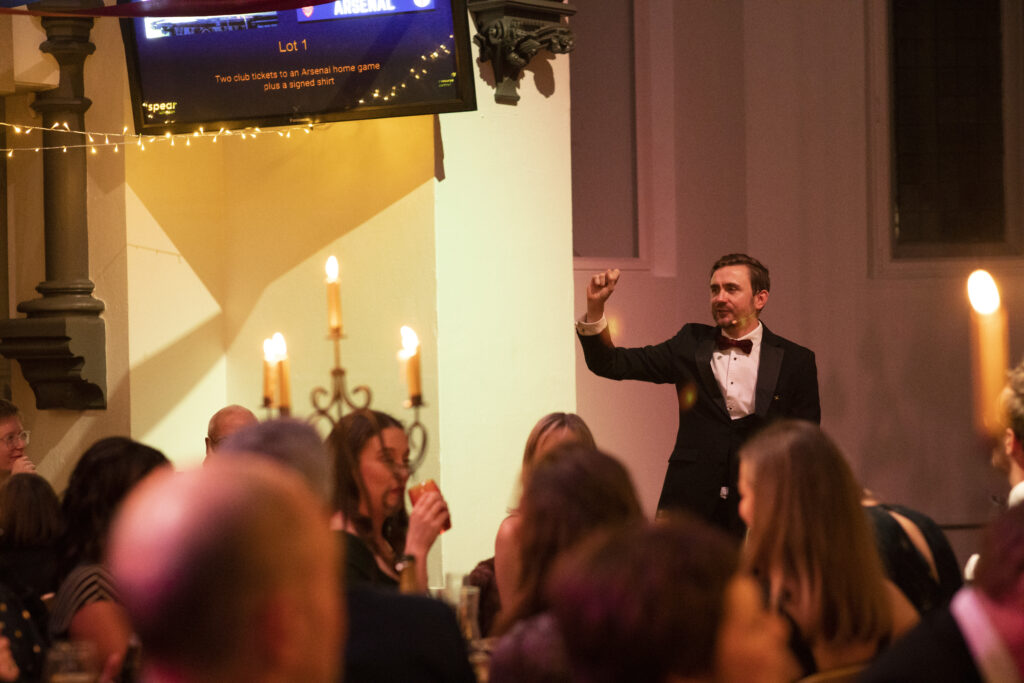
Kevin Durham raising a fist as he sells Lot 1, two club tickets to an Arsenal home game plus a signed shirt, at a candlelit charity dinner

In short

  • In England, a charity match involving affiliated clubs, players or registered referees needs sanction from your county FA. Apply at least six weeks out, even though some counties ask for only two weeks.
  • Unsanctioned football can leave the teams’ public liability and personal accident insurance invalid, and the players open to misconduct charges.
  • Tickets cover your costs. Sponsorship, a raffle and the after-match auction and pledge are where the charity’s money comes from.
  • Admission money cannot be Gift Aided, but each player’s sponsors can Gift Aid their own donations.
  • Book the room for after the final whistle before you book the referee. That is where the night’s total gets decided.

A charity football match is one of the easiest fundraising events to sell. Players bring their own crowd, everyone understands the format, and people will happily pay to watch a colleague try a slide tackle. The catch is that the match itself rarely makes much money. The money is made around it.

I come to sport from the fundraising end, as a professional charity auctioneer. This guide covers the parts organisers tend to get wrong (FA sanction, insurance and referees), then the part I care about most: turning ninety minutes of football into a total worth announcing.

What is a charity football match?

A charity football match is a one-off game played to raise money for a good cause, rather than for points in a league. The teams might be workmates, two pub sides, parents against teachers, or a local club against a team of ex-players.

At the top end you get Soccer Aid, which raised £16,462,353 for Unicef at London Stadium on 31 May 2026. Look at how that money came in: a live TV appeal, celebrity players, and a foundation doubling donations up to £6 million.

Your match will not have ITV behind it. So the question for any football charity match, or any charity sporting event, is the same: what will people give money for beyond the gate?

Does a charity football match need FA sanction?

Yes, in most cases. If any affiliated club, affiliated player or registered referee is involved, a charity football match in England must be sanctioned by the county FA it falls under.

The FA’s competition regulations point charity matches to FA Rule B, and say the county will need to know whether you have affiliated teams or scratch teams. Under the rules themselves, a match taking gate money with a scratch team needs written consent, and the proceeds must go to an approved cause.

Leicestershire FA puts it plainly: affiliation to the county, or to your league, does not cover hosting a charity match. Sanction is how the county checks teams, insurance and safeguarding for coaches and officials.

Each county sets its own process, so check yours:

County FANotice neededNotes
LeicestershireAt least 14 daysOnline form, then documents by email
CumberlandAt least two weeksOnline sanction form
HuntingdonshireOne month for competitionsCharity matches sanctioned free if you supply the day’s accounts

Expect to send accounts afterwards too. For small-sided charity games (up to seven-a-side), FA rules want a statement of accounts within 21 days.

What insurance does a charity football match need?

You need public liability cover for the event, and the players need personal accident cover that actually applies to this match. Sanction is what keeps the clubs’ own policies valid.

Leicestershire FA warns that unsanctioned football means the teams’ public liability and personal accident insurance would be invalid. Cumberland FA says clubs and referees in an unsanctioned event may not be insured and may face disciplinary action.

The Fundraising Regulator expects a written risk assessment before any fundraising event, adequate insurance, and a written agreement with every third party involved, whether you pay them or not. That includes the venue. If you are using scratch teams, ask an insurer about event cover directly rather than assuming a club policy stretches to it.

How do you choose the venue, format and referee for a charity football match?

Choose the format first, because it decides the venue, the number of players and the officials you need. A five-a-side or seven-a-side game on a 3G pitch is easier to staff and weatherproof. An eleven-a-side game at a club ground feels like an occasion and holds a bigger crowd.

When choosing a venue, ask three questions:

  • Is there a room? A clubhouse, function room or marquee for the presentation afterwards matters more than the pitch.
  • What is licensed? If the venue is not licensed for what you plan, a Temporary Event Notice covers fewer than 500 people, staff included. It cost £21 in October 2026 and needs 10 clear working days’ notice.
  • Who does first aid? Some venues provide it. If not, it goes in your risk assessment and your budget.

For the referee, go through the county FA once the match is sanctioned. Huntingdonshire FA notes that registered referees are not permitted to officiate in unaffiliated football, which is one more reason to sort the paperwork early.

A planning timeline that works

Three months out, fix the date, the format and the charity. Then book the venue, including the room for afterwards.

Six weeks out, apply for sanction, agree terms with the venue in writing, and line up sponsors and auction lots. Start selling tickets as soon as the sanction is confirmed.

Two weeks out, confirm the referee, first aid and your volunteer list. Then brief whoever is hosting the presentation on the running order.

On the day, arrive early, walk the pitch, and keep the crowd’s evening in mind. People who stood on a touchline for ninety minutes want to sit down, warm up and be entertained.

Where does a charity football match make its money?

A charity football match makes most of its money from sponsorship and from what happens after the final whistle, not from the gate. Ticket income usually pays for the pitch, the referee and the kit.

Income streamHow it worksWatch out for
TicketsPay at the gate or in advanceAdmission is not a gift, so no Gift Aid
Player sponsorshipEvery player raises a targetSponsors can Gift Aid their own donations with a declaration
Shirt and match-ball sponsorsLocal businesses pay for their nameAgree terms in writing
RaffleSold on the dayEvent raffle tickets can only be sold at the event, while it runs
Live auction and pledgeAfter the matchNeeds a room and a host

Player sponsorship is the quiet winner. Set every player a target, give them a sponsorship page in the charity’s name, and announce the top fundraiser at the presentation.

For the raffle, the Gambling Commission allows up to £500 of ticket money on prizes and £100 on costs, and donated prizes have no limit. My guide to running a charity raffle covers the rest.

After the final whistle: where the real money is

The match is the reason people turn up. The presentation afterwards is where the charity’s total gets made.

Get everyone into one room with food, the players still in their kit, and a short programme: thanks, the score, the top fundraisers. Then the line that always gets a cheer: “Ladies and gentlemen, it’s time for the live auction.” Keep it to six to ten strong lots rather than a long list. A football crowd is already competitive, so let it be.

Charity auctioneer Kevin Durham pointing to a bidder from the floor among guests at a candlelit charity dinner

Strong lots for a charity football event:

  • The player-of-the-match shirt, signed by both teams and sold straight off their back (the striker who missed an open goal is welcome to bid it back)
  • A signed shirt from a professional club, ideally one half the room supports
  • Hospitality at a local professional ground
  • A chance to play in next year’s match, or to be the manager for the day

The same lots and pacing work at a sports dinner, and the principles carry across to a golf day or any other sport charity event.

One warning. A post-match room is loud. I once announced a live auction while a room was still talking, and only a fraction of the guests heard the lots. I’ve never made that mistake again. Whoever holds the room holds the total, so get the quiet first, even if you have to stand on a chair.

Should you run a live pledge after a charity match?

Yes. A live pledge is the most powerful segment I run, and a post-match crowd is primed for it, because everyone in the room knows someone who just played for the cause.

Charles Balchin wrote after his first charity auction: “Kevin was absolutely fantastic at running our event. He added a pledge element we hadn’t considered and it became hugely successful.” That was a powerful team behind a powerful charity, but the lesson travels to a clubhouse: the pledge lets everyone give at a level that suits them.

Charity auctioneer Kevin Durham with a microphone and his lot sheet, running the live auction at Jigsaw Trust's charity gala

Run it straight after the auction. Start with a high tier, work down, and have someone from the charity say in two sentences what the money will do. The tone shifts here, serious and from the heart, but it’s not a funeral: the excitement builds as the hands go up.

Before you book the pitch

Get the sanction application in early, put your risk assessment and insurance in writing, and plan the room before you plan the kick-off.

If you’re building the day around a dinner or presentation, I can run the live auction and pledge for you. The difference shows up in the final total. To check availability, call me on 07596 851647.

Kevin Durham, charity auctioneer

Kevin Durham

Charity auctioneer & event host

20years£10m+raised60–80events/yr
Check availability07596 851647

Football nights and shirt lots

Selling football to a room that does not all support the same club.

Auctioning Signed Shirts at a Footballers' Charity Golf Day
Auctioning signed shirts at a footballers' golf day
Auctioning an Arsenal Shirt to a Room of West Ham Fans
An Arsenal shirt to a room of West Ham fans
Auctioning Framed West Ham Cup Final Photos in Essex
Framed West Ham cup final photos in Essex

Let’s talk

Bring this to your event

Book a free consultation with a charity auctioneer who has raised over £10 million.