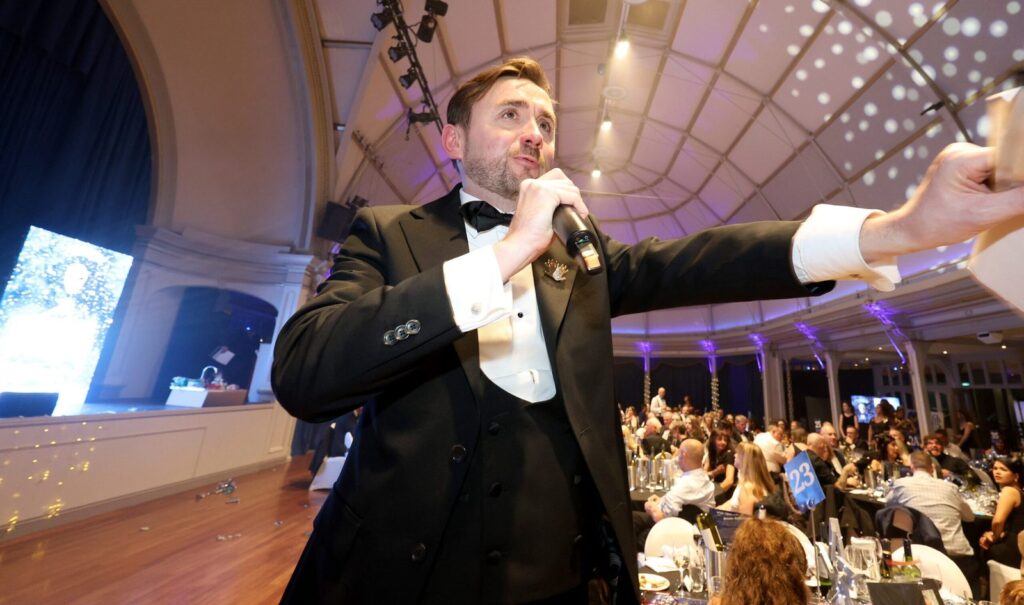
Why corporate CSR events need a professional charity auctioneer, not just an MC
By Kevin DurhamCorporate Charity Auctioneer
In short
A corporate charity auctioneer runs the fundraising mechanics of a CSR gala, lot sequencing, bidding momentum, and a structured pledge drive, which sits outside what a general MC is trained to do.
Most UK businesses give nothing to charity at all, and the ones that do are under more scrutiny than ever on whether their events actually deliver for the cause.
A corporate crowd behaves differently from a typical gala audience: colleagues, clients, and unfamiliar faces in the same room change how bidding and generosity actually play out.
An MC can carry a programme and introduce speakers well without being able to drive competitive bidding or read a room mid-appeal.
Choosing the right person for a corporate CSR event comes down to matching the skill to the moment: hosting for the programme, auctioneering for the fundraising itself.
Hiring a corporate charity auctioneer rather than relying on a general MC is the difference between an evening that looks polished and one that actually raises significant money for the cause. Here is why that distinction matters for a CSR gala specifically, and what to look for when you are deciding who runs the fundraising part of your event.
What does a corporate charity auctioneer actually do at a CSR event?
A corporate charity gala for the Teenage Cancer Trust
A corporate charity auctioneer runs the parts of the evening built specifically to raise money: sequencing auction lots for maximum bids, driving competitive tension between bidders, and structuring a pledge drive that converts the room’s goodwill into real donations.
This is distinct from hosting the programme. An auctioneer’s job during the fundraising segments is to read the room in real time, adjust pacing based on how bidding is going, and push for one more bid rather than moving on too early. None of that is the same skill as introducing speakers or keeping a schedule on track.
A corporate CSR event usually also has a specific charity partner attached, sometimes chosen by the business, sometimes voted on by staff. A good auctioneer weaves that connection into the fundraising itself, making the appeal feel personal to the company’s chosen cause rather than a generic ask bolted onto a work event.
Why isn’t a professional MC enough for a corporate charity gala?
A professional MC is not enough for the fundraising part of a corporate charity gala because running a live auction or pledge drive requires a specific skill set, reading bidder hesitation, building momentum, closing a lot at the right moment, that general hosting experience does not automatically provide.
A skilled MC will keep a corporate evening running smoothly, manage transitions, and hold a room’s attention during speeches. But asking that same person to suddenly drive competitive bidding on a live auction lot, without experience doing exactly that, usually means lots close for less than they should, and pledge appeals fall flat instead of building the tiered momentum that actually raises money.
The gap shows up most clearly in the moments that need a quick decision: when to keep pushing a stalling bid, when to name a table that has gone quiet, when to close a lot rather than let the room’s attention drift. Those are judgement calls built from experience running auctions specifically, not something a strong general presenting style automatically covers.
How much do UK businesses actually give to charity?
Most UK businesses give nothing to charity at all. Roughly three-quarters provide no charitable support through donations, volunteering, or in-kind giving of any kind.
Among the businesses that do give, the numbers are still significant. UK businesses donated an estimated £4.2 billion to charity in 2024, with FTSE 100 companies accounting for nearly half that total at £1.85 billion, though only 24 of those firms met the benchmark of giving at least 1% of pre-tax profits. For a company that has committed to a CSR gala, that context matters: relatively few businesses bother to give at all, which makes it worth making sure the event you do run actually delivers for the cause rather than just looking good on the night.
What makes a corporate crowd different from a typical gala audience?
A corporate crowd differs from a typical charity gala audience because the room mixes colleagues, clients, and unfamiliar contacts who are there partly for the cause and partly for the professional occasion, which changes how comfortable people feel bidding publicly.
Some guests will bid competitively in front of colleagues without hesitation. Others are more cautious about being seen to spend visibly at a work-adjacent event. An experienced auctioneer reads that mix quickly and adjusts pacing and tone accordingly, rather than running the same script regardless of who is in the room.
Should you hire a charity auctioneer or a general event host?
Hire a charity auctioneer specifically for the fundraising segments of your CSR event, and a general host or your own team for the rest of the programme, if you want both parts of the evening to work as well as they can.
You do not have to choose one person for the entire evening. Many corporate events run a general host for arrivals, speeches, and transitions, then bring in a dedicated auctioneer purely for the live auction and pledge segments, where the specific fundraising skill actually matters.
Structuring a corporate CSR fundraising event for maximum impact
Build the evening so the fundraising segments get the attention and pacing they need:
Use your general host or MC for the professional programme, introductions, speeches, and any awards or recognition segments.
Bring in a dedicated auctioneer for the live auction, timed for when the room’s energy is at its peak.
Close with a structured pledge drive, giving guests who did not win a lot a clear, tiered way to contribute.
Thank donors and sponsors visibly, since corporate guests respond well to public recognition of generosity from their own company or peers.
Common mistakes companies make when hosting a charity gala
Assuming any confident speaker can run an auction. Confidence on a microphone is not the same as knowing how to close a bidding war.
Treating the charity partner as a backdrop rather than a genuine focus. Guests notice when the cause feels like an afterthought to the corporate occasion.
Skipping a structured appeal because “the auction will cover it.” A well-run pledge segment consistently adds significant income beyond the auction alone.
Not briefing the auctioneer on company culture and sensitivities. A corporate crowd has dynamics a good auctioneer needs to understand in advance, not guess at on the night.
Overloading the evening with corporate messaging. A gala that feels like a sales pitch for the company rather than a fundraiser for the cause tends to undermine the very generosity it is trying to encourage.
Choosing lots that do not suit a mixed professional audience. What sells at a purely social gala does not always land the same way with clients and colleagues in the room together.
★★★★★
“He had more bids and higher bids than we were expecting, and we sold everything. We made over £18,000 tonight, and the pledge really rallied people together. I really recommend him.”
Katie, Make Events / Co-op Foundation
Make Events on making over £18,000
What to look for when you hire a charity auctioneer for a corporate event
Look for direct experience running both live auctions and pledge drives, comfort working an unfamiliar corporate room rather than a repeat client audience, and a clear plan for how they will pace the evening around your specific programme.
A proper consultation before the event, covering lot sourcing, structure, and what your company and charity partner actually want from the evening, tells you more about whether an auctioneer is right for your event than a polished demo reel ever will. If your event is still at the ideas stage, pairing that planning with some creative fundraising approaches for the wider programme rounds out an evening that works as both a CSR occasion and a genuine fundraiser.
Charity gala Europe: lessons from a Monaco fundraiser that raised over 1,000,000 euros
By Kevin DurhamCharity Gala Europe
In short
I ran a single-evening charity gala in Monaco that raised over €1,000,000, built on pre-event lot planning, a structured pledge drive, and pacing a high-net-worth, multilingual room.
Running a charity gala Europe-wide involves different logistics, insurance, and travel regulations than a UK-only event, and these need planning weeks in advance, not on arrival.
Europe’s wealthiest donors gave roughly a third of all ultra high net worth philanthropy globally in 2022, making the region genuinely significant for major fundraising events, not a niche add-on.
A multilingual audience needs pacing and translation planned into the programme itself, not handled on the fly.
The fundamentals that make any gala work, lot sequencing, room-reading, a well-structured pledge drive, matter even more once you are working across borders and cultures.
Running a charity gala Europe-wide changes almost everything about the planning, from the legal groundwork to how you read a room that does not all speak the same first language. Here is what I learned running a gala in Monaco that raised over €1,000,000 in a single evening, and what it takes to bring that same result to a European fundraising event.
What does hosting a charity gala Europe-wide actually involve?
Hosting a charity gala Europe-wide involves the same fundamentals as any gala, lot sourcing, pacing, and a well-run pledge drive, layered with additional logistics: travel and insurance arrangements, currency decisions, and often a genuinely multilingual audience in the room.
None of that changes the basic goal. The evening still needs to build momentum, sequence its strongest moments correctly, and give guests a structured way to give generously. What changes is the margin for error. A logistics mistake abroad is harder to fix on the night than one at a familiar UK venue.
I have run events across the UK, mainland Europe, and the United States, and the venues, languages, and audiences vary far more than the fundraising mechanics themselves. What stays constant is that guests respond to a well-run room, wherever that room happens to be.
What made the Monaco gala raise over one million euros?
Inside a €1m Monaco charity gala
The Monaco gala raised over €1,000,000 because of deliberate pre-event lot planning and sequencing, combined with a structured pledge drive built specifically for a high-net-worth, multilingual audience.
I was engaged to run a single-evening fundraising gala in Monaco, and the result did not come from luck or a uniquely generous room. It came from planning the lot order in advance so the strongest items landed at the right moment, and from treating the pledge segment as seriously as the auction itself. Maintaining energy and urgency across a room where guests spoke several different first languages took a different kind of pacing than a UK gala, reading reactions and body language as much as verbal cues.
That evening set my baseline for what a properly planned international event can achieve. My career started in rooms of real calibre, sharing a stage with Annie Lennox at my first charity event back in 2005, and Monaco was a reminder that the same preparation and room-reading that works at a UK gala scales up when the stakes and the audience change.
How do you run a pledge drive for a multilingual audience?
Run a pledge drive for a multilingual audience by keeping the ask simple, visual, and tied to clear numbers rather than relying on wordplay or lengthy appeals that do not translate cleanly across languages.
Numbers, tiers, and paddles communicate regardless of first language. What does not translate well is a long, emotionally nuanced appeal delivered entirely in one language to a room where a meaningful portion of guests are following a second or third language. I lean on short, clear statements, repeated for emphasis, and let the energy of paddles going up do most of the communicating once the tiers are set.
Social proof does even more work in this setting than at a domestic gala. Once a handful of guests raise their paddles at the top tier, that visible momentum crosses language barriers far more effectively than any spoken appeal could, and it is often what pulls a hesitant table into giving generously rather than watching from the sidelines.
What legal and logistical rules apply to a charity gala Europe event?
UK charities running events abroad need to sort responsibilities for bookings, travel, equipment, insurance, and health and safety clearly in advance, and in many cases comply with specific UK travel regulations even though the event itself is overseas.
Two UK regulations apply directly when a charity’s fundraising event abroad involves travel: the Package Travel and Linked Travel Arrangement Regulations 2018, and the Civil Aviation (Air Travel Organisers’ Licensing) Regulation 2012. Most of the obligations fall on whoever is organising travel, which is why bringing in a specialist tour operator to hold that role is often worth the cost. Legal advice before committing to an overseas event is not optional caution, it is standard practice.
Currency is worth deciding early too. UK charities running a European event should be clear from the outset whether pledges and bids are collected in euros or pounds, how that affects reporting back to UK trustees, and how any currency conversion is handled so the final total is not diminished by unfavourable rates or unnecessary fees.
Why does Europe matter for high-net-worth fundraising?
Europe matters because its wealthiest donors are a genuinely significant share of global philanthropy, not a niche extension of a UK fundraising strategy.
Europe’s ultra wealthy gave roughly a third of all ultra high net worth donations globally in 2022, with one of the strongest growth rates of any region. For a charity weighing whether a European gala is worth the added complexity, that scale is the answer. The audience is there, and it gives generously when the event is run properly.
Structuring a charity gala Europe event step by step
Build the evening with extra runway compared with a domestic event, since logistics abroad take longer to confirm:
Start venue, travel, and insurance planning months earlier than you would at home. Cross-border logistics rarely move at UK speed.
Confirm language needs early, deciding which parts of the programme need translation or a bilingual host, rather than discovering gaps on arrival.
Sequence lots exactly as you would domestically, saving your strongest items for the point in the evening where energy peaks.
Run the pledge drive with simple, visual, tiered asks that carry across language barriers without losing their impact.
Build in a buffer day before the event to catch any last logistical issues before guests arrive.
Decide your reporting currency and conversion approach in advance, so trustees back home have a clear, accurate final figure without confusion over exchange rates.
Common mistakes when hosting a gala abroad
Underestimating travel regulation obligations. These are UK legal requirements that still apply even though the event is overseas.
Assuming English alone will carry the room. A high-net-worth European audience is often multilingual, but assuming everyone follows nuance in a second language is a mistake.
Treating the pledge drive as secondary to the auction. Abroad or at home, it is frequently the highest-earning segment of the night.
Not building in contingency time. International logistics have more points of failure than a domestic event, and a tight schedule leaves no room to absorb them.
Choosing a host or auctioneer without cross-cultural experience. Reading a room of mixed nationalities is a genuinely different skill from reading a familiar domestic crowd, and it shows on the night if the person running the evening has not done it before.
What I learned from running galas across Europe
The fundamentals do not change abroad. What changes is how much they matter. Reading a room becomes harder and more important at once when guests come from different cultures and languages, and the difference between an average night and one that raises over €1,000,000 comes down to preparation most guests never see: the lot sequencing decided weeks earlier, the pledge tiers rehearsed until they land cleanly in any language, the logistics sorted so nothing visible goes wrong.
If you are weighing up a European or international event for your charity, that preparation is exactly what my fundraising services and event consultancy are built around, backed by direct experience running events across the UK, Europe, and the United States, not just a domestic playbook applied abroad and hoped for the best.
Arts gala fundraising: running a charity auction for a creative crowd
By Kevin DurhamArts Gala Fundraising
In short
Arts gala fundraising works best when the auction leans into storytelling and provenance, not just the visual appeal of the piece on the wall.
Original artwork, commissions, and studio experiences all sell well at an arts gala, often outperforming generic physical lots.
UK Artist’s Resale Right can apply to resold artwork sold through an auctioneer above £1,000, which affects how certain lots should be handled.
An arts crowd responds to narrative pacing rather than pure competitive pressure, so the room needs a different rhythm from a corporate gala.
A well-run arts gala combines a tight live auction of standout pieces with a pledge drive that keeps the emotional case for the cause front and centre.
Arts gala fundraising rewards organisers who understand that a creative audience does not bid the same way a corporate crowd does. The room responds to story, provenance, and connection to the artist as much as to the piece itself. Here is how to structure an arts-focused charity auction so it plays to that strength rather than fighting against it.
What makes arts gala fundraising different?
Arts gala fundraising differs from a standard charity auction because the audience is there partly for the art itself, not just the cause, which means the auction has to do double duty as both a fundraiser and a genuine showcase.
Guests at an arts gala often include collectors, gallery contacts, and artists themselves, alongside the usual mix of supporters and corporate tables. That audience notices when a piece is presented well, and notices even more when it is not. Treating the auction as a proper exhibition moment, not an afterthought between courses, changes how the room responds.
Most of the general principles behind a strong charity auction still apply here: sourcing well, pricing sensibly, and structuring the evening around a handful of standout moments rather than a long, undifferentiated list. What changes for an arts crowd is how much weight presentation and story carry compared with a typical gala.
What auction lots work best at an arts gala?
Auctioning artwork at a charity event
The strongest lots at an arts gala are original artwork with a clear story, commissioned pieces created specifically for the event, and studio or creative experiences that give guests direct access to an artist’s process.
A commissioned piece, made for the evening and revealed on the night, consistently outperforms a piece pulled from an artist’s existing stock, because the room is watching something come into existence specifically for the cause. Studio visits, a private sitting, or a collaborative piece guests can watch being made all trade on the same instinct: access money cannot normally buy.
The same sourcing principles that apply to any charity auction item hold true here too: ask specifically, ask early, and lean on your existing network of artists and collectors before considering a paid supplier. Many artists are glad to donate a piece to a cause they believe in, particularly when the event gives their work genuine visibility in front of a room of potential future buyers.
How should you price and present art at a charity auction?
Price art at a charity auction using a realistic estimate range based on the artist’s typical market value, presented clearly alongside the piece, so bidders have a confident starting point rather than guessing.
Presentation matters as much as pricing. A well-lit display, a short note on the artist and the piece’s story, and a visible link back to the cause all raise the room’s confidence before bidding even opens. Rushing past a piece with a single sentence undersells work that may have taken weeks to create.
Where possible, involve the artist in setting the estimate. They usually have a clearer sense of comparable sales than an organiser guessing from scratch, and a realistic estimate range does more to encourage confident bidding than either an inflated figure that scares guests off or an unrealistically low one that undersells the work.
Does UK law affect art sold at your charity auction?
Yes, in specific circumstances. UK Artist’s Resale Right can apply when an original work is resold through an auctioneer or other art market professional for £1,000 or more, entitling the artist or their estate to a royalty on the sale.
The resale right applies for the artist’s lifetime and 70 years after their death, on a sliding scale starting at 4% and falling as the sale price rises. It matters for gala organisers specifically when a donated piece is a resale, a work someone already owns and is donating from their collection, rather than something an artist is contributing fresh for the event. Sales to non-profit museums are exempt, but a standard charity gala auction generally is not, so it is worth checking provenance before pricing anything of meaningful value.
Why does an arts audience respond differently to pacing?
An arts audience responds to narrative pacing because the value of a piece is emotional and story-driven as much as financial, so rushing the sale undercuts exactly what makes the room want to bid.
A corporate crowd will happily move through ten lots at speed, chasing a number. An arts crowd wants a moment with each significant piece: a line about the artist, the story behind the commission, why this particular work matters to the cause. Two or three well-told lots often outraise a rushed run of eight.
Structuring your arts gala fundraising evening for maximum bids
Build the evening so the art gets room to breathe without losing the momentum a fundraiser still needs:
Exhibit the pieces before the auction begins, giving guests time to view the work properly over drinks or during dinner.
Open the live auction with a strong but not your best piece, warming the room’s bidding confidence before the standout lot.
Give your top two or three pieces real time. Let the story land before opening the bidding, rather than rushing straight to numbers.
Close with a pledge drive, timed for once the auction has demonstrated the room’s generosity, to capture guests who did not win a piece but still want to give.
This final step matters more at an arts gala than people expect. Plenty of guests who love a piece will not win it, and a well-run pledge segment gives them a meaningful way to support the cause anyway, rather than leaving the room having spent the evening as spectators.
Common mistakes at arts gala auctions
Treating every lot the same. A standout commissioned piece deserves more time than a smaller print, and the pacing should reflect that.
Skimping on presentation. Poor lighting or a rushed introduction undersells a piece that may have taken significant time and skill to create.
Ignoring provenance and resale right obligations. Sorting this before pricing avoids an awkward conversation after the sale.
Letting the auctioneer rush a room that wants to linger. An arts crowd needs a different rhythm from a standard gala, and forcing the pace works against the room rather than with it.
Not confirming insurance and handling for high-value pieces. Original artwork needs careful transport and display, and this is worth sorting well before the event, not the week of.
Undervaluing the artist’s presence. If the artist attends, giving them a moment to speak about the piece adds real value to the room and to the final bid.
Getting the storytelling right for a creative crowd
The auctioneer’s job at an arts gala is closer to that of a gallery host than a standard fundraising auctioneer. Building a short, genuine narrative around each significant piece, giving the room space to appreciate it, and only then building bidding momentum is a different skill from the fast-paced, high-energy pacing that works at a corporate dinner.
Getting that balance right, enough pacing and energy to keep the fundraiser moving, enough patience to let the art and its story land, is what separates an arts gala that meets its target from one where beautiful work sells for far less than it deserves.
How to source charity auction lots without losing money to commission
By Kevin DurhamHow To Source Charity Auction Lots
In short
Charity auction lots come from three places: your own network, corporate sponsors, and third-party suppliers who take a commission.
Sourcing auction lots in-house, guided by an experienced auctioneer, keeps significantly more funds with the charity than using commission-based lot suppliers.
Experience-based lots (private dinners, behind-the-scenes access, signature skills) often outsell physical items and cost the charity nothing to source.
Gift Aid rules affect how a lot should be valued and priced, so it pays to get this right before the night, not after.
A simple sourcing checklist, run three months out, beats a scramble in the final fortnight.
Where your auction lots come from has a direct effect on what your charity actually keeps. Get the sourcing wrong and a third-party supplier’s commission quietly eats into money that should have gone to your cause. Here is how to source charity auction lots properly, and what to watch for.
Where do charity auction lots actually come from?
Charity auction lots come from three main sources: your own network of trustees, staff, and supporters, corporate sponsors and local businesses, and commercial lot suppliers who provide packaged items in exchange for a cut of the sale price.
Most charities default to the third option because it feels like the path of least resistance. Someone sends a catalogue, you pick a holiday package or a hamper, and it turns up ready to auction. It also means a slice of every winning bid leaves the charity before it even reaches your accounts.
A healthy lot list usually leans heavily on the first two sources, with third-party suppliers reserved for the small handful of items nobody in your network could realistically provide. When the balance tips the other way, the auction starts to feel less like a fundraiser and more like a shop window, and your bottom line quietly pays for it.
What’s wrong with commission-based lot suppliers?
Commission-based lot suppliers reduce what your charity keeps from every lot they provide, typically taking a percentage of the final sale price off the top. On a night where every pound is meant to go toward your cause, that is money guests believe they are donating that never actually gets there.
This is not to say every third-party supplier is worth avoiding. High-value experiences that genuinely cannot be sourced any other way, like certain travel packages, sometimes justify the arrangement. But as a default option for every lot on your list, commission suppliers should be the exception, not the rule.
Run the numbers on a single lot and the gap becomes obvious. A holiday package that sells for £2,000 through a commission supplier taking a standard cut can hand back several hundred pounds less to the charity than the same lot sourced directly from a hotel or travel contact willing to donate outright. Multiply that across ten or fifteen lots on a catalogue and the difference between a good night and a great one often comes down to where the items came from, not how well the bidding went.
How do you source auction lots in-house?
You source auction lots in-house by asking directly, systematically, and early: trustees and major donors for high-value items, local businesses for products and services, and your own community for experiences only your organisation could offer.
A structured approach beats a scattergun one. Build a simple wishlist first, based on what you know your audience will bid competitively on, then work through your network methodically:
Trustees and board members. They often have access to items or contacts that never occur to staff, from a holiday property to a well-connected friend willing to donate their time.
Corporate sponsors and local businesses. A restaurant, hotel, or retailer is frequently happy to donate in exchange for a mention on the night, a line in the programme, or simply the goodwill of supporting a cause their customers care about.
Supporters with a skill or connection. A guest who can offer a private cookery lesson, a round of golf with a local pro, or a behind-the-scenes tour costs nothing and often outsells a bought item.
Ask each source with a specific request, not a vague appeal. “Would you donate a two-night stay for six” gets a far better response than a general email asking if anyone has anything to give.
What makes an experience-based lot better than a physical item?
An experience lot in action: a private jet
An experience-based lot often sells for more than a physical item because it offers something guests cannot simply buy elsewhere at any price. A private dinner with a well-known supporter, a behind-the-scenes studio visit, or a signed piece tied to a personal story creates emotional pull that a hamper or voucher rarely matches.
Experience lots also cost the charity nothing to source. There is no wholesale price, no shipping, no unsold stock sitting in a cupboard afterward. The only investment is the ask itself.
I have advised charities on this exact shift for years: moving even a third of their lot list from bought items to experiences noticeably lifts the final total, without adding a penny of cost.
The lots that perform best usually involve access guests cannot buy anywhere else: time with someone they admire, a place they cannot normally visit, or a skill they would love to learn from the person offering it. Physical items still have a role, particularly for guests who prefer something tangible to take home, but they should not be the whole catalogue.
Do Gift Aid rules affect how you source and price lots?
Yes. How a lot is valued determines whether any part of the winning bid can be treated as a Gift Aid donation, so it is worth getting this right before pricing anything.
For items with a normal retail price, the Gift Aid benefit is the retail price, not the final hammer price. If a bid genuinely exceeds that value, the overage can sometimes count as a donation, but only if the item could have been bought separately and the bidder knew its value at the time. Services that are not normally sold at all, including most experience lots, are valued at the full bid amount, meaning no portion is Gift Aid eligible.
This is a detail worth confirming with your charity’s own finance guidance before the night, not something to work out afterward when a donor asks for a Gift Aid receipt you cannot legitimately provide.
How I guide charities through lot sourcing
Silent auction guidance is one of the services I offer alongside running the live auction itself: in-house consultation that helps organisations source lots and select the right approach, structured specifically to keep more of the funds with the charity by avoiding third-party providers.
Most organisers do not need a commercial supplier. They need a clear plan, a deadline for each source of lots, and someone who has seen which items actually perform on the night versus which ones look good on paper and sell for far less than expected.
Common lot-sourcing mistakes that cost charities money
Leaving sourcing until the final month. The best lots take weeks of relationship building, not days.
Overloading the catalogue. A long list of mediocre lots dilutes attention away from the handful that could raise real money.
Undervaluing experience lots. Skills-based and access-based lots are frequently priced too low because they feel intangible next to a physical item.
Ignoring Gift Aid at the pricing stage. Sorting valuation after the event creates paperwork problems that are entirely avoidable.
Defaulting to a commission supplier out of habit. It is the easiest option, not the best one for your bottom line.
Not confirming a reserve or minimum bid with the donor. A misunderstanding here can be awkward on the night, and easy to avoid with a five-minute conversation in advance.
Forgetting to thank donors publicly. A supplier or supporter who feels genuinely valued is far more likely to donate again next year.
A simple lot-sourcing checklist to get started
Start roughly three months before your event. Build a wishlist of 15 to 20 lots based on what your specific audience responds to, then split the list across trustees, corporate contacts, and supporter experiences before you ever consider a paid supplier.
Set a soft deadline six weeks out to review what has come in, so there is still time to chase gaps, and a hard deadline two weeks before the event so descriptions, photography, and any print materials can be finalised without a last-minute scramble.
Before anything goes into the auction ideas for the evening, confirm which lots belong in the live auction and which suit a silent auction instead. Getting that split right matters as much as the lots themselves: your three or four strongest lots deserve the live auction and a skilled auctioneer building competitive bidding, while a longer tail of smaller items can perform perfectly well running quietly in the background.
If you want a second pair of eyes on your list before it goes anywhere near a spreadsheet, this is exactly the kind of planning I help charities with ahead of the night, alongside advice on which auction items are worth chasing hardest.
How to run a casino night charity fundraiser that actually raises money
By Kevin DurhamCasino Night Charity Fundraiser
In short
A casino night charity fundraiser uses fun-money chips at tables like blackjack and roulette, then converts entertainment into donations through entry fees, top-up purchases, and prizes.
Charity casino nights are legal in the UK under the Gambling Act 2005 without a licence, provided you follow the non-commercial gaming rules on charges and prize limits.
A casino night works best as entertainment that supports fundraising, not the fundraising mechanism itself. The real money still comes from ticket sales, sponsorship, and a well-run appeal.
Pairing a casino night with a short pledge drive or a small live auction segment consistently raises more than the tables alone.
Energy management matters more here than at a standard gala dinner, because guests are scattered across tables rather than facing a single stage.
Running a casino night charity fundraiser well means treating the tables as entertainment, not the entire fundraising strategy. Here is how the format works, what UK law actually requires, and how to structure the evening so it raises real money rather than just filling the room with noise.
What is a casino night charity fundraiser?
A casino night charity fundraiser is an event where guests play casino-style games such as blackjack, roulette, and poker using fun-money chips instead of real currency, with the entertainment built around a fundraising structure rather than genuine gambling.
Guests typically buy an entry ticket, receive a starting stack of chips, and can top up with additional donations throughout the evening. Prizes are awarded to top chip-holders at the end of the night, and croupiers run the tables to keep the games moving and the room engaged.
The format suits audiences who want something more interactive than a standard dinner and speeches. Because guests move between tables rather than sitting through a single programme, a casino night tends to feel more relaxed and social than a formal gala, which makes it popular for corporate fundraisers and younger donor bases in particular.
Is a charity casino night legal in the UK?
Yes. Charity casino nights are legal under the Gambling Act 2005 and do not require a gambling licence, provided the event is run for charitable or non-commercial purposes and follows the rules for non-commercial gaming.
The Gambling Commission sets out two main routes in its guidance. Under non-commercial prize gaming, players must be told in advance which cause benefits from the proceeds, and prizes are fixed and advertised ahead of time rather than depending on how many people play. Under non-commercial equal chance gaming, every player has equal odds, and there are hard limits on what you can charge and give away, covered below. Either way, the guidance is explicit: apart from reasonable costs, everything raised must go to the cause, with no private gain.
How much can you charge and give away as prizes?
Under the non-commercial equal chance gaming route, you can charge up to £8 per player per day, covering entry, participation, and any gaming-related payments, with total prizes capped at £600 across all players (or £900 for a final event in a series everyone has already played in).
If those limits feel restrictive for a gala-sized fundraiser, the non-commercial prize gaming route is usually the better fit, since the £8 per person cap does not apply there, as long as prizes are fixed in advance and clearly tied to the announced cause rather than scaled to however many people show up. This is the structure most gala-style casino nights actually use, since it removes the per-head charge ceiling that would otherwise cap your ticket price.
Fun chips or a live auction: how does the money actually get raised?
The chips themselves do not raise money directly. The real fundraising comes from ticket sales, chip top-up purchases, table sponsorships, and whatever appeal or auction segment runs alongside the tables.
This is the detail people miss when they picture a casino night as the fundraiser itself. It is entertainment that gives guests a reason to attend, stay engaged, and open their wallets throughout the evening, not a substitute for a structured ask. A casino night with no sponsorship, no top-up mechanism, and no separate appeal will feel like a great party and raise disappointingly little.
Table sponsorship deserves particular attention, since it is often the largest single revenue line and the easiest to forget. A local business paying for the privilege of putting its name on the blackjack table costs nothing to arrange beyond an ask, and several sponsored tables can outraise the chip sales for the entire evening combined.
How do you run a casino night for charity step by step?
Structure the evening in five stages so the games support the fundraising rather than distract from it:
Sell tickets with a built-in chip allocation, so the entry fee itself is the first donation.
Offer chip top-ups throughout the night as an easy, low-friction way for guests to give more without a formal ask.
Secure table sponsorships from local businesses in exchange for signage at a specific table.
Run the tables for two to three hours, long enough to build energy without letting attention drift.
Close with a short appeal or mini live auction while the room is still warm from the games, rather than letting guests drift home straight from the tables.
Should you combine a casino night with a pledge drive or mini auction?
Yes. Pairing a casino night with a short pledge drive or a handful of live auction lots consistently raises more than running the tables alone, because it captures generosity the games themselves cannot.
Casino games are inherently social and dispersed across multiple tables, which makes them brilliant for engagement but weak at capturing a single, room-wide moment of generosity. A five-minute appeal or a short run of two or three strong auction lots, timed for when the tables wind down, gives the evening the concentrated fundraising moment that chips alone cannot provide.
Keep this segment tight. Guests who have spent two hours enjoying blackjack and roulette will not sit through a lengthy formal auction, but they will happily respond to a short, well-paced appeal or a handful of standout lots run by someone who can hold the room’s attention for ten minutes rather than forty.
Common mistakes that flatten a casino night’s energy
Running the tables for too long. Four or five hours of blackjack loses momentum well before the end.
No clear top-up mechanism. Guests will not know how to give more unless it is obvious and easy.
Skipping the appeal entirely. Assuming the tables will raise enough on their own usually falls short.
Understaffing the tables. Too few croupiers means guests queue instead of playing, and energy drops fast.
Ignoring the legal limits. Get the prize gaming rules wrong and you risk far worse than an awkward conversation with the licensing authority.
No clear signal for when the games end. Without an obvious cue, guests keep playing chips instead of moving into the appeal, and the room’s energy fragments right when you need it focused.
Choosing games that intimidate newcomers. Poker can feel exclusive to guests who have never played. Blackjack and roulette are far more approachable for a mixed crowd.
★★★★★
“It was fantastic. He's been great, lively, very dynamic. He roused a room that was really hard to get going and kept the energy flowing. He definitely put the fun into fundraising.”
Nicola, Building Heroes
He put the fun into fundraising
Getting the energy right at your casino night charity fundraiser
Fundraising games like a casino night work best when they are treated as one part of a bigger evening rather than the whole plan. The right games create memorable moments and keep donations flowing throughout the night, but someone still needs to manage the transition from games to appeal, read when the room’s energy has peaked, and make sure that peak gets converted into a final push for the cause.
That handover, from scattered table energy into one focused fundraising moment, is where most casino nights either find their biggest number of the evening or quietly lose it. Planning that transition before the night, not during it, is what separates a fun party from a fundraiser that meets its target.
Fundraising games work best when someone is deliberately watching the room throughout, not just running the closing segment. A good host or auctioneer moves between tables during the games, gauges how the crowd is responding, and adjusts the timing and tone of the closing appeal based on what they have actually seen rather than a fixed script written weeks in advance. That kind of live hosting is what turns a well-organised event into one that meaningfully beats its target.
Sports dinner charity auction: how to structure the evening for maximum bids
By Kevin DurhamSports Dinner Charity Auction
In short
A sports dinner charity auction pairs a formal dinner with a live auction built around memorabilia, sporting experiences, and access most guests cannot buy elsewhere.
Sports crowds bid more competitively than a general gala audience, especially once two or three tables start chasing the same lot.
Verify sports memorabilia before it goes anywhere near the auction. Forged signatures are a genuine, well-documented risk.
A golf day pairs naturally with a sports dinner and can add a second, distinct income stream through entry fees, sponsorship, and its own mini-auction.
Structure and pacing matter more than the lots themselves. A sports crowd rewards a tightly run evening and punishes one that drags.
A sports dinner charity auction works because it plays to exactly what a sporting audience already loves: competition. Get the structure right and that same competitive instinct that drives fans to follow a match closely will drive them to chase a lot at auction. Here is how to build an evening that turns that instinct into real money for your cause.
What is a sports dinner charity auction?
A sports dinner charity auction is a formal dinner event, usually built around a sporting theme, club, or personality, that includes a live auction of memorabilia, sporting experiences, and access lots alongside the meal and any speeches or guest appearances.
These events range from a local club’s annual dinner to large-scale galas built around a national team or major sporting personality. What sets them apart from a standard charity gala is the audience: guests are there because of a shared sporting interest, and that shapes what sells and how people bid.
Corporate tables are common at this kind of event too, particularly when a club or sponsor is involved. That mix of dedicated supporters and corporate guests gives the room a different texture from a typical fundraising dinner, and it rewards an auctioneer who can speak to both groups without losing either.
Why do sports crowds bid differently?
Sports crowds bid more competitively than a general audience because the instinct that makes them fans in the first place, wanting to win, wanting to be seen backing their team, carries straight into the auction.
Tables at a sports dinner often know each other, sit near colleagues or rivals from the same club or company, and are genuinely comfortable competing in public. That dynamic is a gift for an auctioneer who knows how to use it. Naming which table is currently leading a bid, or pointing out when a rival table has gone quiet, taps directly into the same energy that makes live sport compelling to watch.
This works especially well when two tables have a natural rivalry already, whether that is two local businesses, two sides of the same club, or simply two groups of friends who enjoy needling each other. An experienced auctioneer will spot that rivalry early in the evening and hold it in reserve for exactly the right lot.
What auction lots work best at a sports dinner?
Sports lot example: a signed Arsenal shirt
The strongest lots at a sports dinner charity auction combine genuine sporting access with something a guest cannot simply buy: a meet and greet with a player, a matchday experience, signed memorabilia tied to a specific game or season, or a place in a related event like a golf day or five-a-side match.
Physical memorabilia still has a place, particularly shirts, boots, or equipment connected to a specific, well-documented moment. But experience lots, a training session, a seat in the director’s box, dinner with a former player, consistently pull in strong bids because they cannot be replicated outside the room.
A lot that ties directly into the evening itself tends to outperform a generic sporting prize. A signed shirt from the current season, or a training session with a player guests have actually watched play that year, creates a story the room already understands, which makes the bidding feel personal rather than transactional.
How do you verify sports memorabilia is genuine before the auction?
Verify sports memorabilia by checking documented provenance, being wary of items priced suspiciously low, and using recognised third-party authentication rather than relying on a certificate alone.
This matters more than most organisers realise. Genuine authentication practice involves a trusted witness present at the actual signing, not just a printed certificate that anyone could produce. A certificate of authenticity helps, but organisers still need to check the credibility of whoever issued it. Photos of an informal signing, in a car park or through a car window, do not guarantee authenticity on their own. Getting this wrong does not just cost the charity money on the night, it risks the charity’s reputation with a bidder who paid a serious sum in good faith.
Should you add a golf day to your sports fundraiser?
Yes, if your audience and cause suit it. A golf day pairs naturally with a sports dinner and creates a second, distinct income stream through team entry fees, sponsorship, and its own small auction or raffle, often held the same weekend as the dinner itself.
The numbers involved are realistic for most charities, not just major names. One long-running golf day fundraiser raised close to £29,000 over ten years, growing from thirteen teams to twenty-seven as word spread, with a raffle on the day alone regularly bringing in several hundred pounds on top of entry fees. Keeping team pricing reasonable and including breakfast, the round, and a simple meal afterward helped participation grow year on year.
Structuring a sports dinner charity auction for maximum bids
Sequence the evening so the auction lands at its strongest possible moment, once the room is warm but before energy starts to fade:
Open with dinner and any guest speaker or player appearance. This is what gets the room talking and builds anticipation.
Run the live auction once the main course is cleared, while attention is still sharp and guests have had time to look through the catalogue.
Save your two or three strongest lots for last. Ending on your best items, not your weakest, keeps the room’s energy building rather than tailing off.
Close with a short appeal or raffle draw, giving guests who did not win a lot a final way to contribute before the evening winds down.
Common mistakes at sports dinner auctions
Overloading the catalogue with minor memorabilia. A handful of strong, well-verified lots outperforms a long list of forgettable ones.
Skipping authentication to save time. The reputational risk if something turns out to be fake far outweighs the time saved.
Letting the guest speaker run long. By the time the auction starts, a tired room bids less generously.
Using a generalist host instead of an auctioneer who understands the sport. A host unfamiliar with the sporting context misses the references and rivalries that drive competitive bidding.
Not confirming the guest of honour’s availability for photos. Guests who win a memorabilia lot often want a photo with the player or personality involved. Sort this in advance, not on the night.
Underpricing the opening bid. Starting too low on a strong lot can anchor the room’s expectations lower than they should be for the rest of the auction.
Getting the pacing right for a competitive crowd
A sports dinner rewards an auctioneer who understands the audience’s competitive instincts and knows how to use them without letting the evening drag. Calling out a leading table, building a sense of rivalry between bidders, and knowing exactly when to push for one more bid versus when to close a lot is a different skill from running a standard gala auction.
Planning that pacing before the night, alongside a properly structured programme and a professional auctioneer who reads the room rather than working from a fixed script, is what separates a sports dinner that hits its target from one that quietly underperforms despite a room full of engaged, competitive guests.
Pledge drive vs live auction: which raises more at your charity gala?
By Kevin DurhamPledge Drive Vs Live Auction
In short
A pledge drive (also called fund-a-need or a paddle raise) asks guests to donate money directly, in tiers, with no item exchanged. A live auction sells donated items or experiences to the highest bidder.
In my experience, a well-run pledge drive consistently outperforms a lot-based live auction at most UK charity galas, and most event planners do not know this going in.
Live auctions still earn their place when you have genuinely desirable, high-value lots and an audience willing to compete for them.
The two are not rivals. The strongest events run a live auction for premium lots, then close with a pledge drive while the room is at its warmest.
Momentum is the deciding factor either way: a paddle raise dies without pacing, and a live auction stalls without a room reader who knows how to build it.
If you are planning a charity gala, you will eventually face this choice: run a pledge drive, run a live auction, or find a way to do both well. Here is what each format actually does, and why the answer matters more than most event planners realise.
What is a pledge drive?
A live pledge in full flow
A pledge drive is a fundraising appeal where guests commit money directly to a cause, in tiers, with nothing exchanged in return. It is also known as a fund-a-need or a paddle raise. An auctioneer or host makes the case for the cause, then asks the room to give at set levels, from a few hundred pounds up to several thousand, with guests raising a numbered paddle to pledge.
There are no items involved. No one wins anything. The appeal runs on emotional connection to the cause, not competitive bidding.
What is a live auction?
A live auction is the part of the evening where donated items or experiences are sold to the highest bidder. A professional auctioneer runs the bidding, drives competition between guests, and closes each lot at the highest price the room will pay.
Unlike a paddle raise, the winning bidder receives something: a holiday, a private dinner, tickets, signed memorabilia, or a similar experience lot. The energy comes from competition, not generosity alone.
The auctioneer’s job in this format is different from a paddle raise too. Instead of building an emotional case for the cause, they are pacing bids, spotting hesitation before it stalls a lot, and creating urgency between two or three competing bidders in real time. It is a distinct skill from running a pledge appeal, even though both rely on reading the room.
Which raises more money, a pledge drive or a live auction?
A pledge drive consistently outperforms a lot-based live auction at most charity galas when it is structured correctly. Most event planners do not know this until they have tried both.
The reason comes down to the audience, not the format. A pledge drive removes the ceiling that comes with physical lots. You are not limited by how much any one person wants a specific holiday or dinner. You are only limited by how much the room believes in the cause and how well the appeal is run.
I have seen this play out directly. One client came into their gala with a fundraising target based mostly on their planned live auction. By the end of the night they had raised double that target, and the pledge drive did the heavier lifting.
Why do pledge drives outperform lot-based auctions?
Pledge drives outperform for a reason that has less to do with that missing ceiling and more to do with the room.
Most charity auctions underperform not because the lots are wrong, but because nobody is actively managing the room’s energy. Bidding momentum is a skill, not a lucky side effect, and the same is true of a pledge drive.
A paddle raise works because it taps generosity directly, tier by tier, without asking anyone to want a specific item first. Research on donor behaviour builds trust this way: seeing that others have donated reduces uncertainty, and each pledge that goes up in the room makes the next one easier to ask for. That compounding effect is exactly what a skilled host builds during a live pledge segment.
At a gala I ran in Monaco, the pledge drive was structured in tiers and paced deliberately across a high-net-worth, multilingual audience. Combined with careful lot sequencing earlier in the evening, the event raised over €1,000,000 in a single night. The pledge segment was not an afterthought. It was planned with the same rigour as the auction itself.
When does a live auction still make sense?
A live auction earns its place when you have genuinely desirable, high-value lots and a crowd willing to compete for them. Holiday packages, private experiences, and signed memorabilia can pull in bids well above their face value when two or three guests decide they want the same thing.
Live auctions also give the evening a different kind of energy. The competitive, event-driven atmosphere of watching bids climb is part of what makes a gala feel like an occasion rather than just a fundraising appeal.
Corporate tables and sponsor guests in particular respond well to this format. They are often comfortable bidding competitively in front of colleagues, and a strong lot can turn into a mini bidding war between two or three tables, which lifts the total well past what a straight donation ask would achieve for the same item.
How to combine a pledge drive and a live auction in one evening
You do not have to choose. Most of the strongest events I run use both, and it is not an either/or decision.
The sequence matters more than people assume:
Open with dinner and any welcome remarks while guests settle in.
Run the live auction first, while energy and attention are freshest, selling your strongest lots. Keep it tight: five to eight well-chosen lots hold attention far better than fifteen mediocre ones.
Close with the pledge drive, once the room has warmed up, has seen generosity in action through the bidding, and still has time before people start leaving. This is also the moment to make the emotional case for the cause again, briefly, before the first ask.
This order works because the live auction builds social proof that carries straight into the pledge drive. Guests have already watched their table-mates bid generously. Asking them to pledge directly, right after that, is a natural next step rather than a cold ask.
Common mistakes that kill momentum in either format
Both formats fail for the same underlying reason: nobody is reading and driving the room.
Running the pledge drive too late. Wait too long and guests start leaving before the appeal even begins.
Skipping the emotional case for giving. A pledge drive without a clear, specific story about impact asks people to give blind.
Letting a volunteer host run either segment. A host without auction or pledge experience cannot read hesitation in a room or push through a stall.
Treating the pledge drive as an afterthought. It deserves the same pre-event planning as your lot selection, not a rushed five minutes before dessert.
No tiered structure. Asking for one flat amount misses guests who would give more, and puts off guests who cannot match the top tier.
Rushing the count. Whether it is a paddle raise or a bid, giving guests too little time to decide loses money that a few extra seconds of silence would have captured.
Not thanking generosity in the room, out loud, as it happens. Naming a pledge or a winning bid as it lands keeps momentum building instead of letting it flatten between asks.
How I structure a pledge drive for maximum impact
Live Pledges are, in my experience, the most powerful fundraising tool available at a gala, and often the highest-earning segment of the entire evening. I run them as tiered giving rounds, starting high and working down, so early leaders create the social proof that pulls in the rest of the room.
The emotional connection to the cause has to be established before I ask for the first pledge, not during it. That groundwork, combined with reading the room’s energy in real time, is what separates a pledge drive that limps to a modest total from one that doubles a client’s target.
UK charitable giving overall is under pressure. The British public donated £14 billion in 2025, down from £15.4 billion the year before, and the sector is losing supporters faster than it is replacing them. Against that backdrop, getting the most out of every gala matters more than ever. It is exactly why the structure of your pledge drive and your charity fundraising auction deserves proper planning, not a last-minute decision on the night.
If you are weighing up which format to lean on for your next event, my fundraising services cover planning, structuring, and running both, so you are not choosing one at the expense of the other.
What is a charity fundraising auction and how does it work?
By Kevin DurhamCharity Fundraising Auction
In short
A charity fundraising auction is a live bidding event where proceeds go to a charity or nonprofit.
Most successful evenings combine four formats: a fundraising game, a silent auction, a live auction, and a pledge drive.
The pledge drive typically raises more than the auction itself.
The live auction needs a professional auctioneer. A volunteer host will generally raise significantly less.
Lots sourced by your own team keep 100% of what the room bids with your charity.
A charity fundraising auction is a live event at which attendees bid competitively on donated lots, with the proceeds going directly to a charitable cause. It is one of the most effective fundraising formats available to any organisation with a room full of supporters, and it is more structured than most people realise before they run their first one.
This guide explains what the format involves, how a typical evening runs, and what distinguishes a live auction from a silent auction and a pledge drive.
What is a charity fundraising auction?
A charity fundraising auction is a fundraising event format in which guests bid on donated items or experiences. The highest bidder wins each lot, and the money goes to the organising charity or cause. Events are typically held as part of a gala dinner, awards evening, or standalone fundraising night.
The term covers several related formats:
Live auction: a real-time bidding event conducted by a professional auctioneer, usually after dinner
Silent auction: a self-service format in which guests browse lots and place written or digital bids at their own pace, usually during drinks or dinner
Pledge drive (fund-a-need): a segment with no lots, where guests donate cash directly to a specific cause or project
Most successful charity fundraising evenings use all three. Each serves a different function and reaches a different section of the room.
Charity auctions suit corporate fundraising because they combine entertainment with a clear mechanism for giving. That combination is what makes them work.
How does a charity fundraising auction evening typically run?
The structure of the evening has more bearing on the final total than almost any other factor. The format that consistently raises the most money runs in this order.
1. Fundraising game (before or during the reception)
Something like Heads or Tails: simple, fast, and almost everyone participates. At £10 per entry with 200 guests, that is around £2,000 raised in under ten minutes. It also sets the tone immediately: this is an evening where everyone gives, not just the highest bidders.
2. Silent auction (during drinks and dinner)
Lots are displayed around the room or listed in a bidding app. Guests browse between courses and place bids privately, at their own pace. A silent auction running through dinner keeps all three hundred people in the room engaged, without pulling attention away from the meal or the programme.
3. Live auction (after dinner)
Once plates are cleared and the room is settled, the live auction begins. A professional auctioneer takes the room through about ten premium lots, driving competitive bidding in real time. This is the centrepiece of the evening: fast-moving, public, and dependent on whoever is on the microphone.
4. Pledge drive (to close)
The pledge runs last, and it is the highest-earning segment of most well-run events. There are no lots. The auctioneer asks the room to give directly to a specific project: a building, a piece of equipment, a year’s salary for a member of staff. Guests raise their paddles at different giving levels, starting high and working down through the room. It almost always surprises people how much is raised in this final segment.
What is the difference between a live auction, a silent auction, and a pledge drive?
The three formats look similar from the outside but work very differently in practice.
A live auction is competitive and public. A professional auctioneer drives the bidding in real time, reading the room and managing the energy at every stage. Live auction lots tend to be premium, scarce, and experiential: things that cannot be bought elsewhere and that justify a public bidding war. The social element pushes bids higher than a private process would.
A silent auction is self-directed. Guests browse at their own pace and decide privately what they are willing to pay. It works well for a wider range of lots across a wider range of price points. Because there is no auctioneer driving the room, silent auctions rarely generate the same competitive intensity as the live format, but they are excellent for volume and for reaching guests who would not participate in a public bidding process.
A pledge drive has no lots at all. It is a direct appeal for cash donations to a specific cause. The pledge drive format works because it removes the transactional element entirely: guests are not buying something, they are choosing to give. That distinction changes how a room responds. In my experience running events across the UK and Europe, a well-run pledge drive regularly doubles or triples the fundraising target set for the entire evening.
The formats work best together. Each one reaches a different type of giver and creates a different kind of momentum in the room.
The four formats at a glance
Format
When it runs
Who drives it
What it does
Fundraising game
Before or during the reception
Host or auctioneer
Gets everyone giving early and sets the tone for the evening
Silent auction
During drinks and dinner
Guests, at their own pace
Reaches the whole room across a wide range of lots and price points
Live auction
After dinner
A professional auctioneer
Premium lots sold in a public, competitive bidding round
Pledge drive (fund-a-need)
To close the evening
The auctioneer, appealing to the room
No lots: guests give directly to a specific cause or project
Why does a charity fundraising auction need a professional auctioneer?
Inside a live charity auction
The live auction and pledge drive both require someone who can read a room, manage momentum, and push through the hesitation points that every bidding event encounters.
A volunteer host will typically move quickly when the room goes quiet. That is the wrong instinct. Silence during a live auction is not disengagement: it is usually hesitation, and it is recoverable. An experienced auctioneer knows the difference. They adjust bid increments, appeal directly to sections of the room, and use technique developed across hundreds of events to recover momentum that an amateur would assume is lost.
The pledge drive requires the same skills applied differently. An auctioneer running a pledge needs to connect the room emotionally to the cause, create genuine urgency at each giving level, and hold the room’s attention long enough for the people who are still deciding to put their hands up.
What a charity auctioneer does is a separate question from what a charity fundraising auction is, but the two are closely linked. The format does not reach its potential without the right person running it.
How much can a charity fundraising auction raise?
The range is wide. A small room of fifty guests with modest lots and no pledge drive might raise a few thousand pounds. A large gala with a strong lot list, a full four-part structure, and a professional auctioneer can raise hundreds of thousands.
The variables that determine the outcome:
Room size and guest profile
Lot quality and sourcing: donated lots keep every pound with your charity; consignment lots from third-party suppliers do not
Whether the event includes a pledge drive
Whether a professional auctioneer is running the live segments
I have raised over £6 million across my career, including over €1 million at a single gala in Monaco. The events that generate the largest totals are not always the largest rooms. They are the ones with the right structure, the right lots, and the right person on the microphone.
★★★★★
“Tonight has been record-breaking in terms of how much money we made in the auction. I was so nervous about doing this live pledge. What an incredible auctioneer.”
Jo, Temwa
Temwa on a record-breaking auction night
When is it worth hiring a charity auctioneer for this?
It is worth hiring a charity auctioneer when the evening includes a live auction or pledge drive and you want it to raise as much as the room can give. For a small gathering where most giving is a silent auction, a capable volunteer is often enough.
The live auction and the pledge drive are the two formats that depend on someone reading the room, so that is where a professional changes the total. A volunteer can run the game and look after a silent auction perfectly well. If your evening is mostly those two, you may not need me, and I will say so.
If you are weighing it up, have the date, venue, guest numbers, last year’s total, the lots you have so far and what went wrong last time to hand. I am Kevin Durham, a charity auctioneer, and a free consultation will tell you what your room could do. Get in touch here or call 07596 851647. The live auction page shows how I run the room.
Is a charity fundraising auction right for your event?
The format works best when you have a room of supporters with genuine capacity to give, a cause with a clear and emotionally compelling story, and a lot list built around donated experiences rather than items sourced at a cost to the charity.
It is less well-suited to events where the audience is very mixed, the cause is abstract, or the planning timeline is too short to source good lots and secure the right auctioneer.
A charity auction raises the most when it runs in a clear order: a fundraising game, a raffle or silent auction, a short live auction, then a live pledge straight after it.
About ten live lots is the right number for most rooms, and 14 is the most I would recommend. There is no minimum, because the pledge does the heavy lifting.
Plan one volunteer for every 10 to 15 guests, and take as much of the money as possible on the night.
Lots your own supporters donate keep every pound bid with the charity. Supplied lots on a reserve keep only what is bid above it.
You do not need an auctioneer’s licence in the UK, but whoever holds the microphone has to be able to hold the room.
A charity auction is a fundraising sale where guests bid on donated lots and the winning bids go to the cause. Running one well means getting six things right: the lots, the order of the night, the bid steps, the pledge, the people on the floor and the payments. I am Kevin Durham, a professional charity auctioneer and event host, and this guide sets out how I would plan each of them.
Done well, a single evening can exceed your annual fundraising target. Done poorly, the same room can raise a fraction of what it was capable of giving, with part of that going to a third party rather than your cause.
How do you run a charity auction, step by step?
To run a charity auction, set a target, source donated lots, choose live, silent or both, build a running order that ends with a live pledge, brief volunteers to spot bids and take payments, then thank every bidder and pledger within days. Most of the money is decided by the planning, not on the night.
Set a realistic target from last year’s figures, the guest numbers and the ticket price.
Book your date, venue and auctioneer early. Some dates book up many months ahead.
Source your lots from your own supporters and their networks. My guide to sourcing auction lots covers how to ask.
Decide live, silent or both, and which lots go where.
Write the running order and a run sheet with lot order, timings and cues.
Set opening bids and bid steps for every live lot.
Plan the pledge to run straight after the live auction.
Recruit and brief volunteers as spotters, ticket sellers and payment takers.
Set up payments so winners and pledgers can pay before they leave.
Thank people afterwards, starting with the biggest pledgers.
What are charity auctions?
Charity auctions are live fundraising events where attendees bid competitively on donated lots, with the proceeds going directly to a charitable cause. They are typically held as part of a gala dinner or awards evening, though they can run as standalone events.
The term covers several formats: live auctions, silent auctions, online auctions, and pledge drives. This guide focuses on the live format, which consistently produces the highest returns when run with the right structure. A live charity auctioneer manages the room, drives competitive bidding, and maintains the emotional connection to your cause throughout the evening.
The four-part structure that raises the most money
Most underperforming charity auctions follow the same format: dinner, then auction, then the evening ends. That structure leaves a significant amount of money in people’s pockets.
The structure that consistently raises more runs in four parts.
1. Start with a fundraising game
Begin before or during the reception, before anyone sits down for dinner. A simple game like Heads or Tails works because almost everyone in the room will join in. At £10 a head with 200 guests, that is roughly £2,000 raised in under ten minutes. It also sets the tone immediately: this is an evening where everyone gives, not just the high bidders.
2. Run a raffle through dinner
A raffle that runs across the dinner courses uses the time well. Guests have spare cash and something to do between courses. Keep the prizes visible, keep the ticket sellers moving through the room. This is not your biggest earner of the evening, but it builds cumulative momentum and keeps every table engaged. If you run a silent auction, it can sit alongside from the moment guests arrive.
3. Live auction after dinner
Once the plates are cleared, the room is settled and the energy is right for competitive bidding. Keep your lot count tight: about ten strong lots outperform twenty mediocre ones every time. A room that loses momentum halfway through a long lot list rarely recovers it.
4. Close with a live pledge
The pledge goes last, straight after the final lot, and it is the most important segment of the evening. More on this below.
Leave dinner itself mostly alone. A raffle and one or two other things are fine, but an ask every 15 minutes makes guests feel fleeced, and they will not come back next year. My gala running order post has the full timeline.
How many lots should a charity auction have, and in what order?
A charity auction should have about ten live lots, and no more than 14. That is my current view: ten keeps everyone engaged, and the live auction can then run from about 30 minutes to an hour, depending on the lots and how much time there is for banter with the bidders. There is no minimum, because the pledge can carry a short list.
Keep the list open. I let the lot list stay open right up until the auction starts. Earlier this year a former professional footballer who was a guest donated a shooting experience on the night, and it raised £6,000.
Know each lot’s terms. I weave the terms into every lot introduction, so the room knows what it is getting and what it is not.
Order for momentum. As general practice rather than a fixed rule, open with a lot plenty of people can afford, so hands go up early, and do not leave your strongest lot until the room is tired.
Read the room before you choose. A bouncy castle hire at an event full of middle-aged guests is too niche, however generous the donor.
More lots belong in a silent auction. For ideas that sell, see my guide to the best auction items.
How do you set opening bids and bid steps?
Set each opening bid low enough that a hand goes up straight away, then raise it in round, easy steps that grow as the price climbs. Write the opening bid and the steps on the run sheet for every lot, and let the auctioneer change them on the night if the bidding needs a push or a breather.
When two people are fighting over a lot and the donor can supply a second one, there is a further option. I sometimes take the bidding as high as it goes, then offer the lot to both the top two bidders at a slightly lower price. The top bidder gets a discount, the second bidder gets the lot, and the charity is paid twice. Check with the donor before the night that a second one exists.
Most charity events do best with both: a silent auction for the wider range of lots across the evening, and a short live auction for the handful of lots that will start a bidding war. Then the pledge follows the live auction. The two formats do different jobs.
Live auction
Silent auction
How guests bid
From their seats, in real time, to the auctioneer
On bid sheets or phones, over the evening
Number of lots
About ten, 14 at most
As many as you can display well
Best for
Lots that will start a bidding war
Smaller lots with a wider spread of prices
Who runs it
An auctioneer from the front, with spotters
Volunteers or software, with a set closing time
If you can, put the silent lots physically in the room. People take more interest when they can see the item, and a winner who walks away with it, even as a voucher, leaves nothing to post afterwards. My guides on running a silent auction and live versus silent go into the detail.
Why does the live pledge outperform the rest of your charity auction?
The live pledge, sometimes called a paddle raise, is where guests give at set levels without buying anything. In my experience, a well-structured pledge outperforms the lot-based auction at most charity galas. At the Jigsaw Trust, the auction raised £27,000 against an expected £14,000, and a pledge they had never planned to run added £30,600.
The reason is psychological. During the auction, donors get attached to the lot. They want the experience, the item, the weekend away. When they are outbid, many disengage. The cause becomes secondary to the competition.
The pledge is different. There are no lots. The room’s attention goes entirely to the charity: its mission, its impact, the specific outcome that tonight’s money will fund. When a donor raises their paddle, they are not buying something. They are choosing to give. That distinction changes everything about how the room responds.
A well-structured pledge starts at a high opening level and works down through tiers, drawing in donors at each price point. Almost everyone in the room ends up participating. It is the segment where unexpected results happen, where a room that has already given generously finds another gear.
I run the pledge straight after the live auction, while the room is at its warmest. If there has already been a lot of fundraising earlier in the night, a lighter pledge is fine: one tier and a smaller target. If the auction has taken more than expected, have a plan B and ask for a little rather than a lot, which can still surprise you. And in a tight room where the lots struggle, do not cancel the pledge, because it normally still picks up. My guide to the fund-a-need paddle raise sets out the tiers.
If your event does not include a pledge, you are leaving the majority of your potential income on the table.
Should you run your charity auction in-house?
Yes. Running your auction in-house, with lots donated directly by supporters and local businesses, keeps 100% of what the room bids with your charity.
The CIOF guidance on charity fundraising auctions describes them as “a powerful and low-cost way” to raise money, particularly when lots are donated rather than purchased. That cost advantage disappears the moment a third party enters the picture.
Sourcing lots yourself takes more effort up front. But most businesses and experience providers will donate when approached with a clear brief on your cause and the audience who will be bidding. The effort pays off: a donated lot costs your charity nothing and returns everything the room bids.
The problem with external auction companies
This is the most important thing to understand before signing any agreement with a third-party auction supplier.
External auction companies typically offer to bring their own lots to your event. On the surface this sounds like a service: they handle the lots, you focus on the evening. In practice, the arrangement often works against your charity’s total.
Every lot they bring carries a reserve price, which covers the supplier’s cost and margin. Your charity only receives the money bid above that reserve, and the company keeps everything up to it. The more supplied lots on the list, the more of the room’s money goes to the supplier rather than the cause.
The room spends the evening on what looks like a charity auction, but a share of what it bids has gone to a business, not to your cause. The fix is simple: source your own lots, keep your auction focused, and ask for the reserve on every supplied lot. My comparison of a charity auction company and an independent auctioneer sets out the sums.
What makes the best lots for charity auctions?
Donated experiential lots outperform purchased physical items. A weekend at a supporter’s property, a sporting hospitality package, a dinner with a well-known figure from your network. These have high perceived value, cost your charity nothing, and generate genuine competitive bidding because they cannot be bought anywhere else.
Physical items are harder to price and easier to overlook. A varied lot selection that covers different interests and budgets will serve the room better than a list of similar items at similar price points.
When approaching donors, be specific about your audience. A business that knows they are donating to a room of 200 corporate guests with significant disposable income will respond very differently from one given no context at all.
How many volunteers does a charity auction need?
A charity auction needs one volunteer for every 10 to 15 guests. That is my rule of thumb, so a room of 200 needs roughly 13 to 20, and a room of 400 roughly 27 to 40. It can look like overkill, but too few hands is how money gets left on the table.
Spotters. At least half the volunteers spread around the room to help the auctioneer see and capture every bid. In a big room they have to call bids loudly. See my post on auction spotters.
The pledge. All hands on deck. Many hands go up at once, and every one has to be captured and paid.
Records. Someone must log who won each lot, what they bid and how to reach them. Getting that wrong is the most common cause of trouble with prizes after the night.
How should you take payments at a charity auction?
Take as much of the money as you can before guests leave the room. In my experience the vast majority of pledges are paid on the night, and the highest drop-out I have seen came when the client had too few payment terminals and volunteers on the floor. Once people leave, they forget what they promised.
Plan enough card terminals for the pledge, not just the bar, and test the venue’s wifi. For a very big room where payments must be taken quickly, I suggest looking into hiring a satellite connection such as Starlink for the day. See my notes on handling cash safely too.
When you book me, I build auction software around your event, included at no extra charge and live for one month afterwards. Whether a bidder’s card is held at the time of the bid or saved and charged later is set per listing, bidders get receipts, and there is a test mode so your team can rehearse without taking real payments.
How do you thank bidders and donors after a charity auction?
Thank people on the night and again within days. Call the top bidders personally, and pick up the phone to anyone who pledged £1,000 or more, because they gave that money expecting nothing back. People who give like that can become regular donors over many years.
On the night, thank the sponsors at every opportunity, in the programme booklet as well as from the stage, and make sure the volunteers and organisers get proper credit, because they rarely do. Follow up with every bidder soon after, whether they won their lot or not: the guests who bid and lost are your warmest prospects for next year. My post on thanking auction donors has wording ideas.
When should you bring in a professional auctioneer?
Bring in a professional auctioneer when the total on the night matters and nobody on your team can command a full room when the first lot stalls. A professional reads the room, manages momentum and runs the pledge. A small room with strong lots and a confident host may manage without one.
A professional auctioneer does not simply read lot descriptions and call bids. They read the room, manage momentum, identify when bidding is about to stall, and use technique to push through it. You can see how I run the live auction segment on my service page.
A volunteer host, however enthusiastic, will tend to move through lots quickly when the room feels quiet. That is exactly the wrong instinct. A quiet room is not a disengaged room. It often just needs a different approach: a direct appeal to a specific section of the audience, a bid increment adjustment, a moment of genuine humour that breaks the tension and resets the energy.
The difference shows up in the final total. I have raised over £10 million for charitable causes across my career, including a single gala in Monaco that raised over €1 million in one evening. The common factor in the highest-performing events is a clear structure, tight lot curation, and a live pledge run by someone who knows how to bring a room with them.
DIY is the right call sometimes. If the room is small, the lots are strong and a trustee is genuinely confident on the microphone, my honest answer to do I need a charity auctioneer may be no. If you do book one, one person as MC and auctioneer usually costs less than two separate suppliers. My charity auctioneer fees page explains how my flat fee is set, and if you only want planning help, I also take fundraising consultancy on its own.
What rules apply to charity auctions in the UK?
No auctioneer’s licence is required to run charity auctions in the UK. However, events should comply with consumer legislation including unfair commercial practices rules and the Trade Descriptions Act. The CIOF auction guide covers these requirements in detail and is worth reading before your first event.
If you are running any online bidding element alongside a live event, consumer rules on distance sales may also apply. The Consumer Contracts Regulations 2013 replaced the old Distance Selling Regulations in 2014, so check the current rules with your adviser.
On Gift Aid: auction proceeds are generally not eligible because a bid is a purchase, not a donation. There are limited exceptions. Check HMRC’s guidance and speak to your accountant before building any Gift Aid assumptions into your projections.
The Fundraising Regulator’s Code of Fundraising Practice, in its version in force since 1 November 2025 and read in November 2026, covers events under standard 10 and fundraising partnerships with third parties under standard 6. If you are working with any external supplier on your event, those standards are worth reading before you sign anything. This is general information, not legal advice.
★★★★★
“Our Kangaroos 25th anniversary auction went really, really well and raised what we didn't expect. Brilliant job, thanks a lot.”
Kangaroos
Kangaroos charity auction review
A few practical notes before the event
Read the auctioneer tips guide for more on running the evening itself. A few things that make a consistent difference regardless of event size:
Brief your auctioneer thoroughly before the evening. Share the room profile, the cause story, and the specific outcome tonight’s money will fund. The more context they have, the more effectively they can connect the room to your cause.
Keep any appeal video tight: three to four minutes at most. Past five minutes the ask can feel heavy.
Use big round tables if the venue allows. In my experience people hide more easily on long banquet tables.
The structure matters. The lots matter. But the moment that determines how much you raise is the pledge. Get that right and the rest of the evening will take care of itself. If you are planning one now, call me on 07596 851647 with your date, guest numbers and last year’s total, and the auction software for your night comes included when you book.
The parts of the craft that do not show up in a showreel.
Why a Sales Background Makes a Better Charity Auctioneer
Why a sales background makes a better auctioneer
Why a Comedy Background Makes a Sharper Auctioneer
Why a comedy background makes a sharper auctioneer
Why a Charity Auctioneer Has to Ask for More Than Feels Comfortable
Why you have to ask for more than feels comfortable
How to become a great charity auctioneer
By Kevin DurhamGuide
Planning an event?
Looking to hire a charity auctioneer, not become one?
This guide is for people who want to do the job. If you want someone to do it for your gala, that is me, Kevin Durham, charity auctioneer with over £10 million raised, UK-wide and abroad.
Charity auctioneering is a craft you build, not a gift you are born with. I built mine.
Master three things: reading a room, making the ask, and telling the story.
Reps and genuine care for the cause are what turn competent into great.
People assume charity auctioneering is a natural gift. Some of it is temperament, but most of it is craft: learnable, improvable, and built over hundreds of rooms. This is where I found the work actually was.
Learn to read a room
Everything starts here. Before you can raise money you have to feel what a room is: warm or cautious, competitive or reserved, tired or buzzing. The only way to build that instinct is to stand in front of a lot of rooms and pay ruthless attention to how each one responds. I learned one of my sharpest lessons the hard way, by walking into a noisy room and starting before I had it quiet. I lost half the auction to chatter, and I have commanded the room first ever since.
Get comfortable with the ask
The hardest skill is looking a room in the eye and asking for real money without flinching. It feels unnatural at first. I make it feel like an invitation, warm and unembarrassed, so the room gives happily. Practise the pledge moment until it stops scaring you, because that moment is where the biggest numbers live.
Tell the story
A lot is worth what the room believes, and belief comes from story. I learned to make an experience feel like a memory and a cause feel specific and real. Facts inform. Stories move money.
Control your energy and pace
I try to play a room like an instrument: build pressure, release it with a laugh, use silence, never rush. That control only comes with reps. Watch yourself back, notice where you lost the room, and fix one thing at a time.
Care about the cause
The final, unteachable ingredient is that you have to genuinely care. A room can feel the difference between a hired voice and a real advocate, and it gives accordingly.
Master the bidding war instead of just watching it
A bidding war is not luck. When two people in a room both decide they are not losing, that is often something the auctioneer engineered: the right opening number, an eyeline held a beat too long, a bit of theatre that makes staying in feel like winning and dropping out feel like a story you will retell. I keep it fast and warm, name what is happening out loud, and give the underbidder a graceful way to have one more go. The MS UK night is the one I point to. The year before I came in, a for-profit company grossed around 13,000 pounds and the charity saw about 1,300 of it. I told the room at the start exactly where every pound was going, ran the lots straight, and the live pledge afterwards raised 8,300 pounds, all of it to the charity. Momentum follows trust as much as it follows nerve.
Use humour, and never at the room’s expense
Comedy is the fastest way to relax a room and open a wallet, and it is also the fastest way to lose one if it curdles. I came up through television and live entertainment, so banter is native to me, but the rule is simple: I am playful about the moment, never cruel about a person. I will tease a bidder who can clearly take it and turn it into a shared joke that pulls the whole table in. I will never make someone feel small for stopping. A room that is laughing with you gives more than a room that is being performed at.
Improvise, and always carry a plan B
No two nights run to plan. The speaker overruns, the AV dies, a headline lot gets pulled an hour before doors. The great auctioneers are not the ones who never hit trouble, they are the ones who have already imagined it and keep a room from noticing. I go in with a plan for the running order and three or four quiet contingencies underneath it, so when something moves I can move with it and still land the fundraising moments where they do the most work.
Communicate with warmth, clarity and pace
Most of the job is communication under pressure: being heard at the back, being clear about what a lot is and what a pledge level buys, and reading a face fast enough to respond before the moment passes. Quick wit matters here, but it sits on top of something plainer, the ability to be warm and completely clear at the same time, so nobody in the room is ever confused about what they are being asked to do.
The qualities that separate good from great
Plenty of people can competently call lots. The ones who consistently out-raise have a specific mix: judgement about when to push and when to let the room breathe, nerve to hold a silence, warmth that makes the ask feel like an invitation, and genuine humility about their own part in the result. A big number is a powerful team behind a powerful charity, not a solo turn. I have raised over 10 million pounds across 20 years and 60 to 80 events a year, including over a million euros in a single evening in Monaco, and the through line in every good night was the room and the cause, not me.
Things a great charity auctioneer never does
A short list I hold myself to: never bully a bidder, never make the night about yourself, never let a lot run long past its moment, never hide where the money is going, and never oversell an item the room can see through. The difference between a professional and a willing volunteer shows up in the final total, and most of that difference is discipline, not flair.
Where the real money is made: the live pledge
If you take one thing from this guide, take this. The lot-based auction gets the attention, but a well-run live pledge or fund-a-need frequently out-earns it, because it removes the item and asks purely for generosity. At the Jigsaw Trust I generated 27,000 pounds from a live auction the charity had expected to make 14,000, and then a live pledge they had not even planned for added 30,600 pounds on top. Learning to build and run that moment is the single highest-leverage skill in the craft. It pairs with knowing which lots actually raise money and how to run the auction itself.
Frequently asked questions
Can anyone become a charity auctioneer?
Largely, yes. Temperament helps, but the core of it is craft you build over hundreds of rooms: reading a room, making the ask, telling the story, and controlling pace. I started in television and comedy and built the auctioneering rep by rep.
Do you need a licence or a qualification?
In the UK you do not need a licence to run a charity fundraising auction. What you need is competence in front of a room and an understanding of how the fundraising works, including Gift Aid on pledges and how to keep more of the money with the cause.
How long does it take to get good?
There is no shortcut for reps. You can be competent quickly and genuinely good after a lot of nights, watching yourself back and fixing one thing at a time. Caring about the cause is the part you cannot fake or rush.
How much does a charity auctioneer charge?
Fees vary with the event, and a professional’s fee is usually made back many times over in the room. I explain how it works on the fees page, and you can see real results on the reviews page.
None of this replaces reps. If you would like to see what it looks like in practice, take a look at how a few recent nights went, or get in touch about your own event.